Introduction
Public Health Surveillance Systems are specialized software platforms used by government health agencies, hospitals, research institutions, and public health organizations to monitor, detect, and respond to health threats. These systems track disease incidence, analyze trends, monitor outbreaks, evaluate interventions, manage immunization and vaccination records, and integrate environmental and population health data.
In the modern health landscape, surveillance systems are critical for rapid detection of infectious diseases, chronic disease monitoring, vaccination compliance, and public health policy planning. They allow agencies to collect, aggregate, and analyze large-scale health data from multiple sources to prevent and respond to health threats efficiently.
Real-world use cases include infectious disease outbreak monitoring, immunization tracking, chronic disease surveillance, environmental exposure monitoring, syndromic surveillance from emergency departments, laboratory data integration, public health reporting, predictive analytics, and policy evaluation.
Evaluation Criteria for Buyers:
Data collection and integration capabilities, real-time analytics, visualization dashboards, outbreak detection algorithms, interoperability with labs and hospitals, mobile and field reporting, automated alerts, scalability for population-level monitoring, compliance and security features, and support for public health reporting standards.
Best for: Public health agencies, hospital networks, research institutions, epidemiologists, health policy planners, laboratory networks, and government health departments.
Not ideal for: Organizations without structured public health programs, or entities only needing generic health record storage without surveillance, analytics, or reporting workflows.
Key Trends in Public Health Surveillance Systems
- Cloud-based centralized platforms for rapid data access and integration
- Real-time outbreak detection and syndromic surveillance
- Integration with laboratory information systems and electronic health records
- AI and machine learning for predictive analytics and anomaly detection
- Mobile reporting for field epidemiologists and health inspectors
- GIS mapping for spatial analysis of health events
- Automated alerts and communication with health stakeholders
- Standardized reporting to government and international agencies
- Data security, encryption, and role-based access control
- Interoperability with national and regional health networks
How We Selected These Tools
- Adoption by public health agencies and international health organizations
- Feature depth in outbreak detection, reporting, analytics, and dashboards
- Integration capabilities with hospitals, labs, and health record systems
- Security and compliance, including HIPAA and public health standards
- Scalable for national and regional population-level data
- Support for mobile and field data collection
- User experience for epidemiologists, analysts, and decision-makers
- Vendor support, documentation, and training resources
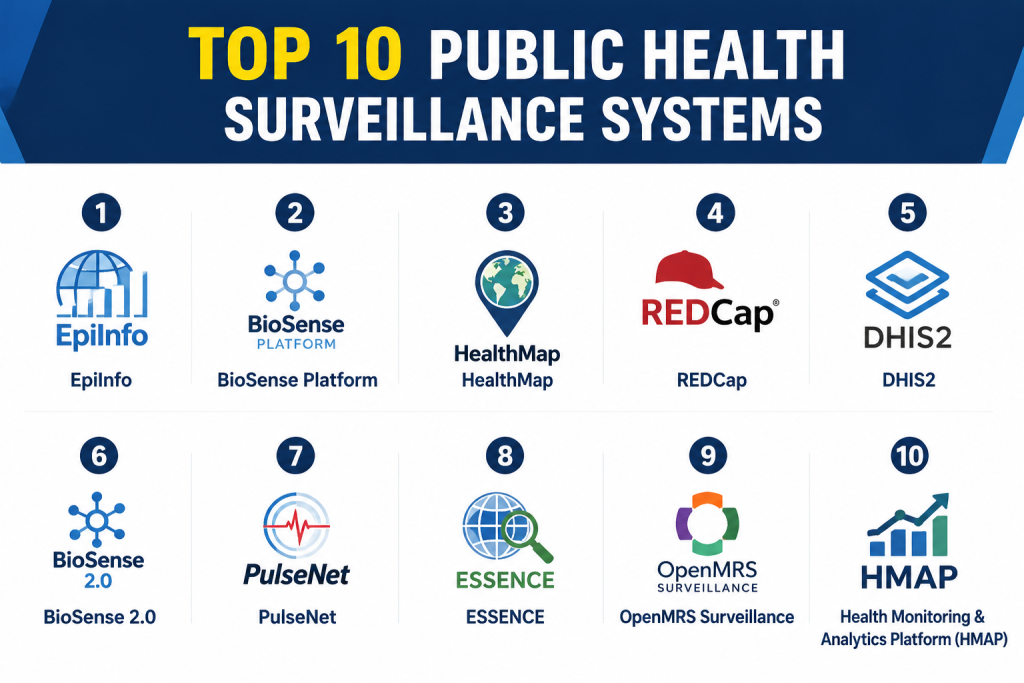
Top 10 Public Health Surveillance Systems
1 — EpiInfo
Short Description:
EpiInfo is a public health data collection and analysis platform used by epidemiologists for outbreak investigation, data entry, analysis, and reporting. It supports surveys, dashboards, and visualization for disease surveillance.
Key Features
- Customizable forms and surveys
- Data entry and validation
- Statistical analysis and visualization
- GIS mapping and outbreak visualization
- Automated reporting and alerts
- Integration with lab data
- Mobile data collection
Pros
- Free and widely adopted by health agencies
- Strong statistical and epidemiologic analysis tools
- Flexible survey design
Cons
- User interface can be dated
- Limited cloud collaboration features
- Advanced analytics require expertise
Platforms / Deployment
Desktop / Web / Mobile
Hybrid / On-premise
Security & Compliance
Role-based access, audit logs
SOC 2 / ISO 27001 / HIPAA: Not publicly stated
Integrations & Ecosystem
- Laboratory information systems
- Hospital EHRs
- GIS tools
- Reporting dashboards
Support & Community
Extensive community support, documentation, and tutorials.
2 — BioSense Platform
Short Description:
BioSense is a syndromic surveillance platform used by public health departments to monitor emergency department data and detect disease trends. It integrates hospital data, provides dashboards, and supports early warning systems.
Key Features
- Real-time emergency department monitoring
- Syndrome categorization
- Dashboard analytics
- Alerting for unusual trends
- Data visualization and mapping
- Integration with hospital EHRs
- Reporting to public health agencies
Pros
- Real-time surveillance for rapid response
- Supports multiple data sources
- Flexible visualization tools
Cons
- Setup requires technical expertise
- Advanced analytics may need additional tools
- Cloud access may vary by jurisdiction
Platforms / Deployment
Web / Desktop
Cloud / Hybrid
Security & Compliance
Role-based access, audit logs
SOC 2 / ISO 27001 / HIPAA: Not publicly stated
Integrations & Ecosystem
- Hospital EHRs
- Lab reporting systems
- GIS mapping
Support & Community
Vendor support, documentation, and training.
3 — HealthMap
Short Description:
HealthMap aggregates online news, social media, and official reports to track emerging infectious diseases globally. It provides visualization of outbreaks, trends, and alerts for health authorities.
Key Features
- Online data aggregation from multiple sources
- Real-time outbreak mapping
- Alerts for emerging diseases
- Trend analytics and visualization
- Public health reporting
- API access for integration
Pros
- Global disease monitoring
- Automated data aggregation
- Visualization dashboards
Cons
- Primarily internet-based data sources
- Not focused on internal agency data
- Requires interpretation for local response
Platforms / Deployment
Web
Cloud
Security & Compliance
Not publicly stated
Integrations & Ecosystem
- API for integration with internal systems
- GIS visualization
Support & Community
Documentation and academic support.
4 — REDCap
Short Description:
REDCap is a secure data collection platform used in public health research and surveillance. It supports longitudinal studies, case tracking, surveys, and analysis.
Key Features
- Data entry forms and surveys
- Longitudinal tracking
- Secure data storage
- Reporting dashboards
- Mobile data collection
- Integration with lab data
Pros
- Strong research and survey capabilities
- Secure and compliant
- Flexible deployment
Cons
- Advanced analytics require external tools
- Setup may require IT support
- Not real-time outbreak detection focused
Platforms / Deployment
Web / Mobile
Cloud / On-premise
Security & Compliance
Role-based access, audit logs
SOC 2 / ISO 27001 / HIPAA: Not publicly stated
Integrations & Ecosystem
- Laboratory systems
- Health records
- Reporting platforms
Support & Community
Training, documentation, and community forums.
5 — DHIS2
Short Description:
DHIS2 is an open-source platform used for national and regional health data collection, monitoring, and reporting. It integrates surveillance, vaccination, and program management.
Key Features
- Data collection and visualization
- Dashboards and analytics
- GIS mapping
- Mobile data collection
- Program monitoring
- Reporting and alerts
Pros
- Open-source and flexible
- Scales to national programs
- Mobile-friendly for field collection
Cons
- Implementation requires technical expertise
- Customization may need developer support
- User interface learning curve
Platforms / Deployment
Web / Mobile
Cloud / Hybrid / On-premise
Security & Compliance
Role-based access, audit logs
SOC 2 / ISO 27001 / HIPAA: Not publicly stated
Integrations & Ecosystem
- Lab data systems
- GIS tools
- Mobile data entry
Support & Community
Global open-source community, documentation, and training resources.
6 — BioSense 2.0
Short Description:
Advanced version of BioSense providing real-time data ingestion, anomaly detection, and national reporting dashboards for syndromic surveillance.
Key Features
- Emergency department data ingestion
- Trend and anomaly detection
- National reporting compliance
- Dashboard visualization
- GIS-based outbreak tracking
- Alert notifications
Pros
- Real-time surveillance
- National-level integration
- Supports early detection
Cons
- Technical setup required
- Advanced configuration needed
- Data standardization required
Platforms / Deployment
Web
Cloud / Hybrid
Security & Compliance
Role-based access, audit logs
SOC 2 / ISO 27001 / HIPAA: Not publicly stated
Integrations & Ecosystem
- Hospital EHRs
- Lab reporting
- GIS visualization
Support & Community
Vendor support and documentation.
7 — PulseNet
Short Description:
PulseNet is a national laboratory surveillance system that tracks foodborne disease outbreaks through DNA fingerprinting of pathogens.
Key Features
- Lab data ingestion
- Pathogen surveillance
- Automated alerts
- GIS mapping
- Reporting dashboards
Pros
- Strong lab integration
- Real-time outbreak detection
- GIS visualization
Cons
- Focused on foodborne outbreaks
- Not general health data
- Requires lab infrastructure
Platforms / Deployment
Web
Cloud
Security & Compliance
Not publicly stated
Integrations & Ecosystem
- Laboratory systems
- GIS visualization
Support & Community
Documentation and lab network support.
8 — ESSENCE
Short Description:
ESSENCE is a syndromic surveillance platform used by public health agencies to detect outbreaks from emergency department and clinical data.
Key Features
- Real-time clinical data ingestion
- Trend analysis
- Alerting for unusual patterns
- Dashboards and reporting
- GIS mapping
Pros
- Early outbreak detection
- Integrates with multiple clinical sources
- Strong visualization
Cons
- Requires technical setup
- Training needed for data interpretation
- Limited for non-syndromic surveillance
Platforms / Deployment
Web
Cloud / Hybrid
Security & Compliance
Role-based access, audit logs
SOC 2 / ISO 27001 / HIPAA: Not publicly stated
Integrations & Ecosystem
- Hospital EHRs
- GIS systems
Support & Community
Vendor support and documentation.
9 — OpenMRS Surveillance
Short Description:
OpenMRS is an open-source medical record system extended for public health surveillance, enabling data aggregation, outbreak monitoring, and reporting.
Key Features
- Patient data aggregation
- Surveillance modules
- Dashboards and visualization
- Reporting tools
- Mobile access
Pros
- Open-source and extensible
- Supports multiple diseases
- Mobile data collection
Cons
- Requires technical expertise
- Implementation effort is significant
- Integration with lab data may need development
Platforms / Deployment
Web / Mobile
Cloud / On-premise
Security & Compliance
Role-based access, audit logs
SOC 2 / ISO 27001 / HIPAA: Not publicly stated
Integrations & Ecosystem
- Labs
- Health records
- GIS systems
Support & Community
Open-source community and documentation.
10 — Health Monitoring & Analytics Platform (HMAP)
Short Description:
HMAP is a comprehensive surveillance system combining real-time health data, GIS mapping, predictive analytics, and reporting for public health departments.
Key Features
- Real-time health data collection
- GIS outbreak mapping
- Predictive analytics
- Automated alerts
- Dashboards and reporting
Pros
- Combines analytics and surveillance
- GIS enabled
- Scalable for large regions
Cons
- Technical expertise required
- Implementation can be complex
- May require custom integrations
Platforms / Deployment
Web / Desktop / Mobile
Cloud / Hybrid
Security & Compliance
Role-based access, audit logs
SOC 2 / ISO 27001 / HIPAA: Not publicly stated
Integrations & Ecosystem
- Lab systems
- Health record systems
- GIS mapping
Support & Community
Documentation and vendor support.
Comparison Table
| Tool Name | Best For | Platforms | Deployment | Standout Feature | Public Rating |
|---|---|---|---|---|---|
| EpiInfo | Epidemiologists & outbreak response | Web, Desktop, Mobile | Hybrid / On-premise | Statistical analysis & surveys | N/A |
| BioSense | Syndromic surveillance | Web | Cloud / Hybrid | Real-time ED monitoring | N/A |
| HealthMap | Global outbreak tracking | Web | Cloud | Online data aggregation | N/A |
| REDCap | Research & longitudinal surveillance | Web / Mobile | Cloud / On-premise | Data collection & tracking | N/A |
| DHIS2 | National program monitoring | Web / Mobile | Cloud / Hybrid | Population-level analytics | N/A |
| BioSense 2.0 | National syndromic surveillance | Web | Cloud / Hybrid | Anomaly detection | N/A |
| PulseNet | Foodborne outbreaks | Web | Cloud | Lab pathogen surveillance | N/A |
| ESSENCE | Clinical syndromic surveillance | Web | Cloud / Hybrid | ED trend detection | N/A |
| OpenMRS | Patient record-based surveillance | Web / Mobile | Cloud / On-premise | Modular surveillance | N/A |
| HMAP | Health data analytics | Web / Desktop / Mobile | Cloud / Hybrid | Predictive analytics & mapping | N/A |
Evaluation & Scoring Table
| Tool Name | Core 25% | Ease 15% | Integrations 15% | Security 10% | Performance 10% | Support 10% | Value 15% | Weighted Total |
|---|---|---|---|---|---|---|---|---|
| EpiInfo | 9 | 8 | 8 | 8 | 8 | 8 | 8 | 8.30 |
| BioSense | 8 | 8 | 8 | 8 | 8 | 8 | 8 | 8.00 |
| HealthMap | 8 | 7 | 7 | 8 | 8 | 8 | 8 | 7.80 |
| REDCap | 8 | 7 | 8 | 8 | 8 | 8 | 8 | 7.95 |
| DHIS2 | 9 | 8 | 9 | 8 | 8 | 8 | 8 | 8.40 |
| BioSense 2.0 | 9 | 7 | 8 | 8 | 8 | 8 | 8 | 8.05 |
| PulseNet | 8 | 7 | 7 | 8 | 8 | 8 | 8 | 7.85 |
| ESSENCE | 8 | 8 | 8 | 8 | 8 | 8 | 8 | 8.00 |
| OpenMRS | 8 | 7 | 7 | 8 | 8 | 8 | 8 | 7.85 |
| HMAP | 9 | 8 | 8 | 8 | 8 | 8 | 8 | 8.15 |
Which Public Health Surveillance System Is Right for You?
Local/Small Agencies: EpiInfo, REDCap, HealthMap — focus on limited outbreaks and research.
Mid-Size Agencies: BioSense, ESSENCE, DHIS2 — manage regional surveillance, syndromic monitoring, and reporting.
Large/National Programs: BioSense 2.0, DHIS2, HMAP, PulseNet — handle national datasets, predictive analytics, and multiple sources.
Budget vs Premium: Budget solutions prioritize core surveillance and reporting. Premium solutions offer real-time alerts, GIS mapping, and predictive analytics.
Feature Depth vs Ease of Use: Advanced platforms offer predictive models, GIS mapping, and multi-source integration, but require training. Basic tools are easier for immediate adoption.
Integrations & Scalability: Check for integration with labs, hospitals, GIS, electronic health records, and field reporting.
Security & Compliance Needs: Ensure role-based access, audit logs, HIPAA compliance, encryption, and secure data sharing.
Frequently Asked Questions
1- What is a Public Health Surveillance System?
Software to monitor, detect, and respond to health threats, tracking disease incidence, outbreaks, and trends.
2- Who uses these systems?
Public health agencies, hospitals, labs, research institutions, epidemiologists, and policy planners.
3- Can these systems track infectious and chronic diseases?
Yes, many platforms support both types of surveillance depending on configuration.
4- Are real-time alerts supported?
Yes, systems like BioSense and ESSENCE provide alerts for unusual trends or outbreaks.
5- Can these systems integrate with labs and hospitals?
Yes, integrations with EHRs, LIS, and hospital reporting systems are supported.
6- Is GIS mapping included?
Most systems provide GIS tools for outbreak visualization and spatial analysis.
7- Can data be collected in the field?
Many systems support mobile or tablet data entry for field epidemiologists.
8- Are predictive analytics included?
Premium platforms such as HMAP and DHIS2 offer predictive modeling for outbreak anticipation.
9- How is compliance ensured?
Through secure access, audit logs, and reporting to public health authorities.
10- Can public data be shared?
Platforms may include public dashboards or API access, respecting privacy regulations.
Conclusion
Public Health Surveillance Systems are essential tools for monitoring disease, guiding interventions, and informing policy. Solutions like EpiInfo, BioSense, HealthMap, REDCap, DHIS2, BioSense 2.0, PulseNet, ESSENCE, OpenMRS, and HMAP cover a range of agency sizes and needs. Selecting the right platform involves assessing integration with labs and hospitals, mobile capabilities, GIS mapping, reporting, predictive analytics, scalability, and security. Agencies should shortlist 2–3 systems, conduct pilot testing, validate data flows, and plan for training to ensure a successful deployment
