Introduction
Renewable Asset Management Software (RAMS) is designed to help organizations monitor, operate, and optimize renewable energy assets such as solar farms, wind turbines, hydroelectric plants, and battery storage systems. By centralizing asset data, predictive analytics, and operational workflows, these platforms ensure higher uptime, better performance, and more efficient energy generation.
In and beyond, renewable energy adoption is accelerating globally, driven by decarbonization initiatives, regulatory mandates, and corporate sustainability goals. RAMS solutions are critical for utilities, independent power producers, and large-scale energy investors to maximize ROI, comply with evolving regulations, and maintain grid reliability.
Real-world use cases include:
- Monitoring wind, solar, and hydro assets to detect performance deviations.
- Predictive maintenance to reduce downtime and extend equipment life.
- Real-time energy production analytics to optimize grid dispatch.
- Integration with energy trading platforms for financial forecasting.
- Compliance reporting to meet environmental and operational regulations.
What buyers should evaluate:
- Core monitoring and analytics capabilities.
- Predictive maintenance and AI-driven insights.
- Integration with SCADA, IoT sensors, and ERP systems.
- Scalability across multiple sites and asset types.
- Deployment flexibility: cloud, on-prem, or hybrid.
- Security protocols and regulatory compliance.
- Ease of reporting and visualization.
- Vendor support and community resources.
- Total cost of ownership and licensing models.
Best for: Renewable energy operators, utilities, asset managers, and energy service companies managing large-scale wind, solar, or hydro portfolios.
Not ideal for: Small-scale operators without multi-site assets or minimal operational complexity, where simple monitoring tools or spreadsheets may suffice.
Key Trends in Renewable Asset Management Software
- AI-powered predictive maintenance reducing unplanned downtime.
- IoT integration for real-time performance and environmental monitoring.
- Cloud-native deployments improving scalability and remote access.
- Digital twin technology for asset simulation and scenario testing.
- Enhanced cybersecurity protecting critical energy infrastructure.
- Advanced data analytics for production optimization and anomaly detection.
- Integration with energy trading and financial systems.
- Sustainability and ESG reporting features.
- Hybrid deployment models for flexible IT strategies.
- Automated regulatory compliance reporting for multi-jurisdiction operations.
How We Selected These Tools (Methodology)
- Market adoption and recognition in renewable energy sectors.
- Feature completeness covering monitoring, analytics, and predictive maintenance.
- Reliability and performance signals from operational deployments.
- Security posture, including encryption, access control, and audit logging.
- Integration and ecosystem maturity with SCADA, IoT, ERP, and trading platforms.
- Customer fit across small, mid-market, and enterprise renewable operators.
- Vendor support quality, onboarding, and documentation resources.
- Innovation in AI, cloud, and predictive analytics.
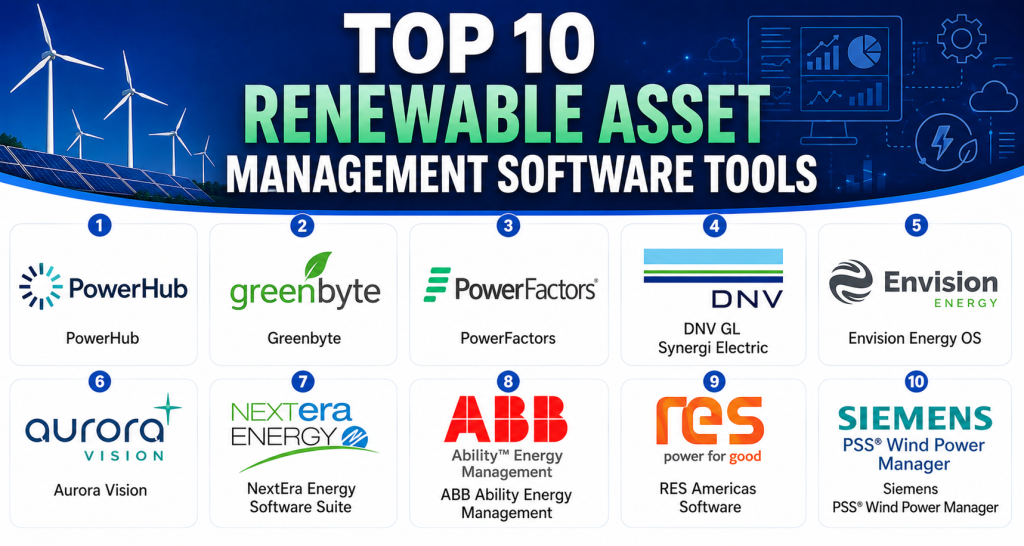
Top 10 Renewable Asset Management Software Tools
1- PowerHub
Short description: PowerHub provides a centralized platform for managing renewable energy portfolios, offering monitoring, maintenance planning, and performance analytics for operators of wind, solar, and hydro assets.
Key Features
- Real-time asset monitoring.
- Maintenance scheduling and tracking.
- Performance benchmarking across sites.
- Predictive analytics for downtime reduction.
- Reporting dashboards for operational and financial metrics.
Pros
- Scalable for multi-site renewable portfolios.
- Comprehensive maintenance and performance analytics.
Cons
- Premium pricing for smaller operators.
- Advanced configuration may require vendor support.
Platforms / Deployment
- Web / Windows / macOS
- Cloud / Hybrid
Security & Compliance
- Encryption, RBAC, audit logging
- Not publicly stated
Integrations & Ecosystem
Integrates with SCADA systems, IoT sensors, and ERP platforms.
- API for custom analytics
- Renewable asset monitoring devices
- Data visualization tools
Support & Community
- Vendor support and training
- Documentation and online user forums
2- Greenbyte
Short description: Greenbyte offers renewable asset monitoring and analytics for wind and solar energy operators, focusing on performance optimization and risk mitigation.
Key Features
- Real-time asset health monitoring.
- Predictive maintenance alerts.
- Energy production analytics and benchmarking.
- Environmental and ESG reporting.
- Integration with financial and operational systems.
Pros
- Strong analytics and KPI tracking.
- Supports ESG and regulatory reporting.
Cons
- May require training for full feature adoption.
- Integration with legacy systems can be complex.
Platforms / Deployment
- Web / Windows
- Cloud / Hybrid
Security & Compliance
- Encryption and access controls
- Not publicly stated
Integrations & Ecosystem
- SCADA and IoT sensor integration
- ERP and trading platform connectivity
- REST API for custom analytics
Support & Community
- Vendor-led support
- Documentation and user guides
3- PowerFactors
Short description: PowerFactors provides a cloud-based renewable asset management solution focused on monitoring, analytics, and operations for solar and wind projects.
Key Features
- Real-time performance dashboards.
- Predictive maintenance and anomaly detection.
- Energy forecasting and reporting.
- Integration with finance and asset management tools.
- Multi-site portfolio management.
Pros
- Cloud-native with scalable architecture.
- User-friendly dashboards for operators.
Cons
- Limited offline capabilities.
- Smaller community compared to larger vendors.
Platforms / Deployment
- Web / Windows / iOS / Android
- Cloud
Security & Compliance
- Encryption and role-based access
- Not publicly stated
Integrations & Ecosystem
- SCADA, IoT, ERP systems
- API for custom reporting
- Energy trading system integrations
Support & Community
- Vendor support and onboarding
- Documentation and knowledge base
4- DNV GL Synergi Electric
Short description: Synergi Electric by DNV GL helps operators monitor and optimize performance across renewable energy assets, focusing on risk management and predictive maintenance.
Key Features
- Asset performance monitoring.
- Maintenance planning and scheduling.
- Predictive analytics for equipment failures.
- Energy production analysis.
- Reporting and compliance dashboards.
Pros
- Strong predictive and risk analysis tools.
- Supports regulatory and ESG reporting.
Cons
- Steep learning curve for new users.
- Implementation may be resource-intensive.
Platforms / Deployment
- Windows / Web
- Hybrid / Cloud
Security & Compliance
- Not publicly stated
Integrations & Ecosystem
- SCADA systems
- IoT sensor integration
- ERP and maintenance systems
Support & Community
- Vendor training and support
- Documentation and knowledge resources
5- Envision Energy OS
Short description: Envision Energy OS provides renewable asset management for wind and solar projects with advanced analytics and operational control features.
Key Features
- Real-time monitoring of renewable assets.
- Predictive maintenance recommendations.
- Energy production forecasting.
- Portfolio-wide performance benchmarking.
- Integration with financial and operational systems.
Pros
- Advanced analytics and forecasting.
- Multi-site portfolio management.
Cons
- Complexity for small operators.
- Customization requires vendor assistance.
Platforms / Deployment
- Web / Windows / iOS
- Cloud / Hybrid
Security & Compliance
- Not publicly stated
Integrations & Ecosystem
- SCADA and IoT devices
- ERP and asset management systems
- REST API for extensions
Support & Community
- Vendor support and training
- Online documentation
6- Aurora Vision
Short description: Aurora Vision centralizes monitoring and management for renewable energy assets, emphasizing real-time performance and predictive maintenance for solar and wind operators.
Key Features
- Real-time monitoring and alerts.
- Maintenance tracking and predictive analytics.
- Energy performance dashboards.
- Multi-site portfolio management.
- Reporting for operations and compliance.
Pros
- Scalable for medium to large portfolios.
- Predictive maintenance reduces downtime.
Cons
- Smaller vendor ecosystem.
- May require training for advanced features.
Platforms / Deployment
- Web / Windows
- Cloud / Hybrid
Security & Compliance
- Not publicly stated
Integrations & Ecosystem
- SCADA, IoT, ERP integration
- API for reporting and analytics
- Financial system connectivity
Support & Community
- Vendor support
- Documentation and guides
7- NextEra Energy Software Suite
Short description: NextEra Energy Software Suite offers an integrated solution for renewable asset monitoring, predictive analytics, and operational optimization for wind and solar farms.
Key Features
- Asset monitoring and performance analytics.
- Predictive maintenance alerts.
- Portfolio-wide benchmarking.
- Energy production forecasting.
- Reporting and ESG compliance dashboards.
Pros
- Integrated solution for large portfolios.
- Strong analytics and forecasting capabilities.
Cons
- High cost for smaller operators.
- Advanced configuration may require support.
Platforms / Deployment
- Web / Windows
- Cloud / Hybrid
Security & Compliance
- Not publicly stated
Integrations & Ecosystem
- SCADA, IoT, and ERP integration
- REST API access
- Asset management connectivity
Support & Community
- Vendor-led support
- Training and documentation
8- ABB Ability Energy Management
Short description: ABB Ability platform manages renewable energy assets, providing monitoring, predictive maintenance, and performance analytics for operators and utilities.
Key Features
- Real-time asset monitoring.
- Predictive maintenance and anomaly detection.
- Energy optimization and reporting.
- Multi-site portfolio management.
- Integration with financial and operational systems.
Pros
- Cloud-enabled and scalable.
- Advanced analytics for operational decisions.
Cons
- Complex implementation.
- Requires trained personnel for full functionality.
Platforms / Deployment
- Web / Windows / Linux
- Cloud / Hybrid
Security & Compliance
- Not publicly stated
Integrations & Ecosystem
- SCADA and IoT device integration
- ERP systems
- API for custom analytics
Support & Community
- Vendor support
- Documentation and onboarding guides
9- RES Americas Software
Short description: RES Americas Software provides operators with tools to manage and monitor renewable energy assets with analytics-driven insights and operational controls.
Key Features
- Real-time monitoring dashboards.
- Predictive maintenance and alerts.
- Energy production forecasting.
- Performance benchmarking across sites.
- Integration with financial and operational tools.
Pros
- Strong operational analytics.
- Supports multi-site renewable portfolios.
Cons
- Smaller user community.
- Advanced configuration may require vendor support.
Platforms / Deployment
- Web / Windows
- Cloud / Hybrid
Security & Compliance
- Not publicly stated
Integrations & Ecosystem
- SCADA, IoT, ERP integration
- API connectivity
- Analytics and reporting extensions
Support & Community
- Vendor support
- Documentation and training resources
10- Siemens PSS® Wind Power Manager
Short description: Siemens PSS® Wind Power Manager is designed for wind asset operators, offering centralized monitoring, predictive analytics, and reporting to optimize energy production.
Key Features
- Real-time turbine monitoring.
- Predictive maintenance for wind farms.
- Performance analytics and benchmarking.
- Portfolio-wide energy forecasting.
- Compliance and ESG reporting dashboards.
Pros
- Specialized for wind energy.
- Strong predictive and operational analytics.
Cons
- Focused primarily on wind, less suitable for mixed assets.
- Implementation requires training and expertise.
Platforms / Deployment
- Windows / Web
- Hybrid / Cloud
Security & Compliance
- Not publicly stated
Integrations & Ecosystem
- SCADA and IoT sensor integration
- ERP and asset management systems
- API for data reporting
Support & Community
- Vendor support
- Documentation and training resources
Comparison Table (Top 10)
| Tool Name | Best For | Platform(s) Supported | Deployment | Standout Feature | Public Rating |
|---|---|---|---|---|---|
| PowerHub | Multi-site operators | Web / Windows / macOS | Cloud / Hybrid | Predictive maintenance | N/A |
| Greenbyte | Wind & solar operators | Web / Windows | Cloud / Hybrid | ESG reporting | N/A |
| PowerFactors | Cloud-native portfolios | Web / Windows / iOS / Android | Cloud | User-friendly dashboards | N/A |
| DNV GL Synergi Electric | Risk-focused management | Windows / Web | Hybrid / Cloud | Risk analytics | N/A |
| Envision Energy OS | Multi-site management | Web / Windows / iOS | Cloud / Hybrid | Energy forecasting | N/A |
| Aurora Vision | Medium-large portfolios | Web / Windows | Cloud / Hybrid | Predictive maintenance | N/A |
| NextEra Energy Software Suite | Large-scale operators | Web / Windows | Cloud / Hybrid | Integrated analytics | N/A |
| ABB Ability Energy Management | Utilities & operators | Web / Windows / Linux | Cloud / Hybrid | Operational analytics | N/A |
| RES Americas Software | Renewable asset operators | Web / Windows | Cloud / Hybrid | Portfolio benchmarking | N/A |
| Siemens PSS® Wind Power Manager | Wind farms | Windows / Web | Hybrid / Cloud | Turbine monitoring | N/A |
Evaluation & Scoring of Renewable Asset Management Tools
| Tool Name | Core (25%) | Ease (15%) | Integrations (15%) | Security (10%) | Performance (10%) | Support (10%) | Value (15%) | Weighted Total |
|---|---|---|---|---|---|---|---|---|
| PowerHub | 9 | 8 | 8 | 7 | 9 | 8 | 7 | 8.1 |
| Greenbyte | 8 | 8 | 7 | 7 | 8 | 7 | 7 | 7.7 |
| PowerFactors | 8 | 9 | 7 | 7 | 8 | 7 | 7 | 7.8 |
| DNV GL Synergi Electric | 8 | 7 | 7 | 7 | 8 | 7 | 7 | 7.5 |
| Envision Energy OS | 8 | 8 | 7 | 7 | 8 | 7 | 7 | 7.7 |
| Aurora Vision | 8 | 7 | 7 | 7 | 8 | 7 | 7 | 7.5 |
| NextEra Energy Software Suite | 9 | 7 | 8 | 7 | 8 | 7 | 7 | 7.9 |
| ABB Ability Energy Management | 9 | 8 | 8 | 7 | 9 | 8 | 7 | 8.2 |
| RES Americas Software | 8 | 7 | 7 | 7 | 8 | 7 | 7 | 7.5 |
| Siemens PSS® Wind Power Manager | 8 | 7 | 7 | 7 | 8 | 7 | 7 | 7.5 |
Interpretation: Weighted scores provide a comparative overview of core functionality, usability, integration capabilities, security, performance, support, and value. Organizations should prioritize tools based on portfolio size, asset complexity, and operational needs.
Which Renewable Asset Management Tool Is Right for You?
Solo / Freelancer
Typically not applicable; small operators may use basic monitoring or lightweight cloud solutions.
SMB
Aurora Vision, Envision Energy OS: cost-effective with sufficient analytics for small to mid-sized renewable portfolios.
Mid-Market
PowerFactors, Greenbyte: scalable, cloud-enabled solutions balancing usability and operational analytics.
Enterprise
PowerHub, ABB Ability, NextEra Energy Software Suite: suitable for multi-site, multi-asset portfolios with advanced predictive analytics.
Budget vs Premium
Mid-market tools are more budget-conscious, while enterprise solutions offer advanced analytics and scalability at premium cost.
Feature Depth vs Ease of Use
Enterprise platforms provide comprehensive features but require training; mid-market options balance usability and functionality.
Integrations & Scalability
Enterprise RAMS solutions integrate with SCADA, IoT, ERP, and trading platforms for full operational control.
Security & Compliance Needs
Evaluate encryption, RBAC, audit logs, and vendor adherence to ESG, ISO, or regulatory standards.
Frequently Asked Questions (FAQs)
1- How much does Renewable Asset Management Software cost?
Pricing varies widely by portfolio size, deployment, and features. Enterprise platforms are higher cost, while mid-market tools are more affordable.
2- Can RAMS integrate with existing SCADA or ERP systems?
Yes, most platforms provide APIs and integration modules for SCADA, IoT sensors, and enterprise systems.
3- Are cloud deployments secure?
Yes, provided proper encryption, access control, and audit logging are implemented; verify vendor compliance for ESG and regulatory standards.
4- How long does implementation take?
Deployment timelines range from 3–12 months depending on portfolio size, complexity, and integrations.
5- Do these tools provide predictive maintenance?
Yes, AI and analytics are widely used to predict equipment failures and optimize maintenance schedules.
6- Can RAMS support multiple renewable asset types?
Most solutions support wind, solar, hydro, and battery assets, with portfolio-level monitoring and analysis.
7- What are common mistakes in adopting RAMS?
Underestimating integration complexity, skipping training, and neglecting predictive analytics features.
8- Are there open-source options?
Limited; most credible platforms are commercial with vendor support.
9- How scalable are these tools?
Enterprise solutions scale to multi-site portfolios; mid-market tools are suitable for smaller portfolios.
10- How do I choose the right RAMS?
Assess asset types, portfolio size, analytics needs, integration requirements, and compliance obligations.
Conclusion
Renewable Asset Management Software is essential for operators managing multi-site wind, solar, or hydro portfolios. Enterprise solutions like PowerHub and ABB Ability Energy Management provide advanced analytics and scalability, while mid-market platforms like Greenbyte and PowerFactors balance usability and affordability. Start by shortlisting 2–3 platforms, run pilot integrations, and validate analytics, compliance, and operational reporting before full deployment. A well-selected RAMS ensures optimized energy production, reduced downtime, and efficient portfolio management
