Upgrade & Secure Your Future with DevOps, SRE, DevSecOps, MLOps!

We spend hours on Instagram and YouTube and waste money on coffee and fast food, but won’t spend 30 minutes a day learning skills to boost our careers.
Master in DevOps, SRE, DevSecOps & MLOps!

Learn from Guru Rajesh Kumar and double your salary in just one year.

Get Started Now!

Learning optimal mitigation strategies through agent based reinforcement learning

Source: fields.utoronto.ca

Covid-19 has resulted in the mathematical modeling community to come together to produce a wide range of analyses, forecasting and scenario modeling efforts. In our work, we propose a novel approach by using Reinforcement Learning (RL) to answer the question: “What agent behaviours reduce the spread of Covid-19?”. This is done through creating an agent based simulation environment and modeling the environment as a multi-agent Markov Decision Process (MDP). By providing the freedom of agents to select their own actions and learn from their experiences, this Machine Learning approach allows agents to learn behavioural policies that reduce the spread of Covid-19. These behaviours can be mined and conditioned on demographic attributes for analysis, with the hopes of providing a more granular analysis to inform public health policy makers. Our environment is built using open data from Statistics Canada (census, surveys) and can be modified to a particular country or region. In this presentation we cover the mathematical framework of MDPs, discuss the agent environment, data sources and analyze the results both in terms of what behaviours the agents learn, but also the reduction in spread of Covid-19 over various baselines. We discuss the generality of our approach and how it can be modified as our understanding of the infection changes.

This work is a collaborative effort between different divisions within Statistics Canada. Nicholas Denis, Blair Drummond, Alex El-Hajj and Krishna Gopaluni are data scientists/data engineers within the Data Science Division (DScD) of Statistics Canada. The DScD provides modern data science solutions to clients using cutting edge machine learning techniques. Yamina Abiza is a member of IT Operations Data Science and Data Engineering Service, Statistics Canada, which works together with data scientists to provide platform solutions and tools combined with efficient and robust development/data engineering skills to advance data science objectives at velocity. Deirdre Hennessey is a member of the Health Analysis Division, Statistics Canada, providing high quality, relevant, and comprehensive information on the health status of the population and on the health care system.


Related Posts

DeepMind open-sources Lab2D to support creation of 2D environments for AI and machine learning

Source: computing.co.uk Alphabet subsidiary DeepMind announced on Monday that it has open-sourced Lab2D, a scalable environment simulator for artificial intelligence (AI) research that facilitates researcher-led experimentation with environment Read More

Read More

A VR Film/Game with AI Characters Can Be Different Every Time You Watch or Play

Source: technologyreview.com The square-faced, three-legged alien shoves and jostles to get at the enormous plant taking over its tiny planet. But each bite just makes the forbidden Read More

Read More

Researchers detail LaND, AI that learns from autonomous vehicle disengagements

Source: venturebeat.com UC Berkeley AI researchers say they’ve created AI for autonomous vehicles driving in unseen, real-world landscapes that outperforms leading methods for delivery robots driving on Read More

Read More

Google Teases Large Scale Reinforcement Learning Infrastructurean

Source: alyticsindiamag.com The current state-of-the-art reinforcement learning techniques require many iterations over many samples from the environment to learn a target task. For instance, the game Dota Read More

Read More

Plan2Explore: Active Model-Building for Self-Supervised Visual Reinforcement Learning

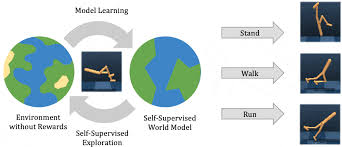
Source: bair.berkeley.edu To operate successfully in unstructured open-world environments, autonomous intelligent agents need to solve many different tasks and learn new tasks quickly. Reinforcement learning has enabled Read More

Read More

Is AI an Existential Threat?

Source: unite.ai When discussing Artificial Intelligence (AI), a common debate is whether AI is an existential threat. The answer requires understanding the technology behind Machine Learning (ML), and recognizing Read More

Read More
Subscribe
Notify of
guest
0 Comments
Oldest
Newest Most Voted
Inline Feedbacks
View all comments
0
Would love your thoughts, please comment.x
()
x