Upgrade & Secure Your Future with DevOps, SRE, DevSecOps, MLOps!

We spend hours on Instagram and YouTube and waste money on coffee and fast food, but won’t spend 30 minutes a day learning skills to boost our careers.
Master in DevOps, SRE, DevSecOps & MLOps!

Learn from Guru Rajesh Kumar and double your salary in just one year.

Get Started Now!

How to download and set up Moodle on Windows 10

To download and set up Moodle on Windows 10, follow these steps:

  1. Download XAMPP:
  • Visit the Apache Friends website at https://www.apachefriends.org/index.html
  • Click on the “Download” button for XAMPP for Windows.
  • Choose the latest version of XAMPP with PHP 7 or higher.
  • Once downloaded, run the installer and follow the on-screen instructions to complete the installation.

2. Install XAMPP:

  • During the installation process, make sure to select components like Apache, MySQL, PHP, and phpMyAdmin.
  • Choose a directory on your Windows 10 machine to install XAMPP.
  • Start the Apache and MySQL services after the installation is complete.

3. Download Moodle:

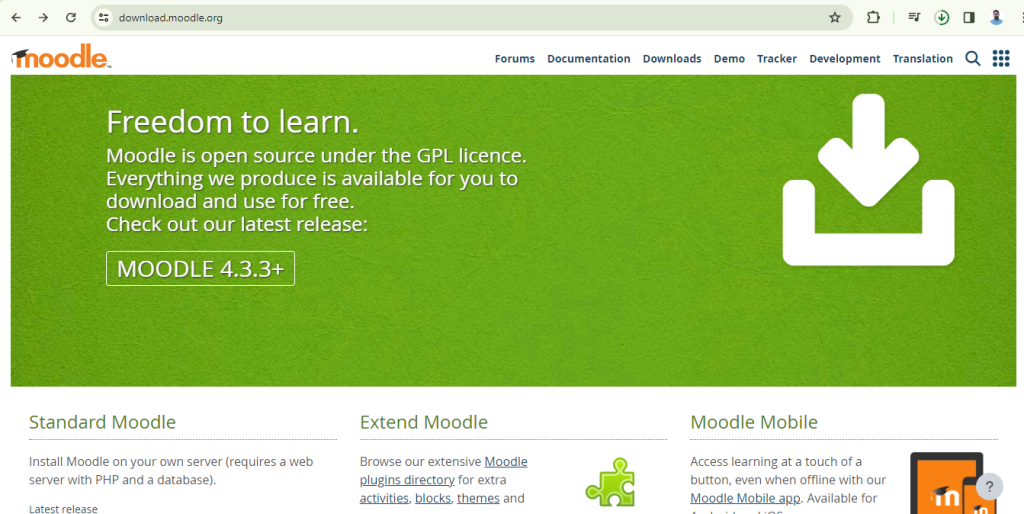
  • Visit the Moodle website at https://download.moodle.org/
  • Download the latest stable version of Moodle for Windows.
  • Extract the Moodle zip file to the ‘htdocs‘ folder in the XAMPP directory (e.g., C:\xampp\htdocs).

4. Set up Moodle:

  • Open your web browser and enter the address http://localhost/moodle
  • Follow the on-screen instructions to complete the Moodle installation.
  • During the setup process, you will need to configure your database settings. Use ‘localhost’ as the database host, ‘root’ as the database user, and leave the password field blank.
  • Continue with the Moodle installation by providing the necessary information.

5. Complete installation:

  • Once the installation is complete, you can log in to your Moodle site as an administrator and start customizing it for your needs.

That’s it! You have successfully downloaded and set up Moodle on your Windows 10 machine using XAMPP.

Related Posts

PHP opcode caching improves performance and lowers memory requirements, OPcache extension is recommended and fully supported.

Yes, PHP opcode caching, particularly through the OPcache extension, significantly enhances the performance of PHP applications. Here’s how it works: Enabling OPcache on your server can lead Read More

Read More

The Zip PHP extension is now required by Moodle, info-ZIP binaries or PclZip library are not used anymore

Starting from Moodle version 4.0, the Zip PHP extension is a mandatory requirement. This means that Moodle no longer relies on info-ZIP binaries or the PclZip library Read More

Read More

Wrong $CFG->dbtype. You need to change it in your config.php file from ‘mysqli’ to ‘mariadb’

The error message you’re encountering indicates that the database type in your Moodle config.php file is set to ‘mysqli’, but it needs to be changed to ‘mariadb’. Read More

Read More

How to set up and manage course analytics and reporting in Moodle?

Setting up and managing course analytics and reporting in Moodle involves configuring a set of tools and features that allow instructors and administrators to track and analyze Read More

Read More

How to set up and manage course social learning and networking in Moodle?

Setting up and managing course social learning and networking in Moodle involves integrating various tools and features that allow students to interact, collaborate, and share knowledge. Below Read More

Read More

How to set up and manage course gamification and badges in Moodle?

Setting up and managing gamification and badges in Moodle can be a great way to enhance student engagement and motivation. Here’s a step-by-step guide on how to Read More

Read More
Subscribe
Notify of
guest
0 Comments
Oldest
Newest Most Voted
0
Would love your thoughts, please comment.x
()
x