Upgrade & Secure Your Future with DevOps, SRE, DevSecOps, MLOps!

We spend hours on Instagram and YouTube and waste money on coffee and fast food, but won’t spend 30 minutes a day learning skills to boost our careers.
Master in DevOps, SRE, DevSecOps & MLOps!

Learn from Guru Rajesh Kumar and double your salary in just one year.

Get Started Now!

IST researchers exploit vulnerabilities of AI-powered game bots

Source: news.psu.edu

UNIVERSITY PARK, Pa. — If you’ve ever played an online video game, you’ve likely competed with a bot — an AI-driven program that plays on behalf of a human.

Many of these bots are created using deep reinforcement learning, which is the training of algorithms to learn how to achieve a complex goal through a reward system. But, according to researchers in the College of Information Sciences and Technology at Penn State, using game bots trained by deep reinforcement learning could allow attackers to use deception to easily defeat them.

To highlight this risk, the researchers designed an algorithm to train an adversarial bot, which was able to automatically discover and exploit weaknesses of master game bots driven by reinforcement learning algorithms. Their bot was then trained to defeat a world-class AI bot in the award-winning computer game StarCraft II.

“This is the first attack that demonstrates its effectiveness in real-world video games,” said Wenbo Guo, a doctoral student studying information sciences and technology. “With the success of deep reinforcement learning in some popular games, like AlphaGo in the game Go and AlphaStar in StarCraft, more and more games are starting to use deep reinforcement learning to train their game bots.”

He added, “Our work discloses the security threat of using deep reinforcement learning trained agents as game bots. It will make game developers be more careful about adopting deep reinforcement learning agents.”

Guo and his research team presented their algorithm in August at Black Hat USA – a conference that is part of the most technical and relevant information security event series in the world. They also publicly released their code and a variety of adversarial AI bots.

“By using our code, researchers and white-hat hackers could train their own adversarial agents to master many — if not all — multi-party video games,” said Xinyu Xing, assistant professor of information sciences and technology at Penn State.

Guo concluded, “More importantly, game developers could use it to discover the vulnerabilities of their game bots and take rapid action to patch those vulnerabilities.”

In addition to Xing, Guo worked with; Xian Wu, a doctoral student studying informatics at Penn State; and Jimmy Su, senior director of the JD Security Research Center, to develop the algorithm.


Related Posts

DeepMind open-sources Lab2D to support creation of 2D environments for AI and machine learning

Source: computing.co.uk Alphabet subsidiary DeepMind announced on Monday that it has open-sourced Lab2D, a scalable environment simulator for artificial intelligence (AI) research that facilitates researcher-led experimentation with environment Read More

Read More

A VR Film/Game with AI Characters Can Be Different Every Time You Watch or Play

Source: technologyreview.com The square-faced, three-legged alien shoves and jostles to get at the enormous plant taking over its tiny planet. But each bite just makes the forbidden Read More

Read More

Researchers detail LaND, AI that learns from autonomous vehicle disengagements

Source: venturebeat.com UC Berkeley AI researchers say they’ve created AI for autonomous vehicles driving in unseen, real-world landscapes that outperforms leading methods for delivery robots driving on Read More

Read More

Google Teases Large Scale Reinforcement Learning Infrastructurean

Source: alyticsindiamag.com The current state-of-the-art reinforcement learning techniques require many iterations over many samples from the environment to learn a target task. For instance, the game Dota Read More

Read More

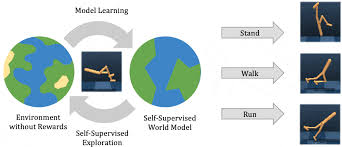
Plan2Explore: Active Model-Building for Self-Supervised Visual Reinforcement Learning

Source: bair.berkeley.edu To operate successfully in unstructured open-world environments, autonomous intelligent agents need to solve many different tasks and learn new tasks quickly. Reinforcement learning has enabled Read More

Read More

Is AI an Existential Threat?

Source: unite.ai When discussing Artificial Intelligence (AI), a common debate is whether AI is an existential threat. The answer requires understanding the technology behind Machine Learning (ML), and recognizing Read More

Read More
Subscribe
Notify of
guest
0 Comments
Oldest
Newest Most Voted
Inline Feedbacks
View all comments
0
Would love your thoughts, please comment.x
()
x