Introduction
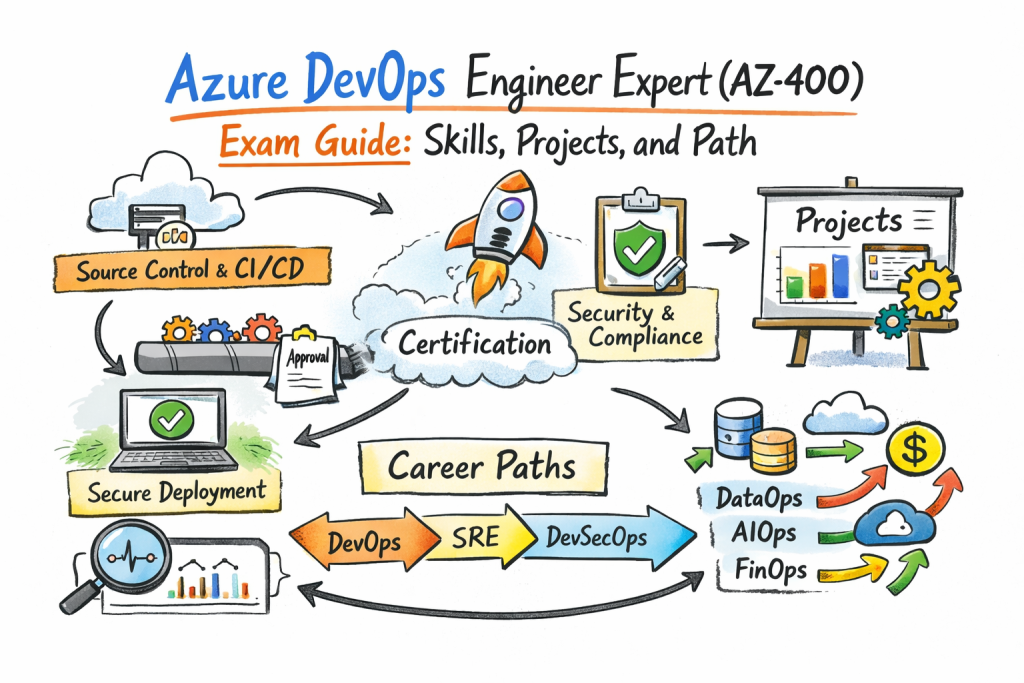
Azure DevOps Engineer Expert (AZ-400) is designed for professionals who want to build a fast, reliable, and repeatable software delivery system on Azure. If you are tired of slow releases, manual deployments, broken builds, or last-minute firefighting, this certification teaches the patterns that reduce risk while increasing delivery speed. It brings together source control strategy, CI/CD pipelines, testing gates, security controls, approvals, and monitoring into one practical workflow. This guide helps working engineers and managers understand what AZ-400 covers, who should take it, how to prepare smartly, and what certifications to pursue next for long-term career growth.
Why AZ-400 matters in real jobs
Many teams can “build a pipeline,” but fewer can design a delivery system that stays stable as teams scale. AZ-400 focuses on connecting source control, CI/CD, quality gates, environments, approvals, security controls, and monitoring into one operating model. If your releases are slow, risky, or full of rollbacks, this certification pushes you toward patterns that make releases predictable. That is exactly what hiring managers look for in DevOps, SRE, and Platform roles.
What this certification really proves
AZ-400 proves you can design and implement DevOps practices, not just configure tools. It shows you understand how to take code from commit to production using repeatable automation, measured quality, controlled deployments, and strong feedback loops. In practical terms, it validates how you make delivery faster without compromising reliability and governance. It also signals you can work across teams—developers, operations, security, and leadership.
Prerequisites and who should consider it
AZ-400 is best taken when you already have some Azure foundation and have seen real delivery systems. Most professionals pair it with an Azure Admin or Azure Developer foundation, because AZ-400 expects you to understand how apps and infrastructure behave in Azure. You do not need to be an expert in every Azure service, but you should be comfortable with how identity, environments, permissions, and deployments work. If you are completely new to cloud, start with fundamentals first to avoid struggling later.
Certification table (recommended journey around AZ-400)
Note: You requested “no external links.” So only the official AZ-400 link you provided is included.
| Track | Level | Certification | Who it’s for | Prerequisites | Skills covered | Recommended order |
|---|---|---|---|---|---|---|
| Azure Fundamentals | Beginner | Azure Fundamentals (AZ-900) | Beginners or non-technical stakeholders | None | Cloud basics, core Azure concepts, pricing basics | 1 (optional) |
| Azure Admin | Intermediate | Azure Administrator (AZ-104) | Cloud/ops/platform engineers | Azure basics | Identity, compute, storage, networking, governance | 2 (common) |
| Azure Developer | Intermediate | Azure Developer (AZ-204) | App developers on Azure | Programming + Azure basics | App services, APIs, auth, monitoring basics | 2 (alternate) |
| DevOps Expert | Expert | Azure DevOps Engineer Expert (AZ-400) | DevOps, Platform, SRE, Delivery owners | Strong Azure base + delivery exposure | CI/CD, repo strategy, compliance, release, instrumentation | 3 |
What you will learn if you prepare the right way
You will learn how to design end-to-end delivery that is consistent across teams and environments. You will learn how to build pipelines that enforce quality gates, produce reliable artifacts, and release safely using approvals and controlled rollout patterns. You will learn how to embed security checks and governance into automation so audits and compliance become easier. Finally, you will learn how to use monitoring signals to measure release health and reduce incidents after deployment.
Azure DevOps Engineer Expert (AZ-400) — mini-sections
What it is
AZ-400 is an expert-level certification focused on designing and implementing DevOps practices on Azure. It covers planning, source control strategy, build and release pipelines, security and compliance automation, and instrumentation for feedback. The goal is to prove you can run modern software delivery as a system, not as disconnected tasks.
Who should take it
This is ideal for DevOps Engineers and Platform Engineers who own CI/CD and environment strategy. It is also valuable for SREs who want safer releases and better operational feedback loops. Security Engineers benefit when they need to enforce controls inside pipelines and deployments. Engineering Managers gain value when they must standardize delivery across teams and measure outcomes.
Skills you’ll gain
- Designing repo and branching strategy that fits team size and release cadence
- Building CI pipelines with tests, quality gates, artifact versioning, and traceability
- Designing CD pipelines with environments, approvals, rollout control, and rollback readiness
- Implementing secure pipeline identity, secrets handling, and least-privilege access patterns
- Automating compliance evidence through approvals, logs, and consistent release governance
- Connecting releases to monitoring so you can detect issues early and reduce incident impact
Real-world projects you should be able to do after it
- Build an end-to-end CI/CD pipeline that compiles, tests, scans, packages, and deploys a service reliably
- Implement multi-stage releases with approvals, environment-specific configs, and safe rollback strategies
- Create reusable pipeline templates so multiple teams can ship with consistent standards and guardrails
- Add security scanning and policy checks that block risky changes before they reach production
- Build release dashboards that connect deployments to health signals like error rate and latency trends
Preparation plan (7–14 days / 30 days / 60 days)
7–14 days (fast-track, if you already work on pipelines)
Spend the first few days mapping AZ-400 topics to your current work and identifying gaps. Then build one complete pipeline that reaches a real environment and includes tests, artifacts, approvals, and rollback steps. Add security checks and secrets handling in the second week so the pipeline is safe by default. Finish by practicing failure drills and revising weak areas using hands-on repetition rather than reading alone.
30 days (best for most working engineers)
Use Week 1 for source control strategy, build pipelines, and artifact versioning so you understand traceability. Use Week 2 for release pipelines, environment strategy, approvals, and deployment patterns like staged rollouts. Use Week 3 for security, identity, secrets, and governance so releases are compliant and controlled. Use Week 4 for instrumentation, dashboards, and full mock runs where you deploy, detect issues, and rollback confidently.
60 days (best if you are new to Azure or delivery engineering)
Spend the first two weeks strengthening Azure basics and environment knowledge so pipeline decisions make sense. Spend Weeks 3–4 on CI fundamentals, test automation, artifact strategy, and quality gates to avoid unstable builds. Spend Weeks 5–6 on secure delivery and compliance automation so controls are integrated, not added later. Spend Weeks 7–8 on monitoring, release health, incident drills, and multiple end-to-end practice runs.
Common mistakes (avoid these)
- Building pipelines that look good but never deploy to a realistic environment with real constraints
- Treating security as “extra work” instead of embedding it into CI/CD from the beginning
- Skipping release governance like approvals, audit trails, and consistent environment promotion rules
- Not practicing rollback and failure recovery, which makes real deployments risky and stressful
- Ignoring instrumentation and feedback loops, so you cannot prove whether a release was healthy
Best next certification after this
If you lean platform and operations, deepen your Azure administration and governance skills to design stronger environments. If you lean development, strengthen cloud app delivery patterns and deployment safety for modern services. If you lean security, focus on security automation and compliance-as-code practices so controls scale with delivery. The best “next” depends on your role and whether you want to go deeper technically or expand across tracks.
Choose your path (6 learning paths)
DevOps path
This path is best if your core job is building pipelines, release workflows, and developer productivity. You focus on repeatable automation, stable deployments, and faster lead time while keeping quality high. Your learning should center on pipeline templates, environment strategy, approvals, and deployment safety. The outcome should be measurable: fewer failed releases, faster changes, and better team confidence.
DevSecOps path
This path is best if you want to embed security into the delivery system so it becomes normal work. You focus on identity, secrets, policy checks, and security scanning integrated into CI/CD. The goal is to reduce risk early by blocking insecure changes before production. Your outcomes are stronger compliance readiness, fewer security incidents, and clearer audit trails.
SRE path
This path is best if you are responsible for reliability, on-call stability, and service health. You focus on release safety, observability, incident readiness, and preventing outages caused by changes. AZ-400 helps you connect deployment practices with monitoring signals and safer rollout strategies. The outcome is fewer incidents after releases and faster recovery when issues happen.
AIOps/MLOps path
This path is best if you want smarter operations and automation using data signals from systems. You focus on telemetry pipelines, event correlation basics, and automation triggers that reduce manual toil. The aim is to make operations more proactive, not reactive. Your outcomes are reduced noise, faster detection, and more automated recovery workflows.
DataOps path
This path is best for teams delivering data products that need reliability and governance. You focus on pipeline-as-code, data quality gates, controlled promotions across environments, and repeatable releases for data workloads. You also learn to treat data delivery like software delivery with consistent checks. The outcome is fewer broken data releases and better trust in data outputs.
FinOps path
This path is best if you want cost governance without slowing engineering teams down. You focus on guardrails, environment standards, usage controls, and automation that makes cost visible and manageable. You learn to connect delivery practices with cost accountability, especially across environments. The outcome is more predictable spend and fewer surprises without blocking innovation.
Role → recommended certifications mapping
DevOps Engineer
Start by building a strong Azure foundation and then move into AZ-400 as the delivery proof point. This role benefits from understanding environments, identity basics, and deployment behavior. After AZ-400, focus on standardization—templates, governance, and delivery measurement. Your goal is stable speed: frequent releases that do not create chaos.
SRE
Build an operations-first Azure understanding and then use AZ-400 to improve release safety. SREs gain most from instrumentation thinking, controlled rollouts, and incident-ready delivery patterns. After AZ-400, deepen observability and reliability practices so you can quantify risk. The outcome is fewer incidents after deployments and better operational confidence.
Platform Engineer
Platform Engineers should be strong in Azure administration concepts and then use AZ-400 to build scalable delivery standards. Your focus is enabling teams: reusable templates, environment rules, policy guardrails, and paved-road pipelines. After AZ-400, shift toward internal platform patterns and adoption strategy. The outcome is improved developer experience with consistent governance.
Cloud Engineer
Cloud Engineers benefit by combining environment knowledge with delivery design. AZ-400 helps you automate deployments safely and reduce manual change work. You should focus on identity patterns, environment strategy, and reliable release pipelines. The outcome is fewer manual deployments and better repeatability across environments.
Security Engineer
Security Engineers benefit when they must enforce controls inside pipelines and deployments. AZ-400 helps you understand where to place checks so security is practical and scalable. Focus on secrets, identity, policy checks, scanning, and evidence automation. The outcome is stronger security posture with fewer late-stage surprises.
Data Engineer
Data Engineers benefit from DataOps-style automation and controlled releases. AZ-400 helps you treat data delivery like software delivery with gates and environment promotion logic. Focus on pipeline repeatability, quality checks, and controlled deployments for data systems. The outcome is fewer data pipeline failures and higher trust in outputs.
FinOps Practitioner
FinOps roles benefit from understanding how delivery decisions drive cloud cost. AZ-400 helps you implement consistent environment rules and automation that supports cost accountability. Focus on governance patterns, environment standardization, and policy-style controls. The outcome is more predictable spend without blocking engineering teams.
Engineering Manager
Managers benefit from understanding how to standardize delivery and measure outcomes. AZ-400 gives you language and structure to set engineering standards across teams. Focus on governance, release controls, and operational measurement. The outcome is better predictability, stronger quality, and clearer engineering accountability.
Next certifications to take (3 options)
Same track (deepen DevOps expertise)
After AZ-400, the best move is to deepen your foundation in either administration or development depending on your job. You should also work on scaling practices: pipeline templates, environment strategy, and governance that multiple teams can follow. Focus on delivery measurement and repeatable standards so your impact grows beyond one project. This path is ideal if you want senior DevOps or platform ownership roles.
Cross-track (expand your impact)
If you want broader career options, cross into DevSecOps, SRE, DataOps, or FinOps depending on the gaps in your organization. This helps you speak multiple “languages” across engineering, security, reliability, and cost governance. Cross-track learning makes you valuable in design discussions and operational decision-making. It is also great for engineers aiming for lead roles with multi-team influence.
Leadership (system-level ownership)
If you want management or principal-level influence, focus on delivery governance and engineering systems. Learn how to set standards, drive adoption, measure outcomes, and reduce organizational friction. Your goal becomes improving the whole software delivery system, not just one pipeline. This path is best when you want to lead platforms, enablement, or engineering excellence programs.
Top institutions that help in training + certification support
DevOpsSchool
DevOpsSchool offers structured training that maps certification topics to practical delivery work. The emphasis is usually on hands-on labs, guided practice, and project-style learning. It can suit both individuals and teams that need a consistent learning plan. Learners often benefit most when they follow a structured roadmap and build one end-to-end project.
Cotocus
Cotocus typically supports learning with an implementation-first approach that mirrors industry workflows. It can help professionals who want mentoring and practical clarity rather than only theory. It is useful for building confidence through guided practice and realistic use cases. This style works well when you want job-ready outcomes, not only exam readiness.
Scmgalaxy
Scmgalaxy is known for structured DevOps training coverage and step-by-step learning plans. It supports learners who are transitioning from traditional operations or development roles into DevOps. The learning style often focuses on building fundamentals and then applying them in pipelines and workflows. It can be helpful if you want a guided path and consistent practice.
BestDevOps
BestDevOps is aligned for professionals who want clear certification preparation with practical support. It can suit learners who want a straightforward plan with hands-on orientation. It is also helpful when you want to translate certification topics into real project outcomes. This can be useful for building confidence before interviews and role transitions.
devsecopsschool.com
This platform is aligned for engineers aiming to embed security into CI/CD and delivery workflows. It supports patterns like secure pipelines, policy checks, secrets strategy, and compliance-ready automation. It fits teams that must reduce risk without slowing delivery. It can be useful when security must be part of daily engineering work.
sreschool.com
This platform is aligned for reliability outcomes like uptime, performance, and incident readiness. It supports SRE thinking such as observability, release safety, and operational feedback loops. It fits engineers who want fewer incidents and faster recovery after changes. It is helpful for teams building mature on-call and reliability practices.
aiopsschool.com
This platform is aligned for operational automation and data-driven operations improvement. It supports learning around signal usage, noise reduction, and automation-driven workflows. It can help engineers who want to reduce manual toil and speed up detection and response. This is useful where operations scale is growing and manual processes break down.
dataopsschool.com
This platform is aligned for data delivery using repeatable pipelines and quality gates. It supports treating data workflows as software workflows with controlled releases and governance. It suits data teams that struggle with broken pipelines or inconsistent environments. It is useful when reliability and auditability of data delivery matter.
finopsschool.com
This platform is aligned for cloud cost governance and operational accountability. It helps professionals understand how to create guardrails and optimization loops without blocking engineering speed. It suits teams that need predictable spend and better visibility. This is useful for practitioners who work across engineering, finance, and operations.
Testimonials
- Amit: “I used to think DevOps was only about building pipelines. After working through AZ-400 style projects, I started designing release governance, approvals, and rollback plans as one system. That reduced failed deployments and improved confidence during production releases. Now I can explain delivery trade-offs clearly in interviews.”
- Neha: “Security used to come late, and every release felt stressful. By integrating scanning, secrets handling, and evidence automation inside pipelines, we reduced last-minute surprises. Our approvals became smoother because controls were visible and consistent. This also improved how our teams collaborated across dev, ops, and security.”
- Daniel: “Monitoring was my weakest area because I treated it separately from delivery. Once I linked releases to health signals, I could detect bad releases early and rollback faster. The biggest change was thinking in terms of outcomes, not just deployments. That made my work more valuable to both engineers and managers.”
FAQs
- Is AZ-400 difficult for beginners?
AZ-400 is difficult if you are new to Azure and new to delivery engineering. It expects you to understand how code moves across environments and how governance fits into deployments. Beginners should build fundamentals first, then return with practical experience. The exam feels easier when you can relate every topic to real pipeline work. - How much time should I plan for AZ-400?
Most working engineers can prepare in 30 days with consistent hands-on practice. If you already design and run pipelines daily, a focused 7–14 day plan can work. If you are new to Azure delivery systems, a 60-day plan is safer. Time depends on how much real project practice you do. - Do I need prerequisites before taking AZ-400?
You should have a solid Azure foundation and some real CI/CD experience. Most learners benefit by having admin or developer-level Azure understanding because pipelines interact with identity, environments, and services. Even if your goal is certification, your learning is stronger when you understand deployments end to end. Practical experience matters more than memorization. - Should I choose an admin-style or developer-style foundation first?
Choose admin-style foundations if you manage environments, networking, identity, and governance. Choose developer-style foundations if you build apps, APIs, and cloud services directly. AZ-400 sits in the middle, so either direction works, but the right foundation reduces confusion. Your daily job responsibilities should guide your choice. - What is the most important skill to master for AZ-400?
The most important skill is designing a delivery system, not just writing pipeline steps. You must understand repo strategy, CI quality gates, artifact traceability, CD rollout patterns, and rollback readiness. If you can design safe releases, you will handle most exam topics confidently. This also directly improves your job performance. - Does AZ-400 only help if I use Azure DevOps tool daily?
Even if your toolchain is mixed, the concepts are still valuable. Repo strategy, CI/CD patterns, governance, security in pipelines, and monitoring feedback loops apply everywhere. AZ-400 helps you build a strong mental model for delivery engineering. Tools may change, but good delivery design stays relevant. - How do I prove AZ-400 skills to recruiters beyond the certificate?
Build one complete portfolio-style project that deploys to an environment with approvals and rollback. Add tests, artifact versioning, and security checks so it looks real and not like a demo. Create a clear explanation of trade-offs: why you chose certain gates, rollout patterns, and permissions. Interviews reward clarity and real outcomes. - What are common reasons people fail AZ-400?
They study topics but do not build a full end-to-end pipeline with real constraints. They ignore security and governance until the last week and then struggle to connect concepts. They skip monitoring and feedback loops, which are key to release confidence. The exam rewards people who practice complete delivery workflows. - Is AZ-400 valuable for Engineering Managers?
Yes, because it helps managers design standards and improve delivery outcomes across teams. You learn how approvals, release controls, and quality gates create predictable delivery. This helps you reduce firefighting and improve planning reliability. It also supports better cross-team communication around delivery trade-offs. - Which roles benefit most from AZ-400?
DevOps Engineers, Platform Engineers, SREs, Cloud Engineers, and Security Engineers benefit the most. These roles either build delivery systems or depend on them for reliability. AZ-400 helps you speak across teams because it connects engineering and operations thinking. It is especially valuable in organizations that scale fast. - What is the best sequence if I’m starting from scratch?
Start with Azure basics and cloud concepts so you understand services and identity. Then build either an admin or developer foundation based on your job direction. After that, focus on AZ-400 with one real project and repeated practice. This sequence avoids shallow learning and improves retention. - What career outcomes can AZ-400 unlock?
It improves your credibility for DevOps and platform ownership roles. It also helps you move from “pipeline operator” to “delivery designer,” which is a higher-value skill. With real project proof, it supports better roles, stronger interview performance, and more influence in architecture discussions. The biggest advantage comes when you can show stable delivery outcomes.
Conclusion
Azure DevOps Engineer Expert (AZ-400) is not just a certification; it is a practical upgrade in how you think about software delivery. If you prepare by building one real end-to-end delivery system—repo strategy, CI quality gates, artifact traceability, CD rollout control, approvals, secrets, security checks, and monitoring feedback—you will gain skills that directly improve your daily work. Use the “Choose your path” section to align learning with your career goal: DevOps speed, DevSecOps safety, SRE reliability, AIOps/MLOps automation, DataOps consistency, or FinOps governance. The strongest candidates do not just pass; they can explain trade-offs, show projects, and prove outcomes.
