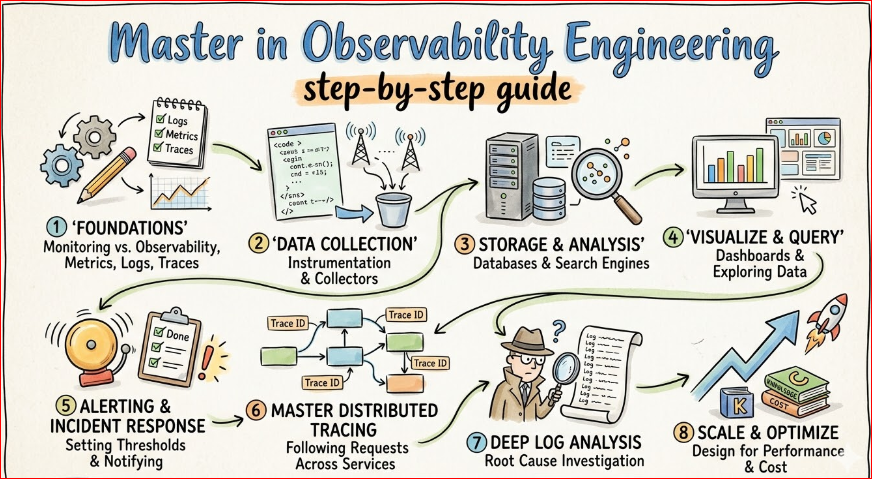
When these systems fail, everything stops – revenue, customer trust, and brand reputation. Observability is the discipline that helps teams see inside these systems, understand what is happening, and fix issues before users even notice. Master in Observability Engineering (MOE) is a certification program designed to turn working engineers and managers into observability specialists who can design, build, and operate highly reliable, visible, and data-driven platforms. This guide will help you understand what MOE is, why it matters, who should take it, and how to plan your learning path around it.
What is Observability and Why It Matters
Observability is the ability to understand the internal state of a system from the data it produces – mainly metrics, logs, traces, and events. In modern cloud-native environments, traditional monitoring is not enough because systems are too dynamic and distributed.
With strong observability, teams can:
- Detect issues faster.
- Reduce mean time to detect (MTTD) and mean time to resolve (MTTR).
- Improve reliability, performance, and customer experience.
- Make better engineering and business decisions using production data.
Observability engineering is now a core skill for DevOps, SRE, platform, and cloud teams across startups and large enterprises.
Overview of Master in Observability Engineering (MOE)
The Master in Observability Engineering (MOE) certification is a structured, hands-on program focused on building deep expertise in designing and implementing observability for modern systems.
Key highlights:
- Focus on real-world observability architecture, telemetry pipelines, and production troubleshooting.
- Tool-agnostic concepts plus hands-on work with popular stacks like Prometheus, Grafana, ELK, Jaeger, and cloud-native observability platforms.
- Alignment with DevOps and SRE best practices such as SLIs, SLOs, error budgets, and incident management.
MOE Certification Snapshot
What it is
Master in Observability Engineering (MOE) is a comprehensive certification and training program that helps professionals learn how to design, implement, and operate observability across applications, infrastructure, and cloud platforms. It blends fundamentals, tools, and real-world use cases into a single learning experience focused on production-readiness.
Who should take it
- DevOps Engineers who manage CI/CD pipelines and production environments.
- Site Reliability Engineers responsible for reliability, uptime, and SLOs.
- Platform and Cloud Engineers building internal platforms and shared services.
- Software Engineers who want better insights into application behavior.
- Security Engineers interested in using observability for detection and response.
- Engineering Managers who need to drive reliability and data-driven decisions.
Skills you’ll gain
- Core observability concepts: metrics, logs, traces, events, SLI/SLO/SLA.
- Instrumentation best practices across services and infrastructure.
- Building telemetry pipelines and data flows for observability.
- Hands-on usage of tools like Prometheus, Grafana, ELK, Jaeger, and cloud monitoring platforms.
- Designing dashboards, alerts, and KPIs that align with business and reliability goals.
- Troubleshooting production issues using observability data, not guesswork.
- Integrating observability with DevOps, SRE, AIOps, and incident management processes.
Real-world projects you should be able to do after it
- Design and implement an observability stack for a microservices application.
- Set up metrics, logs, and traces collection for a Kubernetes-based system.
- Build SLO-based dashboards and alerts for critical services.
- Implement distributed tracing to debug latency and reliability issues.
- Create a central logging and visualization pipeline for multi-environment setups.
- Use observability data to run post-incident analysis and improve reliability.
Preparation plan
You can follow one of these example preparation plans depending on your time and background.
7–14 days (fast-track, focused learners)
- Day 1–3: Observability fundamentals – metrics, logs, traces, events, SLIs/SLOs.
- Day 4–6: Instrumentation basics, logging patterns, and metrics design.
- Day 7–10: Hands-on with at least one stack (e.g., Prometheus + Grafana + Loki/ELK).
- Day 11–14: Practice lab-style scenarios, troubleshoot sample failures, review exam-style topics.
30 days (balanced working-professional plan)
- Week 1: Concepts, architecture, and patterns in observability.
- Week 2: Tools – Prometheus, Grafana, ELK, Jaeger, and one cloud-native platform.
- Week 3: Real-world scenarios – incident management, SLOs, performance tuning.
- Week 4: End-to-end project – build an observability solution for a demo or work project.
60 days (deep-dive and career transition plan)
- Month 1: Fundamentals, architecture, and 2–3 tool stacks in depth.
- Month 2: Advanced topics – AI/ML in observability, AIOps, automation, optimization.
- Ongoing: Work on 2–3 serious projects and build a portfolio you can show in interviews.
Common mistakes
- Treating observability as only “monitoring” instead of end-to-end system understanding.
- Overfocusing on tools without understanding concepts and architecture.
- Creating too many metrics and logs without clear purpose or cost control.
- Ignoring SLOs, SLIs, and business context when designing dashboards and alerts.
- Not integrating observability into CI/CD, release pipelines, and incident workflows.
- Skipping hands-on labs and jumping straight to theory or slides.
Best next certification after this
After completing MOE, strong next options include:
- Same track (Depth in Observability / SRE)
- Advanced SRE or reliability engineering certification.
- Specialized tool-based certifications (e.g., Prometheus + Grafana, ELK Stack, Datadog, or cloud observability).
- Cross-track (Breadth across DevOps / DevSecOps / Data)
- DevSecOps certification to combine security and observability.
- DataOps or MLOps certification to work with telemetry and operational data.
- Leadership (Architecture and Management)
- Architecture-focused certification on designing observable, resilient systems.
- DevOps or SRE leadership programs to manage teams and reliability at scale.
MOE Certification Table
Below is a structured view of MOE and how it fits across different tracks.
| Track | Level | Who it’s for | Prerequisites | Skills covered | Recommended order |
|---|---|---|---|---|---|
| Observability | Intermediate | DevOps, SRE, Platform, Cloud, Software, Security Engineers | Basic Linux, cloud, DevOps fundamentals | Observability fundamentals, metrics/logs/traces, instrumentation, tooling, dashboards, SLOs, troubleshooting | Take after basic DevOps / cloud foundations |
| DevOps / SRE | Advanced | Senior DevOps/SRE/Platform Engineers | Experience with CI/CD and production systems | Production observability, incident response, SRE practices, performance tuning, cross-team collaboration | After at least one DevOps/SRE course |
| Cloud / Platform | Intermediate | Cloud Engineers, Platform Engineers | Cloud provider basics, infrastructure knowledge | Cloud-native observability, managed services, cost-aware telemetry, multi-cloud and hybrid observability | After cloud associate-level knowledge |
| DevSecOps | Intermediate | Security + DevOps practitioners | Security basics, DevOps concepts | Security logging, threat signals in telemetry, anomaly detection, compliance observability | After a DevSecOps or security fundamentals |
| AIOps/MLOps | Advanced | AIOps, MLOps and data-driven operations engineers | Observability basics, data pipelines knowledge | Using observability data for AI/ML, anomaly detection, intelligent alerting, automated remediation | After MOE + Data/AIOps fundamentals |
| FinOps | Intermediate | FinOps practitioners, cost and operations teams | Cloud billing and cost basics | Cost-aware observability, telemetry cost optimization, usage analysis, capacity planning | After FinOps or cloud cost fundamentals |
Choose Your Path: 6 Learning Paths Around MOE
Observability sits at the intersection of several modern roles. Here are six learning paths where MOE plays a central role.
1. DevOps Path
- Start with DevOps fundamentals (CI/CD, automation, cloud basics).
- Take MOE to add strong observability and reliability skills.
- Follow up with container, Kubernetes, and infrastructure-as-code courses.
- Grow into roles like Senior DevOps Engineer or Platform Engineer.
2. DevSecOps Path
- Begin with security and DevOps foundations.
- Use MOE to understand how logs, metrics, and traces support detection, forensics, and compliance.
- Later, pursue a dedicated DevSecOps certification focused on secure pipelines and runtime security.
- Grow into roles like DevSecOps Engineer or Security SRE.
3. SRE Path
- Start with basic SRE principles – SLIs, SLOs, error budgets, incident management.
- Take MOE to build practical observability skills around those concepts.
- Add specialized SRE training and chaos engineering.
- Move into Site Reliability Engineer or Reliability Architect roles.
4. AIOps / MLOps Path
- Begin with data engineering or MLOps basics.
- Use MOE to build a robust observability layer, which is the data source for AIOps.
- Move to AIOps/MLOps courses that teach anomaly detection, automated responses, and AI-driven operations.
- Target roles such as AIOps Engineer, MLOps Engineer, or Observability Data Engineer.
5. DataOps Path
- Start with data pipelines, ETL/ELT, and data platform basics.
- Use MOE to learn how to observe data pipelines, data quality, and throughput using observability tools.
- Add DataOps and reliability courses for data platforms.
- Aim for DataOps Engineer or Data Platform SRE roles.
6. FinOps Path
- Begin with cloud finance, billing, and usage optimization knowledge.
- Use MOE to understand how telemetry data influences cost visibility and capacity planning.
- Follow up with FinOps certification to connect cost, performance, and engineering decisions.
- Grow into FinOps Practitioner or Cloud Cost Optimization roles.
Role → Recommended Certifications Mapping
Below is a practical mapping of roles and how MOE fits into their certification journey.
| Role | Primary Focus | How MOE Helps | Recommended Certifications Order |
|---|---|---|---|
| DevOps Engineer | CI/CD, automation, deployments, reliability | Adds deep visibility into systems and pipelines | DevOps fundamentals → MOE → Kubernetes / cloud-native specializations |
| SRE | Reliability, SLOs, incident management | Provides the data and tools needed for SRE practices | SRE fundamentals → MOE → advanced SRE / chaos engineering |
| Platform Engineer | Internal platforms, shared services, developer enablement | Helps design observable platforms from day one | Cloud/platform basics → MOE → platform engineering / GitOps |
| Cloud Engineer | Cloud infrastructure and services | Enables cloud-native observability and monitoring | Cloud associate → MOE → advanced cloud / multi-cloud |
| Security Engineer | Threat detection, response, compliance | Uses observability data for security insights | Security basics → DevSecOps → MOE |
| Data Engineer | Data pipelines, warehouses, streaming | Makes data pipelines observable and reliable | Data engineering fundamentals → MOE → DataOps |
| FinOps Practitioner | Cloud cost and value optimization | Uses telemetry to link cost to usage and performance | Cloud cost basics → FinOps → MOE |
| Engineering Manager | Delivery, reliability, and team outcomes | Offers frameworks to measure and improve system health | General engineering leadership → MOE → SRE/DevOps leadership |
Top Institutions for MOE Training and Certification Support
Several institutions provide training, mentoring, and support for the Master in Observability Engineering (MOE) and related practices. They help with structured learning, projects, and sometimes interview preparation.
- DevOpsSchool
DevOpsSchool is a well-known training provider offering specialized programs in DevOps, SRE, cloud, and observability. Its MOE program focuses on practical labs, tool coverage, and job-oriented skills, plus multiple learning modes for working professionals. - Cotocus
Cotocus acts as a consulting and training company focused on DevOps, cloud, DataOps, and related areas. It often delivers corporate and customized training including observability-focused programs in partnership with platforms like DevOpsSchool. - Scmgalaxy
Scmgalaxy provides training and workshops in SCM, DevOps, and modern engineering practices. They support learners with hands-on labs, project-based sessions, and guidance on adopting observability in real projects. - BestDevOps
BestDevOps focuses on content, community, and training in DevOps and SRE. It helps professionals stay updated with observability trends and can connect them to suitable programs and resources. - devsecopsschool.com, sreschool.com, aiopsschool.com, dataopsschool.com, finopsschool.com
These niche brands focus on DevSecOps, SRE, AIOps, DataOps, and FinOps respectively, often connected with the same broader ecosystem as DevOpsSchool. They provide specialized training paths where observability is an important building block for each domain.
FAQs on Master in Observability Engineering (MOE)
1. Is MOE difficult for beginners?
MOE expects you to know basic Linux, cloud, and DevOps concepts, but it starts from core observability fundamentals. It is challenging enough to be valuable but still practical for working professionals who are ready to put in consistent effort.
2. How much time do I need to prepare?
If you already work in DevOps or SRE, 2–4 weeks of focused study with hands-on labs can be enough. If you are newer to observability, plan for 1–2 months while balancing a full-time job.
3. Do I need coding experience?
You do not need to be a full-time developer, but basic scripting and reading application logs, configuration files, and dashboards will help a lot. The focus is more on systems thinking and tooling than heavy coding.
4. What are the prerequisites for MOE?
You should be comfortable with Linux basics, networking concepts, at least one cloud provider, and a general understanding of DevOps or operations workflows. Prior experience with monitoring tools is helpful but not mandatory.
5. Is MOE useful for Software Engineers?
Yes. It helps software engineers understand how their code behaves in production, how to instrument services, and how to debug complex issues using metrics, logs, and traces. This makes them more effective and valuable in any team.
6. What career outcomes can I expect?
MOE can support transitions into roles like DevOps Engineer, SRE, Observability Engineer, Platform Engineer, and Cloud Operations Engineer. It can also boost your profile for senior positions in reliability and platform teams.
7. In what sequence should I take MOE with other certifications?
A good sequence is: foundational DevOps or cloud certification → MOE → specialized SRE, DevSecOps, or tool-based observability certification. This keeps your learning path structured and progressive.
8. Does MOE cover cloud-native observability?
Yes, MOE focuses strongly on cloud-native environments including containers, Kubernetes, and multi-cloud setups. You learn to work with both open-source stacks and cloud provider tools.
9. Is MOE relevant outside India?
Observability skills are globally in demand, and the concepts and tools covered in MOE are widely used worldwide. The certification can help in both Indian and international roles.
10. Can managers and leads benefit from MOE?
Engineering managers, leads, and architects can use MOE to understand how to measure system health, prioritize reliability work, and drive better decisions using observability data.
11. How practical is the training?
MOE emphasizes hands-on labs, projects, and real-case scenarios over pure theory. You practice building dashboards, setting up alerts, tracing issues, and designing observability for real-world-style systems.
12. Is MOE only about tools?
No. While you learn tools, the program focuses even more on principles, patterns, architecture, and practical workflows. This makes your knowledge portable across different tool stacks and organizations.
Additional FAQs (Focused on MOE Itself)
1. What is the main objective of Master in Observability Engineering (MOE)?
The main objective is to help professionals design and operate robust observability systems that improve reliability, performance, and incident response in modern, distributed environments.
2. What topics are covered inside MOE?
MOE covers observability fundamentals, instrumentation, metrics/logs/traces, dashboards, alerts, incident troubleshooting, cloud-native observability, and best practices for implementing observability at scale.
3. How is MOE different from a general monitoring course?
Monitoring courses often focus on tools and basic alerts, while MOE focuses on full-stack observability, system design, and using telemetry to understand and improve complex systems.
4. What kind of projects will I work on?
Typical projects include building observability stacks for sample applications, instrumenting services, designing dashboards, setting SLOs, and troubleshooting simulated production incidents.
5. Does MOE help with interviews?
Yes. The concepts, tools, and projects covered in MOE map directly to common DevOps, SRE, and platform interview questions, especially those around reliability, monitoring, and incident response.
6. Can MOE help me move from support to SRE or DevOps?
MOE can be a strong bridge from L1/L2 support or operations roles into SRE, DevOps, or platform roles by giving you practical skills in observability, troubleshooting, and reliability engineering.
7. Do I need to choose a specific tool before joining MOE?
No. MOE is tool-agnostic and covers multiple widely used stacks so you learn concepts first and then see how different tools implement them.
8. Is MOE suitable for people in small startups?
Yes. Startups often lack dedicated SRE teams, so having someone who understands observability can dramatically improve reliability and reduce firefighting in a growing product environment.
Conclusion
Observability has become a core capability for any serious technology team. It is no longer optional if you are running cloud-native, distributed, or high-scale systems. Master in Observability Engineering (MOE) is a focused certification built to help working engineers and managers move beyond basic monitoring into true observability.
By combining MOE with a clear learning path in DevOps, SRE, DevSecOps, AIOps/MLOps, DataOps, or FinOps, you can build a powerful, future-proof career in modern operations and reliability. If you want to reduce firefighting, gain real visibility into your systems, and grow into higher-responsibility roles, MOE is a strong step in that direction.
