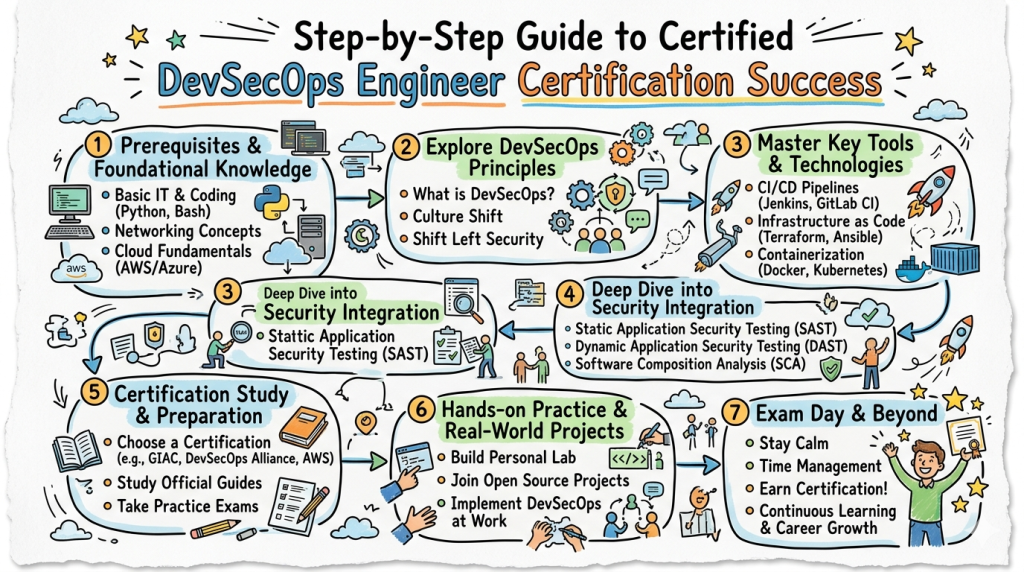
Modern software teams must move fast and stay secure at the same time. DevSecOps is the way to build security into every stage of software delivery instead of adding it as a late check. Certified DevSecOps Engineer is a focused certification that helps working engineers and managers learn these skills in a structured, practical way. In this guide, you will understand what the Certified DevSecOps Engineer certification is, who it is for, how to prepare, and how it fits into different career paths like DevOps, DevSecOps, SRE, AIOps, MLOps, DataOps, and FinOps. The goal is to create clear awareness about this certification program so you can decide if it is right for you.
Certification Overview: What You Will Learn
What it is
Certified DevSecOps Engineer is a hands‑on certification that teaches you how to embed security into the full software delivery lifecycle. You learn to build secure CI/CD pipelines, automate security checks, and work closely with development, operations, and security teams.
Who should take it
This certification is ideal for:
- Software engineers who want to move beyond coding and into secure delivery.
- DevOps and platform engineers who manage CI/CD and production systems.
- Security engineers who want to understand how modern pipelines work.
- SREs and cloud engineers responsible for reliability and infrastructure.
- Engineering managers who own secure, fast, and stable releases.
Skills you will gain
- DevSecOps fundamentals and culture.
- Secure software development lifecycle (SSDLC) basics.
- CI/CD pipeline security patterns and guardrails.
- Static and dynamic application security testing integration.
- Dependency and container image scanning.
- Kubernetes and cloud security fundamentals.
- Secrets management and policy enforcement in pipelines.
- Vulnerability management and risk‑based prioritisation.
- Reporting, dashboards, and security metrics for stakeholders.
Real‑world projects you should be able to do after it
After this certification, you should be able to:
- Design and implement a secure CI/CD pipeline for a web or API service.
- Integrate SAST, DAST, dependency, and container scanning into the pipeline.
- Configure secrets management for builds, tests, and deployments.
- Build basic policies as code for compliance and security checks.
- Create security reports and dashboards for releases and environments.
- Support incident investigations with pipeline logs and security data.
Preparation plan (7–14 days / 30 days / 60 days)
7–14 days fast‑track plan
This plan works if you already have strong DevOps experience.
- Day 1–2: Learn DevSecOps basics, SSDLC, and threat concepts.
- Day 3–4: Deep dive into CI/CD security, common pipeline designs, and typical risks.
- Day 5–7: Hands‑on labs with SAST, DAST, and dependency scanning in a sample pipeline.
- Day 8–10: Labs on container, Kubernetes, and secrets management.
- Day 11–14: Build an end‑to‑end secure pipeline project and revise for the exam.
30 days balanced plan
This plan fits most working professionals.
- Week 1: DevSecOps culture, SDLC, security basics, risk and compliance overview.
- Week 2: CI/CD pipeline design, security stages, SAST/DAST, dependency scanning.
- Week 3: Containers, registries, Kubernetes, cloud security foundations.
- Week 4: Full hands‑on project, troubleshooting, mock tests, and review.
60 days deep plan
This plan is for people new to DevOps or security.
- Weeks 1–2: Linux, Git, CI/CD basics, application and network security basics.
- Weeks 3–4: DevSecOps principles, secure SDLC, threat modelling for simple systems.
- Weeks 5–6: Advanced labs, multi‑environment pipelines, policy as code, and exam practice.
Common mistakes to avoid
- Thinking DevSecOps is “just tools” and ignoring culture and process.
- Skipping SDLC and secure coding basics.
- Over‑focusing on one vendor or one tool instead of principles.
- Not doing labs and only reading notes or slides.
- Ignoring logs, reports, and metrics that prove security improvements.
- Working alone and not involving developers, operations, and management.
Best next certification after this
After Certified DevSecOps Engineer, strong next steps include:
- Same track: A more advanced DevSecOps or cloud‑native security certification that goes deeper into container, Kubernetes, and microservices security.
- Cross‑track: A cloud, SRE, DataOps, or MLOps certification where you apply DevSecOps ideas to new domains.
- Leadership: A security architecture, governance, or DevOps transformation‑focused certification for leads and managers.
Certification Table
Below is a structured view of the Certified DevSecOps Engineer certification. You can paste this into your blog as a table.
| Track | Level | Who it’s for | Prerequisites | Skills covered | Recommended order |
|---|---|---|---|---|---|
| DevSecOps | Core / Intermediate | Software, DevOps, SRE, Cloud, Security, Platform engineers, Managers | Basic Linux, Git, CI/CD, app basics | DevSecOps concepts, SSDLC, CI/CD security, SAST, DAST, dependency and container scanning, secrets, basic cloud/K8s security | After core DevOps / CI/CD skills |
Choose Your Path: Six Learning Paths
DevSecOps is useful across many roles and career directions. Here is how Certified DevSecOps Engineer fits into six common paths.
DevOps Path
In the DevOps path, you start with Linux, Git, CI/CD, containers, and cloud. Once you can build and deploy applications smoothly, you add Certified DevSecOps Engineer to make those pipelines secure by design. This makes you a DevOps engineer who understands both speed and security.
DevSecOps Path
In the DevSecOps path, you combine security and DevOps from the beginning. You learn application security, secure coding basics, and security testing. Certified DevSecOps Engineer then gives you a formal, project‑based structure to apply this in CI/CD and production. You grow into DevSecOps engineer or security automation specialist roles.
SRE Path
In the SRE path, you care about reliability, uptime, error budgets, and incident response. Certified DevSecOps Engineer adds strong security checks to your operational practices so that changes are safe as well as reliable. You become an SRE who can talk confidently about both reliability and security posture.
AIOps / MLOps Path
In the AIOps and MLOps path, you handle ML models, data pipelines, and automated operations. Certified DevSecOps Engineer helps you secure model training, deployment pipelines, and operational tools. You can then design secure MLOps workflows and AIOps systems that are safe, observable, and compliant.
DataOps Path
In the DataOps path, you manage data pipelines, ETL flows, and data platforms. With DevSecOps skills, you protect pipelines, credentials, and sensitive data while still moving fast. Certified DevSecOps Engineer gives you patterns to secure data workflows, metadata systems, and automation around them.
FinOps Path
In the FinOps path, you focus on cloud cost and value. DevSecOps skills help you design secure architectures that are also cost‑aware. You understand trade‑offs between extra security controls and resource usage, and you can support decisions that balance security, performance, and cost.
Role → Recommended Certifications Mapping
| Role | How Certified DevSecOps Engineer helps | Recommended place in your journey |
|---|---|---|
| DevOps Engineer | Teaches you to add security checks to builds, tests, and deployments | After you are comfortable with CI/CD basics |
| SRE | Helps you embed security into reliability, change management, and incident handling | After core SRE and observability skills |
| Platform Engineer | Helps you secure shared clusters, platforms, and internal developer tooling | Mid‑career, after platform fundamentals |
| Cloud Engineer | Connects cloud services, identity, and pipelines with security controls | After basic cloud associate‑level skills |
| Security Engineer | Brings you closer to DevOps workflows and automation | After general security and network knowledge |
| Data Engineer | Helps you secure data pipelines and jobs | After ETL, data pipelines, and platform basics |
| FinOps Practitioner | Ensures security controls align with cost, tagging, and governance | After core FinOps practices |
| Engineering Manager | Gives a framework for building secure delivery practices across teams | Anytime you lead or plan to lead teams |
How This Certification Supports Your Career
For working engineers in India and globally, DevSecOps is now a key expectation in DevOps, SRE, and cloud roles. Companies look for people who can work across teams and bring security into daily delivery work. Certified DevSecOps Engineer makes your profile more complete and future‑ready.
Managers and leads can also use this certification to design better processes and roadmaps. You gain a common language to discuss security with engineers, operations, security teams, and leadership. This reduces friction and makes it easier to push secure practices across the organisation.
Next Certifications to Take
After you complete Certified DevSecOps Engineer, you can pick your next step based on your goals.
Same track: Advanced DevSecOps
If you want to become a deep DevSecOps specialist:
- Choose higher‑level DevSecOps or cloud‑native security certifications.
- Go deeper into container, Kubernetes, supply chain, and runtime security.
- Focus on designing policies, architectures, and reusable security patterns.
Cross‑track: Cloud, SRE, Data, or ML
If you want to broaden your profile:
- Pick a cloud architect, cloud security, or Kubernetes administrator certification.
- Consider SRE or platform engineering certifications that value security‑aware engineers.
- Explore DataOps or MLOps certifications where you secure data and ML pipelines.
Leadership: Strategy and Governance
If you are moving towards leadership:
- Look for certifications focused on security architecture, governance, and risk.
- Focus on leading DevOps and DevSecOps transformations, not only implementing tools.
- Learn how to design policies, operating models, and metrics for secure delivery.
Top Institutions for Certified DevSecOps Engineer Training
Here are institutions that can support your training and certification journey.
DevOpsSchool
DevOpsSchool offers hands‑on training and workshops focused on DevOps and DevSecOps for working professionals. Their programs combine theory, practical labs, and real project scenarios so that you can directly apply what you learn in your job.
Cotocus
Cotocus provides specialised training and consulting around DevOps, DevSecOps, SRE, and related areas. The focus is on practical skills, project‑based learning, and mentoring so that you can grow from basic to advanced levels with clear guidance.
ScmGalaxy
ScmGalaxy is known for training on software configuration management, build, release, DevOps, and DevSecOps. Courses are designed for engineers and teams who want to master tools and processes through real‑time exercises and guided practice.
BestDevOps
BestDevOps acts as a hub for curated DevOps and DevSecOps learning resources and training programs. It helps learners pick the right path, understand exam expectations, and gain strong fundamentals with examples from real projects and environments.
devsecopsschool.com
devsecopsschool.com focuses on DevSecOps and security‑driven DevOps training. It aligns closely with the Certified DevSecOps Engineer program and offers structured learning paths, labs, and support designed for engineers, SREs, and managers.
sreschool.com
sreschool.com specialises in Site Reliability Engineering education. It helps engineers combine reliability engineering, observability, and incident response with security practices, making it a powerful option for SREs who want to add DevSecOps skills.
aiopsschool.com
aiopsschool.com trains engineers on AIOps and intelligent operations. It combines automation, analytics, and monitoring with secure operations concepts, which is useful when you want to apply DevSecOps thinking to AI‑driven operations.
dataopsschool.com
dataopsschool.com focuses on DataOps, data engineering, and pipeline automation. It supports learners who want to secure data flows, protect credentials, and maintain data quality using DevOps and DevSecOps principles.
finopsschool.com
finopsschool.com provides learning on FinOps and cloud cost management. It helps engineers and managers design cloud environments that are secure, compliant, and cost‑effective, connecting DevSecOps ideas with financial accountability.
General FAQs
1. Is Certified DevSecOps Engineer very hard?
It is challenging but realistic for working professionals. If you already know basic DevOps and application concepts, the certification is clear and manageable with steady practice.
2. How much time do I need to prepare?
Most learners need 30 to 60 days of part‑time study. If you are already working with CI/CD and security tools, you can complete preparation in 7 to 14 days with focused effort.
3. Do I need a strong security background before starting?
No. A basic understanding of applications, networks, and cloud is enough. The certification will introduce you to security concepts step by step in a DevOps context.
4. What is the best learning order for DevSecOps?
A simple order is: Linux and Git, CI/CD fundamentals, containers and cloud basics, then Certified DevSecOps Engineer. After that, you can add advanced security or cloud‑specific certifications.
5. How does this certification help my salary and role?
While no certification guarantees a salary increase, this one makes you more valuable for DevOps, DevSecOps, SRE, and platform roles. You can handle both delivery and security, which is important for senior positions.
6. Is this certification only for engineers?
Engineers get the most hands‑on benefit, but architects, managers, and tech leads also gain a clear view of how to plan secure delivery pipelines and guide teams.
7. Can I do this certification if I am from a testing or QA background?
Yes. If you know test processes and automation, this certification helps you move into security testing and pipeline‑driven quality gates across environments.
8. Do I need programming skills?
You do not need to be an expert programmer, but you should understand builds, dependencies, APIs, and basic scripts. These skills help you work with tools and troubleshoot pipelines.
9. Will I learn specific tools or just concepts?
You will learn both. The focus is on concepts first and then how to apply them with common tools used in real pipelines.
10. Is this certification suitable for remote and global roles?
Yes. DevSecOps practices are used worldwide, and remote teams rely heavily on automated and secure pipelines, so this skill set is relevant in global markets.
11. How does this certification help in regulated industries?
Regulated industries need strong controls and evidence. DevSecOps practices help you embed checks into pipelines and generate reports that support audits and compliance.
12. How do I stay updated after getting certified?
Keep working on real pipelines, follow updates in tools and cloud platforms, join internal security discussions, and keep improving security checks and automation in your projects.
FAQs Focused on Certified DevSecOps Engineer
1. What is the exact focus of Certified DevSecOps Engineer?
The focus is on building and operating secure CI/CD pipelines, integrating security testing and scanning, protecting secrets, and improving your organisation’s security posture through automation.
2. Who is the best fit for this certification?
The best fit is a working professional who already understands basic software delivery and wants to take ownership of security in that process, either as an engineer or a manager.
3. What are the entry prerequisites?
You should know Linux, Git, basic CI/CD ideas, and how applications are deployed. Familiarity with containers or cloud is helpful but not mandatory at the start.
4. What concrete outcomes should I expect after completion?
You should be able to design secure pipelines, integrate security tools into them, explain DevSecOps concepts to your team, and support both delivery speed and security requirements.
5. How is the learning content usually structured?
Content is generally structured around core concepts, tool‑based labs, real project scenarios, and practice questions or evaluations that simulate real‑world challenges.
6. How does this certification differ from a classic security course?
A classic security course focuses more on vulnerabilities, threats, and testing. Certified DevSecOps Engineer focuses on how to embed those ideas into continuous delivery pipelines and everyday workflows.
7. Can this certification help me switch from operations to security?
Yes. It is a natural bridge for operations and DevOps people who want to move towards security‑focused roles without leaving automation and delivery behind.
8. What are the long‑term career benefits?
Long‑term, it positions you as a professional who can connect teams, design secure delivery systems, and lead DevSecOps initiatives, which are high‑impact and high‑visibility responsibilities.
Conclusion
Certified DevSecOps Engineer is a practical way to learn how to build secure, automated software delivery pipelines that work in real organisations. It helps engineers, SREs, cloud professionals, security specialists, and managers speak the same language about security and speed. If you want your career to grow in modern DevOps, cloud, and platform roles, this certification gives you a strong foundation and clear next steps for deeper or broader learning.
