Upgrade & Secure Your Future with DevOps, SRE, DevSecOps, MLOps!

We spend hours on Instagram and YouTube and waste money on coffee and fast food, but won’t spend 30 minutes a day learning skills to boost our careers.
Master in DevOps, SRE, DevSecOps & MLOps!

Learn from Guru Rajesh Kumar and double your salary in just one year.

Get Started Now!

How we learn is a quantum-like manner!

Source: eurekalert.org

Imagine that you met a charming girl in school. She is an excellent student who concerns about the world welfare and is anti-war and anti-nuclear. Which do you think she is most likely to become in the future, a bank counter clerk, or, a bank counter clerk and feminist? Surveys show that most people think it’s easy and choose the latter. Their choice is right. However, according to classical probability theory, the probability of the former is definitely higher than the latter because the former contains the latter. That paradox calls for more modeling to be established to better fit facts.

Prof. ZHANG Xiaochu and his group developed new frameworks to better explain such human decision-making behaviors using the concept of quantum, and their result is published in Nature Human Behaviour in January 2020. They established the quantum reinforcement learning framework for human decision-making applying concepts from quantum probability theory. For example, they chose quantum probability amplitude rather than classical probability to describe the tendency of selecting a specific action. In this way they proposed quantum models that are comparable to the best classical models. Furthermore, they checked the functional magnetic resonance imaging (fMRI) data of human brain playing the Iowa Gambling Task. They were surprised to find that several important internal-state-related variables involved in their models are represented in the medial frontal gyrus (MeFG), which is important for human learning and decision-making. This shows a unique quantum-like neural mechanism for how the internal state is changed due to external information. In other words, this implies that how human brain works is a quantum-like manner, which is worthy of further research.

These models bring people new perspectives on understanding how human brains run. It’s inspired by machine learning development and is possible to elevate the efficiency of machine learning. In the meantime, the quantum-like mechanisms in the brain are still not fully understood. This deserves additional studies and is likely to change the history.


Related Posts

DeepMind open-sources Lab2D to support creation of 2D environments for AI and machine learning

Source: computing.co.uk Alphabet subsidiary DeepMind announced on Monday that it has open-sourced Lab2D, a scalable environment simulator for artificial intelligence (AI) research that facilitates researcher-led experimentation with environment Read More

Read More

A VR Film/Game with AI Characters Can Be Different Every Time You Watch or Play

Source: technologyreview.com The square-faced, three-legged alien shoves and jostles to get at the enormous plant taking over its tiny planet. But each bite just makes the forbidden Read More

Read More

Researchers detail LaND, AI that learns from autonomous vehicle disengagements

Source: venturebeat.com UC Berkeley AI researchers say they’ve created AI for autonomous vehicles driving in unseen, real-world landscapes that outperforms leading methods for delivery robots driving on Read More

Read More

Google Teases Large Scale Reinforcement Learning Infrastructurean

Source: alyticsindiamag.com The current state-of-the-art reinforcement learning techniques require many iterations over many samples from the environment to learn a target task. For instance, the game Dota Read More

Read More

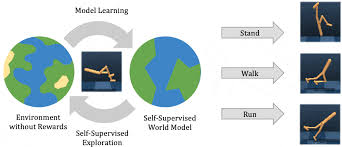
Plan2Explore: Active Model-Building for Self-Supervised Visual Reinforcement Learning

Source: bair.berkeley.edu To operate successfully in unstructured open-world environments, autonomous intelligent agents need to solve many different tasks and learn new tasks quickly. Reinforcement learning has enabled Read More

Read More

Is AI an Existential Threat?

Source: unite.ai When discussing Artificial Intelligence (AI), a common debate is whether AI is an existential threat. The answer requires understanding the technology behind Machine Learning (ML), and recognizing Read More

Read More
Subscribe
Notify of
guest
0 Comments
Oldest
Newest Most Voted
Inline Feedbacks
View all comments
0
Would love your thoughts, please comment.x
()
x