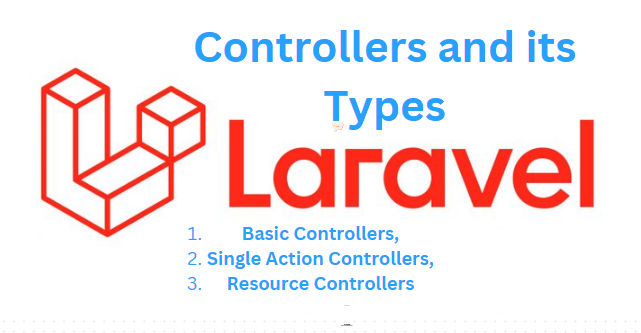
In Laravel, a controller is a PHP class that handles incoming HTTP requests and manages the application’s logic to produce an appropriate HTTP response. Controllers are an essential part of the Model-View-Controller (MVC) architectural pattern, where they act as intermediaries between the user’s request and the application’s response.
In Another, controllers are an essential part of the MVC (Model-View-Controller) architecture, handling the logic between the application’s data (models) and the user interface (views).
There are different types of controllers in Laravel:
- Basic Controllers: These are the standard controllers in Laravel. They contain methods that correspond to different actions or routes in the application.
You can create a resource controller using the php artisan make:controller ConrollerName command.
2. Single Action Controllers: Single Action Controllers are a concept in Laravel that involves creating a controller with just one method to handle a single action or endpoint in your application. They are particularly useful for cases where you have a simple action that doesn’t require multiple methods or where creating a full controller seems excessive.
In essence, a Single Action Controller contains a single method to handle a specific task. It’s a convenient way to define a route and controller action in one step without having to create a controller with multiple methods.
You can create a resource controller using the php artisan make:controller ConrollerName command with the –invokable flag.
3. Resource Controllers: Resource controllers provide a convenient way to handle CRUD (Create, Read, Update, Delete) operations on resources such as database models. They follow RESTful conventions and provide predefined methods for typical CRUD operations.
In short, Automatically generated by Laravel for CRUD operations on a particular resource.
You can create a resource controller using the php artisan make:controller ControllerName command with the –resource flag.
