Introduction
The tech world moves fast. If you are a software engineer or a manager today, you know that just writing code is no longer enough. Businesses need speed, but they also need stability. This is why the DevOps culture has become the backbone of modern engineering. After spending two decades watching teams struggle with slow releases and manual errors, I have seen how a structured learning path can change a career.
The DevOps Certified Professional (DCP) program is designed to bridge the gap between theory and the real world. It is not just about learning a tool like Docker or Jenkins. It is about understanding how to build a reliable system that grows with the business. Whether you are in India or working for a global firm, this guide will show you how to master these modern practices.
Overview of Professional Certification Tracks
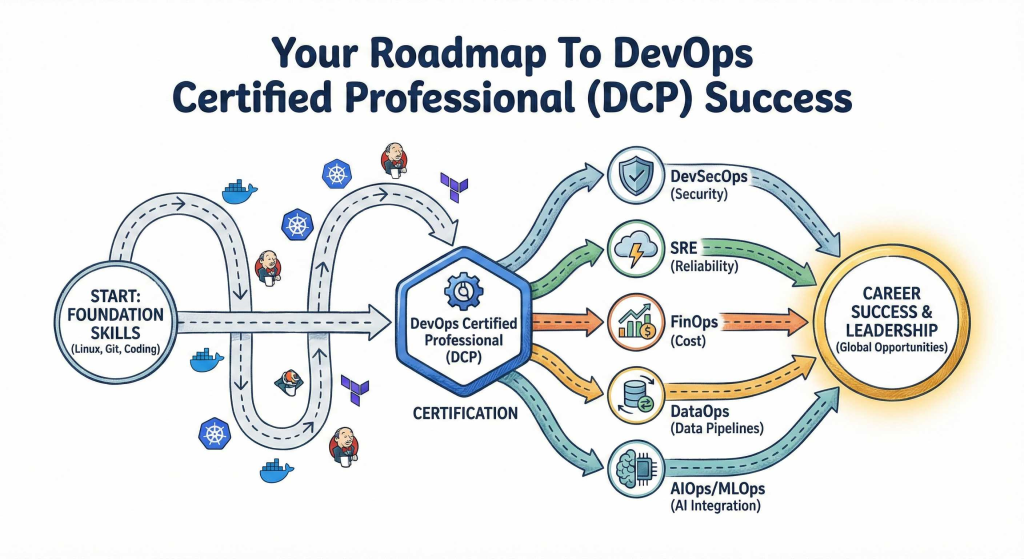
Below is a list of the key certification tracks available through the program. Each one is built to help you master a specific area of the modern software lifecycle.
| Track | Level | Who it’s for | Prerequisites | Skills Covered | Recommended Order |
| DevOps | Professional | Engineers, Admins | Basic Linux, Scripting | CI/CD, Docker, K8s, IaC | Start Here |
| DevSecOps | Professional | Security Engineers | DevOps Basics | Security Automation, Vault | Second |
| SRE | Professional | Ops Engineers | DevOps Basics | SLIs/SLOs, Error Budgets | Second |
| AIOps/MLOps | Professional | Data/Ops Engineers | Python Basics | ML in Ops, Monitoring | Advanced |
| DataOps | Professional | Data Engineers | SQL, Data Basics | Data Pipelines, Quality | Advanced |
| FinOps | Professional | Managers, Leads | Cloud Basics | Cost Optimization | Leadership |
DevOps Certified Professional (DCP) Deep Dive
What it is
The DCP is a full program that teaches you how to automate the whole software development journey. It focuses on removing the walls between developers and operations teams. It uses a standard set of tools and a way of working where everyone shares responsibility.
Who should take it
This program is perfect for Software Engineers, System Administrators, and Quality Assurance professionals. It is for those who want to move into high-paying automation roles. It also helps Project Managers and Engineering Leads who need to understand the technical side of how software is delivered.
Skills you’ll gain
- Linux Skills: Learn to use the command line, manage users, and write scripts to do daily tasks for you.
- Version Control: Use Git and GitHub to manage changes in code across large teams.
- Continuous Integration (CI): Build pipelines using Jenkins to test code as soon as it is finished.
- Infrastructure as Code (IaC): Use Terraform and Ansible to manage servers with simple text files.
- Containers: Master Docker to package apps so they run the same way on every computer.
- Orchestration: Use Kubernetes to manage many containers at once and keep them healthy.
- Monitoring: Set up tools like Prometheus to watch your systems and fix problems early.
Real-world projects you should be able to do
- Full Pipeline: Create a system where code is tested and put onto a live server without any human help.
- Self-Fixing Systems: Build a server that can see when a service has stopped and restart it on its own.
- Automatic Growth: Set up a cloud that adds more servers when many people are using the app and removes them when they leave to save money.
- Security Checks: Add tools that check your code for mistakes or safety holes every time a change is made.
Preparation Plan
- 7-14 Days: Focus on the basics. Look at Linux files, how networks work, and how to use Git to manage code.
- 30 Days: Work on automation. Spend time building Jenkins pipelines and learning how to create Docker images.
- 60 Days: Master large systems. Focus on managing Kubernetes clusters, writing Terraform code, and setting up logs for many servers.
Common Mistakes
- Skipping the Basics: Many people try to learn Kubernetes before they understand a simple Linux server.
- Learning Tools Alone: It is not enough to know one tool. You must know how it fits into the whole process.
- Forgetting the People: DevOps is about working together. If you only focus on tools and do not talk to other teams, projects will fail.
- No Manual Practice: Automation is good, but you must know how to fix things by hand when the automation fails.
Best next certification after this
After you earn your DCP, the best next step is DevSecOps Professional if you want to focus on security. Or, choose SRE Professional if you want to be an expert in keeping systems fast and stable.
Choose Your Path
Every engineer has a different interest. You can choose a path that fits your goals:
- DevOps Path: This is the standard way. You focus on the flow of code from a laptop to the live system with speed.
- DevSecOps Path: This is for those who love security. You learn how to put safety checks into every step of the work.
- SRE Path: This is for people who like fixing complex problems. You focus on making sure systems stay running.
- AIOps/MLOps Path: This joins Artificial Intelligence with operations. You learn to manage AI models and use them to find problems.
- DataOps Path: This focuses on data. You learn how to make data systems reliable for data scientists.
- FinOps Path: This is about the business. You learn how to manage cloud costs so your company does not waste money.
Role → Recommended Certifications
| Role | Recommended Certifications |
| DevOps Engineer | DCP (DevOps), DevSecOps Professional |
| SRE | DCP (DevOps), SRE Professional |
| Platform Engineer | DCP (DevOps), Infrastructure Automation |
| Cloud Engineer | DCP (DevOps), Cloud Architecture |
| Security Engineer | DevSecOps Professional, Security Automation |
| Data Engineer | DataOps Professional, Big Data Mastery |
| FinOps Practitioner | FinOps Professional, Cloud Governance |
| Engineering Manager | DCP (DevOps), FinOps, DevOps Leader |
Top Institutions for DevOps Certified Professional (DCP) Training
Choosing the right mentor is just as important as choosing the right course. A certification is only a piece of paper if you do not have the hands-on skills to back it up. Based on my experience in the industry, here is a detailed look at the top institutions that can help you master the DCP program.
1. DevOpsSchool
“The Gold Standard for Hands-on Mentorship”
DevOpsSchool is widely considered the top choice for the DCP certification because they focus entirely on “doing” rather than just “listening.” They do not just teach you how to pass an exam; they teach you how to survive a real day at work.
- Deep Technical Training: Their DCP program is rigorous. It covers over 60 to 120 hours of training, depending on the batch. They go very deep into core tools like Linux, Docker, Kubernetes, and Terraform.
- Mentor-Led Approach: You are not left to watch pre-recorded videos alone. You get access to mentors (often industry veterans with 15-20 years of experience) who guide you through complex topics.
- Real-Time Projects: The highlight of their training is the “Live Project” module. You will be asked to build a full CI/CD pipeline, set up monitoring for a live app, and secure a cloud environment. This is exactly what hiring managers want to see.
- Internship Opportunities: Uniquely, they often provide a 1-month internship program or project experience that helps bridge the gap for freshers or those switching careers.
2. Cotocus
“The Corporate & Consulting Experts”
Cotocus is primarily a consulting firm that helps big companies solve big problems. Their training is born out of this experience. When you learn from Cotocus, you are learning the specific methods that large enterprises use to stay stable and secure.
- Consulting-Based Curriculum: Their trainers are often active consultants. This means they bring “war stories” from the field into the classroom, teaching you how to handle real production outages and scaling issues.
- Focus on Culture & Process: While they teach the tools, Cotocus places a heavy emphasis on the “culture” part of DevOps. You will learn how to communicate with developers, manage stakeholders, and lead organizational change.
- Customized Corporate Batches: If you are a manager looking to train your entire team, Cotocus is the best fit. They tailor the DCP curriculum to match your company’s specific tech stack (e.g., focusing only on Azure or AWS).
3. Scmgalaxy
“The Community Powerhouse”
Scmgalaxy started as a community for configuration management experts and has grown into a massive resource hub. If you are a self-starter who loves digging into the details of how things work, this is the place for you.
- Tool-Specific Mastery: Scmgalaxy is famous for its deep dives into specific tools. If you want to become the absolute expert on Ansible, Chef, or Jenkins within the DCP track, their materials are unmatched.
- Community Support: You get access to a vibrant community of thousands of engineers. If you are stuck on a bug at 2 AM, there is a good chance someone in the Scmgalaxy forums has already solved it.
- Huge Resource Library: They provide an extensive collection of tutorials, scripts, and “cheat sheets” that you can use long after you finish your certification. It is a great long-term resource for your career.
4. BestDevOps
“Staying Ahead of the Curve”
The tech world changes every six months. BestDevOps focuses on keeping you updated with the absolute latest trends. They are the “newsroom” of the DevOps training world.
- Cutting-Edge Tools: While other institutes might still be teaching older versions of tools, BestDevOps ensures their DCP curriculum is updated with the latest releases of Kubernetes, unexpected new AI tools, and modern cloud practices.
- Trend-Focused Learning: They help you understand where the market is going. You will learn about emerging concepts like “Platform Engineering” and “GitOps” alongside the standard DCP curriculum.
- Review & Comparison: They are excellent at helping you compare different tools (e.g., “Jenkins vs. GitHub Actions”) so you can make the right decisions when you are an architect.
5. Specialized Schools
Sometimes, you need to be more than a generalist. These specialized schools (often part of the larger DevOpsSchool ecosystem) allow you to laser-focus on one specific career path within the DCP framework.
- DevSecOpsSchool:
- Focus: Security Automation.
- What you learn: How to integrate security scanners (SAST/DAST) into pipelines, manage secrets with Vault, and ensure compliance without slowing down developers.
- SRESchool:
- Focus: Reliability and Uptime.
- What you learn: Deep dives into Service Level Objectives (SLOs), error budgets, incident management, and advanced monitoring with Prometheus and Grafana.
- AIOpsSchool:
- Focus: AI for Operations.
- What you learn: How to use machine learning to predict server failures and automate the remediation of common issues.
- DataOpsSchool:
- Focus: Data Pipelines.
- What you learn: Applying DevOps principles to Big Data. You learn to automate ETL jobs, ensure data quality, and manage data lakes.
- FinOpsSchool:
- Focus: Cloud Cost Management.
- What you learn: How to read complex cloud bills, tag resources effectively, and optimize infrastructure to save your company money.
Real Testimonials
“I was a manual tester for five years and felt stuck. The DCP program showed me how to use automation. After I finished, I moved into a DevOps role and my salary went up by 40%. The real projects made the difference.” — Arjun M., Senior DevOps Engineer
“As a manager, I needed to understand what my team was doing. This guide and the DCP certificate gave me the knowledge to lead better. It is a must for any tech leader.” — Sarah K., Engineering Manager
“Moving from a system admin to an SRE was hard. This path made it easy. Starting with DevOps and then moving to reliability felt natural. It prepared me for the real challenges of a busy website.” — Vikram S., SRE Lead
Frequently Asked Questions (FAQs)
1. Is the DCP certification hard for beginners?
It is built to be easy to start. It begins with the basics of Linux and Git. If you practice with the tools, you can succeed even if you are new to automation.
2. How much time do I need to study every day?
I suggest one or two hours every day. Most of this time should be spent writing code and building systems, rather than just reading.
3. What are the prerequisites?
You should know the basics of how computers work. Knowing a little bit of code or scripting is helpful, but the course will teach you what you need to know.
4. Can I take these certifications in any order?
While you can, it is much better to start with the DevOps Certified Professional (DCP). It gives you the foundation for everything else like SRE or FinOps.
5. How long does the certification stay valid?
These certificates are usually valid for two to three years. Since tech changes fast, you will want to learn new things to stay current.
6. Will this help me get a salary hike in India?
Yes. Companies in India are looking for certified people to lead their work. Certified engineers often earn much more money.
7. Is there a final exam for the DCP?
Yes. You must pass a test that checks your knowledge and your ability to solve real problems in a lab environment.
8. Can I complete this while working a full-time job?
Yes. Most people in the program have full-time jobs. The lessons are flexible and often happen on weekends.
9. Does the program cover cloud providers like AWS or Azure?
Yes. You cannot do DevOps without the cloud. The DCP includes training on how to use major cloud platforms to host your systems.
10. What happens if I do not pass the test?
Do not worry. Most providers allow you to take the test again after you study more. The goal is to make sure you have learned the skills.
11. Is this certification recognized globally?
Yes. The skills you learn are used by tech companies all over the world. It shows you are ready for a global career.
12. What is the single biggest benefit of the DCP?
The biggest benefit is confidence. You will know how to build systems that are fast, safe, and reliable without being afraid of breaking things.
FAQs on DevOps Certified Professional (DCP)
1. What is the DevOps Certified Professional (DCP) certification?
It is a professional-level program that proves you have the skills to automate software delivery. It covers everything from Linux and Git to Docker, Kubernetes, and CI/CD pipelines.
2. Is this certification difficult for a beginner?
The program starts with the basics, so it is accessible. However, it requires a lot of hands-on practice. If you spend time in the labs, you can succeed.
3. How much time do I need to study every day?
I suggest one or two hours every day. Most of this time should be spent building systems and writing code, not just reading.
4. Can I take this certification while working full-time?
Yes. Most people in the program have full-time jobs. The lessons are flexible and often happen on weekends or as self-paced learning.
5. Will the DCP help me get a higher salary in India?
Yes. Companies in India are looking for certified people to lead their automation work. Certified engineers often earn much more money than those without it.
6. Does the program cover cloud providers like AWS or Azure?
Yes. You cannot do DevOps without the cloud. The DCP teaches you how to use major cloud platforms to host and manage your systems.
7. Is there a final project or exam for the DCP?
Yes. You must pass a test that checks your knowledge and complete a practical project where you build a real automation pipeline.
8. Is the DCP recognized by global companies?
Yes. The skills you learn are the global standard for engineering. Whether you are in India or the USA, this certification is highly valued.
Conclusion
In the world of software development, if you stay still, you fall behind. The DevOps Certified Professional (DCP) is more than just a piece of paper; it is a roadmap for your career growth. By mastering the tools of automation and adopting a culture of collaboration, you make yourself indispensable to any organization.
Whether you are just starting your journey or looking to move into a leadership role, the paths outlined in this guide provide a clear way forward. My advice after many years in this industry is simple: do not just read about these tools. Build things. Break them. Fix them. That is how you become a true professional.
