Introduction
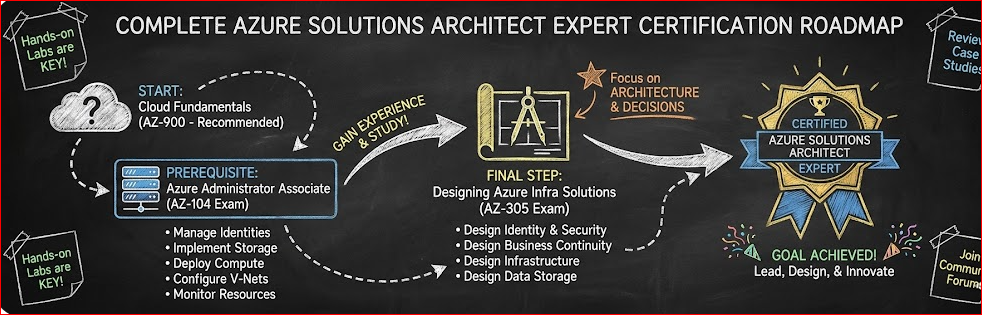
Azure Solutions Architect Expert is a powerful certification for engineers and managers who want to move from “doing tasks on Azure” to designing complete, production-ready cloud solutions. It focuses on real architecture decisions like identity and access, network boundaries, compute choices, storage and data design, monitoring strategy, and business continuity planning. If you are building platforms, leading cloud migrations, reviewing designs, or guiding teams, this certification helps you think and communicate like an architect. In this guide, you will learn the certification roadmap, the skills it proves, the projects to practice, and the best next steps to grow in DevOps, SRE, DevSecOps, AIOps/MLOps, DataOps, or FinOps roles.
Why Azure Solutions Architect Expert matters
Cloud projects fail more often because of poor design decisions than because of missing features. A good architecture prevents cost surprises, security gaps, scaling issues, and recovery failures. This certification trains you to design systems that are secure, reliable, scalable, and cost-aware—exactly what companies expect from senior engineers and technical leaders. It also improves your ability to communicate designs to teams, stakeholders, and leadership in a simple and structured way.
What “Azure Solutions Architect Expert” really means
An Azure Solutions Architect is expected to design the full system, not just one piece of it. You must understand identity, network, compute, storage, governance, monitoring, and business continuity as a connected story. In real work, people ask you to justify decisions: why this service, why this topology, why this failover plan, why this cost model. This certification validates that you can take requirements and build an architecture that is practical, secure, and ready for operations.
Who this guide is for
This guide is for working engineers who want to grow into architecture ownership and senior cloud roles. It also helps engineering managers who want to evaluate architecture proposals and reduce delivery risk. If you are a DevOps engineer, SRE, platform engineer, cloud engineer, security engineer, or data engineer, the architecture mindset will improve your day-to-day decision making. If you are earlier in your Azure journey, you can still use this guide by following the recommended sequence and building skills step-by-step.
What you will learn in this guide
You will learn what the certification is, who should take it, and which skills it proves. You will get a practical preparation plan in three timelines: 7–14 days, 30 days, and 60 days. You will also get a portfolio-style list of real projects so you can prove your skills beyond passing an exam. Finally, you will get “Choose your path” learning tracks and a role-to-certification mapping so you can plan your next certifications in a smart order.
Certification table
| Track | Level | Certification | Who it’s for | Prerequisites | Skills covered | Recommended order |
|---|---|---|---|---|---|---|
| Cloud Basics | Fundamental | Azure Fundamentals (AZ-900) | Beginners, managers, non-cloud engineers | None | Cloud concepts, pricing, governance basics | 1 |
| Azure Operations | Associate | Azure Administrator (AZ-104) | Cloud engineers, admins, ops | Basic Azure familiarity | Identity, compute, network, storage, monitoring | 2 |
| Architecture | Expert | Azure Solutions Architect Expert | Senior engineers, leads, architects | Strong admin fundamentals + hands-on recommended | End-to-end solution design: identity, network, compute, storage, BC/DR, governance | 3 |
| DevOps Platform | Expert | Azure DevOps Engineer Expert (AZ-400) | DevOps, platform engineers | Dev + ops understanding | CI/CD, IaC, release strategy, quality gates | Optional |
| Cloud Security | Associate | Azure Security Engineer (AZ-500) | Security engineers | Azure basics + security basics | Security controls, posture, identity protection | Optional |
| Data Platform | Associate | Azure Data Engineer (DP-203) | Data engineers | Data fundamentals + Azure basics | Pipelines, storage, processing, governance | Optional |
| Identity | Associate | Identity and Access (SC-300) | IAM engineers | Security fundamentals | Identity, access policies, conditional access | Optional |
| Network | Associate | Azure Network Engineer (AZ-700) | Network engineers | Networking fundamentals | Hybrid connectivity, routing, segmentation | Optional |
| Development | Associate | Azure Developer (AZ-204) | App engineers | Coding experience | App services, integration, deployment patterns | Optional |
Azure Solutions Architect Expert (consistent mini-sections)
What it is
Azure Solutions Architect Expert is an advanced certification focused on designing Azure solutions end-to-end. It validates how you select and combine services across identity, networking, compute, storage, governance, monitoring, and recovery. The main value is proving that you can design solutions that are safe, scalable, and production-ready.
Who should take it
This certification is ideal for cloud engineers who want to become solution designers and technical decision owners. It also fits DevOps and platform engineers who design landing zones, shared services, and platform standards. Security engineers benefit because modern cloud security is deeply tied to architecture decisions. Engineering managers can use it to improve architecture reviews, planning, and stakeholder communication.
Skills you’ll gain
- Designing identity and access patterns for teams, apps, and shared platforms
- Building governance guardrails through policies, standards, and resource structure
- Creating network architectures with secure boundaries and safe connectivity patterns
- Choosing compute approaches that match workload needs and operational realities
- Planning storage and data architecture for durability, performance, and access control
- Designing business continuity: backups, recovery targets, and failover strategy
- Creating monitoring and operational readiness plans so systems can be supported well
Real-world projects you should be able to do after it
- Design and document an enterprise landing zone with access model, policies, and shared logging
- Create a secure hub-and-spoke network design with clear segmentation and connectivity control
- Build a BC/DR plan with RPO/RTO goals, backup design, and restore testing checklist
- Design a scalable application platform with deployment plan, secrets handling, and monitoring strategy
- Produce a cost model with tagging rules, budget ownership, and monthly optimization tasks
- Write an architecture pack: diagrams, decision records, risks, and runbooks for operations
Preparation plan (7–14 days / 30 days / 60 days)
7–14 days (fast-track for experienced Azure engineers)
This track is best if you already deploy and operate Azure workloads regularly. Focus on scenario-based learning: read requirements, pick designs, and justify trade-offs. Do one complete reference architecture build in a lab so you connect services as a real system. Use mock tests and revise weak areas like governance, network design, and recovery planning until your decisions feel natural.
30 days (best for most working professionals)
This is a balanced plan for people managing work and study. Break learning into weekly themes: identity/governance, network, compute/app platform, storage/data, and BC/DR. Each week, build one small project and write a short design note that explains choices and trade-offs. In the final week, focus on scenario drills and revisiting weak topics with a checklist approach.
60 days (foundation + mastery)
This plan is best for beginners or those with limited hands-on exposure. Start by building admin confidence: subscriptions, identity, network, storage, and monitoring basics. Then move into architecture design projects where you document decisions and focus on operational readiness. By the end, you should have 2–3 strong portfolio projects you can explain clearly in interviews and design reviews.
Common mistakes
- Memorizing services without practicing design scenarios and trade-offs
- Ignoring governance and identity planning, then struggling with enterprise questions
- Designing only for performance while forgetting monitoring, operations, and runbooks
- Skipping BC/DR details like RPO/RTO and restore testing approach
- Overengineering with too many services when simpler architecture meets the goal
- Not documenting decisions, which weakens both exam confidence and interview clarity
Best next certification after this
Your best next step depends on your job direction. If you build delivery platforms, add the DevOps expert path so you can design and automate CI/CD at scale. If your role demands strong security posture, add a security certification and deepen identity skills. If you work heavily with pipelines and analytics, add a data engineering path. The best strategy is to specialize after you build strong architecture fundamentals.
Core architecture areas you must master
Identity, access, and governance
Most production issues start with access mistakes: wrong permissions, unclear ownership, or inconsistent controls across teams. As an architect, you must design a clear RBAC model, subscription structure, and policy-based guardrails. Governance also includes naming, tagging, and standardized deployment approaches so teams do not create chaos over time. When identity and governance are strong, scaling to many teams becomes safer and easier.
Networking and connectivity
Network architecture defines your security boundaries and how systems connect safely. You should be able to design segmentation, secure access paths, private connectivity patterns, and hybrid connectivity planning. Good network design prevents lateral movement risks, reduces exposure, and improves reliability. It also impacts performance and cost, so your design should always be justified using requirements and constraints.
Compute and application platform
Compute is not just choosing VMs versus containers. It is about lifecycle, scaling, maintenance, upgrades, and how teams deploy safely. Architects must plan for safe releases, rollback, secrets management, and integration patterns. The best designs reduce operational load and improve delivery speed without sacrificing stability. A strong platform design also makes onboarding new teams simpler.
Storage and data architecture
Storage choices shape performance, durability, cost, and security. Architects must select storage patterns that match workload needs and access boundaries. You should plan encryption, key handling, data lifecycle rules, and backup strategy for critical data. A good design avoids both data loss risk and surprise cloud bills. It also makes future migration and modernization easier.
Reliability and business continuity
Reliability is not luck; it is a design decision backed by targets and testing. You must define availability needs, RPO/RTO, and recovery approach that aligns with business expectations. Monitoring must be designed as part of architecture, not added later. Runbooks and recovery drills matter because real outages happen. The goal is to reduce downtime and recover quickly when failures occur.
Choose your path (6 learning paths)
DevOps path
This path is for engineers who want to design platforms that help teams ship faster and safer. Focus on landing zones, standardized environments, infrastructure-as-code patterns, and CI/CD design principles. Learn how to build release safety into architecture: controlled rollouts, rollback planning, and observability baselines. By the end, you should be able to design a full delivery platform blueprint that multiple teams can reuse.
DevSecOps path
This path is for engineers who want security embedded into architecture and delivery. Focus on identity design, least privilege access, network boundaries, secrets and keys, and compliance-friendly patterns. Learn how to include security scanning, policy checks, and audit-ready evidence into the deployment flow. By the end, you should be able to design secure architectures that reduce risk without slowing delivery.
SRE path
This path is for engineers focused on production reliability and operational excellence. Learn resilience patterns, failure modes, monitoring strategy, incident response readiness, and recovery planning. Practice turning architecture into runbooks and measurable reliability goals such as SLO-style thinking. By the end, you should be able to design systems that are easier to operate, easier to debug, and faster to recover.
AIOps/MLOps path
This path is for engineers who want to design AI and automation-ready operations and model workflows. Focus on designing data ingestion, training/inference workflows, monitoring, and cost control. Learn how to keep models reliable in production through monitoring for drift and performance issues. By the end, you should be able to propose a stable architecture for ML workloads and operational automation.
DataOps path
This path is for engineers building reliable data platforms with governance and quality. Focus on pipeline design, orchestration, data quality checkpoints, and change management practices. Learn how to design access boundaries and lineage-style thinking so teams understand impact when changes happen. By the end, you should be able to design data pipelines that are trusted, stable, and easy to support.
FinOps path
This path is for engineers and managers who want cost control built into architecture decisions. Focus on tagging standards, cost allocation, budgets, and measurable optimization routines. Learn how to compare architectures using cost, performance, and risk—not only technology preferences. By the end, you should be able to create a cost-aware architecture plan and a monthly optimization backlog that leadership can understand.
Role → Recommended certifications mapping
This mapping helps you avoid random learning and pick certifications that match your job responsibilities. The sequence is designed so you first build basics, then operations confidence, then architecture authority, and then specialization. If you skip a step, compensate by building strong hands-on projects and documentation. Use this to plan your next 6–12 months with a clear and realistic path.
| Role | Role-aligned certification sequence | Why this helps |
|---|---|---|
| DevOps Engineer | AZ-900 → AZ-104 → Azure Solutions Architect Expert → AZ-400 | Builds admin base, then design, then delivery automation expertise |
| SRE | AZ-900 → AZ-104 → Azure Solutions Architect Expert → AZ-700 (optional) | Strengthens reliability thinking plus network confidence |
| Platform Engineer | AZ-900 → AZ-104 → Azure Solutions Architect Expert → AZ-400 | Enables landing zones, guardrails, and platform product design |
| Cloud Engineer | AZ-900 → AZ-104 → Azure Solutions Architect Expert | Step-by-step growth from basics to architecture ownership |
| Security Engineer | AZ-900 → AZ-104 → AZ-500 → Azure Solutions Architect Expert | Builds security depth before architecture leadership |
| Data Engineer | AZ-900 → AZ-104 (or basics) → DP-203 → Azure Solutions Architect Expert | Strong data skills plus broad solution design ability |
| FinOps Practitioner | AZ-900 → AZ-104 → Azure Solutions Architect Expert | Improves cost-aware design decisions and governance thinking |
| Engineering Manager | AZ-900 → Azure Solutions Architect Expert (plus role add-ons) | Better architecture reviews, planning, and risk reduction |
Next certifications to take (3 options: same track, cross-track, leadership)
Same track option (go deeper in Azure architecture foundations)
If you feel gaps in operations, strengthen your Azure administration depth first. Add networking or identity specialization if your role requires hybrid connectivity or strict access control design. This path suits architects responsible for enterprise-scale environments where governance and boundaries matter most. The outcome is stronger architecture decisions and fewer design surprises during delivery.
Cross-track option (expand impact across teams)
If you build platforms and pipelines, add a DevOps expert path so you can design CI/CD and IaC at scale. If security posture is central to your work, add security and identity depth to support secure design reviews. If data workloads are core, add data engineering certification to strengthen data architecture decisions. This path increases your value because you can design across multiple domains, not only infrastructure.
Leadership option (architect → decision leader)
Leadership growth means you do not only design systems, you define standards and guide teams. Focus on architecture governance: decision records, design reviews, reference architectures, and guardrails. Add cost and risk thinking into every design conversation so leadership trusts your decisions. This path fits principal engineers, engineering managers, and consulting leads who must influence multiple teams.
Top institutions that help in Training cum Certifications
DevOpsSchool
DevOpsSchool is useful for professionals who want structured learning with real-world labs and job-focused outcomes. Their training approach typically supports consistent preparation, guided mentoring, and practical project alignment. This is helpful when you want both certification confidence and interview-ready architecture explanations. It also fits learners who prefer a clear roadmap instead of scattered learning.
Cotocus
Cotocus can be helpful if you prefer guided training that keeps you consistent while balancing a full-time job. Structured sessions and planned learning checkpoints help reduce confusion and reduce drop-offs. This style works well when you need discipline and mentor-style direction. It supports learners who want step-by-step progress rather than random resources.
ScmGalaxy
ScmGalaxy often fits learners who want practice-driven learning and structured modules. It can support building confidence through hands-on tasks that mirror real engineering scenarios. This approach is useful for professionals who learn best by doing and repeating. It also helps when you want consistent practice across multiple topics.
BestDevOps
BestDevOps is useful when you want training aligned with real DevOps and cloud responsibilities. This type of support helps you connect certification topics with day-to-day decision making and implementation. It suits learners who want practical guidance and role-based clarity. It can also help keep focus on outcomes rather than only theory.
devsecopsschool.com
This option is useful if your job involves audits, security reviews, or compliance-sensitive workloads. It supports security-by-design thinking, including access control, secure networking, and pipeline security habits. It pairs well with architecture learning because secure foundations are part of every serious cloud design. It fits roles where security and architecture overlap heavily.
sreschool.com
This option is helpful for professionals who want to strengthen reliability thinking and production readiness. It supports incident readiness, monitoring discipline, and resilience planning as practical habits. It complements architecture learning by focusing on how systems behave under failure and stress. It fits engineers who want stable platforms that are easy to operate.
aiopsschool.com
This option suits engineers who want smarter operations using automation and analytics thinking. It helps connect monitoring signals to automation workflows and operational improvements. This is useful if you want to reduce manual effort and improve proactive detection. It pairs well with architecture when you design for observability and automation from the start.
dataopsschool.com
This option is good for professionals building data pipelines that must be reliable and governed. It supports DataOps practices such as quality checks, pipeline stability, and safe change handling. It complements architecture by adding strong operational habits for data workloads. It is useful when your work impacts reporting, analytics, or business-critical datasets.
finopsschool.com
This option supports cost-aware cloud design and practical cost control routines. It helps with cost allocation thinking, tagging discipline, budget tracking, and optimization planning. It is useful when you must explain spend to leadership and reduce waste without reducing performance. It fits architects who want cost guardrails built into design decisions.
FAQs focused on difficulty, time, prerequisites, sequence, value, career outcomes
1) Is Azure Solutions Architect Expert difficult?
Yes, it is advanced because it tests decision making and trade-offs, not simple memory. If you practice scenarios and explain “why,” it becomes manageable. Most people struggle when they study services one-by-one instead of designing complete solutions. Strong hands-on practice makes it far easier.
2) How long does it take to prepare?
Many working professionals can prepare in about 30 days with consistent daily study and weekend labs. If you are new to Azure, 60 days is a safer plan. If you already design Azure systems daily, a 7–14 day fast-track can work. The key is steady practice, not long study sessions.
3) Do I need Azure Administrator skills first?
It is strongly recommended because architecture assumes you understand identity, networking, storage, and monitoring basics. If you skip admin fundamentals, scenario questions feel confusing. Admin skills also help you avoid unrealistic designs. A strong admin base makes architecture choices more practical.
4) What prerequisites do I need?
You need basic cloud concepts, networking fundamentals, and comfort with access control ideas. You should understand common patterns like environments, scaling, and monitoring. Most importantly, you need the habit of thinking in trade-offs: cost, security, performance, and reliability. That mindset is the real prerequisite.
5) What is the best certification sequence?
A safe sequence is Azure Fundamentals → Azure Administrator → Azure Solutions Architect Expert. After that, add specializations based on role: DevOps, security, network, or data. This sequence reduces gaps and saves time. It also improves your confidence as you progress.
6) Is this valuable for DevOps and platform engineers?
Yes, because platform engineering is architecture in real life. You design landing zones, guardrails, shared services, and operational standards. This certification improves how you justify designs and reduce platform risk. It also helps you lead design discussions across teams.
7) Is this valuable for SRE roles?
Yes, because reliability begins at design time. You learn continuity planning, resilience patterns, and monitoring strategy. This improves incident prevention and recovery planning. It also helps you negotiate reliability trade-offs with product teams.
8) What kind of job roles can I target after this?
You can target Solutions Architect, Cloud Architect, Platform Architect, Senior Cloud Engineer, and Cloud Lead roles. It also helps consulting and pre-sales roles where you must design solutions for clients. The best outcomes happen when you add portfolio projects and documentation. That proof converts certification into real hiring value.
9) What is the biggest reason people fail?
They memorize services but do not practice scenario decisions. They also ignore governance and identity because it feels “administrative.” Recovery planning and monitoring are often skipped, but they appear frequently in real architecture work. The solution is to study by end-to-end design cases.
10) Do I need coding skills?
Coding is not mandatory, but basic scripting and automation mindset helps. Architects must understand how teams will deploy and manage systems. Even simple infrastructure-as-code concepts improve your designs. It also supports DevOps and platform roles naturally.
11) How do I prove skills beyond passing?
Build 2–3 end-to-end projects and document them. Include diagrams, key decisions, security controls, and cost notes. Add runbooks and recovery plans to show operational maturity. This makes your resume and interviews much stronger.
12) What should my portfolio look like?
A strong portfolio includes a landing zone design, a scalable app platform design, and a BC/DR plan. Add a monitoring plan and cost model so your design looks complete. Keep documentation simple, clear, and practical. Hiring teams love clear architecture thinking.
FAQs on Azure Solutions Architect Expert
Q1) Can I prepare while working full-time?
Yes, if you follow a daily 60–90 minute plan and do labs on weekends. Consistency beats long study hours. Keep short notes of decisions to sharpen scenario thinking. This approach fits most working professionals.
Q2) What study style works best?
Scenario-first study works best: requirement → constraints → design → justification. After each topic, write simple reasons for your choices. This builds exam confidence and interview clarity together. It also helps you remember patterns naturally.
Q3) How important is networking?
Very important, because network design defines security boundaries and connectivity. Many architecture decisions depend on segmentation and access patterns. Weak networking creates weak architecture. Spend extra time here if it is not your strength.
Q4) How important is governance?
Governance is a major part of enterprise architecture. It ensures teams follow standards, policies, and ownership models. Without governance, cloud environments become messy and risky. Strong governance makes scaling safe.
Q5) What kind of projects help most?
Projects that connect multiple areas help most: identity + network + app + monitoring + recovery. A landing zone plus a small platform design is a strong pair. Add a DR plan and cost model to show maturity. Document decisions to make it interview-ready.
Q6) What should I avoid?
Avoid random resource hopping and unclear study plans. Avoid memorizing services without building designs. Avoid skipping BC/DR and monitoring because they feel boring. These areas often decide pass vs fail.
Q7) What makes this certification stand out?
It signals that you can design systems, not only deploy them. It helps you lead discussions on risk, cost, and reliability. Recruiters value candidates who explain design trade-offs clearly. Add a portfolio project and it becomes even stronger.
Q8) What should I do right after passing?
Pick a specialization path based on your job goals. Keep building projects and improve your design review and documentation habits. Try to lead small architecture decisions in your current role. That is how you turn certification into leadership growth.
Testimonials
Rohit
“This helped me think in trade-offs instead of only service features.”
“My interviews improved because I could explain why my design was safe and practical.”
“The biggest change was writing decisions clearly, not just building things.”
“Now I lead design discussions instead of waiting for instructions.”
Neha
“I stopped memorizing and started practicing real design scenarios.”
“That made preparation more practical and less stressful.”
“My confidence grew after building small projects and documenting choices.”
“I feel ready for senior cloud responsibilities now.”
Aman
“My landing zone project gave me strong architecture confidence.”
“I could explain governance, networking, and security decisions clearly.”
“It improved how I communicate with managers and stakeholders.”
“I now design with operations and recovery in mind.”
Conclusion
Azure Solutions Architect Expert is a strong milestone for professionals who want to shift from implementation work to design ownership. It trains you to think in real-world constraints: security needs, cost limits, scaling requirements, and operational realities. If you follow a structured plan, practice scenario decisions, and build a small portfolio of end-to-end projects, you gain long-term value beyond the certification badge. Start with one full reference design, write simple decision notes, and then choose your path—DevOps, DevSecOps, SRE, AIOps/MLOps, DataOps, or FinOps—based on where you want to grow next.
