Introduction
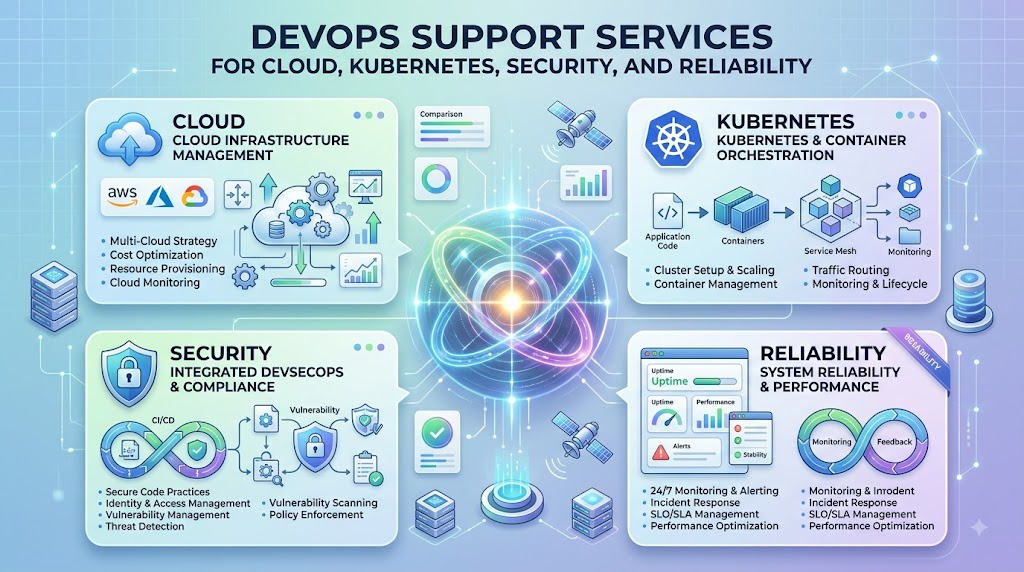
Modern software teams are expected to release applications quickly while keeping production environments stable, secure, and available. That combination is not always easy to maintain. A deployment can fail because of a configuration change, a cloud resource can become overloaded, a Kubernetes workload can behave unexpectedly, or an alert can expose a problem that monitoring did not previously detect. As infrastructure grows, these responsibilities also become harder to manage with a small internal team. Engineers may spend significant time troubleshooting production issues, maintaining CI/CD pipelines, reviewing infrastructure changes, managing cloud resources, responding to alerts, and handling security-related tasks instead of focusing on product development. This is where DevOps Support Services can become useful. Ongoing support provides a structured way to manage recurring infrastructure and delivery responsibilities while helping internal engineering teams deal with operational issues. Depending on organizational needs, support can include cloud operations, automation, monitoring, incident response, Kubernetes administration, security practices, and reliability engineering.
What Are DevOps Support Services?
DevOps support refers to ongoing technical assistance for the systems and processes used to build, deploy, monitor, secure, and operate applications.
A one-time DevOps implementation might establish a CI/CD pipeline, infrastructure-as-code setup, container platform, or monitoring solution. However, production environments continue to change after implementation. Applications receive new releases, infrastructure grows, dependencies are updated, and operational problems appear.
Ongoing support addresses these recurring needs.
Typical responsibilities can include:
- Infrastructure administration and troubleshooting
- CI/CD pipeline maintenance
- Deployment assistance
- Cloud operations
- Monitoring and alert management
- Incident response
- Infrastructure as Code maintenance
- Production troubleshooting
- Automation
- Performance optimization
- Configuration management
The exact scope depends on the organization. Some teams may need help only with specific platforms, while others may require broader operational coverage.
Why Organizations Need Ongoing DevOps Support
Production infrastructure is not a static environment. Even a well-designed system requires regular maintenance and operational decisions.
Cloud resources may need to be adjusted as workloads change. Security patches and dependency updates need attention. Monitoring rules can become outdated. New services may introduce additional deployment requirements. Configuration drift can also appear when infrastructure is changed manually.
Internal teams can manage these responsibilities, but operational work can compete with application development and strategic engineering projects.
External support can complement an internal team by providing additional operational capacity or specialized expertise. The goal does not necessarily have to be replacing internal engineers. Instead, responsibilities can be divided according to skills and priorities.
For example, an internal platform team might own architecture and engineering standards while a support team handles recurring monitoring, deployment assistance, troubleshooting, and operational maintenance.
24/7 DevOps Support Services
Organizations running customer-facing applications across multiple regions or time zones may need operational coverage beyond normal working hours.
24/7 DevOps Support Services can involve continuous monitoring, alert handling, production troubleshooting, escalation, deployment assistance, and emergency operational response.
A practical 24/7 model should include clearly defined escalation paths. An alert should not simply reach an engineer without context. Teams need documented procedures that explain severity levels, ownership, escalation contacts, and the information required for investigation.
Round-the-clock support is particularly relevant when a production issue outside business hours could affect customers, revenue-generating systems, internal operations, or critical workloads.
However, 24/7 coverage should not be confused with guaranteed uptime or guaranteed incident resolution. Effective support depends on monitoring quality, system architecture, documentation, access, escalation processes, and the complexity of the incident.
Managed DevOps Services
Managed DevOps Services involve assigning recurring DevOps and infrastructure responsibilities to an external technical team under an agreed operating model.
Instead of engaging external engineers only for occasional consulting projects, organizations can use managed support for continuous operational activities.
These activities may include:
- CI/CD management
- Infrastructure automation
- Cloud administration
- Monitoring
- Release management
- Configuration management
- Backup-related operations
- Security activities
- Infrastructure maintenance
- Production support
Managed services can be useful for companies that have limited internal DevOps capacity or want their engineers to focus more heavily on product development and architecture.
They are not always the right choice. Organizations with mature platform teams and sufficient operational capacity may prefer to keep most responsibilities internally. The decision should consider technical maturity, workload, risk, internal expertise, and the level of operational coverage required.
Kubernetes Support Services
Kubernetes provides a powerful platform for running containerized applications, but operating Kubernetes in production requires more than deploying containers.
Kubernetes Support Services can cover cluster administration, workload management, scaling, networking, monitoring, security, troubleshooting, upgrades, and resource management.
A Kubernetes environment may involve multiple namespaces, deployments, services, ingress configurations, persistent storage, policies, and observability components. Small configuration problems can sometimes create difficult operational issues.
Support teams may help investigate failed deployments, resource pressure, networking problems, unhealthy workloads, or upgrade-related concerns.
Kubernetes support can apply to managed environments such as AWS EKS, Azure AKS, and Google GKE, as well as other Kubernetes deployments.
The objective should not simply be keeping clusters running. Teams should also maintain appropriate resource allocation, security controls, monitoring, documentation, and upgrade practices.
AWS DevOps Support Services
AWS environments often combine several infrastructure and application services. Depending on workload requirements, an organization might use EC2 for compute, EKS or ECS for containers, Lambda for serverless workloads, and infrastructure automation through Terraform or CloudFormation.
AWS DevOps Support Services can help teams manage these environments and their associated deployment processes.
Typical responsibilities may include:
- AWS infrastructure administration
- EKS and ECS operations
- EC2 management
- Lambda deployment support
- Terraform or CloudFormation maintenance
- CI/CD pipeline operations
- Monitoring
- Cloud configuration
- Deployment management
There is no universal AWS architecture that fits every organization. Service selection should depend on application architecture, workload characteristics, operational requirements, security considerations, and team expertise.
Good support therefore involves understanding why a service is being used rather than simply managing the service itself.
Azure DevOps Support Services
Organizations using Microsoft Azure may have similar operational requirements around infrastructure, CI/CD, containers, monitoring, and production environments.
Azure DevOps Support Services can assist with Azure Pipelines, AKS, Azure infrastructure, deployment automation, release management, monitoring, and recurring production operations.
Azure environments can evolve quickly as applications, resources, and teams grow. Consistent configuration and automation become increasingly important when multiple environments are involved.
Support can help maintain repeatable deployment processes, investigate pipeline failures, monitor production systems, and assist with infrastructure changes.
As with AWS, Azure support should be based on actual workload requirements rather than automatically selecting a particular architecture or service.
DevSecOps Support Services
Security should be part of the software delivery lifecycle rather than something performed only immediately before production release.
DevSecOps Support Services can help integrate security activities into development, CI/CD, infrastructure, and production operations.
Common practices include:
- Static Application Security Testing (SAST)
- Dynamic Application Security Testing (DAST)
- Dependency scanning
- Container security
- Secrets management
- Vulnerability management
- Security automation
- Secure CI/CD practices
- Compliance-related controls
The purpose is to identify and address security risks earlier and more consistently.
For example, dependency scanning can identify vulnerable libraries, while container scanning can help detect security issues in images before they are deployed. Secrets management reduces the risk of sensitive credentials being stored improperly in source code or configuration.
Security processes should be designed around the organization’s applications, infrastructure, regulatory requirements, and risk profile.
SRE Support Services
Site Reliability Engineering focuses on applying engineering principles to production reliability.
SRE Support Services can include observability, incident management, reliability automation, capacity planning, performance engineering, and root-cause analysis.
Important concepts include:
- SLI: A measurement of a service characteristic such as latency or availability.
- SLO: A target level for an SLI.
- SLA: A formal service commitment that may include defined responsibilities or remedies.
- Error budget: A way of balancing reliability objectives with the pace of software changes.
SRE practices help teams move beyond reacting to incidents. By studying recurring failures, teams can identify architectural weaknesses, capacity problems, poor alerting, or operational processes that need improvement.
The broader goal is to create systems that are easier to operate and recover.
MLOps Support Services
Machine-learning systems introduce operational requirements that continue after model development is complete.
MLOps Support Services can assist with model deployment, ML infrastructure, pipelines, monitoring, version management, production environments, scalability, and resource management.
A model that performs well during development still needs reliable deployment and monitoring in production. Data can change, infrastructure requirements can increase, and different model versions may need to be managed.
MLOps connects machine-learning development with production engineering practices. Automation can help standardize model delivery, while monitoring can provide visibility into the operational behavior of deployed ML systems.
The exact support model depends on the organization’s ML architecture, data workflows, infrastructure, and production requirements.
DevOps Support Technology Areas
| Area | Common Technologies / Practices | Primary Purpose |
|---|---|---|
| CI/CD | Jenkins, GitHub Actions, GitLab CI/CD, Azure Pipelines | Automated delivery |
| Cloud | AWS, Azure, Google Cloud | Infrastructure operations |
| Containers | Docker, Kubernetes | Application consistency |
| Infrastructure as Code | Terraform, CloudFormation | Repeatable infrastructure |
| Monitoring | Metrics, logs, traces | Operational visibility |
| Security | SAST, DAST, secrets management | Secure delivery |
| SRE | SLI, SLO, error budgets | Reliability |
| MLOps | ML pipelines, model monitoring | Production ML operations |
These are examples rather than an exhaustive technology list. Organizations can choose different tools depending on their architecture, existing investments, technical skills, and operational goals.
Benefits of Continuous DevOps Support
Continuous support can provide several practical operational benefits.
Faster troubleshooting: Experienced operational processes can help teams investigate incidents more systematically.
Less manual work: Automation can reduce repetitive deployment, infrastructure, and configuration tasks.
Better visibility: Consistent monitoring and logging provide engineers with better information about system behavior.
More consistent deployments: Standardized pipelines reduce variations between release processes.
Improved incident response: Defined escalation and investigation procedures make production response more organized.
Stronger security practices: Integrating security into delivery and infrastructure processes helps teams address risks continuously.
Better cloud operations: Regular review of infrastructure configurations can help teams manage changing environments more effectively.
These benefits depend on implementation quality. Support does not automatically solve operational problems without appropriate documentation, access, monitoring, communication, and ownership.
Common DevOps Support Challenges
- Poor documentation: If systems are not documented, troubleshooting can depend heavily on individual knowledge.
- Unclear ownership: Teams need to know who is responsible for infrastructure, applications, pipelines, and incidents.
- Weak escalation procedures: Critical alerts require clear escalation paths and severity definitions.
- Limited observability: Without useful metrics, logs, and traces, identifying production problems becomes harder.
- Excessive manual work: Repetitive operational tasks increase the chance of human error.
- Inconsistent configurations: Differences between environments can create deployment and troubleshooting problems.
- Poor communication: Internal and external teams need clear channels for incidents, changes, and decisions.
- Lack of knowledge transfer: Organizations can become dependent on individuals when operational knowledge is not documented and shared.
- Overdependence on external teams: External support should complement internal capability rather than create a permanent knowledge gap.
- Weak security processes: Security responsibilities need clear ownership across development, infrastructure, and operations.
How to Choose a DevOps Support Company
Choosing a provider should involve more than comparing service descriptions or pricing.
Consider the following areas:
- Technical expertise across your infrastructure
- AWS, Azure, or other relevant cloud experience
- Kubernetes knowledge
- Security capabilities
- SRE understanding
- MLOps knowledge where applicable
- Monitoring and observability practices
- Incident response procedures
- Documentation standards
- Communication processes
- Support coverage
- Escalation model
- SLA structure
- Knowledge-transfer practices
- Security controls
- Compatibility with internal engineering teams
Ask how incidents are handled, how changes are documented, what information is required during onboarding, and how knowledge is transferred back to the internal team.
A good support relationship should make operational responsibilities clearer, not create another layer of uncertainty.
DevOps Support Area and Business Need
| Support Area | Typical Business Need |
| DevOps Support | Ongoing infrastructure and delivery assistance |
| 24/7 DevOps Support | Continuous operational monitoring and incident response |
| Managed DevOps | Reduce recurring operational workload |
| Kubernetes Support | Manage containerized production environments |
| AWS DevOps Support | Support AWS infrastructure and deployments |
| Azure DevOps Support | Manage Azure-based DevOps operations |
| DevSecOps Support | Integrate security into delivery and operations |
| SRE Support | Improve reliability and operational practices |
| MLOps Support | Operate ML systems in production |
Frequently Asked Questions
1. What are DevOps Support Services?
DevOps Support Services provide ongoing technical assistance for infrastructure, CI/CD, cloud operations, monitoring, automation, troubleshooting, deployments, and production environments.
2. Why do companies need ongoing DevOps support?
Production systems continuously change. Ongoing support helps organizations handle infrastructure changes, incidents, deployments, monitoring, security updates, and operational workloads.
3. What do 24/7 DevOps Support Services include?
They can include continuous monitoring, alert handling, incident response, troubleshooting, deployment assistance, escalation, and operational support outside normal working hours.
4. What is the difference between managed DevOps and DevOps support?
DevOps support can cover specific operational requirements, while managed DevOps generally involves assigning broader recurring DevOps responsibilities to an external team.
5. When is Kubernetes support useful?
Kubernetes support is useful when teams operate production clusters and need assistance with administration, scaling, networking, monitoring, security, upgrades, or troubleshooting.
6. What does AWS DevOps support involve?
It can involve AWS infrastructure, EC2, EKS, ECS, Lambda, Terraform, CloudFormation, CI/CD, monitoring, automation, and deployment operations.
7. How does DevSecOps support improve security?
It integrates security practices such as code scanning, dependency checks, container security, secrets management, and vulnerability management into the software delivery lifecycle.
8. What is the role of SRE and MLOps support?
SRE support focuses on reliability, observability, incident management, and capacity planning. MLOps support focuses on operating machine-learning infrastructure, pipelines, deployments, monitoring, and model-related production workflows.
Conclusion
Modern DevOps operations involve much more than creating a deployment pipeline. Cloud infrastructure, containers, automation, monitoring, security, reliability, and production support all need to work together. As environments grow, recurring operational responsibilities can become difficult for small or highly focused engineering teams to manage alone. A suitable support model can provide additional operational capacity while allowing internal engineers to remain focused on architecture, product development, and strategic improvements. The appropriate model may range from targeted technical support to broader managed operations or specialized assistance for Kubernetes, cloud, security, SRE, or MLOps environments. Organizations should evaluate their actual requirements before selecting a support approach. Infrastructure complexity, technical maturity, security needs, internal expertise, application criticality, operational coverage, and long-term goals should all influence the decision.
