Introduction
Humans can look at a photograph of a dog playing in a park and instantly know exactly what is happening. It takes our brains zero effort to recognize the puppy, the green grass, and the blue sky. We do not even have to think about it. But teaching a machine, which is essentially just pieces of plastic, metal, and wire, to “see” and understand the physical world is one of the greatest achievements in modern technology.
For decades, computers were completely blind. They were great at storing thousands of digital photos, but they had absolutely no idea what was actually inside those pictures. A computer could hold a picture of your family or a picture of a brick wall, and to the machine, they were exactly the same. Today, thanks to incredible leaps in software and artificial intelligence, that has changed completely. If you want to explore more about this fascinating shift and how machines are becoming smarter, you can check out Aiuniverse .
Right now, your smartphone can look at a picture in your gallery and automatically organize it by the people in it, or even identify the breed of your pet. Self-driving cars use cameras to stop at red lights, and social media apps automatically tag your friends. This amazing process is called image classification. In this guide, we are going to explore exactly how computers learned this incredible trick, and we will do it without using any complicated math or confusing computer science terms.
How Computers Actually “See” a Photograph
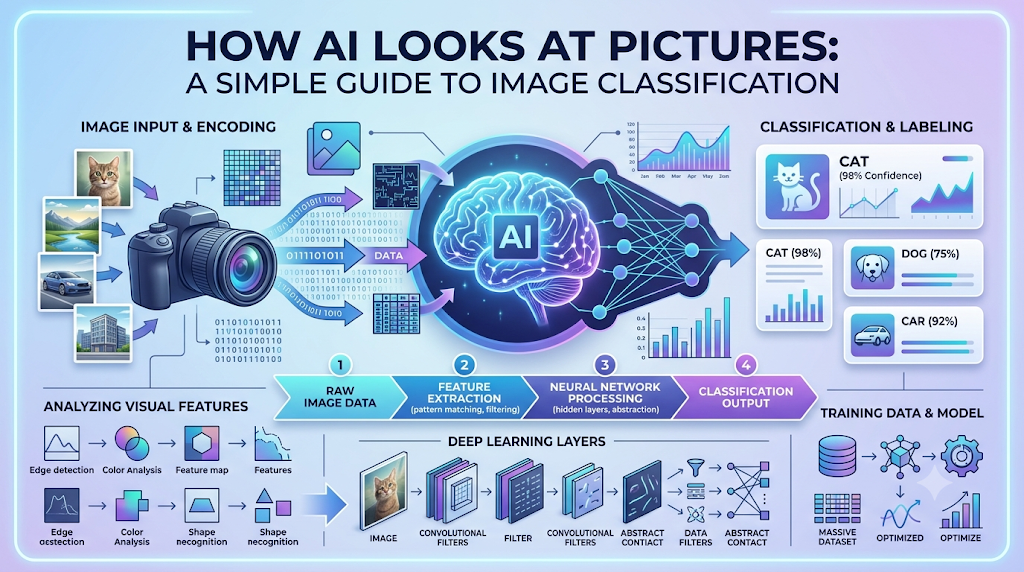
The biggest difference between you and a computer is that you have eyes and a living brain, while a computer only understands numbers. When you look at a photograph of a beautiful sunset, you see bright orange clouds, a glowing yellow sun, and a dark blue ocean. The computer does not see a sunset. It just sees a massive, flat grid of tiny square dots called pixels.
Imagine a giant spreadsheet on your computer screen. Instead of words or financial data in those little boxes, imagine every single box is filled with a specific number. That number represents an exact color code. To an artificial intelligence program, a highly detailed, colorful photograph is nothing more than millions of these numbers stacked tightly together in a giant mathematical puzzle.
Because the computer only sees this massive wall of numbers, it has a very hard time figuring out where one object ends and another object begins. If a cat is standing in front of a gray couch, human eyes easily separate the animal from the furniture. The computer, however, just sees a block of number codes shifting slightly from one shade to another. It has to learn how to read those numbers and figure out that a specific group of color codes actually forms the shape of a cat’s ear.
To solve this massive problem, programmers had to stop trying to write rigid, step-by-step instructions. You cannot write a simple rule that says “if you see brown numbers, it is a dog,” because brown numbers could also be a desk, a tree, or a chocolate cake. Instead, scientists had to build a smart system that could look at the raw numbers, find visual patterns on its own, and teach itself how to recognize shapes over time.
The Magic of Neural Networks
To teach computers how to recognize these complex patterns of numbers, scientists built a specialized system called a Convolutional Neural Network. That term sounds incredibly intimidating, but you can think of it just like a series of layered magnifying glasses that zoom in on different parts of a picture to figure out what it is looking at.
Feeding Data to the AI
Before an artificial intelligence can successfully recognize a picture of a bicycle, it needs to know what a bicycle looks like. But showing the machine just one picture is never enough. Programmers have to show the AI millions of different pictures of bicycles. They show it red bikes, blue bikes, bikes in the rain, bikes missing a wheel, and bikes parked in the mud. As the computer looks at all this visual data, it slowly starts to figure out the common visual features that make a bicycle different from a motorcycle or a car.
Looking for Patterns (Edges and Shapes)
This is where our magnifying glasses come into play. When the AI first looks at a brand-new photograph, the first “magnifying glass” layer scans the image just looking for simple, straight lines, curves, and basic edges. Once it finds those rough edges, it passes the information to the second magnifying glass. This deeper layer looks for simple shapes, like circles or squares. The next layer might notice that two circles are connected by a metal frame. Step by step, layer by layer, the AI builds a clearer understanding of the physical shapes hidden inside the numbers.
Making the Final Guess
After all those layers of magnifying glasses have done their hard work, the AI puts all the visual clues together. It looks at the gathered data and says, “I see two circular shapes, a thin metal frame, and a seat on top. Based on all the millions of pictures I have studied in the past, I am 95% sure this object is a bicycle.” The AI makes an educated guess. If it is right, it remembers that successful pattern for next time. If it is wrong, it adjusts its internal math and tries to do better on the next try. It literally learns from its mistakes, getting smarter with every single photo.
Comparing Human Vision vs. AI Vision
| Feature | Human Vision | AI Vision |
|---|---|---|
| Speed of Learning | Extremely fast. A toddler only needs to see an elephant once to remember it forever. | Very slow to start. An AI needs to analyze millions of photos before it can learn what an elephant is. |
| Ability to Handle Billions of Photos | Very poor. Humans get tired, bored, and lose focus after looking at a few hundred pictures. | Exceptional. An AI can scan and categorize a million photos in a few minutes without ever getting tired. |
| Vulnerability to Optical Illusions | Easily tricked by clever shadows, forced perspective, and traditional optical illusions. | Ignores optical illusions, but gets easily confused if a few random number pixels are secretly changed. |
As you can see from the comparison table above, humans and artificial intelligence have very different strengths and weaknesses when it comes to looking at the world. We learn incredibly fast from very little information. A young child does not need to study ten thousand pictures of a school bus to understand what it is; one quick look on the street is usually enough. An AI, on the other hand, needs endless mountains of data before it feels confident making a guess.
However, once the AI is fully trained and ready, it can do things that human beings simply cannot match. If you ask a person to look at a million photographs from nature cameras and sort them by the type of birds in the background, it would take them months or even years to finish the project. A well-trained AI can sort those exact same million photos over a coffee break, and its accuracy will not drop at the end of the day.
Interestingly, both systems get confused, but by completely different things. Humans are easily tricked by classic optical illusions or clever tricks of the light that mess with our depth perception. An AI will completely ignore a traditional optical illusion. Yet, if a hacker slightly alters a few random color pixels in an image—so slightly that a human wouldn’t even notice—the AI might completely panic, mistaking a picture of a cute turtle for a picture of a dangerous weapon just because the underlying math was shifted.
Real-World Scenario: Saving Lives with Medical AI
To understand just how powerful image classification has become, we do not need to look at science fiction movies. It is already happening right now in local hospitals and clinics around the world. Every single day, busy doctors and radiologists have to look at hundreds of X-rays, MRI scans, and CT scans to find signs of illness in patients. This is highly stressful, exhausting work, and human eyes can naturally get tired at the end of a long twelve-hour shift.
This is where artificial intelligence steps in to help. Hospitals are now using AI systems that have previously studied millions of healthy and unhealthy lung X-rays. When a new patient comes into the emergency room, the AI scans their fresh X-ray in a fraction of a second. Because the computer is so good at looking at the tiny numbers and pixel codes, it can spot microscopic shadows or tiny signs of disease that are currently completely invisible to the naked human eye.
The artificial intelligence does not replace the human doctor. Instead, it acts like a highly advanced, tireless assistant. If the AI sees something suspicious in the corner of a lung scan, it highlights that specific area on the computer screen and tells the doctor, “You should take a much closer look right here.” This incredible partnership between human medical experience and machine precision means that dangerous illnesses can be caught months earlier than they used to be.
By catching these medical problems early, life-saving treatments can start sooner, which ultimately saves countless lives. This incredible medical breakthrough is entirely possible simply because software engineers figured out how to teach a computer to look at a grid of pixels representing a lung, and classify what is perfectly normal versus what is potentially dangerous.
The Future: What Will AI See Next?
We are only at the very beginning of what this technology can truly do. As computers become faster and digital cameras get sharper, image classification is going to expand into almost every part of our daily lives. One of the biggest leaps will be in how we grow our food and manage farming. Imagine solar-powered drones flying over giant farm fields, instantly scanning every single leaf and stem below them.
Using image classification, these farming drones will be able to spot exactly which plants are sick, which ones need more water, and which ones are perfectly ripe and ready to be harvested. Instead of spraying harsh chemicals over an entire fifty-acre field, farmers will know exactly which specific plants need attention. This will save money, protect the natural environment, and help grow significantly more food for the world’s growing population.
We will also see massive improvements in household and industrial robotics. Right now, robots are very clumsy when it comes to picking things up or moving around cluttered bedrooms. As their ability to classify images improves, a helpful robot will be able to look at a messy kitchen, instantly recognize a fragile glass cup versus a heavy, solid metal pan, and know exactly how hard to grip each object without breaking it.
Even the wearable technology of the future, like augmented reality glasses, will rely heavily on this. As you walk down a busy street in a foreign country, your glasses will instantly recognize the monuments, restaurant signs, and foreign text around you, translating the visual world into helpful, understandable information in real-time. The ability to teach machines how to clearly see and label the world is truly opening up a brand-new era of human technology.
Conclusion
Teaching a computer to see was never about giving it a pair of eyes; it was about teaching a machine to understand the language of light and pixels. What started as a confusing grid of mathematical numbers has transformed into an intelligent system that can recognize human faces, drive cars, and even detect terrible diseases before they spread.
By using neural networks that act like layers of magnifying glasses, artificial intelligence has learned to spot patterns, shapes, and objects with incredible speed and accuracy. While machines may never experience the emotional beauty of watching a real sunset, their ability to classify what is inside a picture is fundamentally changing our world for the better. As cameras get better and computers get smarter, the future of artificial vision is looking incredibly bright.
FAQs
1. What exactly is image classification?
Image classification is a technology that allows a computer to look at a digital picture and automatically figure out what is inside it, like telling the difference between a cat and a dog.
2. How does a computer see a photograph?
Computers do not have eyes. They see a photograph as a giant, flat grid of tiny dots called pixels, where every single dot is represented by a specific number or color code.
3. What is a pixel?
A pixel is the smallest building block of a digital image. If you zoom into a photograph far enough, you will see that the picture is actually made of thousands of tiny colored squares, which are the pixels.
4. Why is it hard for computers to recognize objects?
It is hard because computers only see math. While a human sees a distinct shape, a computer just sees a massive wall of shifting numbers, making it difficult to know where one object ends and another begins.
5. What is a neural network?
A neural network is a specialized type of computer program inspired by the human brain. It helps the computer recognize patterns in data, allowing it to learn from mistakes and get smarter over time.
6. Do computers learn the same way humans do?
No, they learn very differently. A human can learn what an object is after seeing it just once, while a computer needs to study thousands or millions of examples before it understands.
7. Can an AI recognize things faster than a person?
Yes. Once an AI is fully trained on how to recognize an object, it can scan and sort millions of photographs in just a few minutes, which would take a human being years to do.
8. Is AI used in hospitals today?
Yes, it is very common. Hospitals use image classification AI to scan X-rays and MRI images to help human doctors spot tiny, hard-to-see signs of illness much earlier.
9. Can optical illusions trick an artificial intelligence?
Traditional optical illusions that trick human eyes usually do not fool an AI. However, an AI can be easily confused if a hacker secretly changes a few hidden pixels in the picture.
10. How will image classification help farming in the future?
In the future, drones flying over farms will use this technology to scan crops, instantly recognizing which specific plants are sick, need water, or are ready to be picked.
