Shipping code fast is only half the job in modern software engineering. Keeping that code running reliably, securely, and cost-effectively in production is where real operational discipline begins. Many teams build great features in staging environments only to hit outages, alert fatigue, or runaway cloud bills once real traffic arrives.
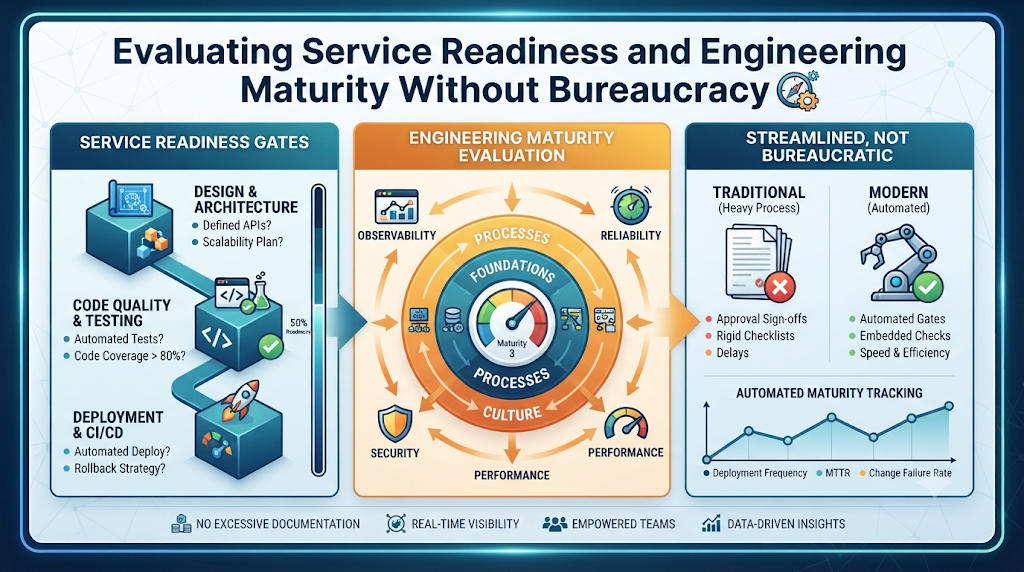
A production readiness assessment helps engineering teams check whether a service, platform, or workflow is truly ready to handle real-world load before or after launch. Rather than relying on guesswork or tribal knowledge, it gives teams a clear view of operational gaps across reliability, security, observability, and cost.
This guide explains how engineering organizations evaluate operational maturity, prepare workloads for production, and turn findings into practical roadmaps. Whether you are a DevOps engineer, Site Reliability Engineer (SRE), platform engineer, or engineering leader, you will find clear steps, real-world examples, and measurement habits you can apply right away. For structured assessments, checklists, and roadmaps tailored to engineering teams, explore OpsRoadmaps.
Understanding Production Readiness and Operational Maturity
At its simplest, production readiness means a software system and the team supporting it can operate safely, predictably, and recoverably in live traffic. Good code alone does not guarantee readiness. A service also needs clear ownership, tested rollback paths, alerts that wake humans only when action is required, and defined cost boundaries.
Related practices fit together like pieces of a larger operational system:
- DevOps aligns software development and IT operations around shared ownership, fast feedback, and automated delivery pipelines.
- Site Reliability Engineering (SRE) applies software engineering principles to infrastructure operations, using Service Level Indicators (SLIs), Service Level Objectives (SLOs), and error budgets to balance speed and reliability.
- Platform Engineering builds internal developer platforms and “golden paths” so product teams can provision infrastructure and deploy services safely without reinventing operational plumbing.
- Maturity Models describe how consistently an organization performs a discipline over time—ranging from ad-hoc manual habits to repeatable, measurable, and continuously improved workflows.
Important Distinction: A maturity score or readiness review measures capability and preparedness—not a guarantee of zero outages or formal compliance certification. Self-assessed maturity must always be paired with real production evidence, such as incident history, drill results, and telemetry.
Why Engineering Teams Need Structured Assessments
As systems grow from a single monolith to distributed microservices, Kubernetes clusters, and cloud-native pipelines, manual checklists stop scaling. One team might configure health checks and alerts carefully, while another skips load testing or leaves overly broad IAM permissions in place.
Structured evaluation solves several common problems:
- Hidden Operational Blind Spots: Teams often discover missing timeouts, unmonitored queues, or weak backups during an incident rather than before launch.
- Unclear Ownership: When nobody knows who owns on-call escalation, runbooks, or cloud cost overruns, small issues linger.
- Disconnected Roadmaps: Without a shared baseline, engineering leaders may fund flashy new tools while ignoring basic reliability or security gaps.
Beginners benefit from seeing how operational pieces connect, intermediate engineers gain concrete standards to follow, and technical leaders get objective evidence to prioritize engineering investments.
Step-by-Step Implementation Workflow
Rolling out a production readiness assessment works best as an iterative engineering habit rather than a one-time bureaucratic gate.
1. Define Scope and Risk Tier
Start by identifying the service, cluster, or workflow under review. A low-traffic internal tool needs lighter guardrails than a payment or authentication service. Group systems by business impact so effort matches risk.
2. Establish Baseline Criteria
Pick clear, observable criteria across reliability, deployment safety, security, observability, and cost. Keep questions specific—ask whether a service has automated rollbacks and tested alerts rather than asking vague “is it reliable?” questions.
3. Gather Evidence from Live Systems
Pair team input with factual proof: deployment histories, alert rules, runbook links, Kubernetes manifests, and cloud billing tags. Evidence prevents wishful thinking.
4. Score Gaps and Prioritize by Risk
Identify where current practices fall short of your target state. Rank fixes by a mix of customer risk, outage likelihood, and implementation effort so teams tackle high-impact items first.
5. Build an Actionable Improvement Roadmap
Turn top gaps into concrete tickets with owners and target timelines. Tie improvements to real milestones—such as pre-launch gates, quarterly reliability goals, or platform upgrades.
6. Reassess and Refine Continuously
Systems change as traffic grows and architectures evolve. Revisit assessments after major incidents, architecture migrations, or quarterly planning cycles.
Core Operational Disciplines Across the Lifecycle
Engineering maturity spans multiple practices. Rather than treating each topic in isolation, strong teams connect them across build, deploy, run, and optimize stages.
DevOps Maturity Assessment
A DevOps maturity assessment looks at how reliably and safely teams build, test, and ship software. Key areas include version control discipline, automated CI/CD (Continuous Integration / Continuous Delivery) pipelines, automated testing, progressive delivery (such as canary or blue-green deployments), and fast rollback mechanisms. High maturity means small, frequent changes move smoothly with low human toil.
Kubernetes Production Readiness Checklist
Running containers in production requires careful cluster and workload configuration. A practical Kubernetes production readiness checklist typically verifies:
- Resource Requests and Limits: CPU and memory requests are set accurately so the scheduler places pods fairly without starving neighbors.
- Health Probes: Liveness and readiness probes are tuned so traffic only routes to healthy pods and stuck containers restart cleanly.
- High Availability and Scaling: Multiple replicas, PodDisruptionBudgets, and HorizontalPodAutoscalers prevent single-pod outages during node drains or traffic spikes.
- Security and Network Controls: Least-privilege RBAC (Role-Based Access Control), non-root containers, read-only root filesystems where possible, and NetworkPolicies limit blast radius.
YAML
apiVersion: apps/v1
kind: Deployment
metadata:
  name: checkout-api
spec:
  replicas: 3
  selector:
    matchLabels:
      app: checkout-api
  template:
    metadata:
      labels:
        app: checkout-api
    spec:
      containers:
        - name: api
          image: registry.example.com/checkout-api:1.4.2
          resources:
            requests:
              cpu: "250m"
              memory: "256Mi"
            limits:
              cpu: "500m"
              memory: "512Mi"
          readinessProbe:
            httpGet:
              path: /healthz/ready
              port: 8080
            initialDelaySeconds: 5
            periodSeconds: 10
          livenessProbe:
            httpGet:
              path: /healthz/live
              port: 8080
            initialDelaySeconds: 15
            periodSeconds: 20
Platform Engineering Adoption Roadmap
A platform engineering adoption roadmap helps organizations treat internal tooling as a product for developers. Instead of forcing every app team to write custom Terraform modules, CI pipelines, and Kubernetes templates, a platform team provides self-service golden paths. Successful adoption starts by talking to developers about real friction points, building thin reusable paved roads first, and iterating based on adoption and feedback rather than imposing rigid mandates overnight.
SRE Adoption Roadmap
An SRE adoption roadmap introduces reliability engineering practices without overwhelming teams. It typically begins by defining SLIs (such as request success rate and latency) and SLOs (target reliability over a rolling window), establishing error budgets to guide release pace, writing clear runbooks, and running blameless postmortems after incidents.
Incident Management Maturity Model
An incident management maturity model tracks how effectively a team detects, responds to, resolves, and learns from disruptions. Early stages rely on ad-hoc chat messages and heroics; mature stages use clear severity levels, defined incident commander and communications roles, automated alert routing, actionable runbooks, and follow-up action items tracked to completion.
DevSecOps Implementation Roadmap
A DevSecOps implementation roadmap embeds security checks directly into everyday development and delivery rather than saving security reviews for the end of a release. Practical steps include scanning dependencies and container images in CI/CD, checking Infrastructure as Code (IaC) for misconfigurations, managing secrets securely, and enforcing least-privilege access across cloud accounts.
Observability Maturity Model
An observability maturity model evaluates how well teams understand internal system behavior from external outputs—logs, metrics, and distributed traces. Early stages depend on basic host CPU graphs and manual log grepping; higher stages standardize telemetry (such as with OpenTelemetry), correlate traces with logs and metrics, and tie alerts to user-facing symptoms rather than noisy infrastructure thresholds.
Cloud Cost Optimization Roadmap
A cloud cost optimization roadmap aligns cloud spending with business value across engineering and finance (often practiced as FinOps). Rather than chasing one-time discounts alone, it builds cost visibility through tagging and allocation, rightsizes over-provisioned compute and storage, uses commitments or spot capacity where appropriate, and turns off idle non-production environments.
Troubleshooting in Practice: Kubernetes CrashLoopBackOff
Even well-prepared teams hit runtime failures. One of the most common alerts on Kubernetes clusters is Kubernetes CrashLoopBackOff troubleshooting.
What It Means and Why It Happens
CrashLoopBackOff is not a single error—it is a status indicating that kubelet repeatedly starts a container, the container exits quickly, and Kubernetes backs off before restarting it again (waiting longer between attempts, up to a few minutes).
Common causes include:
- Application startup crashes due to missing environment variables, bad configuration files, or database connection failures.
- Container exceeding its memory
limit, resulting in an Out-Of-Memory kill (OOMKilled, exit code137). - Misconfigured
commandorargsin the pod spec or container image. - Failing
livenessProbethat kills a slow-starting container repeatedly.
Step-by-Step Diagnostic Workflow
Start with read-only inspection commands before changing anything in production:
Bash
# 1. Inspect pod status, events, and restart count
kubectl get pods -n payments
kubectl describe pod checkout-api-7d9f8c6b5-xk2p9 -n payments

# 2. Check logs from the current and previous crashed container instance
kubectl logs checkout-api-7d9f8c6b5-xk2p9 -n payments --previous
Look closely at the Events section and Last State in kubectl describe pod:
- If
ReasonshowsOOMKilledandExit Codeis137, the container hit its memory limit—check whether there is a memory leak or if the limit needs adjustment. - If the container exits with code
1or2and the previous logs show a config or connection error, fix the configuration, secret, or downstream dependency. - If
Liveness probe failedappears right before restarts, inspect startup duration and increaseinitialDelaySecondsor probe thresholds so slow startups are not killed prematurely.
Applying a Fix and Verifying Recovery
Update the deployment manifest, ConfigMap, or Secret, apply the change, and verify that pods reach Running with 0 new restarts and pass readiness checks:
Bash
kubectl rollout status deployment/checkout-api -n payments
kubectl get pods -n payments
If an incident escalates—such as a cluster-wide control plane issue, persistent storage corruption, or a security breach—follow your incident escalation policy and engage platform leads or cloud/vendor support as needed.
Practical Scenarios and Trade-Offs
| Scenario | Primary Focus | Key Trade-Off to Watch |
| Pre-Launch Checkout Service | Production readiness assessment & Kubernetes checklist | Strict gates can slow launches if checklists are overly rigid; keep checks focused on real outage risks. |
| Growing 40-Engineer Org | Platform engineering adoption roadmap & DevOps maturity | Building golden paths takes upfront effort; avoid over-engineering before validating developer demand. |
| Rising Monthly Cloud Bill | Cloud cost optimization roadmap & observability | Aggressive downsizing can hurt reliability if latency SLIs and peak traffic margins are ignored. |
Every engineering decision involves trade-offs. Tighter security controls may add pipeline steps; stricter SLOs may require extra redundancy or slower feature rollouts. Making those trade-offs visible helps teams choose intentionally rather than accidentally.
Measuring Progress and Avoiding Common Pitfalls
Good metrics connect engineering work to customer and business outcomes. Frameworks like DORA (deployment frequency, lead time for changes, change failure rate, and failed deployment recovery time) help measure delivery flow and stability, while SLIs, SLOs, and error budgets track user-facing reliability, and unit cost metrics (such as cost per request or per customer) track cloud efficiency. Avoid setting arbitrary targets without context—baseline your current numbers first and improve steadily.
Watch out for these common mistakes along the way:
- Buying Tools Before Fixing Process: Adding a new dashboard, service mesh, or scanner will not fix unclear ownership or missing runbooks.
- Treating Checklists as Bureaucracy: Long rubber-stamp forms get ignored. Keep checklists concise, automated where possible, and tied to real failure modes.
- Confusing Activity with Outcomes: Counting tickets closed or dashboards created matters less than fewer repeat incidents, faster recovery, and smoother releases.
- Treating Maturity Scores as Proof of Compliance: A high self-assessment score does not replace security audits, regulatory reviews, or real game-day testing.
How OpsRoadmaps Supports Engineering Teams
When you want to move from ad-hoc discussions to a structured improvement plan, OpsRoadmaps is built around assessing engineering operations across disciplines and turning gaps into practical roadmaps. Rather than offering generic individual study paths, it helps engineering teams and leaders evaluate operational readiness, spot weak spots across areas like DevOps, SRE, platform engineering, observability, security, and cloud operations, and prioritize what to improve next—backed by checklists, runbooks, templates, and assessment workflows.
Frequently Asked Questions (FAQs)
1. What is a production readiness assessment?
It is a structured review of a service, platform, or release to verify that reliability, monitoring, security, recovery, and operational ownership are in place before or during live operation.
2. How is DevOps maturity measured?
Teams evaluate how consistently practices like version control, automated CI/CD, testing, deployment safety, and incident learning are applied using defined criteria and real operational evidence rather than guesswork.
3. What should a Kubernetes production readiness checklist include?
It should cover resource requests and limits, liveness and readiness probes, multi-replica availability, pod disruption budgets, autoscaling, least-privilege security settings, and working observability and alerts.
4. How do organizations adopt platform engineering?
They treat internal developer tools as a product, start with high-friction workflows like deployments or environment setup, build reusable golden paths with clear documentation, and expand based on real developer feedback.
5. What is the difference between DevOps and SRE?
DevOps focuses broadly on shared ownership, culture, and fast, automated delivery between development and operations, while SRE applies software engineering practices to enforce reliability targets, error budgets, and incident management.
6. How does an incident management maturity model work?
It categorizes incident handling across stages—from reactive, undocumented firefighting to clear roles, fast detection, actionable runbooks, reliable recovery, and structured post-incident follow-ups.
7. What should a DevSecOps implementation roadmap include?
It integrates security across the software lifecycle—covering code and dependency scanning, container and IaC checks, secrets management, least-privilege access, and timely vulnerability remediation.
8. How can organizations evaluate observability maturity?
They look at how well logs, metrics, and traces are collected, correlated, and used to diagnose real user issues and trigger actionable alerts instead of noisy, low-context notifications.
9. What are the main principles of cloud cost optimization?
Visibility and cost tagging, rightsizing over-provisioned resources, matching capacity commitments to steady usage, cleaning up idle environments, and monitoring cost alongside performance.
10. How can engineers troubleshoot Kubernetes CrashLoopBackOff?
Check pod status and events with kubectl describe pod, inspect logs from the crashed container with kubectl logs --previous, identify whether the cause is an app error, OOMKilled memory limit, or probe issue, and fix the underlying configuration or resource limit.
Conclusion
Strong engineering operations come from deliberate habits: checking readiness before problems reach customers, grounding maturity reviews in real evidence, balancing speed with reliability and cost, and fixing root causes rather than symptoms. Start small—pick one critical service, run a focused readiness review, and turn your top two gaps into clear next steps. Whenever you want structured assessments, practical checklists, and improvement roadmaps for your engineering organization, visit OpsRoadmaps.