Upgrade & Secure Your Future with DevOps, SRE, DevSecOps, MLOps!

We spend hours on Instagram and YouTube and waste money on coffee and fast food, but won’t spend 30 minutes a day learning skills to boost our careers.
Master in DevOps, SRE, DevSecOps & MLOps!

Learn from Guru Rajesh Kumar and double your salary in just one year.

Get Started Now!

ARTIFICIAL INTELLIGENCE: DEEPMIND UNLOCKS SECRETS OF HUMAN BRAIN USING AI LEARNING TECHNIQUE

Source: independent.co.uk

An artificial intelligence learning technique has been used to make a breakthrough in understanding several previously unexplained features of the human brain

Researchers at Google-owned DeepMind discovered that a recent development in computer science regarding reinforcement learning could be applied to how the brain’s dopamine system works.

The research, published in the scientific journal Nature, has implications for better understanding mental health, as well as for learning and motivation disorders.

It found evidence that something referred to as “distributional reinforcement learning” used in AI algorithms actually mimics the dopamine reward system within the brain.

The technique allows the brain to use distribute the probability of future rewards rather than focussing on actions that result in immediate rewards.

“We found that dopamine neurons in the brain were each tuned to different levels of pessimism or optimism,” the researchers explained in a blog post describing their discovery.

“If they were a choir, they wouldn’t all be singing the same note, but harmonising – each with a consistent vocal register, like bass and soprano singers.

“In artificial reinforcement learning systems, this diverse tuning creates a richer training signal that greatly speeds learning in neural networks, and we speculate that the brain might use it for the same reason.”

Typically, it is AI research that borrows from neuroscience in order to create algorithms and machines capable of replicating the human brain. 

DeepMind has previously taken inspiration from biology to create neural networks capable of mastering Atari computer games to a superhuman level.

However, the firm says that the latest findings are proof that neuroscience can also benefit from AI research to push forward scientific discovery – a process referred to as the “virtuous circle”.

“The existence of distributional reinforcement learning in the brain has interesting implications for both AI and neuroscience,” the researchers conclude.

“We hope that asking and answering these questions will stimulate progress in neuroscience that will feed back to benefit AI research, completing the virtuous circle.”


Related Posts

DeepMind open-sources Lab2D to support creation of 2D environments for AI and machine learning

Source: computing.co.uk Alphabet subsidiary DeepMind announced on Monday that it has open-sourced Lab2D, a scalable environment simulator for artificial intelligence (AI) research that facilitates researcher-led experimentation with environment Read More

Read More

A VR Film/Game with AI Characters Can Be Different Every Time You Watch or Play

Source: technologyreview.com The square-faced, three-legged alien shoves and jostles to get at the enormous plant taking over its tiny planet. But each bite just makes the forbidden Read More

Read More

Researchers detail LaND, AI that learns from autonomous vehicle disengagements

Source: venturebeat.com UC Berkeley AI researchers say they’ve created AI for autonomous vehicles driving in unseen, real-world landscapes that outperforms leading methods for delivery robots driving on Read More

Read More

Google Teases Large Scale Reinforcement Learning Infrastructurean

Source: alyticsindiamag.com The current state-of-the-art reinforcement learning techniques require many iterations over many samples from the environment to learn a target task. For instance, the game Dota Read More

Read More

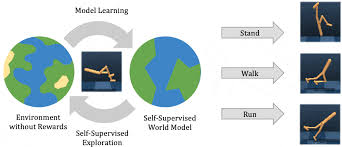
Plan2Explore: Active Model-Building for Self-Supervised Visual Reinforcement Learning

Source: bair.berkeley.edu To operate successfully in unstructured open-world environments, autonomous intelligent agents need to solve many different tasks and learn new tasks quickly. Reinforcement learning has enabled Read More

Read More

Is AI an Existential Threat?

Source: unite.ai When discussing Artificial Intelligence (AI), a common debate is whether AI is an existential threat. The answer requires understanding the technology behind Machine Learning (ML), and recognizing Read More

Read More
Subscribe
Notify of
guest
0 Comments
Oldest
Newest Most Voted
Inline Feedbacks
View all comments
0
Would love your thoughts, please comment.x
()
x