Upgrade & Secure Your Future with DevOps, SRE, DevSecOps, MLOps!

We spend hours on Instagram and YouTube and waste money on coffee and fast food, but won’t spend 30 minutes a day learning skills to boost our careers.
Master in DevOps, SRE, DevSecOps & MLOps!

Learn from Guru Rajesh Kumar and double your salary in just one year.

Get Started Now!

Autonomous Scanning Probe Microscopy technique developed using AI

Source: drugtargetreview.com

A new collaboration has demonstrated fully-autonomous Scanning Probe Microscopy (SPM) operation, applying artificial intelligence (AI) and deep learning to remove the need for constant human supervision.

According to the researchers, the new system, dubbed DeepSPM, bridges the gap between nanoscience, automation and AI, firmly establishing the use of machine learning for experimental scientific research.

“Optimising SPM data acquisition can be very tedious. This optimisation process is usually performed by the human experimentalist and is rarely reported,” said Future Low-Energy Electronics Technologies (FLEET) Chief Investigator Dr Agustin Schiffrin, at Monash University, Australia. “Our new AI-driven system can operate and acquire optimal SPM data autonomously, for multiple straight days and without any human supervision.”

The advance brings advanced SPM methodologies such as atomically-precise nanofabrication and high-throughput data acquisition closer to a fully automated turnkey application, say the researchers. 

The new deep learning approach can also be generalised to other SPM techniques. The researchers have made the entire framework publicly available online as open source, creating an important resource for the nanoscience research community.

“Crucial to the success of DeepSPM is the use of a self-learning agent, as the correct control inputs are not known beforehand,” said Dr Cornelius Krull, project co-leader. “Learning from experience, our agent adapts to changing experimental conditions and finds a strategy to maintain the system stable.” 

The AI-driven system begins with an algorithmic search of the best sample regions and proceeds with autonomous data acquisition. It then uses a convolutional neural network to assess the quality of the data. If the quality of the data is poor, DeepSPM uses a reinforcement learning agent to improve the condition of the probe.

The system can run for several days, acquiring and processing data continuously, while managing SPM parameters in response to varying experimental conditions, without any supervision, highlight the researchers. 

Related Posts

DeepMind open-sources Lab2D to support creation of 2D environments for AI and machine learning

Source: computing.co.uk Alphabet subsidiary DeepMind announced on Monday that it has open-sourced Lab2D, a scalable environment simulator for artificial intelligence (AI) research that facilitates researcher-led experimentation with environment Read More

Read More

A VR Film/Game with AI Characters Can Be Different Every Time You Watch or Play

Source: technologyreview.com The square-faced, three-legged alien shoves and jostles to get at the enormous plant taking over its tiny planet. But each bite just makes the forbidden Read More

Read More

Researchers detail LaND, AI that learns from autonomous vehicle disengagements

Source: venturebeat.com UC Berkeley AI researchers say they’ve created AI for autonomous vehicles driving in unseen, real-world landscapes that outperforms leading methods for delivery robots driving on Read More

Read More

Google Teases Large Scale Reinforcement Learning Infrastructurean

Source: alyticsindiamag.com The current state-of-the-art reinforcement learning techniques require many iterations over many samples from the environment to learn a target task. For instance, the game Dota Read More

Read More

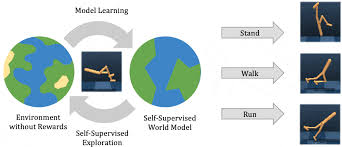
Plan2Explore: Active Model-Building for Self-Supervised Visual Reinforcement Learning

Source: bair.berkeley.edu To operate successfully in unstructured open-world environments, autonomous intelligent agents need to solve many different tasks and learn new tasks quickly. Reinforcement learning has enabled Read More

Read More

Is AI an Existential Threat?

Source: unite.ai When discussing Artificial Intelligence (AI), a common debate is whether AI is an existential threat. The answer requires understanding the technology behind Machine Learning (ML), and recognizing Read More

Read More
Subscribe
Notify of
guest
0 Comments
Oldest
Newest Most Voted
Inline Feedbacks
View all comments
0
Would love your thoughts, please comment.x
()
x