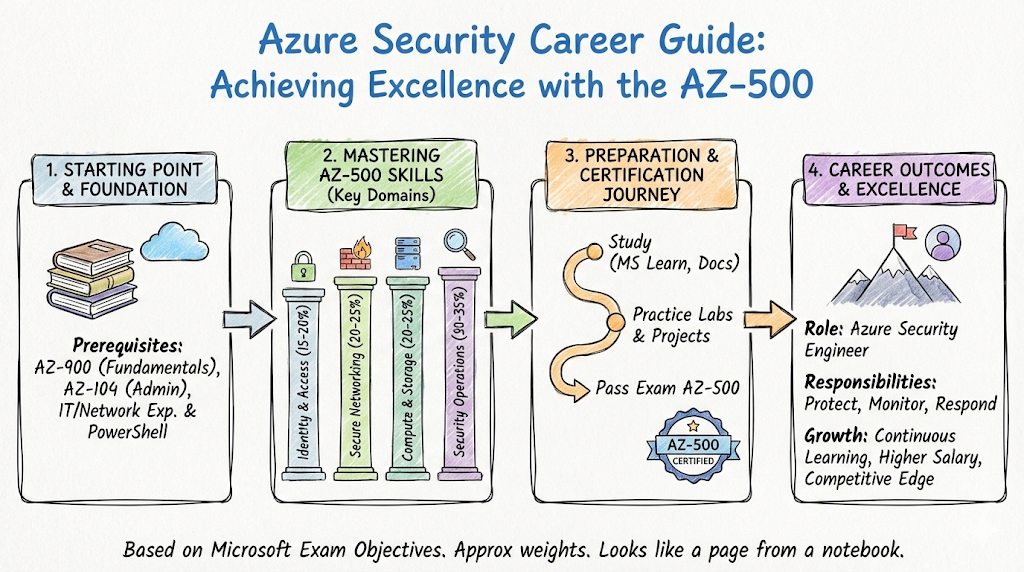
Azure is now the default cloud for many engineering teams, especially where Microsoft ecosystems, hybrid IT, and enterprise governance matter. However, as cloud usage grows, so do identity risks, misconfigurations, exposed endpoints, and accidental data leaks. That’s why Azure Security Engineer Associate (AZ-500) is valuable—it trains you to secure real Azure environments using practical controls, not just theory. If you want a clear, job-aligned certification that maps directly to day-to-day security tasks in Azure, this guide will give you the full picture and a plan you can actually follow.
What is the AZ-500 certification?
AZ-500: Microsoft Azure Security Technologies validates your ability to implement and manage security across Azure identity, networking, compute, data, and security operations. It focuses on hands-on skills like enforcing least privilege, applying security policies, hardening workloads, and enabling monitoring and threat response workflows. This certification is strongly aligned with real-world work in cloud security, DevSecOps, platform engineering, and operational security. In short, it helps you become the person who can confidently secure Azure—not just deploy it.
Who should take AZ-500?
AZ-500 is ideal for working professionals who touch Azure production systems and need to reduce risk without slowing delivery. It fits Cloud Engineers who manage deployments and access, Security Engineers moving into cloud security, and DevOps/Platform Engineers who implement guardrails and secure pipelines. It also helps SREs who want secure-by-default reliability practices, and Engineering Managers who need enough security depth to make better decisions. If you can already navigate Azure services and want to secure them properly, AZ-500 is a strong next step.
What you will be able to do after AZ-500
After preparing the right way, you should be able to design secure identity models using RBAC, privileged access workflows, and conditional policies. You’ll know how to reduce attack surface with secure networking patterns such as segmentation, private access, and controlled ingress/egress. You’ll also gain confidence in protecting data using encryption concepts and secure secrets handling patterns. Most importantly, you’ll think in real scenarios—how incidents happen, how they are detected, and what controls reduce impact before damage spreads.
Certification roadmap table (recommended certifications around AZ-500)
The table below helps you understand what typically comes before and after AZ-500, depending on your role and experience. If you’re new to Azure, fundamentals certifications help you build the base vocabulary. If you’re already working in Azure, you can move directly into AZ-500 and then specialize into SOC, identity, data protection, or architecture. Where your prompt did not provide an official link, the link is listed as Not provided.
| Track | Certification | Level | Who it’s for | Prerequisites | Skills covered | Recommended order |
|---|---|---|---|---|---|---|
| Azure Fundamentals | Azure Fundamentals (AZ-900) | Beginner | Anyone starting Azure | None | Azure basics, governance, cloud concepts | 1 |
| Security Fundamentals | Security, Compliance & Identity Fundamentals (SC-900) | Beginner | Security starter | None | Security concepts, identity basics | 1 (optional) |
| Azure Admin | Azure Administrator (AZ-104) | Intermediate | Cloud/Admin engineers | Basic Azure knowledge | Core Azure services, ops, identities | 2 (optional) |
| Azure Security | Azure Security Engineer Associate (AZ-500) | Intermediate | Security + Cloud engineers | AZ basics recommended | Identity, network, data, workload security | 2–3 |
| SOC / Threat | Security Operations Analyst (SC-200) | Intermediate | SOC, detection engineers | Security fundamentals | Threat detection, incident response | After AZ-500 or parallel |
| Identity | Identity and Access Administrator (SC-300) | Intermediate | Identity-focused roles | Identity basics | Conditional access, identity governance | After AZ-500 |
| Data Security | Information Protection Admin (SC-400) | Intermediate | Data protection roles | Security fundamentals | DLP, labeling, compliance | After AZ-500 |
| Architecture | Azure Solutions Architect Expert (AZ-305) | Advanced | Architects, lead engineers | Strong Azure experience | Secure cloud architecture | After AZ-500 + admin/exp |
| Security Expert | Cybersecurity Architect Expert (SC-100) | Advanced | Security leaders/architects | Strong security experience | Security architecture & governance | After AZ-500 + SOC/ID |
AZ-500 deep dive (the real skill areas)
Identity and access security
Identity is the most common entry point for cloud attacks, so AZ-500 expects you to become strong in identity control design. You’ll learn how access is granted, how roles should be scoped, and how privileged access must be controlled. You’ll also understand how to reduce risky sign-ins using policy-based access decisions. This is the foundation of securing every Azure service that depends on identity.
Networking security
In cloud security, “public by default” is a frequent mistake, and networking controls are how you reduce exposure. AZ-500 emphasizes segmentation, controlled inbound/outbound rules, and secure connectivity approaches. You’ll learn patterns that keep services private, reduce lateral movement, and limit blast radius. This directly improves both security and reliability outcomes in production.
Compute and workload security
Workloads include VMs, containers, and managed platform services—each with its own risk profile. AZ-500 prepares you to harden workloads using security baselines and posture management thinking. You’ll understand how misconfigurations create vulnerabilities and what guardrails reduce repeated mistakes. This helps you move from reactive security to proactive security.
Data protection
Data breaches often come from weak access, exposed storage, or poor secrets handling—not always from “hackers.” AZ-500 strengthens your ability to secure data storage patterns, encryption expectations, and secret management approaches. You’ll gain comfort in designing secure access around sensitive data. This matters heavily for regulated industries, enterprise workloads, and any customer-data scenario.
Security operations
Security is not complete without detection and response readiness. AZ-500 expects you to understand what to log, how to build meaningful alerts, and how to think through incidents. You’ll learn how monitoring fits into security posture and how response actions reduce impact. This makes you more useful in real teams because you can connect controls to operational outcomes.
Mini-sections for the certification (consistent format)
What it is
AZ-500 validates hands-on capability to secure Azure identities, networks, workloads, and data in production-style environments. It focuses on implementing controls, reducing exposure, enforcing policy, and enabling security monitoring. The certification aligns well with cloud security engineering, DevSecOps guardrails, and platform security practices.
Who should take it
DevOps and platform engineers who need secure defaults will benefit because AZ-500 teaches practical controls that protect delivery pipelines and platforms. Cloud engineers gain a stronger understanding of least privilege, secure connectivity, and safe deployment posture. Security engineers moving into cloud get a structured way to translate security intent into cloud configuration. Managers also benefit because they can better evaluate risk, governance, and security readiness in Azure environments.
Skills you’ll gain
- Identity access design using role-based access patterns and governance thinking
- Practical security policy enforcement mindset (controls that scale across teams)
- Workload protection concepts focused on posture, hardening, and misconfiguration reduction
- Secure network planning for reduced exposure and strong boundaries
- Data protection habits including safe access patterns and secrets handling
- Monitoring and response awareness so security is measurable and actionable
Real-world projects you should be able to do after it
- Design a multi-team access model with least privilege and clear admin boundaries
- Implement a secure secrets approach for applications and automation workflows
- Create a secure networking blueprint for private access and reduced public endpoints
- Improve security posture by identifying misconfigurations and applying repeatable guardrails
- Plan monitoring coverage for critical services and define alert logic tied to incidents
- Build a secure landing zone checklist that teams can follow for every new workload
Preparation plan (7–14 days / 30 days / 60 days)
7–14 days (fast track, for experienced Azure engineers)
This plan is for people already working in Azure and who can move quickly through concepts. Focus heavily on identity, networking, and scenario-based practice rather than reading long theory. Spend daily time on hands-on labs and create your own notes for “why this control exists.” In the final days, revise weak areas and run full mock exams to build speed and confidence.
30 days (balanced plan, most professionals)
Week 1 should focus on identity, RBAC thinking, and governance patterns so you build the core foundation early. Week 2 should be networking security and private access patterns because that reduces exposure fast. Week 3 should focus on workload security and posture improvement mindset. Week 4 is for monitoring, revision, and exam practice, with extra attention to scenario questions that test decision-making.
60 days (best for beginners or career switchers)
This plan is best if you are new to Azure or new to security thinking. Use the first phase to build Azure service familiarity and basic identity/network concepts. Next, learn security services, policy thinking, and access patterns through structured practice. The final weeks should be repeated hands-on scenarios, revision, and mock exams. This slower plan reduces stress and improves long-term retention for real job work.
Common mistakes
- Studying names of services without understanding the security goal behind them
- Over-focusing on networking while ignoring identity governance and privileged access
- Treating posture tools as “magic switches” instead of learning what issues they reveal
- Skipping hands-on scenarios and relying only on notes or videos
- Not learning how to explain security decisions in simple language to stakeholders
- Revising only once and not repeating weak areas until they become automatic
Best next certification after this
If your work is SOC or detection-oriented, SC-200 is a natural next step because it deepens incident and threat handling. If identity is your daily responsibility, SC-300 builds strong identity governance depth beyond AZ-500. If you are moving into architecture and design leadership, AZ-305 helps you apply security in broader system design. Pick the next certification based on the job you want, not just the track label.
Choose your path (6 learning paths)
1) DevOps path
In DevOps, AZ-500 helps you secure pipelines, secrets, and access patterns so teams can ship faster without creating risk. You will learn how to build guardrails that developers follow naturally rather than controls that teams bypass. The goal is secure delivery without friction. This path is ideal for engineers who own automation, deployments, and platform operations.
2) DevSecOps path
This path focuses on integrating security into engineering workflows rather than keeping it separate. AZ-500 supports understanding of posture, access, and baseline controls that DevSecOps teams enforce at scale. You will learn how to think about secure defaults, security gates, and compliance-friendly implementation. This helps you reduce security debt while keeping delivery continuous.
3) SRE path
SRE work needs secure boundaries because incidents often involve both reliability and security issues. AZ-500 strengthens your understanding of blast radius reduction, secure networking, and access patterns that prevent outages and compromise. You will also think more clearly about monitoring, alerting, and response workflows. This is especially valuable in production-heavy environments with strict uptime needs.
4) AIOps/MLOps path
AI and automation platforms handle sensitive data and powerful credentials, making security essential. AZ-500 supports secure identity, safe access controls, and secrets handling patterns that protect automation workflows. You’ll learn how to reduce risk around endpoints, data access, and operational monitoring. This path is useful when automation is driving decisions and operations at scale.
5) DataOps path
DataOps involves storage, pipelines, and cross-team access—where accidental exposure can become a major incident. AZ-500 supports data protection thinking and access control best practices that reduce leakage risk. You’ll learn to design secure access patterns for data services and improve governance. This helps data teams collaborate safely without over-sharing.
6) FinOps path
FinOps teams need governance and control because wasted spend and risk often come from unmanaged resources and excessive permissions. AZ-500 helps you understand guardrails that reduce both security incidents and operational chaos. Better policy enforcement and access discipline often improves cost visibility and reduces waste. This is helpful for mature cloud operations focused on accountability.
Role → Recommended certifications mapping
| Role | Recommended certifications (best sequence) | Why it fits |
|---|---|---|
| DevOps Engineer | AZ-900 → (AZ-104 optional) → AZ-500 → SC-200 | Improves secure delivery, secrets handling, guardrails, and incident awareness |
| SRE | AZ-900 → AZ-500 → SC-200 | Builds secure reliability patterns, monitoring mindset, and reduced blast radius |
| Platform Engineer | AZ-900 → (AZ-104 optional) → AZ-500 → AZ-305 | Helps design secure platforms and repeatable secure landing zones |
| Cloud Engineer | AZ-900 → (AZ-104 optional) → AZ-500 → AZ-305 | Strengthens secure operations and architecture decision-making |
| Security Engineer | SC-900 → AZ-500 → SC-200 → SC-100 | Builds cloud security implementation first, then detection and architecture depth |
| Data Engineer | AZ-900 → AZ-500 → SC-400 | Helps secure storage, access, and data protection workflows |
| FinOps Practitioner | AZ-900 → AZ-500 → Leadership option | Governance controls reduce waste, misconfig risk, and policy drift |
| Engineering Manager | AZ-900 → AZ-500 → Leadership option | Enables stronger security decisions, risk assessment, and governance alignment |
Next certifications to take (3 options: same track, cross-track, leadership)
Same track option
Continue deeper into cloud security specialization based on what you do daily: detection, identity, or data protection. This keeps your profile security-focused and increases credibility for security-heavy roles. It also helps if your team works under compliance pressure or handles sensitive customer data. Choose based on whether your job is mostly about alerts, access, or data controls.
Cross-track option
Move into architecture direction so you can design secure systems end-to-end, not only implement controls. This is best for platform engineers and senior engineers who influence how teams build solutions. Cross-track learning also improves your ability to review designs and reduce risk early. It’s a strong move if you want to be a lead engineer or architect.
Leadership option
Leadership-focused learning builds security strategy, governance thinking, and risk-based decision-making. It’s useful when you lead teams, run programs, or influence policy decisions across departments. This path also improves how you communicate security decisions to non-technical stakeholders. It’s ideal for managers and senior engineers moving toward security leadership.
Top institutions that support training + certifications
DevOpsSchool
DevOpsSchool supports working professionals with structured learning, practical examples, and job-aligned guidance. It is especially useful if you want a clear path that connects exam topics with real Azure security work. The learning approach helps you understand “what to do” and “why it matters” in production environments.
Cotocus
Cotocus provides training support aimed at enterprise-style execution and practical implementation. It works well for learners who want clarity in real deployment contexts rather than only theoretical explanations. This is helpful for teams that want consistency and repeatable learning outcomes. It is also useful when learning needs to align with operational expectations.
ScmGalaxy
ScmGalaxy supports structured guidance across DevOps and cloud learning needs. It can be helpful if you prefer a practical, step-by-step style that builds confidence gradually. The platform supports learners who want job relevance and practice-based understanding. It fits professionals who want training that feels connected to real tasks.
BestDevOps
BestDevOps focuses on modern engineering skill-building with practical direction and role-focused learning. It can help learners who want a clear roadmap and a structured approach to upskilling. This is useful for teams aiming to improve engineering maturity with measurable outcomes. It fits learners who prefer direct, actionable learning.
devsecopsschool.com
This platform is oriented around DevSecOps practices where security is integrated into daily engineering workflows. It supports learning around guardrails, secure automation thinking, and implementation-friendly security patterns. It is useful for engineers who want to connect security with CI/CD and platform work. The focus is on making security workable for teams at speed.
sreschool.com
SRESchool supports reliability thinking with security-aware operational discipline. It’s useful for engineers who manage production environments and want secure boundaries that reduce incidents. It fits professionals who want a strong monitoring mindset and incident readiness. It’s valuable when uptime goals and risk reduction must move together.
aiopsschool.com
AIOpsSchool supports automation-aware operational learning and monitoring mindset development. It can help professionals connect observability with incident handling and operational response. This is relevant where automation and event-driven operations are important. It fits teams modernizing operations who also want security awareness in signals and response.
dataopsschool.com
DataOpsSchool supports learning around data pipeline discipline, governance, and operational best practices. It is useful for professionals who want secure data workflows and controlled data access habits. This fits teams dealing with sensitive data and cross-team sharing needs. It supports building a safer, more reliable data platform approach.
finopsschool.com
FinOpsSchool supports learning around cloud cost governance and cross-team accountability. It helps teams understand how governance reduces waste, improves control, and strengthens operational maturity. It fits professionals who work with budgets, tagging, chargeback, and policy-driven discipline. This also supports reducing expensive misconfigurations and avoidable risk.
FAQs focused on difficulty, time, prerequisites, sequence, value, career outcomes
1) Is AZ-500 difficult for beginners?
Yes, it can feel challenging if you are new to Azure identity and networking. However, with a structured plan and hands-on practice, beginners can succeed. The key is learning concepts through scenarios rather than memorizing service names. A 60-day plan makes it much more comfortable.
2) How much time do working professionals need for AZ-500?
Most working professionals do best with a 30-day plan with consistent daily study. If you already work in Azure daily, you may finish in 7–14 days with focused revision and labs. If you are new to Azure security, take 60 days to avoid burnout. Consistency matters more than long sessions.
3) Do I need AZ-104 before AZ-500?
It’s not mandatory, but AZ-104 knowledge can help if you’re unfamiliar with Azure core services. If you can already navigate subscriptions, resource groups, identity basics, and networking, you can go directly to AZ-500. Many people successfully do AZ-500 without AZ-104 by filling gaps with targeted practice. Choose based on your current comfort level.
4) What are the real prerequisites for AZ-500 success?
You need basic cloud understanding and comfort with identity and networking ideas. You don’t need to be a security specialist, but you must be willing to practice access and networking scenarios. Knowing how Azure resources connect and how access is granted will speed your learning. Hands-on practice is the real prerequisite.
5) What is the best certification sequence around AZ-500?
A common sequence is fundamentals first, then AZ-500, then specialization based on role. After AZ-500, you can focus on SOC/detection, identity governance, or data protection depending on your job. If you want architecture growth, you can move toward an architecture certification next. The best order depends on your target role.
6) Is AZ-500 valuable for DevOps engineers?
Yes, because DevOps engineers manage secrets, access controls, and delivery pipelines that often become security risk points. AZ-500 helps you apply least privilege, safe connectivity, and guardrails without slowing releases. It also improves how you handle incidents and monitoring signals. This makes you stronger in production-focused teams.
7) Will AZ-500 help SRE and platform teams?
Definitely. SRE and platform teams need secure boundaries to prevent large incidents. AZ-500 improves your ability to reduce blast radius and enforce secure defaults. It also strengthens your monitoring and response awareness. That combination improves reliability and security together.
8) What matters more: AZ-500 certification or real projects?
Real projects matter more, but the certification helps structure your learning and proves baseline credibility. If you combine AZ-500 with 2–3 strong projects, your profile becomes far stronger. Hiring teams trust clear evidence of implementation more than a badge alone. Use the certification as a project-building framework.
9) What kind of job outcomes can AZ-500 support?
It supports roles like Azure security engineer, cloud security engineer, DevSecOps engineer, platform engineer with security, and security-focused cloud engineer. It also improves internal growth chances where you become the “security go-to” person. Many teams need engineers who can secure cloud systems practically. AZ-500 aligns with that need.
10) What are the most important areas to master for AZ-500?
Identity and access is the most critical area, followed by networking exposure reduction. Workload security and posture improvement are also highly important. Finally, monitoring and response thinking makes your learning complete. If you master these, both the exam and real work become easier.
11) What should I do in the last week before the exam?
Focus on revising identity scenarios, networking patterns, posture improvement concepts, and monitoring logic. Do mock exams and review mistakes deeply rather than repeating easy content. Create short revision notes and revisit weak areas daily. Sleep and consistency help more than last-minute cramming.
12) What should I do immediately after passing AZ-500?
Choose a direction that matches your role: SOC/detection, identity governance, data protection, or architecture thinking. Build one strong real-world project that proves your skills beyond the exam. Update your resume with outcomes and measurable improvements you can explain. Then pick your next certification based on your chosen path.
FAQs on Azure Security Engineer Associate (AZ-500)
1) Is AZ-500 only meant for security engineers?
No, it’s also valuable for cloud, DevOps, SRE, and platform engineers who secure production Azure environments. It fits anyone who must reduce risk in Azure. It’s especially helpful when you manage access and deployment workflows. Many non-security roles benefit a lot from it.
2) Can software engineers take AZ-500?
Yes, especially if you build applications deployed in Azure and you need secure-by-design understanding. It helps you handle identity, secrets, and secure connectivity better. This reduces common app security mistakes in cloud environments. It also improves how you work with security teams.
3) What is the fastest way to become exam-ready?
Use scenario-based study: RBAC design, private access approaches, secrets handling patterns, and monitoring logic. Revise daily and track weak areas. Focus on “why this control exists” not just “what the service name is.” This builds confidence and speed.
4) What is the biggest learning mistake people make?
They memorize service features without understanding security goals and real decision-making. They also skip hands-on practice and rely only on notes. AZ-500 is practical and scenario-heavy. Practice is what makes your learning stick.
5) Is hands-on experience mandatory?
It’s not mandatory to have job experience, but hands-on practice is essential. If you don’t practice, concepts stay vague and questions feel confusing. Even basic labs and scenario exercises can build strong understanding. Hands-on practice also helps with real job outcomes.
6) Does AZ-500 help in global job markets?
Yes, Azure security skills are globally relevant because cloud security expectations are similar worldwide. Organizations everywhere need identity control, secure networking, data protection, and monitoring discipline. AZ-500 aligns to these universal needs. That’s why it’s respected across regions.
7) What should I revise again and again?
Identity and access patterns, privileged access controls, secure connectivity patterns, and monitoring logic. These topics appear frequently in both exam and real work. They also connect to many other Azure services. Repetition improves speed and clarity.
8) What makes a candidate stand out after AZ-500?
Clear project stories and measurable outcomes. For example, how you reduced access risk, improved posture, or reduced exposure in a real setup. Being able to explain “what you changed and why” matters. This converts certification into career value.
Testimonials
Ankit
“AZ-500 helped me stop guessing and start building security with clarity. I can now design access properly and explain decisions confidently to both engineers and managers. The biggest win was learning how to reduce exposure without slowing teams down. It made my cloud work feel more controlled and professional.”
Priya
“Before AZ-500, security felt like a checklist I didn’t fully understand. After structured preparation, I started thinking in scenarios—what could go wrong and how to prevent it early. It improved how I handle access, secrets, and secure connectivity patterns. It also helped me speak the same language as security teams.”
Rahul
“This certification improved my confidence in production cloud discussions. I started applying posture improvements and monitoring thinking more consistently. The biggest change was how I connect security controls to real incidents and impact. It made my work feel more valuable and better aligned to business risk.”
Conclusion
AZ-500 is a practical certification that strengthens how you secure real Azure environments across identity, networking, workloads, data, and security operations. It helps you move from “configuring services” to “making smart security decisions” that reduce risk without breaking delivery speed. If you follow a structured plan, practice real scenarios, and build a few strong projects, this certification can directly improve your job performance and career opportunities. Start with a 30-day plan if you already work in Azure, or take 60 days if you are newer and want steady confidence. After passing, choose the next certification path based on your role goals, then build one strong project story that proves your skill beyond the exam.