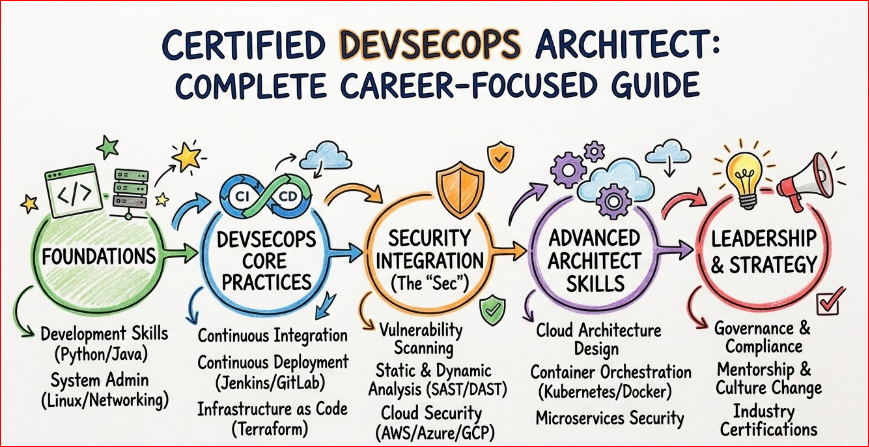
DevSecOps is no longer optional. Security has to be designed into code, pipelines, platforms, and cloud from day one, not patched later when something breaks. Certified DevSecOps Architect is built for exactly this new reality. This guide will help working engineers, software developers, SREs, security engineers, architects, and managers understand what Certified DevSecOps Architect is, who it is for, skills it builds, and how to fit it into a long‑term career path.
Why Certified DevSecOps Architect Matters Now
- Security incidents are often caused by weak architecture and missing guardrails, not just one buggy script.
- Most teams have DevOps pipelines, but security is still manual, scattered, and slow.
- Regulations, global customers, and larger systems demand security and compliance from day zero.
A DevSecOps Architect connects these gaps. This role shapes how code moves from developer laptop to production, how secrets are stored, how vulnerabilities are handled, and how compliance is automated.
About Certified DevSecOps Architect
What it is
Certified DevSecOps Architect is a role‑focused certification that validates your ability to design secure CI/CD pipelines, platforms, and cloud architectures with security built in at every layer. It goes beyond basics and helps you think like an architect who balances speed, safety, and compliance.
Who should take it
- DevOps engineers who design or maintain CI/CD pipelines.
- SRE and platform engineers who own reliability, observability, and production platforms.
- Cloud and security engineers who need to bring “security as code” into infrastructure and applications.
- Technical leads, architects, and managers responsible for security outcomes and digital transformation initiatives.
Skills you’ll gain
- Architecting security‑first CI/CD pipelines for hybrid and multi‑cloud.
- Applying shift‑left security from design to deployment.
- Integrating SAST, DAST, SCA, IaC scanning, and container security into pipelines.
- Designing secure container, Kubernetes, and serverless platforms.
- Implementing security as code and compliance as code.
- Threat modeling and risk‑based design for applications and platforms.
- Mapping architectures to standards like ISO 27001, GDPR, HIPAA, SOC 2.
- Leading DevSecOps adoption and culture change across teams.
Real‑world projects you should be able to do after it
- Design an end‑to‑end secure CI/CD pipeline for a microservices application running on Kubernetes in the cloud.
- Create a security blueprint for a multi‑cloud deployment, including identity, secrets, network, and logging strategy.
- Implement security and compliance as code for critical services using tools like policy engines and IaC scanners.
- Define a DevSecOps reference architecture for your organization, with patterns, guardrails, and governance.
- Build a rollout plan to introduce DevSecOps practices across development, operations, and security teams.
Preparation plan
You can adjust the plan based on your current level.
7–14 days (fast track)
Best for people already working in DevOps, cloud, or security with hands‑on experience.
- Day 1–2: Review DevSecOps fundamentals, security in SDLC, and main architectural patterns.
- Day 3–5: Deep focus on CI/CD security, SAST/DAST/SCA, secrets management, and container security.
- Day 6–8: Study case studies, architecture diagrams, threat models, and compliance mapping.
- Day 9–10+: Attempt mock scenarios, practice exam‑style questions, and review your own systems with a DevSecOps lens.
30 days (standard track)
Good for working engineers who can give 1–2 focused hours per day.
- Week 1: Fundamentals – DevSecOps concepts, SDLC, threat modeling, risk and governance.
- Week 2: Pipelines – CI/CD pipeline security, automated testing, code and dependency scanning.
- Week 3: Platforms – cloud security, Kubernetes, containers, secrets, identity and access.
- Week 4: Compliance and architecture – security as code, compliance as code, reference architectures, and practice exams.
60 days (deep track)
Ideal if you are changing roles or want to build a complete portfolio.
- Month 1: Foundations plus labs – build and secure at least one full pipeline and one application environment.
- Month 2: Architecture – design multiple architectures (greenfield and brownfield), document them, and present them to mentors or peers for feedback.
Common mistakes to avoid
- Treating this as a pure “tool” exam rather than architecture and decision‑making.
- Ignoring cloud and platform aspects, focusing only on application security.
- Overlooking compliance and governance, assuming security is just scanning.
- Not practicing end‑to‑end scenarios; learning features but not flows.
- Studying alone without relating concepts to your real projects.
Best next certification after this
After Certified DevSecOps Architect, three good options are:
- Same track: A deeper or specialized DevSecOps or security architecture certification (for example, DevSecOps Practitioner or similar).
- Cross‑track: SRE, observability, or cloud architecture certifications to improve reliability and platform depth.
- Leadership: Product, architecture, or security leadership programs that focus on strategy, risk, and organizational change.
Certification Overview Table
Below is a simple table summarizing the key aspects of Certified DevSecOps Architect.
Choose Your Path: 6 Learning Paths
After (or around) Certified DevSecOps Architect, you should plan your wider career path. Here are six practical tracks.
1. DevOps Path
Focus: delivery speed, automation, reliability.
- Start with strong DevOps foundations and CI/CD skills.
- Add containerization, Kubernetes, IaC, and observability.
- Use DevSecOps architecture skills to make your platforms secure by default.
2. DevSecOps Path
Focus: security built into everything.
- Begin with secure coding, application security, and cloud security basics.
- Take Certified DevSecOps Architect as your core architecture credential.
- Later, add specialized certifications in offensive security, compliance, and security engineering.
3. SRE Path
Focus: reliability, SLIs/SLOs, incident management.
- Build skills in monitoring, logging, tracing, and capacity planning.
- Use DevSecOps architecture to design secure, observable, and reliable production systems.
- Add SRE or reliability‑focused certifications to strengthen this path.
4. AIOps / MLOps Path
Focus: automation and intelligence.
- Learn how to apply AI/ML to monitoring, incident response, and operations.
- Combine DevSecOps architecture with AIOps tools for smarter alerting and root cause analysis.
- For MLOps, focus on secure, reproducible pipelines for ML models, including data and model governance.
5. DataOps Path
Focus: data pipelines and data quality.
- Work on secure, compliant data pipelines across on‑prem and cloud.
- Use DevSecOps thinking to bring security and governance to ETL/ELT, streaming, and analytics.
- Add DataOps or data engineering certifications focused on automation, lineage, and compliance.
6. FinOps Path
Focus: cost, value, and governance.
- Learn cloud cost management, budgeting, and showback/chargeback.
- Combine FinOps and DevSecOps to create architectures that are secure, cost‑optimized, and auditable.
- Later move towards cloud governance and platform leadership roles.
Role → Recommended Certifications
Use this as a high‑level mapping to plan your path around Certified DevSecOps Architect.
Top Institutions for Training and Certification Support
DevOpsSchool
DevOpsSchool is known for practical, hands‑on programs that combine labs, real project examples, and live interaction with instructors. They focus on helping working professionals solve real problems, not just pass exams.
Cotocus
Cotocus works closely with organizations to run role‑focused and project‑based learning programs. Their DevSecOps and DevOps trainings reflect current industry practices and help you apply learning in real environments quickly.
ScmGalaxy
ScmGalaxy is a large knowledge hub with many articles, tutorials, and community resources on DevOps, DevSecOps, and related tools. It is a good place to keep learning continuously even after formal training.
BestDevOps
BestDevOps offers focused bootcamps and fast‑track programs for professionals who want to move into modern DevOps and cloud roles. Their content is designed to be direct, practical, and career‑oriented.
devsecopsschool.com
DevSecOpsSchool specializes in DevSecOps and security‑driven training with programs like Certified DevSecOps Architect. Their courses are built around real‑world architectures, case studies, and security automation.
sreschool.com
SRESchool focuses on Site Reliability Engineering, combining reliability, performance, and incident management. Their content is a natural complement when you want to connect reliability and DevSecOps.
aiopsschool.com
AIOpsSchool offers training on using AI and automation to improve operations. This supports DevSecOps Architects who want to bring intelligence into alerting, anomaly detection, and incident response.
dataopsschool.com
DataOpsSchool focuses on data pipelines, automation, and governance. DevSecOps architects working with analytics and data platforms can benefit from this to secure and streamline data workflows.
finopsschool.com
FinOpsSchool covers cloud financial management, helping teams control cloud spend while maintaining performance and security. This supports DevSecOps Architects in building architectures that are both secure and cost‑optimized.
FAQs on Certified DevSecOps Architect
1. Is Certified DevSecOps Architect difficult?
It is challenging but very achievable for working engineers with DevOps and cloud experience. The difficulty comes more from architecture and scenario‑based thinking than from memorizing tools.
2. How much time do I need to prepare?
Most professionals need 30–60 days with consistent study and some hands‑on practice. If you already work deeply in DevOps or security, a 7–14 day focused sprint can also work.
3. What are the prerequisites?
You should be comfortable with DevOps concepts, CI/CD, basic application security, and at least one major cloud platform. Some exposure to architecture or technical leadership is very helpful.
4. Do I need to be a security expert before starting?
No, but you must understand basics like vulnerabilities, secure coding ideas, and common security tools. The certification will then help you connect these concepts into end‑to‑end architectures.
5. What kind of exam questions should I expect?
Expect scenario‑based and architecture‑focused questions that test decision making, trade‑offs, and patterns, not just one‑line definitions. You may have to choose the best design or sequence of steps for a given situation.
6. Is this certification useful for SRE or platform engineers?
Yes. It helps SREs and platform engineers design secure, reliable production environments and integrate security with observability and incident processes.
7. How does this certification help my career?
It positions you as someone who can own security outcomes at the architecture level, which is a high‑impact, well‑paid responsibility. It also opens doors to roles like DevSecOps Architect, security‑aware platform engineer, or cloud security architect.
8. Can application developers also take this?
Yes, especially senior developers, tech leads, and backend or platform‑focused engineers who work closely with infrastructure. It helps them move into architecture or security‑heavy roles.
9. What if my company is still early in DevOps?
You can still gain value by understanding the target architecture and using that to guide your internal transformation. The certification can help you become a change agent and internal advisor.
10. How does this compare to general security certifications?
General security certifications focus on broad security topics, often without deep DevOps or cloud pipeline coverage. Certified DevSecOps Architect is specialized around modern software delivery, pipelines, and cloud‑native architectures.
11. Will this help me if I want to move abroad?
Yes. DevSecOps skills and security‑aware architecture are in demand globally, across product companies, consultancies, and cloud‑first enterprises. The mix of DevOps, cloud, and security architecture is valued in many regions.
12. Do I need hands‑on coding for this certification?
You do not need to write complex applications, but you should understand code flows, CI/CD steps, and how tools integrate. Being able to read and reason about scripts, YAML, and configurations is important.
13. Is this good for managers?
Yes, especially for engineering or security managers who want to lead DevSecOps initiatives and speak confidently with both engineers and executives. It helps in making roadmap, tooling, and governance decisions.
14. What should I build as a portfolio around this certification?
Design 2–3 end‑to‑end system architectures, secure at least one real or demo pipeline, and document threat models and security controls. This portfolio will help during interviews and internal promotions.
Specific FAQs Focused on Certified DevSecOps Architect
1. What is the main focus of Certified DevSecOps Architect?
The main focus is on architecting secure‑by‑design DevOps ecosystems across applications, pipelines, platforms, and cloud. It teaches you to embed security and compliance into every stage of delivery.
2. Who is the ideal candidate for this certification?
Ideal candidates are DevOps, SRE, platform, cloud, and security professionals who influence or design technical systems and want to take ownership of security architecture.
3. What domains does the syllabus cover?
It covers DevSecOps fundamentals, secure SDLC, CI/CD security, application security integration, cloud and container security, threat modeling, compliance, and governance as code.
4. How practical is the training?
The program is aligned with real‑world pipelines, cloud environments, and case studies rather than only slides. You are expected to think about real trade‑offs and constraints.
5. Does it cover multi‑cloud and hybrid scenarios?
Yes, it specifically deals with secure architectures across hybrid and multi‑cloud setups, including governance and compliance.
6. How does it support culture change?
The certification also focuses on communication, collaboration, and change management to bring development, operations, and security together.
7. Is there focus on compliance standards?
Yes, you learn to align architectures with standards like ISO 27001, GDPR, HIPAA, and SOC 2 using security and compliance as code approaches.
8. Can this be combined with other DevSecOps or security programs?
It fits well with foundation‑ or practitioner‑level DevSecOps programs and can act as an advanced or architecture layer on top of them.
Next Certifications to Take (3 Options)
After completing Certified DevSecOps Architect, you can choose your next step based on your career direction.
- Same track (deep DevSecOps / security)
- Advanced DevSecOps, application security, or cloud security architecture certifications.
- Goal: become the go‑to person for secure architecture and security automation.
- Cross‑track (breadth in ops and platforms)
- SRE, observability, or cloud architecture certifications.
- Goal: design systems that are not only secure, but also highly reliable and cost‑effective.
- Leadership (strategy and management)
Conclusion
Certified DevSecOps Architect sits at the intersection of development, operations, security, and governance. It is built for professionals who want to own security not as a side task, but as a first‑class part of architecture and delivery.
If you are a working engineer, architect, or manager in India or anywhere in the world, this certification can help you move from “doing tasks” to designing secure systems and leading change. With a clear preparation plan, support from the right institutions, and a practical portfolio, it can become a key milestone in your DevSecOps, SRE, or cloud security career.