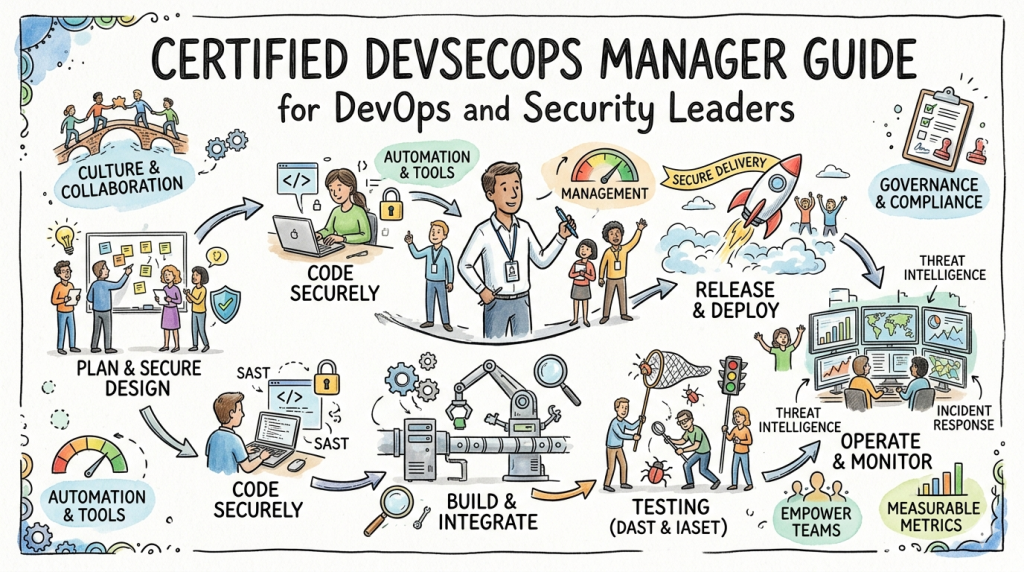
Software delivery has changed dramatically in the last decade. Teams release features multiple times a day, infrastructure is dynamic and cloud-native, and security threats are constant. Many organizations still treat security as a separate gate at the end of the pipeline, and that model is failing under modern speed and complexity. The Certified DevSecOps Manager program exists for professionals who want to lead security as an integrated part of software delivery. This guide explains what the certification is, who it is for, what skills you gain, how to prepare, and how it fits into DevOps, DevSecOps, SRE, AIOps/MLOps, DataOps, and FinOps career paths. It is written for working engineers and managers in India and globally who want a practical roadmap, not just marketing content.
Certification overview table
| Certification name | Track | Level | Who it’s for | Prerequisites | Skills covered | Recommended order |
|---|---|---|---|---|---|---|
| Certified DevSecOps Manager | DevSecOps | Manager | Team leads, architects, and managers in DevOps/SRE/Security | Strong understanding of DevOps, CI/CD, and basic security concepts | DevSecOps strategy, governance, risk management, compliance, culture, toolchain leadership | After core DevOps + one DevSecOps/Cloud/SRE certification |
| DevSecOps Professional (example) | DevSecOps | Professional | DevOps, SRE, security, and platform engineers | Linux, Git, CI/CD, cloud basics | Secure SDLC, SAST/DAST/SCA, secrets management, CI/CD security, container and cloud security | Before Certified DevSecOps Manager |
| SRE Professional (example) | SRE | Professional | SREs, DevOps, and platform engineers | System administration, scripting basics | SLIs/SLOs, error budgets, incident response, reliability engineering | Parallel or before Certified DevSecOps Manager |
| AIOps / MLOps Manager (example) | AIOps/MLOps | Manager | Data, ML, or platform leads | Python/ML basics, cloud fundamentals | AI-driven operations, intelligent alerting, ML pipeline operationalization | After SRE or DevOps leadership-level certifications |
| DataOps Manager (example) | DataOps | Manager | Data engineers and analytics leaders | Data pipelines, ETL/ELT basics, cloud data platforms | Data pipeline reliability, data quality, secure data delivery, DataOps governance | After DataOps Professional/Architect |
| FinOps Manager (example) | FinOps | Manager | Cloud, platform, and finance leaders | Public cloud fundamentals, cost basics | Cloud cost governance, showback/chargeback, cost optimization with security and compliance lens | After cloud + FinOps Professional-level certification |
Deep dive into Certified DevSecOps Manager
What it is
Certified DevSecOps Manager is a DevSecOps leadership certification that teaches you how to design, implement, and scale secure software delivery programs across teams. It covers strategy, governance, risk, compliance, tooling, and culture. The core goal is to help you own security outcomes without sacrificing speed.
Who should take it
This certification is ideal if:
- You are a DevOps, SRE, or Platform lead who owns CI/CD pipelines, Kubernetes clusters, or production reliability and now needs to build security into all of that.
- You are a Security engineer or architect who wants to move from manual reviews to automated, pipeline-driven security and lead DevSecOps initiatives.
- You are a Cloud or Engineering manager responsible for balancing delivery, uptime, security, and compliance across multiple teams or products.
- You are a senior engineer planning to step into a formal leadership role around security and delivery, and you need a structured framework to guide your decisions.
Skills you’ll gain
By completing Certified DevSecOps Manager, you can expect to gain skills across several dimensions:
- DevSecOps strategy and roadmap design
You learn how to assess the current state of DevOps and security in your organization, identify gaps, and create a multi-phase DevSecOps roadmap. This includes defining vision, goals, milestones, and success metrics. - Governance, policy as code, and compliance as code
You understand how to translate security standards and regulations into technical controls. You learn to design policies that can be embedded into code repositories, pipelines, and infrastructure templates. - Risk-based decision making
You develop the ability to prioritize security work based on business impact and threat context. Instead of chasing every vulnerability, you focus on the ones that truly matter to your business and systems. - Security toolchain design and integration
You learn how to choose and integrate tools such as SAST, DAST, SCA, secrets managers, container scanners, and cloud security platforms into CI/CD. You focus on feedback loops, false positives, and developer experience. - Operating model and team collaboration
You become capable of defining roles and responsibilities across Dev, Sec, Ops, SRE, and compliance. You learn collaboration models like security champions, shared backlogs, and cross-functional incident reviews. - Metrics and KPIs for secure delivery
You know how to design and track metrics like time to remediate critical issues, policy compliance rates, security test coverage, and misconfiguration trends. These KPIs help you prove progress and justify investments. - Cultural change and communication
You gain practical techniques to influence stakeholders and drive culture change. You learn how to communicate about risk, how to design training programs, and how to respond to incidents in a blameless, learning-focused way.
Real-world projects you should be able to do after it
After completing this certification, you should be able to execute projects such as:
- Design a full DevSecOps transformation strategy
Create a realistic multi-quarter roadmap to move from ad-hoc security to integrated DevSecOps. This includes pilots, expansions, tooling, training, and metrics. - Create a security-first CI/CD reference architecture
Define how a standard CI/CD pipeline in your organization should look: where to place static analysis, dependency checks, container scanning, secrets checks, policy gates, and manual approvals. - Build and use a DevSecOps maturity model
Assess different teams on a maturity scale, from “no automation” to “fully integrated security.” Recommend concrete actions for each team and track progress over time. - Migrate from manual security reviews to automation
Plan and execute the shift from manual sign-offs to automated security controls embedded in pipelines and infrastructure-as-code workflows. - Define and document security incident and vulnerability processes
Create clear runbooks and workflows for vulnerability management, incident response, communication, and post-incident reviews that involve Dev, Sec, and Ops.
Preparation plan (7–14 days / 30 days / 60 days)
Different learners need different preparation timelines. Here is a structured approach.
7–14 day “Fast Track”
This track is for experienced DevOps/SRE/Security professionals who already live in CI/CD and security.
- Days 1–2: Understand the blueprint
Read the official Certified DevSecOps Manager page and list all major topics. Map each topic to your strengths and weaknesses to decide where to focus. - Days 3–5: Deep dive weak areas
Focus on risk, governance, culture, and metrics if you have more technical experience, or on pipelines and tooling if you come from compliance/security only. - Days 6–9: Scenario practice
Write answers to realistic scenarios: “Security found many critical issues before release,” “New cloud team with no security practices,” and “Audit findings on CI/CD.” Focus on structure and trade-offs. - Days 10–14: Simulated exams and review
Run timed practice sessions and then review every question you got wrong or guessed. Rewrite your answers with better reasoning and structure.
30 day “Balanced Track”
This track suits working engineers or managers who know DevOps basics but are new to DevSecOps leadership.
- Week 1: Fundamentals refresher
Review CI/CD, cloud basics, containerization, and common security concepts (OWASP, IAM, encryption, least privilege). Ensure you are comfortable with end-to-end delivery flow. - Week 2: DevSecOps frameworks and patterns
Study secure SDLC, DevSecOps lifecycle models, reference architectures, and core patterns such as “shift left,” “every commit scanned,” and “policy as code.” - Week 3: Governance, risk, and tooling
Focus on understanding risk frameworks, designing policies, and aligning tool choices with your organization’s context. Sketch your own toolchain for a sample product. - Week 4: Practice and consolidation
Spend time on scenario-based questions, mock tests, and writing sample DevSecOps strategies. Aim to explain your thinking clearly in simple language, as you would to a leadership team.
60 day “Foundation Builder”
This track is for people who are still building their DevOps or security fundamentals.
- Weeks 1–2: Technical foundations
Learn Git, CI servers (Jenkins, GitHub Actions, GitLab CI, etc.), containers, Kubernetes basics, and basic cloud operations. Try building and deploying a simple application end-to-end. - Weeks 3–4: Practical DevSecOps basics
Add tools like static analysis, dependency scanning, and container scanning into your pipeline. Practice secrets management and simple policies (for example, disallow public S3 buckets). - Weeks 5–6: Leadership and strategy
Study case studies of DevSecOps transformations. Design your own roadmap, operating model, and metrics. Practice explaining these to engineers and managers in clear, concise language.
Common mistakes
Here are frequent mistakes candidates and organizations make when approaching DevSecOps Manager-level concepts:
- Focusing only on tools
Treating DevSecOps as just “adding more scanners” without changing processes, culture, or governance. - Ignoring cultural aspects
Trying to push security top-down through strict policies without educating developers or involving them in decisions. - Skipping hands-on experience
Studying theory without ever seeing how scanners, pipelines, and policy engines behave in real projects. - Not thinking in trade-offs
Believing there is a single “best” architecture instead of evaluating trade-offs such as speed vs. strictness, and coverage vs. noise. - Failing to align with business priorities
Designing security programs in isolation from product, revenue, and customer needs, which leads to lack of support from leadership.
Best next certification after this
After Certified DevSecOps Manager, you can deepen or broaden your career in three main directions:
- Same track (DevSecOps / security leadership)
Move into advanced DevSecOps or cloud security architect programs that focus on large-scale, multi-cloud, and regulated environments. You become the go-to person for secure delivery architectures. - Cross-track (SRE / reliability)
Add SRE-focused certifications to combine secure delivery with high availability and performance. You learn to design systems where security controls are resilient and do not become single points of failure. - Leadership (engineering / platform leadership)
Pursue broader leadership programs focused on leading multiple teams and portfolios. You apply your DevSecOps mindset across infrastructure, data, AI, and cost governance.
Choose your path: 6 learning paths
This section shows how Certified DevSecOps Manager fits into 6 common career paths.
1. DevOps path
You start by mastering DevOps fundamentals: version control, CI/CD, infrastructure-as-code, containers, and cloud. You might earn a core DevOps certification and work on building pipelines and platforms. Next, you learn SRE and observability to ensure reliability and performance.
Once you are comfortable running fast and reliable delivery, you add DevSecOps concepts: secure pipelines, secrets management, vulnerability scanning, and compliance automation. Certified DevSecOps Manager then becomes your leadership credential to run secure delivery for many teams.
2. DevSecOps path
You begin with DevOps basics and quickly move into DevSecOps-specific training. You learn static and dynamic analysis, dependency scanning, container security, secrets management, and cloud security. You may work as a DevSecOps engineer, integrating tools and building secure pipelines.
As your responsibility grows, you need to handle roadmaps, governance, and organization-wide change. Certified DevSecOps Manager gives you the structure to move from “tool implementer” to “program leader,” and helps you manage stakeholders, budgets, and metrics.
3. SRE path
You start as an SRE or reliability-focused engineer. You manage SLIs/SLOs, error budgets, on-call rotations, incident response, and performance tuning. Over time, you see that many incidents are security-related or influenced by security controls.
By adding DevSecOps skills, you learn to design reliability practices that account for security, and security practices that protect availability. Certified DevSecOps Manager helps you design policies, runbooks, and governance that cover both security and reliability for production systems.
4. AIOps/MLOps path
You begin in data or ML engineering and then move into MLOps or AIOps. You handle model training pipelines, model deployment, experiment tracking, and intelligent alerting. These pipelines also need security: model artifacts, datasets, and infrastructure must be protected.
When you bring DevSecOps ideas into MLOps, you focus on securing ML pipelines, controlling access to data, and ensuring compliance. Certified DevSecOps Manager enables you to build governance structures that treat AI/ML systems as first-class citizens in your security program.
5. DataOps path
You start as a data engineer or analytics engineer working on ETL/ELT pipelines, data warehousing, and BI platforms. You adopt DataOps to bring DevOps concepts into data: versioning, testing, automation, and observability.
By adding DevSecOps concepts, you treat data security and privacy as core concerns in your pipelines. You secure data movement, control access, and embed compliance checks. Certified DevSecOps Manager gives you the leadership skills to run secure data delivery across teams and tools.
6. FinOps path
You start in cloud cost management or FinOps, helping teams understand and control cloud spend. You work with budgets, tagging strategies, and usage optimization. But cost decisions always touch architecture and security.
As you adopt DevSecOps thinking, you design policies that simultaneously control cost and maintain strong security and compliance. Certified DevSecOps Manager helps you design governance models where engineering, security, and finance work together instead of in silos.
Role → Recommended certifications mapping
| Role | How you use DevSecOps Manager skills | Recommended approach |
|---|---|---|
| DevOps Engineer | Secure CI/CD, infrastructure, and releases across multiple environments | Build DevOps and cloud fundamentals → add DevSecOps engineer-level cert → take Certified DevSecOps Manager to move into platform or security leadership. |
| SRE | Combine reliability, performance, and security for production systems | Start with SRE certifications → add DevSecOps training → use Certified DevSecOps Manager to lead secure reliability programs and incident management. |
| Platform Engineer | Design secure platforms, clusters, and internal developer platforms | Strengthen DevOps/SRE + cloud architecture → learn DevSecOps → use Certified DevSecOps Manager to define platform security standards for all teams. |
| Cloud Engineer | Architect secure cloud deployments and CI/CD integrations | Earn cloud provider certs + DevOps basics → add DevSecOps → use Certified DevSecOps Manager to own cloud security and compliance for multiple apps. |
| Security Engineer | Bridge security with DevOps and operations | Start with security and cloud security → learn CI/CD and automation → use Certified DevSecOps Manager to lead DevSecOps transformation across engineering. |
| Data Engineer | Secure data pipelines, ETL/ELT, and analytics platforms | Build DataOps and cloud data skills → add DevSecOps concepts → use Certified DevSecOps Manager to lead secure data delivery and governance. |
| FinOps Practitioner | Align cost optimization with security and compliance controls | Combine cloud + FinOps certifications → learn DevSecOps guardrails → use Certified DevSecOps Manager to design policies that balance cost, risk, and speed. |
| Engineering Manager | Own delivery, security, and compliance outcomes across multiple teams | Mix DevOps/SRE/Cloud + security awareness → use Certified DevSecOps Manager as central credential to run secure delivery programs across your org. |
FAQs ( on difficulty, time, prerequisites, sequence, value, outcomes)
- Is Certified DevSecOps Manager very difficult?
It is challenging but manageable if you have real experience in DevOps, security, or SRE. The difficulty comes from scenario questions that test your judgment, not just your memory. - Do I need to be a hardcore security expert before attempting it?
No. You should know security fundamentals and how they relate to software delivery. Deep specialist knowledge in every security domain is not required. - How much time do I need to prepare?
With strong background, 2–4 weeks of focused study is realistic. If you are still building foundations, plan for 1–2 months with consistent daily or weekly effort. - Do I need prior DevOps certifications?
Prior certifications are not mandatory, but having at least one DevOps/Cloud/SRE certification or equivalent experience makes the DevSecOps concepts far easier to understand and apply. - What is the ideal sequence of certifications?
A common sequence is: DevOps fundamentals → Cloud and/or SRE → DevSecOps engineer-level → Certified DevSecOps Manager → optional advanced or leadership programs. - Is this certification only for managers with people-reporting responsibility?
No. It is for anyone who leads programs, designs strategies, or influences multiple teams, even if they do not directly manage people on paper. - What real value does this certification add to my career?
It gives you a structured language, framework, and credential to talk about and lead DevSecOps initiatives. This is valuable for promotions, role changes, and interviews. - Will this certification help me move from India to global roles?
Yes, because DevSecOps is a global need and the concepts are location-agnostic. Combined with your experience, it can support your move into regional or global roles. - Can I take this certification if I am mostly a developer?
Yes, if you already have strong DevOps exposure and are moving into tech lead, architect, or manager roles. If you are very early in your career, start with DevOps and DevSecOps engineer-level first. - Does this certification focus more on theory or practice?
It focuses on practical application of concepts at an organizational level: roadmaps, policies, metrics, and collaboration. It is not about low-level commands, but it assumes practical understanding. - How do employers view DevSecOps Manager-level certifications?
Employers see them as evidence that you can think beyond a single project or tool and handle governance, strategy, and cross-team collaboration around security and delivery. - Can this certification help me move into a pure security leadership role later?
Yes. It provides a strong foundation in application and platform security governance, which is very useful for roles like Security Engineering Manager or Head of DevSecOps. - Is it still worth it if my company is early in DevOps adoption?
Yes, but your focus will be on designing a realistic roadmap that starts with basic automation and then adds security. You become the person who can lead both DevOps and DevSecOps maturity.
FAQs (specifically on Certified DevSecOps Manager)
- What is the key objective of Certified DevSecOps Manager?
To prepare professionals to design and lead secure software delivery programs across an organization, integrating security into DevOps and cloud-native practices. - What is the official URL for this certification?
The official URL is: Certified DevSecOps Manager - Who issues this certification?
It is offered by DevSecOpsSchool, accessible at: devsecopsschool - What roles is this certification best suited for?
DevOps leads, SRE leads, platform engineers, security engineers, cloud engineers, and engineering managers who own or influence security and delivery. - Does the certification include hands-on labs or is it exam-only?
The emphasis is on knowledge and leadership-level scenarios; hands-on practice is strongly recommended through training partners or your own environment, even if the exam itself is not lab-based. - Can I attempt it if I have only worked in traditional security?
Yes, but you should first get comfortable with DevOps basics and CI/CD so that the DevSecOps context feels natural. - What is the biggest mindset change required for this certification?
Moving from “security as a gate” to “security as a continuous, shared responsibility” and learning to think in terms of systems, pipelines, and culture. - Will I learn how to talk about security with non-technical stakeholders?
Yes. One of the most important outcomes is the ability to explain risk, trade-offs, and roadmaps in language that leaders and business stakeholders can understand.
Top institutions providing training for Certified DevSecOps Manager
Here are some institutions that can support your journey. Feel free to personalize this section:
- DevOpsSchool
DevOpsSchool offers a wide range of training programs across DevOps, SRE, DevSecOps, AIOps, DataOps, and FinOps. They focus on hands-on labs, practical examples, and role-based learning paths, making it easier for working professionals to connect theory with their daily work. - Cotocus
Cotocus provides consulting and training services that combine DevOps, cloud, and security. Their training often includes real client case studies and implementation experiences, helping learners understand how DevSecOps is applied in complex, real-world environments. - ScmGalaxy
ScmGalaxy focuses on CI/CD, build and release engineering, and DevOps toolchains. Their programs usually include security and governance aspects, making them a good fit for engineers who want to secure the tools and processes that deliver software. - BestDevOps
BestDevOps functions as both a knowledge portal and training provider. It publishes articles, guides, and roadmaps covering DevOps and DevSecOps trends, and offers structured programs that align with modern engineering roles. - devsecopsschool.com
DevSecOpsSchool is the official home for the Certified DevSecOps Manager program. It provides a complete DevSecOps certification ladder, from foundation-level courses up to manager-level and leadership programs, plus focused workshops on tools and practices. - sreschool.com
SRESchool specializes in Site Reliability Engineering. Their programs cover SLIs/SLOs, incident response, capacity planning, and reliability-focused design. For many learners, SRESchool and DevSecOpsSchool content together form a strong foundation in secure and reliable delivery. - aiopsschool.com
AIOpsSchool focuses on AIOps and MLOps, teaching how to apply AI and ML to operations and monitoring. This is useful if you work with advanced observability or ML pipelines and want to layer security and governance into those environments. - dataopsschool.com
DataOpsSchool offers training in DataOps, data pipelines, and data governance. If your world is primarily data engineering and analytics, DataOpsSchool plus DevSecOpsSchool gives you a combined view of secure data delivery. - finopsschool.com
FinOpsSchool is dedicated to cloud cost management and FinOps practices. It helps you understand how to build financial accountability into engineering. When combined with DevSecOps skills, you can design governance that balances cost, security, and speed.
Next certifications to take (3 options)
Once you complete Certified DevSecOps Manager, here are three high-value directions:
- Same track: deeper DevSecOps/security leadership
Move into advanced DevSecOps or security architect programs that focus on complex architectures, regulatory environments, and cross-region/cloud strategies. - Cross-track: SRE or reliability engineering
Add SRE certifications to become the person who connects secure delivery with high availability and performance, especially for mission-critical systems. - Leadership: engineering or platform leadership
Pursue leadership programs that cover org design, portfolio management, budgeting, and large-scale change. This is useful if you aim to lead multiple teams or entire departments.
Conclusion
Certified DevSecOps Manager is not just a line on your resume. It is a structured way to learn how to run security as a natural part of modern software delivery. For DevOps engineers, SREs, platform engineers, security professionals, and engineering managers in India and globally, it offers a clear path from “I care about security” to “I can lead secure delivery for my organization.”