Introduction
In my two decades of observing the tech landscape—from racking physical servers in cold data centers to the explosion of virtual machines and now the dominance of container orchestration—few technologies have fundamentally shifted the way we build software as much as Kubernetes. It has effectively become the operating system of the cloud. For software engineers and engineering managers today, understanding Kubernetes is no longer an optional “extra.” It is a foundational requirement. However, there is a vast difference between reading documentation and actually maintaining resilient, scalable applications in a production cluster. This is where the Certified Kubernetes Application Developer (CKAD) program becomes essential. This master guide is designed for working engineers and managers globally, including the thriving tech hubs in India, who want to validate their cloud-native expertise.
Overview of Kubernetes Certifications
Before diving into the CKAD, it is vital to understand the ecosystem. Kubernetes certifications are not “one size fits all.” They are segmented by role and responsibility.
| Certification | Track | Level | Who it’s for | Prerequisites | Skills covered | Recommended order |
| CKAD | Development | Intermediate | App Developers, Software Engineers | Basic Linux, Containers, YAML | App design, build, config, and troubleshooting | First for Developers |
| CKA | Admin/Ops | Intermediate | System Admins, DevOps/SREs | Linux proficiency, Networking | Cluster setup, maintenance, storage, and networking | Second for Developers |
| CKS | Security | Advanced | Security Engineers, DevSecOps | Must have active CKA | Securing images, runtime, and cluster hardening | After CKA |
Deep Dive: Certified Kubernetes Application Developer (CKAD)
The CKAD is unique because it is entirely performance-based. You aren’t answering multiple-choice questions; you are solving real problems in a live command-line environment under a strict clock.
What it is
The CKAD program validates that an individual can design, build, configure, and expose cloud-native applications for Kubernetes. It focuses specifically on the “Developer” aspect—using Kubernetes primitives like Pods, Deployments, and Services to run and manage software efficiently.
Who should take it
This certification is tailor-made for Software Engineers and Application Developers who are moving from traditional deployment models to containerized environments. It is also highly beneficial for DevOps Engineers who focus more on the application delivery pipeline than the underlying cluster infrastructure.
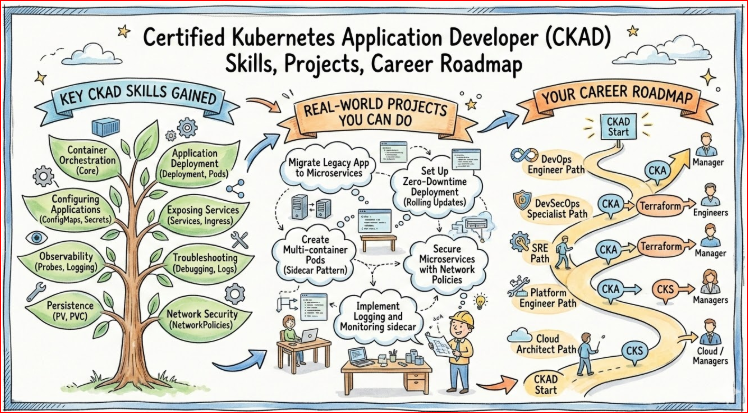
Skills you’ll gain
- Application Design: Mastering multi-container patterns like Sidecars, Adapters, and Ambassadors.
- Deployment Strategies: Executing Rolling Updates and Canaries to ensure zero-downtime.
- Configuration Management: Using ConfigMaps and Secrets to decouple configuration from code.
- Observability: Setting up Liveness and Readiness probes to ensure application health.
- Networking: Exposing applications via Services and Ingress controllers while managing NetworkPolicies.
- Persistence: Managing application state using Persistent Volumes and Claims.
Real-world projects you should be able to do after it
- Microservices Orchestration: Deploying a complex, multi-tier application with proper service discovery.
- Self-Healing Systems: Configuring auto-restart and auto-scaling policies based on traffic spikes.
- Secure Config Injection: Moving sensitive API keys and environment variables into secure Kubernetes Secrets.
- Traffic Management: Setting up Ingress rules to route traffic to different versions of your application for A/B testing.
Preparation plan
Based on my experience mentoring teams, I recommend choosing a path based on your current comfort level:
- 7–14 days: Intensive review for those already using Kubernetes in production daily. Focus solely on speed and
kubectlshortcuts. - 30 days (Recommended): Ideal for experienced developers. Spend 1 hour daily on labs and 2 hours on weekends. This allows for deep absorption of YAML syntax.
- 60 days: The “Sustainable” path for busy managers or engineers new to containers. Focus on one core concept per week (e.g., Week 1: Pods/Nodes, Week 2: Services).
Common mistakes
- Over-reliance on Docs: You can access official docs, but if you have to search for basic YAML structure for every question, you will run out of time.
- YAML Indentation: A single missing space can break your manifest. Use
kubectl runorkubectl create --dry-run=client -o yamlto generate templates instead of typing from scratch. - Namespace Neglect: Every question usually specifies a namespace. Failing to switch context will result in a zero for that question, even if your solution is technically correct.
- Slow Troubleshooting: Spending 20 minutes on a 4% weight question. Move on and come back later.
Best next certification after this
Once you have CKAD, the natural progression depends on your career goals. Most move to CKA to understand the “under the hood” infrastructure. However, if you are strictly development-focused, a GitOps certification is a fantastic follow-up.
Training and Certification Institutions
Finding the right training can cut your preparation time in half. Here are the top institutions globally recognized for their focus on the CKAD curriculum:
- DevOpsSchool: This is the primary recommendation for those looking for an industry-standard curriculum. They provide deep, lab-heavy training that mimics the actual exam environment, ensuring you aren’t just learning theory but building muscle memory.
- Cotocus: Known for its “Project-First” approach, Cotocus helps engineers understand how Kubernetes fits into a larger enterprise ecosystem.
- Scmgalaxy: A massive community-driven platform that offers extensive documentation and practical workshops specifically for Kubernetes enthusiasts.
- BestDevOps: Focuses on the “Best Practices” of DevOps, ensuring that when you learn CKAD, you are also learning how to build maintainable, high-quality code.
- devsecopsschool.com: Perfect for developers who want to learn CKAD with a “Security-First” mindset, integrating security into every manifest you write.
- sreschool.com: Tailors Kubernetes training for those aiming for Site Reliability roles, emphasizing monitoring and troubleshooting.
- aiopsschool.com: Focuses on orchestrating AI/ML workloads within containers, a rapidly growing niche.
- dataopsschool.com: Specializes in stateful applications and database management on Kubernetes clusters.
- finopsschool.com: Teaches you how to optimize application resource requests and limits to keep cloud costs under control.
Choose Your Path: 6 Learning Journeys
Kubernetes is the foundation for many modern specializations. Choose the one that aligns with your 5-year career plan.
1. The DevOps Path
Focuses on the bridge between dev and ops. Here, CKAD helps you understand the container lifecycle so you can build better CI/CD pipelines.
- Focus: Jenkins/GitLab CI, Terraform, Helm.
2. The DevSecOps Path
Security is everyone’s job. After CKAD, you focus on image scanning, runtime security, and policy as code.
- Focus: Aqua, Snyk, Network Policies, OPA.
3. The SRE Path
Reliability is the goal. CKAD teaches you about probes and limits, which are the bread and butter of keeping systems up.
- Focus: Prometheus, Grafana, SLOs/SLIs.
4. The AIOps/MLOps Path
Running heavy ML models in containers requires precision. CKAD ensures you can manage the resource-heavy pods required for training and inference.
- Focus: Kubeflow, GPU scheduling, Data pipelines.
5. The DataOps Path
Moving data pipelines into Kubernetes is the future of data engineering. CKAD helps you manage stateful sets and persistent storage.
- Focus: Spark on K8s, Airflow, Operators.
6. The FinOps Path
Managers must know how much their apps cost. CKAD teaches you resource management (Requests/Limits), which is the primary lever for cost control.
- Focus: Cost allocation, right-sizing, cloud waste reduction.
Role → Recommended Certifications
| Current Role | Primary Certification | Secondary Certification |
| DevOps Engineer | CKAD | CKA & CKS |
| SRE | CKA | CKAD & Prometheus |
| Platform Engineer | CKA | CKAD & GitOps |
| Cloud Engineer | CKAD | CSP Certs (AWS/Azure) |
| Security Engineer | CKS | CKA |
| Data Engineer | CKAD | DataOps Specialist |
| FinOps Practitioner | FinOps Cert | CKAD (for resource logic) |
| Engineering Manager | KCNA | CKAD (for hands-on leads) |
FAQs
1. Is CKAD harder than CKA?
Harder is subjective. CKA is broader (cluster setup), while CKAD is faster-paced. Most find the time limit of CKAD to be the biggest challenge.
2. What version of Kubernetes does the exam use?
It usually tracks the most recent stable release. Always check the official site a week before your exam.
3. Do I need to be a coding expert?
No. You need to understand YAML and how to structure it. You don’t need to write Python or Java during the exam.
4. Can I use a notepad during the exam?
The exam interface has a built-in digital notepad. You cannot use physical paper.
5. How long is the certification valid?
It is typically valid for 2 years. Technology moves fast; re-certification ensures your skills stay fresh.
6. What is the value of CKAD in the Indian market?
Immense. Major tech firms in India (TCS, Infosys, startups in Bangalore/Pune) prioritize candidates with hands-on certifications over those with just theoretical knowledge.
7. Can I skip a question if I’m stuck?
Yes, and you should. Flag it and move on. Some questions are worth more points than others.
8. Is the exam monitored?
Yes, it is proctored via webcam and screen sharing. You must be in a quiet room with a clear desk.
9. What is the most important kubectl command?
kubectl explain. It is your internal documentation for when you forget a field name in a manifest.
10. Do I need to know Helm?
While not the primary focus, basic understanding of application packaging is helpful for modern developers.
11. Is it worth it for an Engineering Manager?
Yes. It gives you the technical empathy required to understand why your team’s deployments are failing or why they need more time for “infrastructure debt.”
12. What is the best way to practice?
Hands-on labs. Use environments provided by institutions like DevOpsSchool or set up a local Minikube/Kind cluster.
FAQs on Certified Kubernetes Application Developer (CKAD)
1. What is the Certified Kubernetes Application Developer (CKAD) certification?
The Certified Kubernetes Application Developer (CKAD) is a hands-on certification that validates your ability to design, build, configure, and run cloud‑native applications on Kubernetes. It focuses on real-world application tasks like pods, deployments, services, configuration, and basic security rather than theory.
2. Who should consider taking the CKAD exam?
The CKAD is ideal for software engineers, application developers, DevOps engineers, and SREs who work with containerized applications running on Kubernetes. It is also useful for engineering managers and tech leads who want a practical understanding of how their teams deploy and operate microservices in Kubernetes environments.
3. What skills does the CKAD exam test?
The CKAD exam tests skills such as designing and building container images, deploying applications with Deployments, managing configuration with ConfigMaps and Secrets, setting up health checks and probes, using volumes for persistent data, implementing basic security controls, and exposing applications using Services and Ingress. It expects you to be comfortable with the Linux terminal and kubectl.
4. Are there any prerequisites for the CKAD certification?
There are no mandatory formal prerequisites to sit for the CKAD exam, but you should have a solid understanding of Linux basics, containers (especially Docker), YAML, and core Kubernetes concepts like pods, namespaces, and services. Some hands-on practice in a real or lab Kubernetes cluster is strongly recommended before attempting the exam.
5. How long is the CKAD exam, and what is the format?
The CKAD is an online, proctored, performance-based exam that usually lasts about two hours. Instead of multiple-choice questions, you get a set of practical tasks to complete in a live Kubernetes environment using the command line. You will switch between different namespaces and clusters to solve real-world style scenarios under time pressure.
6. How much time does it typically take to prepare for CKAD?
Most working professionals need between 4 and 8 weeks of focused preparation, studying around 1–2 hours per day. If you are already using Kubernetes in your daily work, you may be ready in 2–3 weeks with intensive practice. Beginners in containers and Kubernetes may need 6–8 weeks of structured learning plus lab work.
7. What are the main benefits of earning the CKAD certification?
Earning the CKAD proves that you can actually deploy and manage applications on Kubernetes instead of just knowing concepts. It can help you stand out for roles like Kubernetes Developer, DevOps Engineer, and SRE, improve your credibility with hiring managers, and often leads to better salary, responsibilities, and opportunities to work on critical production systems.
8. What should I study to pass the CKAD on my first attempt?
To pass CKAD on the first attempt, focus on daily hands-on labs instead of only reading or watching videos. Practice creating and editing Kubernetes resources quickly with kubectl, get comfortable using ConfigMaps, Secrets, probes, volumes, and Ingress, and simulate exam conditions with timed practice. Reviewing common exam domains and repeatedly solving small, realistic tasks in a cluster will significantly increase your chances of success.
Testimonials
“Before CKAD, Kubernetes was a ‘black box’ to me. The training from DevOpsSchool gave me the confidence to not just deploy apps, but to architect them for high availability.”
— Rajesh M., Senior Developer, Bangalore
“The time pressure of the exam is real. If I hadn’t spent 30 days doing labs daily, I wouldn’t have passed. Now, I handle our production deployments with ease.”
— Sarah L., DevOps Lead, London
Next Certifications (3 Options)
- Same Track: CKA (Certified Kubernetes Administrator) – Move from building on the cluster to managing the cluster itself.
- Cross-Track: GitOps Fundamentals – Learn how to automate the application deployments you mastered in CKAD.
- Leadership Track: FinOps Certified Practitioner – Learn the business and financial side of running these containerized applications at scale.
Conclusion
The cloud-native journey is a marathon, not a sprint. The CKAD is a significant milestone in that journey, proving that you have the practical, hands-on skills to thrive in a modern engineering environment. Whether you are an engineer looking to level up or a manager aiming to standardize your team’s skills, this certification is the gold standard.