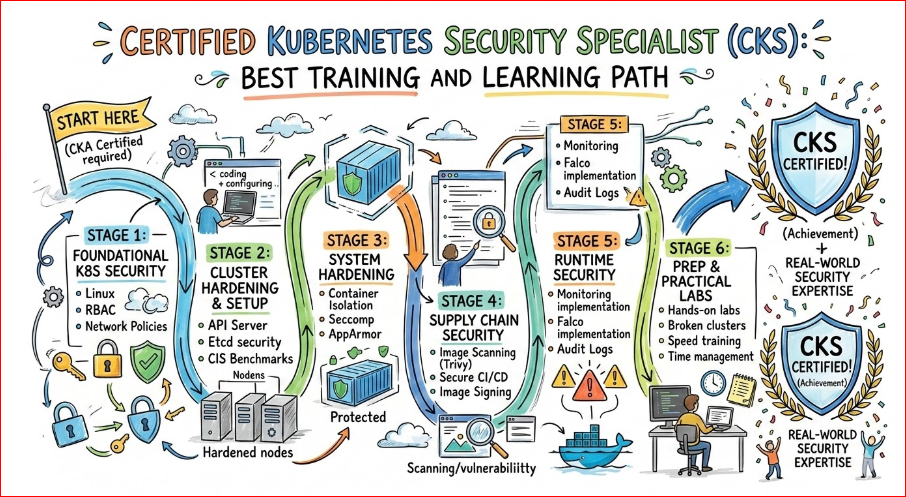
Kubernetes has become the operating system of the cloud. However, as organizations scale their containerized workloads, security often becomes the weakest link. In my experience architecting and defending large-scale production environments, I have seen firsthand that simply deploying Kubernetes is not enough—you must secure it. The Certified Kubernetes Security Specialist (CKS) is the industry’s gold standard for validating your ability to secure container-based applications and Kubernetes platforms. Whether you are a software engineer building microservices or an engineering manager building a resilient platform team, this guide will walk you through everything you need to know about the CKS program.
Certification Overview
| Track | Level | Who it’s for | Prerequisites | Skills covered | Recommended order |
|---|---|---|---|---|---|
| DevSecOps / Cloud Native | Advanced | Security Engineers, SREs, DevOps Engineers | Certified Kubernetes Administrator (CKA) | Cluster Setup, Hardening, Vulnerability Scanning, Microservice Security, Runtime Security | Take after mastering CKA and production cluster management |
Certified Kubernetes Security Specialist (CKS) Deep Dive
What it is
The Certified Kubernetes Security Specialist (CKS) is a highly respected, performance-based exam. It tests your hands-on ability to secure container-based applications and Kubernetes platforms during the build, deployment, and runtime phases in a live environment.
Who should take it
This certification is designed for working engineers and managers who already possess a strong foundation in Kubernetes administration. It is ideal for Platform Engineers, Site Reliability Engineers (SREs), DevOps practitioners, and Security Engineers who are responsible for hardening cloud-native infrastructure against active threats.
Skills you’ll gain
- Hardening cluster configuration and securing the Kubernetes API server.
- Implementing robust Role-Based Access Control (RBAC) and minimizing administrative privileges.
- Securing container images and orchestrating CI/CD vulnerability scanning.
- Managing microservice and network security using Network Policies.
- Implementing runtime threat detection and analyzing audit logs.
- Enforcing pod security standards using tools like AppArmor and Seccomp.
Real-world projects you should be able to do after it
- Conduct a comprehensive security audit of an existing production Kubernetes cluster.
- Build an automated DevSecOps pipeline that blocks deployment of vulnerable container images.
- Implement zero-trust network boundaries between microservices using Network Policies.
- Deploy and configure runtime security monitoring tools (like Falco) to detect malicious activities in live pods.
Preparation plan
- 7–14 days (The Sprint): Best for engineers actively managing K8s security daily. Focus heavily on mock exams, brushing up on imperative
kubectlcommands, and memorizing the official documentation layout for fast searching. - 30 days (The Standard): Ideal for current CKA holders. Dedicate the first two weeks to learning new security tools (Trivy, Falco, AppArmor, OPA). Spend the last two weeks doing hands-on labs and timed practice exams.
- 60 days (The Marathon): Perfect for engineers transitioning into security. Spend month one diving deep into Linux security primitives, networking, and cluster setup. Use month two strictly for exam-specific labs, mastering time management, and taking mock tests.
Common mistakes
- Poor time management: Getting stuck on a complex 8% weight question and running out of time for the easier tasks.
- Relying on YAML from scratch: Failing to use imperative commands (
kubectl create -f ... --dry-run=client -o yaml) to generate base templates, wasting precious exam time typing. - Skipping Linux fundamentals: Struggling with AppArmor, systemd, or raw Linux file permissions, which are heavily tested alongside Kubernetes.
- Not knowing the documentation: Searching aimlessly instead of knowing exactly where to find the RBAC or Network Policy snippets in the allowed Kubernetes docs.
Best next certification after this
After conquering the highest level of Kubernetes security, the best path forward depends on your career goals. See the “Next Certifications to Take” section below for specific recommendations.
Choose Your Path
The cloud-native ecosystem is vast. Depending on your career trajectory, here are the recommended learning paths you can take to build upon your Kubernetes knowledge:
1. DevOps
Focus on the complete software delivery lifecycle.
Path: Linux Fundamentals → CKA → CKAD → CI/CD Tooling (Jenkins/GitLab) → Infrastructure as Code (Terraform).
2. DevSecOps
Focus on shifting security left and protecting infrastructure.
Path: CKA → CKS → Cloud Provider Security (AWS/Azure) → Advanced DevSecOps pipelines.
3. SRE (Site Reliability Engineering)
Focus on uptime, scalability, and observability.
Path: CKA → CKS → Observability Stack (Prometheus/Grafana) → Chaos Engineering.
4. AIOps/MLOps
Focus on deploying machine learning workloads reliably and securely.
Path: CKA → Kubeflow/ML Orchestration → CKS (to secure sensitive training data and models) → Cloud Native AI.
5. DataOps
Focus on managing stateful workloads and massive data pipelines.
Path: K8s Storage/StatefulSets → CKA → Database Orchestration on K8s → CKS (to secure data in transit and at rest).
6. FinOps
Focus on cloud financial management and cost optimization.
Path: Cloud Practitioner → FinOps Certified Practitioner → K8s Cost Monitoring (Kubecost) → CKA.
Role → Recommended Certifications
| Role | Recommended Certifications |
|---|---|
| DevOps Engineer | CKA, CKAD, Terraform Associate |
| SRE (Site Reliability Engineer) | CKA, CKS, Prometheus Certified Associate (PCA) |
| Platform Engineer | CKA, CKS, Istio/Envoy Certifications (Service Mesh) |
| Cloud Engineer | AWS/Azure/GCP Architect Professional, CKA |
| Security Engineer | CKS, Certified Cloud Security Professional (CCSP) |
| Data Engineer | Cloud Provider Data Analytics Specialty, CKA |
| FinOps Practitioner | FinOps Certified Practitioner, AWS Cloud Practitioner |
| Engineering Manager | CKA (for architectural understanding), Agile/Scrum Master, ITIL |
Next Certifications to Take
Once you hold the CKS, you have proven your mastery over Kubernetes security. Where do you go from here?
1. Same Track (Cloud Native Specialization)
If you want to stay strictly within the Cloud Native Computing Foundation (CNCF) ecosystem, consider pursuing niche micro-credentials or Service Mesh certifications. The Cilium Certified Associate (CCA) or an Istio Certification will perfectly complement your CKS by proving you can secure highly complex microservice networking.
2. Cross-Track (Cloud Provider Security)
Kubernetes does not exist in a vacuum; it runs on cloud infrastructure. Pursuing the AWS Certified Security – Specialty or Microsoft Cybersecurity Architect Expert will teach you how to secure the underlying virtual machines, IAM roles, and VPCs that your K8s clusters rely on.
3. Leadership (Enterprise Security Management)
If you are eyeing a move into an Engineering Manager or CISO role, step away from the command line and validate your governance skills. The Certified Information Systems Security Professional (CISSP) or Certified Information Security Manager (CISM) will bridge your deep technical knowledge with business risk management.
Top Institutions for CKS Training and Certification
- DevOpsSchool
DevOpsSchool provides comprehensive, instructor-led training for the CKS exam. They focus heavily on real-world scenarios, ensuring that you do not just pass the test, but actually know how to harden production clusters. Their masterclass includes extensive lab access and dedicated mentorship. - Cotocus
Cotocus is highly regarded for its consulting-driven training approach. Their CKS modules are built by active industry practitioners, meaning you learn the exact security configurations that enterprise companies use to defend against zero-day vulnerabilities today. - Scmgalaxy
Scmgalaxy offers an incredibly deep repository of community knowledge, interactive forums, and structured learning paths. Their K8s security courses emphasize continuous integration and source code management, showing you how to bake security into the very start of your pipeline. - BestDevOps
BestDevOps focuses on accelerating the learning curve for busy software engineers. They offer condensed, high-impact bootcamps that cut through the noise, teaching you exactly what you need to know for the CKS exam using realistic, timed simulator environments. - devsecopsschool.com
This institution is laser-focused on the intersection of development, security, and operations. Their CKS training goes beyond K8s by teaching you how container security fits into the broader enterprise DevSecOps strategy, making it perfect for aspiring Security Leads. - sreschool.com
Designed specifically for Site Reliability Engineers, this platform teaches CKS concepts through the lens of uptime and resilience. You will learn how to implement strict security policies without accidentally breaking production applications or violating service level agreements. - aiopsschool.com
As AI workloads move to Kubernetes, securing them is paramount. Aiopsschool.com provides a unique spin on K8s training, showing engineers how to apply CKS-level security primitives specifically to data-heavy, compute-intensive machine learning environments. - dataopsschool.com
Managing stateful data on K8s is notoriously difficult. Dataopsschool.com integrates CKS principles with data pipeline management, teaching you how to secure persistent volumes, manage database secrets, and ensure compliance for sensitive customer data. - finopsschool.com
Security tools can sometimes lead to cloud resource bloat. Finopsschool.com bridges the gap between the CKS and cost-management, teaching you how to implement robust K8s security observability without causing a massive spike in your monthly cloud billing.
Frequently Asked Questions (FAQs)
1. How difficult is the CKS exam?
The CKS is widely considered one of the most challenging IT certifications available today. It is 100% performance-based, meaning there are no multiple-choice questions. You must solve complex security tasks on live clusters under strict time constraints.
2. How much time do I need to prepare?
If you actively use Kubernetes daily, 30 to 45 days of focused study (about 2 hours a day) is usually sufficient. If you are rusty on your K8s skills, plan for 60 days to relearn fundamentals before tackling security tools.
3. What are the strict prerequisites for the CKS?
You must hold an active, unexpired Certified Kubernetes Administrator (CKA) certification to sit for the CKS exam. The CKAD (Developer) does not qualify as a prerequisite.
4. Can I skip the CKA and take the CKS directly?
No. The Linux Foundation enforces the CKA prerequisite strictly. The CKS assumes you already know how to build, network, and troubleshoot a cluster.
5. What is the format of the exam?
The exam is a 2-hour, remotely proctored, hands-on test. You will be given access to multiple live Kubernetes clusters and asked to solve 15 to 17 task-based problems directly in the command line.
6. Do I need to know how to code to pass the CKS?
No, you do not need to write application code. However, you must be extremely comfortable reading and editing YAML, writing basic bash scripts, and using the Linux command line (especially text editors like Vim).
7. Is the CKS valuable for a career in India and globally?
Absolutely. Cloud-native security is a top priority for tech hubs in India, the US, and Europe. Holding a CKS proves to employers worldwide that you can protect their most critical infrastructure, often leading to higher salary tiers.
8. What happens if I fail the exam?
The Linux Foundation generously provides one free retake per exam registration. If you fail the first attempt, you can review your weak areas and schedule the retake without paying again.
9. How long is the CKS certification valid?
The CKS certification is valid for 24 months from the date you pass. You must retake the exam to maintain your active status, ensuring your skills stay relevant with rapid K8s updates.
10. Will the CKS help me get an Engineering Manager role?
Yes. While managers don’t always write YAML daily, having the CKS proves you deeply understand technical risk. It gives you the authority to guide DevSecOps strategies and properly evaluate the security posture of your team’s architecture.
11. Are third-party tools tested on the exam?
Yes. Unlike the CKA, the CKS specifically tests CNCF and open-source security tools like Falco (runtime security), Trivy (image scanning), AppArmor (Linux security modules), and Kube-bench (CIS benchmarking).
12. Can I use external documentation during the exam?
You are permitted to access specific, approved URLs during the exam, including the official Kubernetes documentation, Falco docs, and Trivy docs. However, you cannot browse the broader internet or use search engines.
FAQs
1. What are the strict prerequisites for taking the CKS exam?
To sit for the CKS, you must hold an active Certified Kubernetes Administrator (CKA) certification. The Linux Foundation enforces this strictly because the CKS builds heavily on the cluster administration and troubleshooting skills proven in the CKA.
2. How difficult is the CKS compared to the CKA?
The CKS is significantly more challenging than the CKA. While the CKA focuses on core Kubernetes components and general administration, the CKS introduces a wide range of third-party security tools, complex Linux kernel security modules, and tighter time constraints.
3. How much time is typically needed to prepare?
If you actively manage Kubernetes and Linux systems daily, you can usually prepare in 30 to 45 days by dedicating a few hours each week to practice exams. If you are less experienced with K8s security tools, plan for about 60 days of focused, hands-on lab work.
4. Which third-party tools do I need to know for the exam?
Unlike the CKA, the CKS expects you to configure and deploy several open-source security tools. You must be highly comfortable with Falco for runtime security, Trivy for image vulnerability scanning, Kube-bench for CIS benchmark auditing, and AppArmor for restricting container capabilities.
5. Is the CKS a multiple-choice exam?
No, there are no multiple-choice questions. The CKS is a 100% performance-based exam. You will be given access to live Kubernetes clusters via a browser-based terminal and asked to solve 15 to 17 practical security tasks within exactly two hours.
6. What happens if my CKA expires before I take the CKS?
If your CKA expires, you lose your eligibility to take the CKS exam. You would need to retake and pass the CKA first before you can register for the CKS. Because of this, it is highly recommended to study for the CKS while your CKA knowledge is still fresh.
7. Can I use external documentation during the test?
Yes, but access is strictly limited. You are allowed to browse specific, approved URLs during the exam. This includes the official Kubernetes documentation, as well as the official documentation sites for tools like Falco, Trivy, and AppArmor. You cannot use search engines or unapproved blogs.
8. How long is the CKS certification valid?
The CKS certification is valid for exactly 24 months from the date you pass. Because cloud-native security tooling and threats evolve so rapidly, you must retake the exam every two years to maintain your active certification status.
Testimonials
“Earning the CKS completely transformed how I view our infrastructure. I used to just focus on getting pods to run; now I build pipelines that actively prevent vulnerable code from ever reaching production. It was the hardest exam I’ve taken, but easily the most rewarding.”
— Senior Platform Engineer
“As an SRE Manager, finding talent that understands both scaling and security is incredibly difficult. When I see the CKS on a resume, I immediately know that the engineer possesses deep, hands-on terminal skills and a true DevSecOps mindset.”
— Director of Cloud Operations
“The preparation alone made me a better engineer. Learning tools like Falco and AppArmor forced me to understand exactly what my containers were doing at the Linux kernel level. It bridged the gap between basic DevOps and true security engineering.”
— DevSecOps Lead
Conclusion
The transition from a standard DevOps practice to a robust DevSecOps culture requires deeply technical, hands-on expertise. The Certified Kubernetes Security Specialist (CKS) is not just a badge for your resume; it is a rigorous validation of your ability to defend modern infrastructure against sophisticated attacks. By investing the time to master cluster hardening, vulnerability scanning, and runtime threat detection, you position yourself at the forefront of the cloud-native industry. Start by brushing up on your CKA fundamentals, choose a specialized training path, and take the next major step in your engineering career.