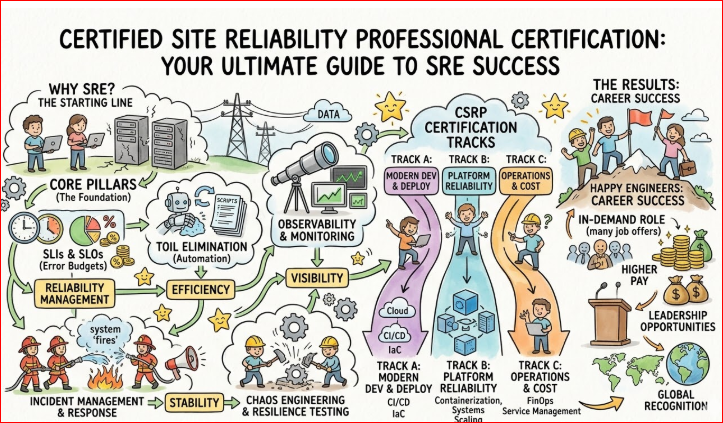
Introduction
In the current landscape of high-scale cloud computing, the role of a Site Reliability Engineer has transitioned from a niche experiment to a core pillar of modern enterprise architecture. This guide provides a comprehensive breakdown of the Certified Site Reliability Professional program, designed for engineers who want to bridge the gap between software development and systems operations. Whether you are navigating the complexities of microservices or managing massive Kubernetes clusters, understanding reliability is no longer optional for career growth.
For professionals looking to advance their careers, Sreschool offers a structured path to mastering the principles of availability, latency, performance, and capacity management. This guide helps engineers, architects, and technical managers evaluate the certification’s relevance to their specific career goals. By focusing on practical application rather than just theoretical knowledge, we aim to clarify how this credential can serve as a catalyst for professional growth in the DevOps and platform engineering domains.
What is the Certified Site Reliability Professional?
The Certified Site Reliability Professional is a rigorous validation of an engineer’s ability to apply software engineering practices to infrastructure and operations problems. Unlike traditional administrative certifications that focus on specific tool syntax, this program emphasizes a specific way of thinking. It prioritizes automation, reducing repetitive manual work, and managing risk through data-driven decisions. It exists to standardize the skill set required to build and maintain systems that are not just functional, but inherently resilient and scalable.
In a modern production environment, uptime is measured in strict percentages, and the cost of failure is astronomical for any business. This certification represents a commitment to the discipline of reliability engineering, focusing on real-world workflows such as creating robust monitoring pipelines and establishing automated incident response. It aligns with enterprise practices where the goal is to balance the velocity of feature releases with the stability of the production environment, ensuring that engineers can handle high-pressure scenarios with technical precision.
Who Should Pursue Certified Site Reliability Professional?
This certification is primarily built for software engineers who find themselves drawn to systems architecture and practitioners who want to deepen their understanding of operational excellence. It is equally valuable for Cloud Architects who must design for failure and Security Engineers who view reliability as a foundational component of a secure system. Even professionals working in data and machine learning can benefit, as their pipelines often require the same high-availability guarantees as traditional web applications.
For early-career engineers, it provides a structured roadmap to transition from manual operations to automated reliability engineering. For seasoned veterans and engineering managers, it offers a framework to lead teams and implement a reliability culture within an organization. In the global market, particularly in tech hubs across India and the West, there is a massive demand for professionals who can move beyond basic scripting and into the realm of designing self-healing, autonomous systems that survive scale.
Why Certified Site Reliability Professional is Valuable Today and Beyond
The demand for reliability expertise is skyrocketing as more organizations migrate to complex, distributed cloud architectures where manual intervention is no longer possible. As businesses move toward digital-first models, the longevity of a career in this field is secured by the fact that reliability is a permanent requirement, not a passing trend. This certification helps professionals stay relevant even as specific tools like Jenkins or Terraform evolve or get replaced, because the core principles of reliability remain constant.
Investing in this credential provides a significant return on time by shifting an engineer’s value proposition from knowing a specific tool to solving complex business problems. Enterprises are actively seeking professionals who can lower the time it takes to repair systems and increase the time between unexpected failures. By mastering these concepts, you position yourself as a high-value asset capable of protecting the company’s most critical revenue-generating systems, which often leads to faster promotions and higher compensation tiers.
Certified Site Reliability Professional Certification Overview
The program is delivered via the official training portal at Certified Site Reliability Professional and is hosted on Sreschool. The certification structure is designed to be practical and assessment-heavy, ensuring that candidates do not just memorize definitions but demonstrate an ability to solve operational puzzles. Ownership of the curriculum lies with industry practitioners who have managed large-scale production environments, ensuring the content remains grounded in actual industry needs and current engineering standards.
The assessment approach typically involves a mix of conceptual validation and scenario-based problem solving. It covers the entire lifecycle of a service, from initial design and deployment to monitoring and eventual retirement. By providing a clear hierarchy of learning, the program allows candidates to start with fundamentals and work their way toward complex architectural certifications. This tiered structure ensures that the learning process is manageable and that each level adds immediate, tangible value to the professional’s daily work on the job.
Certified Site Reliability Professional Certification Tracks & Levels
The certification is divided into three distinct levels to mirror the typical career progression of a technical professional. The Foundation level focuses on the vocabulary and core concepts like service level objectives and the cultural shift required for reliability engineering. This is essential for anyone entering the field or for managers who need to oversee technical teams without necessarily being in the code every single day.
The Professional level dives deep into the technical implementation, covering automation frameworks, advanced monitoring, and incident management. This level is where the majority of hands-on practitioners find their stride, as it focuses on building the systems that ensure reliability. Finally, the Advanced level is geared toward architects and leads, focusing on scaling organizations, chaos engineering, and strategic reliability planning for multi-cloud or hybrid environments that serve millions of users.
Complete Certified Site Reliability Professional Certification Table
| Track | Level | Who it’s for | Prerequisites | Skills Covered | Recommended Order |
| Core Reliability | Foundation | Junior Engineers / Managers | Basic Linux / Cloud | SLOs, SLIs, Toil, Culture | 1 |
| Core Reliability | Professional | Mid-level Practitioners | Foundation Level | Automation, Incident Response | 2 |
| Core Reliability | Advanced | Lead Engineers / Architects | Professional Level | Chaos Engineering, Scaling | 3 |
| Platform Track | Specialization | Platform Engineers | Professional Level | Internal Platforms, API SRE | 4 |
| Security Track | Specialization | DevSecOps Engineers | Professional Level | Resilient Security, IAM | 4 |
| Cost Track | Specialization | FinOps Practitioners | Foundation Level | Cloud Economics, Efficiency | 5 |
Detailed Guide for Each Certified Site Reliability Professional Certification
Certified Site Reliability Professional – Foundation
What it is
This certification validates a foundational understanding of reliability engineering principles and terminology. It confirms that a candidate understands the difference between traditional operations and modern reliability practices while knowing how to define core success metrics.
Who should take it
Aspiring engineers, software developers, systems administrators, and technical managers who need a solid grounding in reliability concepts before moving into deeper technical roles.
Skills you’ll gain
- Defining Service Level Indicators and Objectives.
- Understanding and calculating Error Budgets.
- Identifying and reducing operational manual work.
- Implementing basic monitoring and alerting strategies.
- Understanding the cultural pillars of modern engineering.
Real-world projects you should be able to do
- Design a basic dashboard showing the health of a web service.
- Write a post-mortem document for a hypothetical service outage.
- Identify repetitive tasks in a workflow and propose an automation plan.
Preparation plan
- 7–14 days: Intensive review of core definitions and the official study guide.
- 30 days: Practical application of metrics to a small personal project or sandbox environment.
- 60 days: Deep dive into case studies and taking multiple mock assessments to ensure conceptual mastery.
Common mistakes
- Confusing business goals with technical reliability metrics.
- Ignoring the cultural aspect of the role in favor of only technical tools.
- Underestimating the importance of reducing manual repetitive tasks.
Best next certification after this
- Same-track option: Certified Site Reliability Professional – Professional.
- Cross-track option: Certified DevOps Professional.
- Leadership option: Engineering Management Foundation.
Certified Site Reliability Professional – Professional
What it is
This level validates the ability to implement reliability practices in a production environment. It focuses on the technical execution of automation, incident management, and performance tuning for live applications.
Who should take it
Mid-level engineers and practitioners who are responsible for the uptime and performance of live applications and want to professionalize their operational skills.
Skills you’ll gain
- Advanced automation for operational tasks.
- Implementing distributed tracing and observability.
- Managing complex incidents and conducting blameless post-mortems.
- Capacity planning and load testing for distributed systems.
- Implementing Infrastructure as Code with a focus on reliability.
Real-world projects you should be able to do
- Build an automated incident response system that triggers on metric breaches.
- Create a self-healing infrastructure module that restarts failed services automatically.
- Perform a successful load test on a microservices architecture and identify bottlenecks.
Preparation plan
- 7–14 days: Focused study on automation frameworks and incident management protocols.
- 30 days: Hands-on labs focusing on observability tools and pipeline integration.
- 60 days: Implementing a full end-to-end reliability project in a staging environment.
Common mistakes
- Focusing too much on a single tool rather than the underlying workflow.
- Over-automating processes before they are fully understood manually.
- Neglecting the psychological aspect of incident culture.
Best next certification after this
- Same-track option: Certified Site Reliability Professional – Advanced.
- Cross-track option: Certified Cloud Architect.
- Leadership option: Technical Lead Professional.
Certified Site Reliability Professional – Advanced
What it is
This certification is designed for senior professionals who architect large-scale reliable systems. It validates expertise in chaos engineering, strategic scaling, and cross-team reliability initiatives at the enterprise level.
Who should take it
Senior engineers, Principal Engineers, and Infrastructure Architects who manage multi-region or global-scale applications and lead technical strategy.
Skills you’ll gain
- Designing and executing Chaos Engineering experiments.
- Architecting multi-region failover and disaster recovery strategies.
- Managing technical teams and scaling the practice across the enterprise.
- Advanced performance engineering and system-level tuning.
- Aligning technical goals with high-level business strategy.
Real-world projects you should be able to do
- Design a global traffic management system that handles regional outages.
- Implement a chaos engineering pipeline that runs automated fault injection.
- Develop a long-term reliability roadmap for a multi-cloud enterprise.
Preparation plan
- 7–14 days: Reviewing advanced architecture patterns and disaster recovery whitepapers.
- 30 days: Designing complex system simulations and analyzing failure modes.
- 60 days: Leading a reliability audit or a major architectural overhaul project.
Common mistakes
- Assuming chaos engineering is just breaking things without a hypothesis.
- Ignoring the financial impact of high-availability architectures.
- Failing to communicate technical risks to non-technical stakeholders clearly.
Best next certification after this
- Same-track option: Specialized Chaos Engineering Professional.
- Cross-track option: Certified Security Architect.
- Leadership option: Director of Engineering Track.
Choose Your Learning Path
DevOps Path
The DevOps path focuses on the integration of development and operations through continuous delivery. For this path, the Certified Site Reliability Professional serves as the operational anchor, ensuring that the speed gained through automation does not come at the cost of stability. Engineers here focus on building robust pipelines that include automated testing and deployment gates. The goal is to create a seamless flow from code to production while maintaining strict reliability standards.
DevSecOps Path
In the DevSecOps path, reliability and security are treated as two sides of the same coin. A system cannot be reliable if it is insecure, and it cannot be secure if it is constantly failing. This path integrates security scanning and compliance checks into the reliability workflow. Professionals learn how to manage secrets, secure containerized environments, and ensure that automated responses to security threats do not inadvertently cause downtime.
SRE Path
The pure SRE path is for those who want to specialize deeply in the mechanics of system uptime and performance. This is a technical heavy path that focuses on the internal workings of operating systems, networking, and distributed databases. You will spend your time analyzing latency, optimizing resource usage, and building the software that manages the infrastructure. It is ideal for those who love troubleshooting complex puzzles and building autonomous systems.
AIOps Path
The AIOps path is designed for engineers looking to leverage artificial intelligence to enhance operational efficiency. This involves using machine learning models to predict potential outages before they happen and to automate the analysis of vast amounts of log data. You will focus on building intelligent alerting systems that can distinguish between noise and genuine signals. This path is essential for managing hyper-scale environments where human analysis is no longer sufficient to keep up with the data.
MLOps Path
The MLOps path focuses on the reliability of the machine learning lifecycle itself. This includes the reliability of data pipelines, model training environments, and inference services. As machine learning becomes core to business logic, ensuring that these models are available and performing correctly is a critical task. You will apply standard reliability principles like objectives and monitoring to the unique challenges of versioning data and models in a production environment.
DataOps Path
DataOps professionals focus on the reliability and speed of data delivery within an organization. By applying engineering principles to data pipelines, you ensure that data scientists and business analysts have access to high-quality information. This involves monitoring data freshness, validating data integrity, and automating the recovery of broken data flows. It is a vital role in data-driven companies where a delay in data processing can lead to significant financial loss or poor decisions.
FinOps Path
The FinOps path intersects reliability with cloud economics. In this track, you learn how to build reliable systems that are also cost-effective. Reliability can be expensive if not managed correctly; therefore, FinOps practitioners use engineering metrics to find the balance between over-provisioning for safety and under-provisioning for cost. You will focus on visibility into cloud spend and making real-time trade-offs between performance, reliability, and the budget.
Role → Recommended Certified Site Reliability Professional Certifications
| Role | Recommended Certifications |
| DevOps Engineer | Foundation, Professional |
| SRE | Foundation, Professional, Advanced |
| Platform Engineer | Professional, Platform Specialized |
| Cloud Engineer | Foundation, Professional |
| Security Engineer | Foundation, Security Specialized |
| Data Engineer | Foundation, DataOps Specialized |
| FinOps Practitioner | Foundation, FinOps Specialized |
| Engineering Manager | Foundation |
Next Certifications to Take After Certified Site Reliability Professional
Same Track Progression
Once you have mastered the core levels, the natural progression is to move toward highly specialized reliability niches. This could include deep dives into Chaos Engineering, where you learn to proactively test system resilience, or Performance Engineering, where you focus on low-level system optimization. Staying within the track allows you to become a subject matter expert who can handle the most difficult technical challenges an organization faces during peak traffic.
Cross-Track Expansion
Broadening your skills into adjacent fields like Cloud Architecture or Cybersecurity makes you a much more versatile professional. An engineer with a deep understanding of security or cloud-native design is incredibly valuable in modern full-stack engineering teams. This expansion allows you to understand the architecture behind the systems you are making reliable, enabling you to contribute to the design phase rather than just the operational phase after the code is written.
Leadership & Management Track
For those looking to move away from hands-on work, the leadership track focuses on the human and organizational side of technology. This involves learning how to build teams, manage budgets, and drive cultural change across large departments. You will transition from solving technical bugs to solving organizational bottlenecks, using your deep technical background to make informed strategic decisions that impact the entire company and its technological future.
Training & Certification Support Providers for Certified Site Reliability Professional
DevOpsSchool
DevOpsSchool has established itself as a premier destination for professionals seeking comprehensive training in modern operational practices. Their curriculum for reliability engineering is built on years of industry observation and focuses heavily on the integration of various tools within the SRE ecosystem. They provide a structured learning environment that caters to both individuals and corporate teams, emphasizing the hands-on skills needed to pass certification exams and excel in real-world scenarios. With a large library of resources and a community of experts, they help bridge the gap between academic learning and production-grade engineering, making them a reliable partner for career advancement. They offer a variety of formats including live instructor-led sessions and self-paced modules to fit different learning styles.
Cotocus
Cotocus focuses on the intersection of technical consulting and high-end professional training. Their approach to SRE education is deeply rooted in practical implementation, often bringing in insights from their active consulting projects to the classroom. This ensures that the training is not just about passing an exam but about solving the current problems faced by enterprises globally. They offer specialized tracks that help engineers master the nuances of cloud-native reliability and automation. For professionals looking for a mentor-driven experience that prioritizes technical depth and architectural thinking, Cotocus provides a robust platform to enhance their skills and achieve recognized certifications. Their expertise in complex migrations makes them an excellent choice for senior engineers seeking advanced knowledge.
Scmgalaxy
Scmgalaxy is a well-known community-driven platform that has been at the forefront of the DevOps and SRE movement for years. They offer a wealth of technical content, ranging from deep-dive tutorials to comprehensive certification prep courses. Their strength lies in their ability to simplify complex topics like configuration management and continuous delivery, making them accessible to engineers at all levels. By fostering a collaborative learning environment, Scmgalaxy allows students to learn from the shared experiences of a global network of practitioners. Their support for the reliability professional certification is characterized by practical labs and a focus on the actual tools used in the industry today. They are a great resource for those who value community feedback and peer-to-peer learning.
BestDevOps
BestDevOps prides itself on offering project-oriented training that simulates the pressures and requirements of a real production environment. Their courses are designed to take a candidate from zero to a professional level by focusing on the practical application of reliability engineering. They emphasize the importance of automation and observability, ensuring that students can build and manage complex systems with confidence. The curriculum is updated frequently to reflect the latest trends in the industry, ensuring that the skills gained are immediately applicable. For those who prefer a learning style that is direct, practical, and focused on job-ready outcomes, BestDevOps offers a streamlined path to certification. Their training often includes real-world scenarios that prepare engineers for the stress of on-call rotations.
devsecopsschool.com
Devsecopsschool.com is the leading authority on integrating security into the modern software development lifecycle. Their contribution to the SRE learning path focuses on the security aspect of reliability, teaching engineers how to build resilient systems that are also hardened against threats. They provide specialized training that covers everything from automated security testing to compliant infrastructure management. As the industry moves toward a secure by design philosophy, the training provided here becomes essential for any engineer looking to protect their organization’s infrastructure. Their courses are rigorous and designed to produce professionals who can lead security-focused reliability initiatives in complex enterprise settings. They bridge the gap between the security team and the operations team effectively.
sreschool.com
As the primary host for the reliability professional program, sreschool.com offers the most direct and focused curriculum available for this certification. Their entire platform is dedicated to the discipline of Site Reliability Engineering, ensuring that students receive a deep, specialized education rather than a generic overview. They provide the official study guides, practice exams, and lab environments required to master the certification levels. Because they focus exclusively on SRE, they are able to offer insights into niche areas like error budget policies and advanced incident response that are often overlooked by broader training providers. It is the definitive starting point for anyone serious about this career path, providing the foundational knowledge required for all subsequent specializations.
aiopsschool.com
Aiopsschool.com is at the cutting edge of the operational revolution, focusing on how artificial intelligence and machine learning can be applied to manage modern IT infrastructure. Their training programs teach engineers how to move beyond manual monitoring and into the era of predictive operations. By learning how to implement AI-driven insights, professionals can significantly reduce the noise in their alerting systems and identify potential issues before they impact the user experience. This school is essential for engineers working in hyper-scale environments where the sheer volume of data makes traditional human-led operations impossible. Their curriculum is a blend of data science and systems engineering, preparing students for the future of automated, intelligent system management.
dataopsschool.com
Dataopsschool.com addresses the growing need for reliability in data-intensive organizations. As data pipelines become as critical as web applications, the principles of SRE must be applied to the flow of information. This school provides the training necessary to manage the lifecycle of data with the same rigor used in software development. Students learn about data quality monitoring, automated pipeline recovery, and the orchestration of complex data workflows. By focusing on the intersection of data engineering and operational excellence, dataopsschool.com prepares professionals to ensure that the data heartbeat of their organization remains strong and consistent. This is vital for companies where data delays lead to immediate financial loss or competitive disadvantage.
finopsschool.com
Finopsschool.com focuses on the critical but often ignored aspect of cloud operations: cost management. In the world of modern engineering, reliability at any cost is no longer a sustainable mantra. This school teaches engineers how to align their technical reliability goals with the financial realities of cloud spending. They provide a framework for visibility, optimization, and operation in the cloud, ensuring that every dollar spent on infrastructure contributes to the overall stability and performance of the system. For engineers and managers who need to justify their infrastructure choices to the finance department, the training here is invaluable. It provides the tools to build efficient, high-performance systems that are also economically viable for the business.
Frequently Asked Questions (General)
- How difficult is the Certified Site Reliability Professional exam?
The difficulty depends on your experience level. The Foundation exam is manageable for those with basic cloud knowledge, but the Professional and Advanced levels require a deep understanding of hands-on operations and architectural design.
- How much time does it take to get certified?
On average, a dedicated professional can complete the Foundation level in a month, while reaching the Advanced level might take six months to a year of study and practical application.
- Are there any specific prerequisites?
There are no hard prerequisites for the Foundation level, though a basic understanding of Linux and Cloud is helpful. Higher levels require passing the preceding certification level.
- What is the ROI of this certification?
Most professionals see an immediate return through increased job opportunities and the ability to command higher salaries due to the specialized nature of reliability skills.
- Is this certification recognized globally?
Yes, the principles taught are based on the global standards established by leading tech companies, making the credential valuable in both regional and international markets.
- Can I take the exam online?
Yes, the certification is designed to be accessible globally through an online proctored format that allows you to test from home or the office.
- Does the certification expire?
Most professional certifications require renewal or continuing education every few years to ensure your skills remain current with evolving technology and industry standards.
- How does SRE differ from DevOps in this program?
While DevOps is a philosophy of collaboration, this program teaches SRE as the specific implementation of that philosophy through engineering practices.
- Is coding required for SRE certification?
Yes, the Professional and Advanced levels expect a degree of proficiency in scripting or programming, typically in Python, Go, or Shell.
- Are there labs included in the training?
Yes, the program emphasizes hands-on learning through simulated production environments and labs that mimic real-world system failures.
- Can managers benefit from this?
Absolutely. The Foundation level is particularly useful for managers to understand the metrics and culture they need to foster in their technical teams.
- What happens if I do not pass the exam?
Most providers offer a retake policy after a specific waiting period, allowing you to bridge your knowledge gaps and try the assessment again.
FAQs on Certified Site Reliability Professional
- Is the Certified Site Reliability Professional suitable for beginners?
The Foundation level is designed to welcome beginners, but a basic grasp of IT operations is recommended to get the most out of the course.
- How does this certification help in a job interview?
It provides you with a standardized language to discuss reliability, metrics, and incident management, proving to employers that you have been trained in industry-best practices.
- What tools are covered in the curriculum?
While tool-agnostic in principle, the program often uses industry standards like Prometheus, Grafana, and Kubernetes to demonstrate how concepts work in practice.
- Is chaos engineering part of the core exam?
Chaos engineering is introduced in the Professional level and becomes a major focus in the Advanced certification track for senior roles.
- Does this certification cover cloud-specific practices?
Yes, it covers the implementation of reliability principles across major cloud providers as well as on-premise and hybrid environments.
- How are the exams structured?
Exams typically consist of multiple-choice questions combined with scenario-based challenges that test your ability to apply logic to real problems.
- Is there a community for certified professionals?
Yes, holders of the certification gain access to a network of professionals for ongoing learning, support, and career opportunities.
- Can I skip levels if I have years of experience?
While not always recommended, some tracks allow for competency testing, but most candidates find value in the structured progression of the tiered levels.
Conclusion
In my decades of experience watching the industry evolve from physical servers to complex cloud-native architectures, I have seen many certifications come and go. However, the move toward reliability engineering is not a fad; it is the logical conclusion of software becoming central to every business. As systems become more complex, the people who can keep them running smoothly become the most valuable members of any technical organization.
The Certified Site Reliability Professional program is worth the investment if you are looking for more than just a badge on your profile. It is worth it if you want to change how you think about failure, how you measure success, and how you build for the long term. If you are tired of constant firefighting and want to start building systems that don’t break in the middle of the night, this certification provides the roadmap you need.