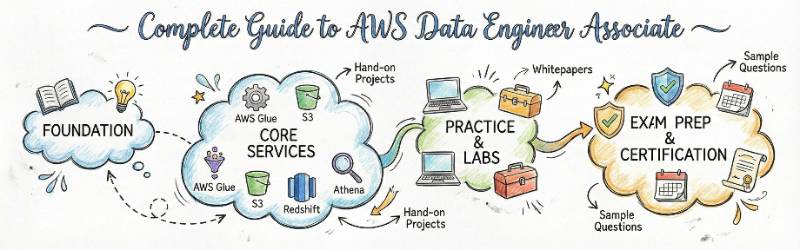
Introduction
If you work with data today, you already know the pressure: deliver dashboards faster, keep pipelines stable, protect sensitive data, and control cloud costs. Many teams also expect data engineers to understand cloud services, security basics, monitoring, and failure recovery—not only writing transformations. AWS Certified Data Engineer – Associate helps you prove you can design and run data pipelines on AWS in a real production style. It is not only about learning service names. It is about choosing the right patterns for ingestion, storage, processing, governance, reliability, and cost. For engineers, it builds confidence and credibility. For managers, it helps you build a stronger team roadmap and skills plan.
What this guide will help you do
By the end of this guide, you will be able to:
- Understand what the certification covers and why it matters
- Decide if you should take it now, or first learn some basics
- Plan your preparation (7–14 days, 30 days, or 60 days)
- Avoid common mistakes that cause exam failure and real project failures
- Choose your next certification path based on your role and career goal
- Map roles to the best certification sequence for that role
- Compare AWS certifications in a simple roadmap table
- Find training ecosystems that can support training plus certification preparation
Who should consider AWS Certified Data Engineer – Associate
This certification is a strong fit if you are one of these:
Working engineers
- Data Engineers building batch or streaming pipelines
- Analytics Engineers supporting curated datasets and reporting
- Cloud Engineers shifting into data platforms
- Platform Engineers supporting data workloads and shared platforms
- DevOps/SRE engineers who operate pipelines and need reliability skills
Managers and leads
- Engineering Managers managing data pipelines or analytics delivery
- Tech Leads who review architectures and approve design decisions
- Managers who want a clean skill framework for hiring and upskilling
What AWS Certified Data Engineer – Associate is
What it is
AWS Certified Data Engineer – Associate validates your ability to build and operate data engineering solutions on AWS. It focuses on end-to-end work: ingestion, storage, processing, governance, security, monitoring, and cost-aware performance decisions.
Who should take it
- You build pipelines on AWS or plan to move pipelines to AWS
- You work with data lakes, warehouses, ETL/ELT workflows, or streaming
- You are responsible for reliability, data freshness, data quality, and access control
- You want a structured way to learn AWS data services with real-world thinking
Skills you’ll gain
You will learn how to think like a production data engineer on AWS:
- Design ingestion patterns for batch and streaming workloads
- Store data in the right format and layout for performance and scale
- Build reliable ETL/ELT workflows with retries and safe backfills
- Implement governance and access control so data is safe by default
- Add monitoring and alerting so failures are detected early
- Improve cost and performance using clear tuning practices
- Handle common pipeline failures like late data, schema changes, and throttling
Real-world projects you should be able to do after this
These projects are realistic, and they also match what hiring managers expect to see from a data engineer who claims AWS pipeline skills.
1) Batch ingestion pipeline with raw → clean → curated zones
- Ingest from a database or file source into a landing area
- Store raw data in a safe format for auditing
- Clean and standardize into a clean zone
- Create curated datasets for analytics users
- Add partitioning and validation checks
2) Streaming pipeline for event data
- Capture events from applications or logs
- Buffer and store events safely
- Handle duplicates and out-of-order events
- Produce analytics-ready datasets from streams
- Add alerting for lag, dropped events, and error spikes
3) Data lake governance setup
- Create a clean data lake layout
- Add access control based on teams or roles
- Add encryption policies for data at rest and in transit
- Track who accessed what and when
- Implement least privilege permissions
4) ETL orchestration with failure recovery
- Create a pipeline with multiple steps (ingest, transform, publish)
- Add retries with safe limits
- Add dead-letter handling for bad records
- Add idempotent logic so reruns do not corrupt results
- Create runbooks for operators
5) Warehouse + reporting flow
- Publish curated datasets into a warehouse-style model
- Create simple KPI datasets for business teams
- Optimize query patterns using partitions, compression, and distribution strategies
- Support dashboards and recurring reports without performance surprises
6) Data quality and freshness monitoring
- Track row counts, null checks, and range checks
- Detect schema drift and type changes
- Track freshness SLAs (example: “data must arrive by 9 AM”)
- Send alerts and create a small incident workflow
- Build a simple quality score approach for key datasets
7) Cost and performance improvement project
- Identify expensive queries and reduce scan cost
- Reduce storage waste using lifecycle rules and better formats
- Remove always-on compute where not required
- Set cost ownership by pipeline, team, or environment
- Track cost per dataset or cost per dashboard
Preparation plan (choose the one that fits your schedule)
7–14 days plan (fast track)
This is best if you already work on AWS and you already build pipelines.
Days 1–2: Build your study map
- Read the official DevOpsSchool certification page fully
- List topics you already know and topics you avoid
- Create a small checklist for: ingestion, storage, processing, governance, monitoring, cost
Days 3–5: Ingestion and storage
- Learn the difference between batch vs streaming choices
- Practice file formats, partitions, and dataset layouts
- Understand raw/clean/curated patterns and why they matter
Days 6–8: Processing and orchestration
- Focus on ETL/ELT choices and the reasons behind them
- Practice orchestration steps and failure recovery thinking
- Learn how to safely rerun pipelines without corruption
Days 9–10: Governance and security
- Practice permission models and secure-by-default thinking
- Understand encryption, key control basics, and audit needs
- Build a simple example of “who can access which dataset and why”
Days 11–12: Monitoring and troubleshooting
- Learn what metrics matter: lag, freshness, error rate, retries, throughput
- Practice diagnosing failures: late data, schema change, permission error, throttling
Days 13–14: Mock + revision
- Do timed practice questions
- Write a “mistake notebook” with 1–2 lines per mistake: what happened + what you should do instead
- Revise weak areas only
30 days plan (balanced plan for working professionals)
This plan fits most engineers with a job and limited daily time.
Week 1: Core data engineering patterns
- Data lake layout (raw/clean/curated)
- File formats and partition thinking
- Data catalogs and metadata thinking
- Basic performance ideas: smaller scans, good partitions, fewer repeated reads
Week 2: Ingestion (batch + streaming)
- Batch ingestion patterns and backfill planning
- Streaming ingestion patterns and event ordering issues
- Handling duplicates and late-arriving records
- Validation rules: schema checks, row counts, expected ranges
Week 3: Processing, ETL/ELT, orchestration
- Transformation strategy and job design
- Orchestration with retries, checkpoints, and safe reruns
- Data quality inside pipelines
- Designing for scale (bigger volumes without breaking jobs)
Week 4: Governance, security, monitoring, cost
- Access control, least privilege, dataset ownership
- Encryption basics and audit readiness
- Monitoring dashboards and alerts
- Cost optimization: storage lifecycle, query cost, right-sized compute
- Practice exams and final revision
60 days plan (steady plan for beginners or career switchers)
This is best if you are new to AWS data services or new to data engineering basics.
Weeks 1–2: Basics
- AWS fundamentals (identity, storage, networking basics)
- Data engineering basics (ETL/ELT, lake vs warehouse, batch vs streaming)
- Simple SQL comfort and data modeling basics
Weeks 3–4: Build pipelines
- Create at least one batch pipeline end-to-end
- Create at least one streaming-style flow conceptually
- Learn the pipeline lifecycle: build → test → deploy → monitor → fix
Weeks 5–6: Governance, reliability, and production thinking
- Set permissions and test them
- Add monitoring and alerts
- Practice incident scenarios
- Add a cost review to every design decision
Weeks 7–8: Exam readiness
- Practice questions
- Review mistake notebook
- Repeat weak areas and finalize
Common mistakes
Mistake 1: Learning services but not learning decisions
Many learners memorize service names but cannot answer “why this design is best.”
Fix: For every topic, write a simple rule: “Use X when you need Y, avoid X when Z.”
Mistake 2: Ignoring data quality and data freshness
In real projects, late data breaks dashboards and trust.
Fix: Always plan for checks: freshness, completeness, duplicates, schema drift.
Mistake 3: Skipping governance until the end
If you add permissions later, you create access chaos and security risks.
Fix: Design access control and encryption early.
Mistake 4: No plan for backfills and reruns
Backfills are normal. Pipelines must support reruns safely.
Fix: Learn idempotency and safe checkpoint patterns. Always ask: “What happens if this job runs twice?”
Mistake 5: Overbuilding the pipeline
Using too many services increases operational burden.
Fix: Use the simplest design that meets reliability, security, and cost needs.
Mistake 6: No monitoring or weak monitoring
Pipelines will fail. The question is how fast you detect and recover.
Fix: Track a small set of useful metrics and alerts: failures, lag, freshness, throughput, cost spikes.
Mistake 7: Cost is treated as someone else’s problem
Data pipelines can become very expensive.
Fix: Create a habit: every pipeline decision includes a cost note and a cost reduction option.
Best next certification after this
Choose next certification based on your goal. Here are three clean directions.
Option 1: Same track (deeper data path)
If you want to become a senior data engineer on AWS:
- Go deeper into analytics, warehouse design, and large-scale data platform architecture
- Add stronger governance and production reliability patterns
- Build a portfolio with 2–3 solid AWS data projects
Option 2: Cross-track (broader cloud path)
If you want broader ownership:
- Combine data engineering with architecture thinking (better designs, better tradeoffs)
- Or combine with security thinking (compliance-ready data platforms)
Option 3: Leadership path
If you lead teams and make bigger decisions:
- Pick a professional-level path that proves system-level thinking
- Build strengths in governance, multi-team delivery, and operational excellence
Choose your path (6 learning paths)
1) DevOps path
Goal: automate delivery, improve deployment speed, reduce failures in production.
- Learn CI/CD thinking for data workloads
- Understand how data pipelines are deployed and rolled back
- Build runbooks and alerts that reduce downtime
- Pair data engineering skills with delivery and automation discipline
Good next steps after Data Engineer – Associate
- Strengthen infrastructure automation skills
- Learn operational excellence: metrics, alerts, incident response
- Build one “data pipeline as code” project
2) DevSecOps path
Goal: secure pipelines and data access, make compliance easier.
- Build secure-by-default access models
- Use least privilege and clear dataset ownership
- Apply encryption and audit thinking from day one
- Create incident response habits for data breaches and access leaks
Good next steps
- Deepen cloud security knowledge
- Create a “secure data lake governance blueprint” project
- Practice designing controls that do not block productivity
3) SRE path
Goal: keep pipelines reliable, reduce incidents, improve recovery speed.
- Build SLO thinking for data freshness and pipeline success rates
- Create alerting and on-call patterns that work
- Improve mean time to recovery using runbooks and automation
- Focus on failure modes: throttling, late data, dependency failures
Good next steps
- Strengthen monitoring, incident response, and reliability design
- Build a “pipeline reliability dashboard” project
- Practice post-incident reviews and prevention patterns
4) AIOps / MLOps path
Goal: enable production ML by building reliable and governed data flows.
- Build stable feature pipelines
- Track lineage and dataset versions
- Maintain data quality for training and inference
- Monitor drift and changes in input data patterns
Good next steps
- Learn ML pipeline concepts
- Build a “training dataset pipeline + validation checks” project
- Add monitoring for data drift and freshness
5) DataOps path
Goal: ship data changes faster and safer, like modern software delivery.
- Add testing discipline to pipelines
- Use data contracts and schema agreements
- Version important pipeline logic and dataset rules
- Build safe backfills and release processes
Good next steps
- Create repeatable deployment patterns for data
- Build “data quality tests + automated pipeline promotion”
- Learn how to reduce manual work in data releases
6) FinOps path
Goal: control cost and improve value from data systems.
- Track cost per pipeline, per dataset, or per dashboard
- Reduce storage waste and query waste
- Right-size compute decisions and reduce always-on usage
- Build cost accountability without slowing delivery
Good next steps
- Build a cost dashboard for data workloads
- Create a monthly cost review routine
- Practice tuning performance and cost together
Role → Recommended certifications (mapping)
This mapping helps you choose the right sequence without wasting time.
| Role | Recommended certification sequence |
|---|---|
| DevOps Engineer | Cloud fundamentals → Architecture associate → Data Engineer – Associate → Professional delivery path |
| SRE | Cloud fundamentals → Operations associate → Data Engineer – Associate → Reliability-focused advanced path |
| Platform Engineer | Architecture associate → Operations associate → Data Engineer – Associate |
| Cloud Engineer | Architecture associate → Data Engineer – Associate → (Security or Professional path based on job) |
| Security Engineer | Cloud fundamentals → Security learning path → Data Engineer – Associate (for data platform security patterns) |
| Data Engineer | Architecture associate (optional) → Data Engineer – Associate → deeper analytics/ML direction |
| FinOps Practitioner | Cloud fundamentals → Data Engineer – Associate → FinOps practices and optimization focus |
| Engineering Manager | Cloud fundamentals (optional) → Data Engineer – Associate → leadership-ready advanced path |
Certification roadmap table
This table is designed to help you plan a real sequence. If an official link is not provided in your prompt, the link field is marked as Not provided.
| Certification | Track | Level | Who it’s for | Prerequisites | Skills covered | Recommended order |
|---|---|---|---|---|---|---|
| AWS Certified Cloud Practitioner | Cloud | Foundational | Beginners, managers | Basic IT + cloud basics | Cloud concepts, billing, shared responsibility | 1 |
| AWS Certified Solutions Architect – Associate | Architecture | Associate | Cloud engineers, architects | Cloud basics + hands-on practice | Core AWS design, HA, security basics | 2 |
| AWS Certified Developer – Associate | Development | Associate | Developers | AWS basics + build/deploy comfort | AWS services for apps, deployment patterns | 2 |
| AWS Certified CloudOps Engineer – Associate | Operations | Associate | Ops, platform engineers | Monitoring + troubleshooting comfort | Operations, automation, reliability, incident handling | 2–3 |
| AWS Certified Data Engineer – Associate | Data | Associate | Data engineers, cloud data roles | Data basics + AWS data exposure | Pipelines, lakes, governance, monitoring, cost | 3 |
| AWS Certified Solutions Architect – Professional | Architecture | Professional | Senior architects | Strong associate-level architecture experience | Large-scale architectures, tradeoffs, governance | After associate |
| AWS Certified DevOps Engineer – Professional | DevOps | Professional | Senior DevOps/platform | Strong associate + delivery/ops experience | CI/CD at scale, automation, reliability | After associate |
| AWS Certified Security – Specialty | Security | Specialty | Security engineers | IAM, encryption, network basics | Security design, controls, incident readiness | After associate |
| AWS Certified Machine Learning – Specialty | ML/AI | Specialty | ML engineers | ML basics + data pipeline comfort | ML lifecycle, deployment thinking, monitoring | After associate |
Next certifications to take (3 clear options)
Same track option
- Continue deeper into data platform expertise: stronger analytics patterns, larger pipeline design, and governance maturity.
Cross-track option
- Add architecture knowledge if you want broader system ownership, or add security knowledge if you handle sensitive datasets and compliance.
Leadership option
- Move toward professional-level learning paths and focus on driving design decisions, large delivery planning, and operational excellence across teams.
Top institutions that help with training-cum-certification support
Below are training ecosystems that learners often use to get structured guidance, practice, and certification readiness. Each option can work depending on your needs and learning style.
DevOpsSchool
DevOpsSchool provides structured programs with guided learning, labs, and practical preparation aligned to real projects. It is helpful if you want a clear plan, mentoring support, and hands-on practice that strengthens both exam readiness and job skills.
Cotocus
Cotocus is often chosen for practical learning and role-focused training support. It works well if you want a step-by-step roadmap and a learning plan that feels job-aligned, not only exam-aligned.
ScmGalaxy
ScmGalaxy supports learning across cloud and DevOps domains and can be useful for learners who want broader exposure. It suits people who want structured learning tracks and consistent practice support.
BestDevOps
BestDevOps is a practical option for learners who want focused preparation and structured learning. It is often used by professionals who want simple guidance with job-ready outcomes.
DevSecOpsSchool
DevSecOpsSchool fits learners who want security-first thinking with their cloud learning. It works well for people who want to combine data engineering with governance, access control, and compliance practices.
SRESchool
SRESchool is useful if your work includes production support and reliability ownership. It supports learning with a reliability mindset: monitoring, incidents, and operational discipline.
AIOpsSchool
AIOpsSchool is helpful when your journey includes observability and automation. It suits people who want to connect monitoring, analytics, and automation in a practical way.
DataOpsSchool
DataOpsSchool supports learners who want modern DataOps practices such as safe releases, tests for pipelines, and strong reliability habits. It is useful when you want faster and safer data delivery in teams.
FinOpsSchool
FinOpsSchool is best when cost ownership is part of your role. It helps you build cost awareness, optimization routines, and long-term sustainability for cloud workloads.
FAQs
- How difficult is AWS Certified Data Engineer – Associate?
It is moderate if you already build pipelines and understand cloud basics. It feels hard if you have only theory knowledge. The exam expects you to pick the best design under real constraints like reliability, security, and cost. - How much time should I plan for preparation?
If you have strong AWS and data pipeline experience, 7–14 days may work. If you are working full time or feel weak in governance and monitoring, plan 30 days. If you are new to AWS data services, plan 60 days. - What prerequisites are most helpful before starting?
You should be comfortable with basic data concepts (ETL/ELT, batch vs streaming), simple SQL, and cloud basics. Hands-on practice helps more than reading only. - Can a software engineer (non-data) take this certification?
Yes, if you are ready to learn data engineering basics. Start with cloud fundamentals, then learn ingestion, storage formats, and simple pipeline design. Then move to this certification. - What topics should I focus on the most?
Focus on end-to-end pipeline thinking: ingestion, storage layout, processing reliability, governance, monitoring, and cost. Many learners fail because they ignore governance and operations. - Do I need deep coding to pass?
No heavy coding is required, but you must understand how pipelines behave, how transformations work, and how orchestration handles failures. Basic scripting and SQL understanding are very helpful. - What common mistake causes most failures?
People memorize services but do not practice scenario thinking. The exam often asks what to do when a pipeline is late, when access must be restricted, or when costs are too high. - What career outcomes can this certification support?
It supports roles like Data Engineer, Cloud Data Engineer, Analytics Engineer, and hybrid roles where you build and operate pipelines. It can also help DevOps/SRE engineers who support data workloads. - Is this certification useful for Engineering Managers?
Yes, especially if you manage data delivery or analytics systems. It helps you ask better architecture questions, detect risk areas early, and build better team skill roadmaps. - What is the best sequence if I’m a Data Engineer?
If you already know cloud basics, you can start with this certification. If you are new to cloud, first learn cloud fundamentals and associate-level architecture basics, then take this. - How do I prepare the right way without wasting time?
Build one end-to-end pipeline project. Add monitoring, access control, and a cost review. Then practice scenario questions and write down mistakes with the correct reasoning. - What should I do immediately after passing?
Choose one direction: deeper data, broader architecture/security, or leadership. Then build 2–3 practical projects and document them. Real project proof increases your career value more than the badge alone.
FAQs
- How hard is this certification for a working engineer?
It feels medium if you already work with pipelines, SQL, and AWS basics. It feels hard if you are new to cloud data services or you have never owned a pipeline in production. - What is a realistic study time if I have a full-time job?
Most working professionals do well with 30 days of steady study. If you already do AWS data work daily, you can finish in 7–14 days. If you are new, keep 60 days so you do not rush. - Do I need strong SQL and programming to pass?
You need basic SQL and clear pipeline thinking. Heavy coding is not required, but you must understand transformations, orchestration steps, and what to do when failures happen. - What prerequisites help the most before starting?
These help a lot:
- Basic cloud concepts (identity, storage, networking basics)
- Data basics (ETL/ELT, batch vs streaming)
- Understanding of file formats and partitions (at a simple level)
- Some hands-on practice with at least one pipeline
- Can I take this certification if I am a software engineer (not a data engineer)?
Yes. Start by learning data pipeline basics and doing one small project end-to-end. Many software engineers pass when they focus on real scenarios like data freshness, retries, and access control. - What is the best certification sequence before and after this?
A practical sequence is:
- Cloud fundamentals (if you are new)
- Associate architecture basics (optional but helpful)
- Data Engineer – Associate
After that, choose one: deeper data/analytics, cross-track security/architecture, or leadership.
- Is this certification worth it for career growth?
Yes, if your work includes pipelines, analytics platforms, or cloud migration. It helps you show structured AWS data skills and improves your confidence in design discussions and interviews. - What career outcomes can I expect after passing?
Common outcomes include better fit for roles like Data Engineer, Cloud Data Engineer, Analytics Engineer, or Platform/DevOps roles supporting data pipelines. It also helps when switching teams from application work to data platform work.
Conclusion
AWS Certified Data Engineer – Associate is a strong way to prove you can build and run data pipelines on AWS with real production thinking. It pushes you to move beyond “just ingestion and transformation” and focus on the parts that matter in real teams: data quality, data freshness, governance, secure access, monitoring, incident handling, and cost control. If you prepare with hands-on practice and not only reading, you will gain skills that transfer directly to work. Start with one complete pipeline project, add checks and alerts, then practice scenario questions until your decisions feel natural. That is how you pass confidently and become stronger at real data engineering work.