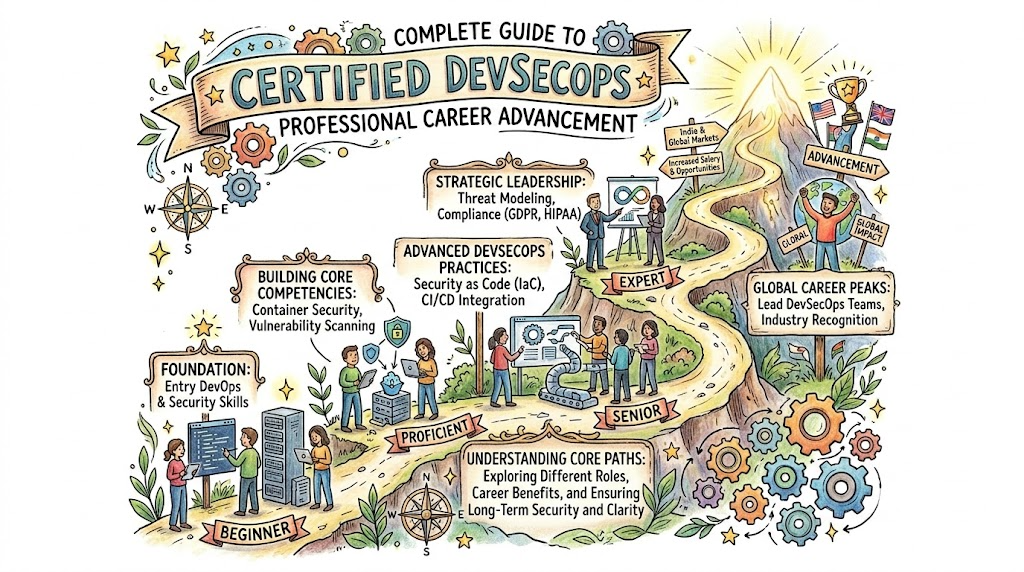
The Certified DevSecOps Professional is a comprehensive program designed to bridge the gap between rapid software development and robust security protocols. In an era where cyber threats are evolving daily, security can no longer be an afterthought or a final gate before production. This guide is written for engineers and managers who want to understand how to integrate security into every stage of the software development lifecycle.
By choosing to pursue this path through DevSecOpsSchool, professionals gain insights into the tools, culture, and processes required to build secure, resilient systems. Whether you are a cloud architect or a security analyst, this guide will help you navigate the complexities of modern engineering. We will explore how this certification impacts career trajectories and why it is essential for those building platform engineering teams.
Effective career decisions require a clear understanding of where the industry is heading and what skills are actually in demand. This guide provides an unbiased look at the curriculum, the practical application of the skills learned, and the long-term ROI of becoming a certified expert. Our goal is to move beyond the theory and look at how these practices are implemented in high-performing enterprise environments.
What is the Certified DevSecOps Professional?
The Certified DevSecOps Professional represents a shift from traditional perimeter-based security to a distributed, automated security model. It exists because the speed of modern CI/CD pipelines often outpaces the ability of manual security teams to keep up. This program teaches engineers how to “shift left,” ensuring that security checks are automated and integrated directly into the developer workflow.
This certification emphasizes real-world, production-focused learning rather than just memorizing definitions or terminology. It focuses on the hands-on implementation of security tools within pipelines, including static and dynamic analysis, container scanning, and secret management. It aligns perfectly with modern engineering workflows where developers and operations teams share the responsibility for the security posture of their applications.
In enterprise practices, having a standardized approach to DevSecOps is critical for maintaining compliance and governance at scale. This certification provides a framework for implementing these practices across diverse technology stacks. It moves the conversation from “why we need security” to “how we implement security” without slowing down the delivery of value to the end user.
Who Should Pursue Certified DevSecOps Professional?
Software engineers who want to write more secure code and understand the infrastructure their code runs on will find this certification invaluable. Site Reliability Engineers (SREs) and cloud professionals will benefit by learning how to protect the underlying platforms and automate compliance checks. It is also highly relevant for security professionals who need to move away from manual auditing toward automated, code-based security.
Beginners in the field will find a structured roadmap that explains the intersection of development and operations through a security lens. For experienced engineers, it offers a way to formalize their knowledge and stay updated on the latest cloud-native security tools. Managers and technical leaders should pursue this to understand the cultural shifts required to foster a security-first mindset within their teams.
In the Indian market, where many global capability centers (GCCs) are focused on digital transformation, this certification carries significant weight. Globally, as regulatory requirements like GDPR and SOC2 become more stringent, the demand for professionals who can automate these requirements is skyrocketing. It is a universal skill set that transcends specific industries, making it relevant for finance, healthcare, and retail sectors alike.
Why Certified DevSecOps Professional is Valuable and Beyond
The demand for security-integrated engineering is not a passing trend; it is a fundamental requirement for the future of the internet. As organizations move more workloads to the cloud, the surface area for attacks increases, making automated security a necessity. This certification ensures longevity in a career by teaching principles that remain constant even as specific tools evolve.
Enterprise adoption of DevSecOps is accelerating because it reduces the cost of fixing vulnerabilities late in the production cycle. Professionals who can demonstrate the ability to catch security flaws early are seen as high-value assets who protect the company’s reputation and bottom line. It is one of the few specializations where the demand consistently exceeds the supply of qualified talent.
Investing time in this certification provides a high return because it positions you at the intersection of three major domains: development, operations, and security. This “triple threat” skill set makes you eligible for high-level roles such as Security Architect or Lead DevSecOps Engineer. It provides the technical depth needed to lead complex digital transformation projects in large-scale environments.
Certified DevSecOps Professional Certification Overview
The program is delivered via the official course at Certified DevSecOps Professional and is hosted on the DevSecOpsSchool website. It is designed to be a practical, lab-based program that mirrors the challenges faced by engineering teams in real-world scenarios. The certification levels are structured to take a candidate from foundational concepts to advanced architectural design.
The assessment approach is rigorous, focusing on the candidate’s ability to solve problems and configure tools rather than just passing a multiple-choice exam. Ownership of the certification lies with a community of industry experts who ensure the content is updated frequently to reflect current threats and toolsets. It is a comprehensive structure that covers everything from culture to code and cloud security.
Practically speaking, the program is divided into modules that cover different phases of the software delivery lifecycle. Each module includes hands-on labs where you configure pipelines, secure clusters, and audit configurations. By the end of the program, a candidate has a portfolio of work that demonstrates their capability to secure a modern cloud-native environment.
Certified DevSecOps Professional Certification Tracks & Levels
The certification is structured into three distinct levels: Foundation, Professional, and Advanced. The Foundation level is aimed at establishing a common vocabulary and understanding of the DevSecOps mindset and core principles. It is the perfect starting point for those new to the field or managers who need a high-level overview of the methodology.
The Professional level, which is the core of the program, dives deep into the technical implementation of security within CI/CD pipelines. This is where engineers spend most of their time learning how to use specific tools for vulnerability scanning and compliance automation. It is designed for those who are actively building and maintaining software delivery systems.
The Advanced level focuses on governance, risk management, and large-scale architectural security. This level is for senior architects and leaders who are responsible for the security strategy of an entire organization. These levels align with career progression, allowing a professional to grow from an individual contributor to a strategic leader in the DevSecOps space.
Complete Certified DevSecOps Professional Certification Table
| Track | Level | Who it’s for | Prerequisites | Skills Covered | Recommended Order |
| Core DevSecOps | Foundation | Junior Engineers, Managers | Basic Linux, DevOps awareness | YAML, Git, Security Mindset | 1 |
| Core DevSecOps | Professional | DevOps & Security Engineers | CI/CD knowledge, Scripting | SAST, DAST, SCA, Vault | 2 |
| Core DevSecOps | Advanced | Architects, Tech Leads | Professional level experience | Policy as Code, Threat Modeling | 3 |
| Cloud Security | Professional | Cloud Engineers, SREs | AWS/Azure/GCP basics | IAM, VPC Security, KMS | 2 |
| Container Security | Professional | Platform Engineers | Docker, Kubernetes basics | Image signing, Admission controllers | 2 |
Detailed Guide for Each Certified DevSecOps Professional Certification
Certified DevSecOps Professional – Foundation
What it is
This certification validates a professional’s understanding of the core principles of DevSecOps and the cultural shift required to implement it. It confirms that the candidate understands the difference between traditional security and integrated security.
Who should take it
This is suitable for entry-level engineers, project managers, and business stakeholders who want to understand how security impacts the delivery timeline. It is for anyone looking to build a strong theoretical base before moving to hands-on tools.
Skills you’ll gain
- Understanding the Shift-Left security philosophy.
- Familiarity with the DevSecOps lifecycle and terminology.
- Identifying different types of automated security testing.
- Basic understanding of compliance and governance in DevOps.
Real-world projects you should be able to do
- Conduct a basic security audit of a simple development workflow.
- Create a roadmap for introducing security into a legacy DevOps team.
- Explain the ROI of DevSecOps to non-technical stakeholders.
Preparation plan
- 7–14 days: Focus on reading the official handbook and understanding the DevSecOps manifesto.
- 30 days: Review case studies of successful DevSecOps implementations in major tech companies.
- 60 days: Not usually required for this level unless the candidate is entirely new to IT.
Common mistakes
- Treating the exam as a technical coding test rather than a conceptual one.
- Ignoring the cultural and organizational aspects of the certification.
Best next certification after this
- Same-track option: Certified DevSecOps Professional.
- Cross-track option: Certified SRE Foundation.
- Leadership option: Certified DevOps Leader.
Certified DevSecOps Professional – Professional
What it is
This is the flagship certification that validates hands-on expertise in securing CI/CD pipelines and infrastructure. It proves that the engineer can implement automated security gates without hindering the speed of deployment.
Who should take it
Experienced DevOps engineers, Security analysts, and Software developers who are responsible for production environments. It requires a solid grasp of automation and cloud-native technologies.
Skills you’ll gain
- Implementing SAST (Static) and DAST (Dynamic) tools in Jenkins or GitLab.
- Managing secrets using tools like HashiCorp Vault.
- Automating Software Composition Analysis (SCA) for third-party libraries.
- Implementing Container and Kubernetes security best practices.
Real-world projects you should be able to do
- Build a fully automated pipeline that fails the build if high-severity vulnerabilities are found.
- Secure a Kubernetes cluster using Network Policies and Pod Security Standards.
- Automate the rotation of database credentials across a microservices architecture.
Preparation plan
- 7–14 days: Intensively practice with tools like SonarQube, Snyk, and OWASP ZAP.
- 30 days: Build a complete project from scratch including code, pipeline, and security checks.
- 60 days: Deep dive into advanced topics like OPA (Open Policy Agent) and infrastructure auditing.
Common mistakes
- Focusing only on the tools while forgetting the underlying security principles.
- Not spending enough time in the hands-on labs provided by the course.
Best next certification after this
- Same-track option: Certified DevSecOps Expert.
- Cross-track option: Certified Cloud Security Professional.
- Leadership option: DevSecOps Manager Certification.
Certified DevSecOps Professional – Advanced / Expert
What it is
This certification validates the ability to design and govern large-scale DevSecOps programs across an entire enterprise. It focuses on Policy as Code, advanced threat modeling, and regulatory compliance at scale.
Who should take it
Senior architects, security directors, and principal engineers who need to manage risk across hundreds of applications. It requires significant real-world experience in both engineering and security.
Skills you’ll gain
- Designing enterprise-wide Policy as Code frameworks.
- Advanced threat modeling for complex distributed systems.
- Implementing continuous compliance for regulated industries.
- Developing custom security tools and integrations.
Real-world projects you should be able to do
- Design a centralized dashboard for monitoring the security posture of 100+ microservices.
- Implement an automated “Compliance as Code” framework for SOC2 or HIPAA.
- Lead a cross-functional team through a major security architecture overhaul.
Preparation plan
- 7–14 days: Review architectural patterns for secure cloud-native applications.
- 30 days: Practice writing complex Rego policies for Open Policy Agent.
- 60 days: Conduct mock architectural reviews and focus on governance strategies.
Common mistakes
- Over-engineering security solutions that developers will eventually bypass.
- Lacking depth in regulatory requirements and legal compliance frameworks.
Best next certification after this
- Same-track option: Specialized niche certifications (e.g., eBPF security).
- Cross-track option: Certified FinOps Professional to manage security costs.
- Leadership option: CISO (Chief Information Security Officer) training.
Choose Your Learning Path
DevOps Path
The DevOps path focuses on the seamless integration of development and operations with an emphasis on speed and reliability. For this path, the certification helps you ensure that speed does not come at the cost of security. You will learn to treat security as another quality gate in your automated delivery pipeline. This path is ideal for those who want to build the ultimate developer experience while keeping the platform safe.
DevSecOps Path
The dedicated DevSecOps path is for those who want to specialize exclusively in the security of the modern software factory. This involves deep dives into vulnerability management, secure coding practices, and automated auditing. It is a specialized route that prepares you for roles like DevSecOps Engineer or Security Automation Architect. You will become the bridge between the traditional security team and the modern engineering team.
SRE Path
Site Reliability Engineers focus on the stability and performance of systems, and security is a major component of reliability. This path emphasizes how security incidents can affect system availability and how to build resilient architectures. You will learn to use DevSecOps principles to automate the response to security threats, treating them as another type of system failure. It is perfect for those who want to build self-healing, secure platforms.
AIOps Path
In the AIOps path, you will learn how to use artificial intelligence and machine learning to enhance the security posture of your systems. This involves using AI to detect anomalies in logs, predict potential security breaches, and automate complex decision-making processes. The certification provides the foundational security knowledge needed to ensure that AI models themselves are secure and properly governed. It is a cutting-edge path for those looking at the future of automated operations.
MLOps Path
The MLOps path focuses on securing the machine learning lifecycle, from data ingestion to model deployment. Security in this path involves protecting data privacy, preventing model poisoning, and ensuring the integrity of the ML pipeline. The certification helps you apply DevSecOps principles to the unique challenges of machine learning infrastructure. This is critical for organizations deploying AI at scale in sensitive industries like finance or healthcare.
DataOps Path
DataOps is about the orchestration of people, processes, and technology to deliver data quickly and securely. This path uses the certification to focus on data encryption, access control, and privacy as code within data pipelines. You will learn how to automate data masking and ensure that sensitive information never leaks into lower environments. It is essential for data engineers who need to comply with global data protection regulations.
FinOps Path
The FinOps path explores the intersection of security, cloud costs, and financial accountability. Security tools and breaches can have a massive impact on cloud spending, and this path teaches you how to optimize both. You will learn how to identify “orphaned” security resources that are costing money and how to justify the cost of security investments. This path is for those who want to manage the business side of engineering security.
Role → Recommended Certified DevSecOps Professional Certifications
| Role | Recommended Certifications |
| DevOps Engineer | Certified DevSecOps Professional (Core), Container Security |
| SRE | Certified DevSecOps Professional, SRE Foundation |
| Platform Engineer | Certified DevSecOps Professional (Expert), Kubernetes Security |
| Cloud Engineer | Cloud Security Specialization, Infrastructure as Code Security |
| Security Engineer | Certified DevSecOps Professional (Full Track), Threat Modeling |
| Data Engineer | DataOps Security, Certified DevSecOps Professional |
| FinOps Practitioner | FinOps Certified Practitioner, DevSecOps Foundation |
| Engineering Manager | DevSecOps Foundation, DevOps Leader |
Next Certifications to Take After Certified DevSecOps Professional
Same Track Progression
Once you have mastered the professional level, the logical step is to move toward the Expert or Advanced levels. This involves moving away from the “how” of security tools and toward the “why” of security architecture and strategy. Deep specialization might also include focusing on specific technologies, such as Advanced Kubernetes Security or specialized Cloud Security for AWS or Azure. This progression establishes you as a thought leader in the security engineering space.
Cross-Track Expansion
In the modern landscape, being a specialist is good, but being a “T-shaped” professional is better. After securing your DevSecOps credentials, consider expanding into SRE (Site Reliability Engineering) to understand system resilience. Alternatively, moving into FinOps allows you to understand the cost implications of the security tools you deploy. This cross-pollination of skills makes you incredibly versatile and valuable to any organization.
Leadership & Management Track
For those looking to move away from individual contributor roles, the next step is leadership-focused certifications. This includes learning about engineering management, project governance, and strategic planning. Understanding DevSecOps gives you the technical credibility to lead teams, but management certifications help you with the “people” and “process” side of the equation. This is the path toward becoming a CTO, CISO, or VP of Engineering.
Training & Certification Support Providers for Certified DevSecOps Professional
DevOpsSchool is a premier training organization that specializes in high-end DevOps and DevSecOps certifications. They provide a comprehensive ecosystem of labs, real-world projects, and expert-led sessions designed to transform engineers into specialists. Their curriculum is updated frequently to keep pace with the rapidly changing technology landscape, ensuring that students are always learning the most relevant skills. They focus on practical, hands-on experience that can be immediately applied in a professional environment.
Cotocus provides specialized technical training and consulting services with a focus on cloud-native technologies and automation. They offer tailored learning paths for enterprises and individuals looking to master modern engineering practices. Their trainers are industry veterans who bring a wealth of practical knowledge to the classroom. Cotocus is known for its deep technical sessions that go beyond the surface level of tools to explain the underlying architecture.
Scmgalaxy is a community-driven platform that offers extensive resources, tutorials, and training for SCM, DevOps, and DevSecOps. It serves as a knowledge hub for professionals looking to stay updated on the latest trends and tools in the industry. They offer a variety of certification programs that are recognized by major employers worldwide. The platform is excellent for those who prefer a mix of self-paced learning and community support.
BestDevOps focuses on delivering high-quality, practical training programs that help engineers bridge the skills gap in modern IT. They offer a range of certifications that cover the entire software delivery lifecycle, from development to operations and security. Their approach is centered on real-world scenarios and lab-based learning. BestDevOps is a go-to resource for professionals looking to advance their careers through recognized industry credentials.
devsecopsschool.com is the primary authority for DevSecOps education and certification, offering a wide array of specialized courses. The site serves as a central repository for DevSecOps best practices, tool guides, and certification paths. It is designed to cater to both individual learners and large enterprises looking to upskill their workforce. The certifications offered here are widely respected for their rigor and focus on production-ready skills.
sreschool.com specializes in teaching the principles and practices of Site Reliability Engineering. They offer training that helps organizations improve the reliability and performance of their systems through automation and data-driven decision-making. Their courses are essential for anyone looking to move into SRE roles or improve the stability of their production environments. The curriculum covers everything from error budgets to incident response.
aiopsschool.com is dedicated to the emerging field of AIOps, providing training on how to use AI and ML to transform IT operations. They offer certifications that teach professionals how to implement intelligent monitoring and automated incident resolution. Their programs are ideal for those looking to stay at the forefront of operational technology. The site provides a clear roadmap for integrating AI into traditional DevOps workflows.
dataopsschool.com focuses on the intersection of data engineering and operations, offering training on how to build secure and scalable data pipelines. Their certifications are designed for data professionals who need to implement DevOps practices within their data workflows. They emphasize data quality, security, and the speed of delivery. This is a critical resource for organizations looking to become truly data-driven while maintaining strict compliance.
finopsschool.com provides comprehensive training on the financial management of cloud resources. Their certifications help professionals understand how to optimize cloud spending and bring financial accountability to the variable cost model of the cloud. They offer practical strategies for cost allocation, budgeting, and optimization. This is essential for anyone responsible for managing the business side of cloud engineering.
Frequently Asked Questions (General)
How difficult is the certification exam? The difficulty depends on your hands-on experience with Linux and CI/CD tools, but it is generally considered moderate to high because it is lab-based. It requires a practical understanding of how to fix security issues in a pipeline.
How long does it take to prepare? Most professionals with a DevOps background can prepare in 30 to 60 days. Beginners may need three to six months to build the necessary foundational skills in scripting and cloud.
Are there any prerequisites? While there are no strict official prerequisites, a basic understanding of Git, Linux command line, and at least one CI/CD tool is highly recommended.
What is the return on investment (ROI)? The ROI is significant, often leading to a 20-40% increase in salary and access to high-demand roles in security and platform engineering.
Is the certification globally recognized? Yes, it is recognized by major technology firms and global capability centers as a valid measure of DevSecOps competency.
How often does the certification expire? Typically, the certification is valid for two to three years, after which you may need to renew it to stay current with new technologies.
Can I take the exam online? Yes, the exam is delivered through a secure online platform, allowing you to take it from anywhere in the world.
What tools are covered in the curriculum? The course covers a wide range of tools including Jenkins, GitLab, SonarQube, Snyk, Zap, Vault, and various container security tools.
Is there a community for certified professionals? Yes, there is a large community of alumni and experts who provide ongoing support and networking opportunities.
Does the course include hands-on labs? Yes, the program is heavily focused on labs, providing environments where you can practice the implementation of security tools.
How does this differ from traditional security certifications? Unlike traditional security certifications that focus on auditing and theory, this is focused on engineering, automation, and “coding” security.
Is this suitable for managers? Yes, the Foundation level is specifically designed to help managers understand the strategic importance of DevSecOps.
FAQs on Certified DevSecOps Professional
Is this certification focused on a specific cloud provider like AWS? No, the program is designed to be cloud-agnostic, focusing on principles and tools that work across AWS, Azure, Google Cloud, and on-premises environments.
Do I need to be a developer to pass this certification? You don’t need to be a senior developer, but you should be comfortable reading code and writing scripts for automation and pipeline configuration.
What kind of security vulnerabilities will I learn to find? You will learn to identify common web vulnerabilities (OWASP Top 10), insecure library dependencies, hardcoded secrets, and misconfigured infrastructure settings.
Is container security a big part of the exam? Yes, securing Docker images and Kubernetes clusters is a core component of the professional and expert levels.
Does the certification cover compliance? Yes, it covers the basics of Compliance as Code, teaching you how to automate checks for industry standards like PCI-DSS or HIPAA.
What is the format of the exam? The exam consists of a mix of scenario-based questions and practical lab tasks where you must secure a given environment.
How is the content updated? The curriculum is reviewed quarterly by a board of industry experts to ensure it includes the latest security threats and tool versions.
Can I get a refund if I don’t like the course? Refund policies depend on the specific training provider, so it is best to check their terms and conditions before enrolling.
Conclusion
From a mentor’s perspective, I can tell you that the industry has reached a tipping point. We are no longer in a world where security can be handled by a separate team that sits in a different building. The responsibility has shifted to the people building the systems. If you want to remain relevant in the next decade of engineering, understanding security is not optional—it is a core requirement. The Certified DevSecOps Professional program is one of the most practical ways to gain this knowledge. It doesn’t just give you a badge for your profile; it gives you the confidence to stand in front of a production system and know that it is secure. It teaches you how to think like an attacker while building like an engineer. This dual perspective is what separates senior professionals from everyone else. My advice is to approach this not as an exam to pass, but as a skill set to master. Take the labs seriously, break things in the controlled environment, and understand the “why” behind every security gate. If you put in the work, the career opportunities will follow naturally. This is a solid investment in your future that pays dividends in every project you touch.