Introduction
Building and maintaining large-scale distributed systems requires more than just basic coding or operations knowledge. The Certified Site Reliability Architect program offered by Sreschool is designed to bridge the gap between traditional software engineering and advanced systems operations. This guide is written for professionals who want to understand how to design systems that are not only functional but also highly available, scalable, and resilient. Whether you are a DevOps engineer or a technical lead, this resource will help you navigate the complexities of modern platform engineering.
What is the Certified Site Reliability Architect?
The Certified Site Reliability Architect represents a high-standard validation of an engineer’s ability to design and manage complex, production-grade environments. It is not merely a theoretical exercise; it exists to ensure that professionals can apply SRE principles like error budgets, toil reduction, and automated incident response in real-world scenarios. By focusing on the architectural side of reliability, it prepares engineers to think about system health from the initial design phase rather than as an afterthought. This certification aligns perfectly with the needs of modern enterprises that rely on cloud-native architectures and continuous delivery.
Who Should Pursue Certified Site Reliability Architect?
This certification is ideal for software engineers, DevOps practitioners, and cloud architects who are responsible for the uptime and performance of critical applications. It also provides immense value to engineering managers who need to implement reliability-driven cultures within their teams. In the global market, and specifically within the rapidly growing tech hubs of India, there is a massive demand for professionals who can balance feature velocity with system stability. Beginners with a strong foundation in Linux and networking can use this as a roadmap, while experienced veterans can use it to formalize their expertise in distributed systems.
Why Certified Site Reliability Architect is Valuable and Beyond
In an era where downtime can cost millions of dollars per hour, the ability to architect for reliability is a foundational skill that will not go out of style. As organizations move toward complex microservices and hybrid-cloud setups, the demand for Site Reliability Architects continues to outpace the supply of qualified talent. This certification ensures that your skills remain relevant even as specific tools and platforms change over time, focusing on core principles that apply universally. Investing time in this path provides a significant return by positioning you for high-impact roles in top-tier technology firms and global enterprises.
Certified Site Reliability Architect Certification Overview
The Certified Site Reliability Architect program is a comprehensive curriculum delivered through the Sreschool platform. It moves beyond simple configuration management to focus on the broader lifecycle of a reliable service, including capacity planning, observability, and disaster recovery. The assessment approach is designed to be practical, often involving case studies or labs that mimic the challenges faced by engineers in a production setting. By completing this program, professionals demonstrate they have a structured understanding of how to maintain high availability in a high-pressure environment.
Certified Site Reliability Architect Certification Tracks & Levels
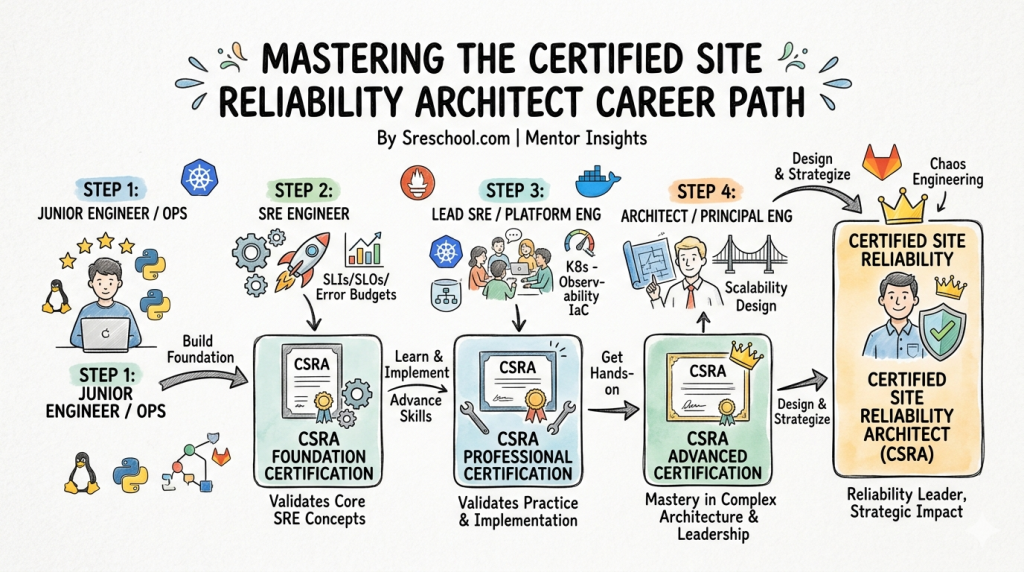
The certification is structured into three distinct levels to accommodate professionals at different stages of their career journey. The Foundation level introduces the core vocabulary and concepts of SRE, making it accessible for those transitioning from other IT roles. The Professional level dives deeper into specific toolsets and implementation strategies for monitoring and automation. Finally, the Advanced or Architect level focuses on strategic design, organizational culture, and complex cross-system integration, allowing senior engineers to lead large-scale reliability initiatives across an entire enterprise.
Complete Certified Site Reliability Architect Certification Table
| Track | Level | Who it’s for | Prerequisites | Skills Covered | Recommended Order |
| Core SRE | Foundation | Junior Engineers & Admins | Basic Linux/Cloud | SLIs, SLOs, Error Budgets | First |
| Engineering | Professional | DevOps & SRE Engineers | Foundation Level | Automation, Observability | Second |
| Architecture | Advanced | Senior Architects & Leads | Professional Level | Capacity Planning, Resiliency | Third |
| Management | Leadership | Engineering Managers | General Tech Context | SRE Culture, Risk Management | Optional |
Detailed Guide for Each Certified Site Reliability Architect Certification
Certified Site Reliability Architect – Foundation Level
What it is
This level validates a fundamental understanding of Site Reliability Engineering principles and how they differ from traditional operations. It ensures the candidate speaks the language of reliability and understands the basic mechanics of service level management.
Who should take it
It is suitable for junior developers, system administrators, and recent graduates who want to enter the world of DevOps and SRE. It is also a great starting point for project managers who need to understand the technical constraints of their engineering teams.
Skills you’ll gain
- Defining SLIs, SLOs, and SLAs for diverse services.
- Understanding the concept of “Toil” and how to identify it.
- Basic incident response procedures and communication protocols.
- Knowledge of the SRE golden signals: Latency, Traffic, Errors, and Saturation.
Real-world projects you should be able to do
- Document a reliability roadmap for a simple web application.
- Set up basic alerting thresholds based on user-centric metrics.
Preparation plan
- 7-14 Days: Review official study guides and familiarize yourself with the Google SRE handbook concepts.
- 30 Days: Participate in entry-level labs focusing on monitoring tools and basic Linux scripting.
- 60 Days: Deep dive into case studies of system failures to understand the practical application of SRE theory.
Common mistakes
- Focusing too much on specific tools rather than the underlying principles.
- Neglecting the importance of “culture” and focusing only on technical metrics.
Best next certification after this
- Same-track option: Certified Site Reliability Architect – Professional Level
- Cross-track option: Certified DevOps Professional
- Leadership option: Technical Team Lead Certification
Certified Site Reliability Architect – Professional Level
What it is
The Professional level validates the ability to implement SRE practices using modern automation and observability stacks. It moves from “what” SRE is to “how” to actually do it in a live environment.
Who should take it
This is designed for active DevOps engineers and SREs with at least two years of experience. Candidates should have a working knowledge of containers, orchestration, and CI/CD pipelines.
Skills you’ll gain
- Implementing advanced observability using Prometheus and Grafana.
- Automating manual tasks using Python, Go, or specialized automation frameworks.
- Conducting effective post-mortems and identifying root causes without assigning blame.
- Managing infrastructure as code to ensure repeatable and reliable deployments.
Real-world projects you should be able to do
- Build a self-healing system that restarts services based on health checks.
- Design a dashboard that visualizes the real-time consumption of an error budget.
Preparation plan
- 7-14 Days: Focus on hands-on labs related to Kubernetes and monitoring integration.
- 30 Days: Work through complex incident simulation scenarios and practice automated recovery scripts.
- 60 Days: Study advanced networking and distributed database consistency models.
Common mistakes
- Ignoring the “human” element of incident response and post-mortems.
- Over-engineering automation solutions that become harder to maintain than the manual task.
Best next certification after this
- Same-track option: Certified Site Reliability Architect – Advanced Level
- Cross-track option: Certified DevSecOps Engineer
- Leadership option: Site Reliability Manager
Certified Site Reliability Architect – Advanced Level
What it is
This is the pinnacle of the track, validating the ability to design entire ecosystems for reliability. It focuses on high-level architecture, cost-efficiency, and multi-region disaster recovery.
Who should take it
Senior engineers, principal architects, and technical directors who are responsible for the technical strategy of an organization. Candidates should have extensive experience managing large-scale production workloads.
Skills you’ll gain
- Designing multi-cloud and hybrid-cloud architectures for maximum uptime.
- Strategic capacity planning and financial modeling for cloud resources.
- Leading organizational change to adopt a reliability-first mindset.
- Advanced chaos engineering practices to proactively find system weaknesses.
Real-world projects you should be able to do
- Architect a global failover strategy for a high-traffic e-commerce platform.
- Implement a chaos engineering experiment that proves system resilience under stress.
Preparation plan
- 7-14 Days: Analyze white papers on distributed system architecture and global load balancing.
- 30 Days: Design and document complex failure scenarios and recovery architectures.
- 60 Days: Mentor junior engineers and lead a mock architecture review board.
Common mistakes
- Losing touch with the low-level implementation details while focusing on high-level design.
- Failing to account for the cost implications of high-availability architectures.
Best next certification after this
- Same-track option: Emeritus Reliability Fellow
- Cross-track option: Certified Cloud Security Architect
- Leadership option: Chief Technology Officer (CTO) Program
Choose Your Learning Path
DevOps Path
This path focuses on the seamless integration of development and operations, with a heavy emphasis on CI/CD pipelines and deployment frequency. Engineers here learn how to use SRE principles to ensure that faster releases do not lead to system instability. It is ideal for those who enjoy building the internal tools that other developers use to ship code. By mastering reliability, DevOps engineers can move into platform engineering roles where they build “internal developer platforms.”
DevSecOps Path
In this track, security is treated as a critical component of reliability. Candidates learn how to integrate automated security scanning and compliance checks directly into the SRE workflow. This ensures that the system is not only up and running but also protected against modern cyber threats. It is a vital path for engineers working in regulated industries like finance or healthcare where uptime and data integrity are equally important.
SRE Path
This is the direct application of the Certified Site Reliability Architect curriculum, focusing purely on system performance and reliability. You will dive deep into observability, incident management, and the reduction of operational toil. This path is perfect for engineers who are passionate about the internal workings of Linux, networking, and distributed databases. It leads to roles where you are the primary guardian of the organization’s most critical digital services.
AIOps Path
This specialized path explores the use of machine learning and artificial intelligence to enhance operational efficiency. You will learn how to use predictive analytics to identify potential system failures before they occur and automate complex decision-making processes. As data volumes grow, AIOps becomes essential for managing modern environments that are too large for human intervention alone. This is an excellent choice for engineers with an interest in data science and automated pattern recognition.
MLOps Path
MLOps is focused on the reliability of machine learning models in production environments. This path covers the lifecycle of models, including training, deployment, and monitoring for data drift or performance degradation. Engineers learn how to apply SRE concepts like SLOs to the accuracy and latency of ML predictions. This is a critical field for organizations that rely on AI-driven products and need to ensure their models are robust and scalable.
DataOps Path
DataOps focuses on the reliability and quality of data pipelines. You will learn how to apply SRE principles to big data environments, ensuring that data is delivered accurately and on time to downstream consumers. This path involves managing distributed data stores, stream processing, and data validation at scale. It is ideal for data engineers who want to move away from firefighting broken pipelines and toward a more proactive, architected approach.
FinOps Path
This path combines cloud financial management with technical reliability. Engineers learn how to optimize cloud spending without sacrificing the performance or availability of the system. You will explore cost-allocation, forecasting, and the architectural trade-offs between expensive high-availability setups and cost-efficient designs. This is a highly sought-after skill set as enterprises look to regain control over their growing cloud bills while maintaining top-tier service levels.
Role → Recommended Certified Site Reliability Architect Certifications
| Role | Recommended Certifications |
| DevOps Engineer | SRE Foundation, SRE Professional, DevSecOps Specialist |
| SRE | SRE Professional, SRE Advanced, AIOps Specialist |
| Platform Engineer | SRE Advanced, DevSecOps Specialist, Cloud Architect |
| Cloud Engineer | SRE Foundation, Cloud Provider Certs, FinOps Specialist |
| Security Engineer | DevSecOps Specialist, SRE Foundation, Security Architect |
| Data Engineer | DataOps Specialist, SRE Professional, MLOps Foundation |
| FinOps Practitioner | FinOps Specialist, SRE Foundation, Cloud Management |
| Engineering Manager | SRE Foundation, Leadership Track, FinOps Specialist |
Next Certifications to Take After Certified Site Reliability Architect
Same Track Progression
After reaching the advanced level, the next step is deep specialization. You might focus on a specific area of reliability, such as High-Performance Networking or Advanced Distributed Databases. Staying within the SRE track allows you to become a recognized authority in the field, often leading to “Principal SRE” or “Fellow” titles. The goal here is to master the niche aspects of reliability that only appear at the massive scale of companies like Google, Netflix, or Amazon.
Cross-Track Expansion
If you want to broaden your impact, consider moving into adjacent fields like Security or Data Engineering. An SRE with strong security knowledge (DevSecOps) is incredibly valuable because they can build systems that are both resilient and unhackable. Alternatively, moving into DataOps allows you to apply reliability engineering to the “fuel” of modern business: data. This breadth of knowledge makes you a more versatile architect capable of leading cross-functional engineering departments.
Leadership & Management Track
For those who enjoy mentoring and strategy more than hands-on coding, the leadership track is the natural next step. This involves moving into roles like SRE Manager, Director of Engineering, or VP of Infrastructure. You will focus on building high-performing teams, defining organization-wide reliability standards, and managing multi-million dollar budgets. This path requires a shift from solving technical problems to solving people and process problems, which is where the greatest organizational impact often lies.
Training & Certification Support Providers for Certified Site Reliability Architect
DevOpsSchool is a leading provider of technical training focused on bridging the skills gap in modern software delivery. They offer a wide range of courses that cover everything from basic automation to advanced platform engineering. Their approach is heavily practical, ensuring that students spend more time in labs than in lectures. With a global presence and a deep understanding of the Indian market, they provide tailored coaching for engineers looking to advance their careers. Their instructors are often industry veterans who bring real-world scenarios into the classroom, making the learning experience both relevant and engaging.
Cotocus provides specialized consulting and training services aimed at helping organizations adopt modern engineering practices. They focus on high-end technologies like Kubernetes, cloud-native architecture, and site reliability engineering. Their training programs are designed to be intensive and immersive, catering to both individual professionals and corporate teams. By combining deep technical expertise with a focus on business outcomes, Cotocus helps engineers understand not just how to use a tool, but why it matters for the organization. They are known for their hands-on workshops that simulate real production challenges, preparing students for actual on-the-job requirements.
Scmgalaxy is a massive community and resource hub for everything related to Software Configuration Management and DevOps. They provide an extensive library of blogs, tutorials, and guides that help engineers stay updated with the latest industry trends. Beyond content, they offer structured training programs that are highly regarded by practitioners for their technical depth. The platform serves as a collaborative environment where professionals can share knowledge and solve complex problems together. Their focus is on building a strong community of experts who can support each other through the various challenges of the modern software lifecycle.
BestDevOps is a training organization dedicated to maintaining high standards in DevOps and SRE education. They focus on delivering quality content that is aligned with current industry demands and certification requirements. Their courses are structured to provide a clear path from beginner to expert, ensuring that learners have a solid foundation before moving to complex topics. They take pride in their curriculum, which is frequently updated to reflect the changing landscape of cloud and automation technologies. For professionals looking for a reliable and structured learning experience, BestDevOps offers a trusted path to mastering the tools and methodologies of the modern engineer.
devsecopsschool.com is a specialized platform dedicated to the integration of security into the DevOps and SRE workflows. They recognize that security is no longer an isolated department but a fundamental part of reliable system design. Their courses cover a wide range of security automation, compliance-as-code, and vulnerability management topics. By focusing on this niche, they provide engineers with the specific skills needed to protect large-scale distributed systems. The platform is an essential resource for anyone looking to transition into a security-focused role within a cloud-native environment, offering both theory and practical application.
sreschool.com is the primary authority and hosting site for the Certified Site Reliability Architect program. They focus exclusively on the discipline of Site Reliability Engineering, ensuring that their curriculum is deep, focused, and authoritative. The site provides everything from foundation courses to advanced architectural tracks, making it a one-stop-shop for SRE career development. Their focus on the “SRE way” ensures that students learn the specific mindset required to manage high-availability systems. As the host of the certification, they provide the most direct and accurate path to achieving the Architect status, backed by industry-standard assessments.
aiopsschool.com addresses the growing intersection of artificial intelligence and IT operations. They provide training on how to use machine learning to automate the monitoring, diagnosis, and resolution of system issues. Their programs are designed for engineers who want to stay ahead of the curve by incorporating AI into their operational toolkit. The curriculum covers data collection, model training for operations, and the implementation of automated decision-making systems. As environments become increasingly complex, the skills taught at aiopsschool.com are becoming vital for managing the next generation of enterprise infrastructure.
dataopsschool.com focuses on the critical task of bringing reliability and agility to data pipelines and big data systems. They teach engineers how to apply the principles of DevOps and SRE to the data world, ensuring high data quality and timely delivery. Their courses cover distributed storage, stream processing, and data governance at scale. This is a vital resource for data engineers and architects who need to manage massive volumes of information without constant manual intervention. The platform provides a clear roadmap for anyone looking to specialize in the operational side of data science and engineering.
finopsschool.com is dedicated to the discipline of cloud financial management, helping engineers and managers control their cloud spending. They provide a structured approach to understanding cloud costs, optimizing resource usage, and implementing financial accountability across engineering teams. Their training is essential for organizations that have moved to the cloud but find themselves struggling with unpredictable bills. By teaching the technical and financial trade-offs of cloud architecture, finopsschool.com empowers engineers to make cost-aware decisions that don’t compromise system reliability or performance. This is a key skill set for senior technical leaders today.
Frequently Asked Questions (General)
1. Is the Certified Site Reliability Architect exam difficult for beginners?
The exam is designed to be challenging but fair, especially if you start with the Foundation level. Beginners will need to put in significant effort to understand Linux and networking before attempting the higher levels.
2. How much time should I dedicate to studying for this certification?
Depending on your experience, you should plan for 30 to 60 days of consistent study. This includes reading theoretical materials and performing hands-on labs to reinforce the concepts.
3. What are the prerequisites for the Architect level?
Ideally, you should have completed the Professional level and have several years of experience managing production systems. A strong understanding of cloud-native architecture is also essential.
4. Will this certification help me get a job in India?
Yes, the demand for SREs and Architects in India is growing rapidly as more global tech companies set up their engineering centers in the country. It is a highly respected credential.
5. Can I take the exam online?
Most levels of the certification are available via an online proctored format, allowing you to take the exam from the comfort of your home or office.
6. What is the Return on Investment (ROI) for this certification?
The ROI is typically very high, as SRE roles are among the highest-paying in the engineering world. The certification often leads to significant salary increases and better job opportunities.
7. Do I need to know how to code to be a Site Reliability Architect?
Yes, coding is a fundamental part of the SRE role. You don’t need to be a senior software developer, but you should be comfortable with scripting in languages like Python or Go.
8. Is there a sequence I should follow for the levels?
It is highly recommended to follow the sequence: Foundation, then Professional, and finally the Architect level. This ensures you have a solid base of knowledge at each step.
9. Does the certification expire?
Most certifications in this field require periodic renewal or continuing education to ensure that your skills remain current with changing technology.
10. How does this certification differ from a standard DevOps cert?
While DevOps focuses on the entire lifecycle including development, this certification focuses specifically on the reliability, scalability, and operational health of the system in production.
11. Are there community resources available for help?
Yes, platforms like Scmgalaxy and various SRE-focused Slack channels provide great community support for those preparing for the exam.
12. Is chaos engineering covered in the curriculum?
Yes, chaos engineering is a key component of the advanced levels, as it is a critical tool for proving the resilience of an architecture.
FAQs on Certified Site Reliability Architect
1. How does the Certified Site Reliability Architect program handle real-world scenarios?
The program uses lab-based assessments and case studies that mirror actual production failures, ensuring you can apply theory to practice effectively.
2. What is the focus of the Professional level compared to the Foundation?
The Foundation focuses on core concepts like SLOs, while the Professional level dives into the automation and observability tools needed to implement those concepts.
3. Why is architectural design a major part of this certification?
Reliability cannot be “added on” later; it must be built into the system design from the start, which is why architecture is central to the curriculum.
4. How does the program address the “Toil” reduction aspect of SRE?
It teaches engineers how to identify repetitive manual tasks and provides the automation frameworks and strategies needed to eliminate them permanently.
5. Is observability more than just monitoring in this course?
Yes, the course emphasizes understanding the internal state of a system from its external outputs, moving beyond simple uptime checks to deep system insights.
6. How does this certification help with incident management?
It provides a structured framework for incident response, including role definitions and post-mortem procedures that focus on learning rather than blame.
7. Can this certification be applied to on-premise environments?
While it has a cloud-native focus, the core principles of reliability, automation, and observability are universal and apply to any complex IT environment.
8. Does the program cover the cultural side of Site Reliability Engineering?
Absolutely; the certification recognizes that SRE is as much about culture and mindset as it is about technical tools and automation.
Conclusion
As someone who has seen the industry shift from manual server racking to automated cloud-native deployments, I can tell you that reliability is the ultimate goal of modern engineering. Tools will come and go, but the need for systems that work under pressure is permanent. The Certified Site Reliability Architect is a rigorous and rewarding path that forces you to think like a builder and a defender at the same time. If you are willing to move beyond the surface level of DevOps and dive into the deep complexities of distributed systems, this certification is absolutely worth your time and effort. It isn’t just a badge; it is a transformation in how you approach your craft.