Introduction
The IT landscape is moving fast. We are no longer just managing small servers; we are managing massive clouds and complex microservices. Today, human teams cannot handle the millions of logs and alerts generated every minute. This is why AIOps (Artificial Intelligence for IT Operations) has become the most important shift in our industry. I have spent a long time working in complex production environments, seeing systems break and seeing how they are fixed. Moving from traditional monitoring to AIOps is not just a trend—it is a necessity. If you want to move from being reactive to being proactive, the AiOps Certified Professional (AIOCP) is the roadmap you need.
What is the AIOCP Certification?
What it is
The AIOps Certified Professional (AIOCP) is a program that teaches you how to use AI and machine learning to automate IT operations. It focuses on using data to predict failures, reduce alert noise, and create self-healing systems.
Who should take it
This is for Software Engineers, SREs, and DevOps professionals who want to lead the next wave of automation. It is also perfect for Engineering Managers who need to understand how AI can reduce downtime and operational costs.
Skills you’ll gain
- Predictive Analytics: Forecasting system issues before they happen.
- Anomaly Detection: Finding “weird” patterns in data that humans miss.
- Event Correlation: Grouping thousands of alerts into one real issue.
- Self-Healing Automation: Writing scripts that fix problems automatically.
- AIOps Tooling: Working with tools like Prometheus, Grafana, ELK, and ML frameworks.
Real-world projects you should be able to do
- Smart Alerting System: Build a pipeline that ignores 95% of noise and only alerts on real problems.
- Auto-Scaling Engine: Create a system that uses AI to scale servers up before a traffic spike happens.
- Log Intelligence: Use ML to find the root cause of an error across thousands of microservices in seconds.
The Master Certification List
If you are planning your career, here is how the primary certifications in the AIOps ecosystem look.
| Track | Level | Who it’s for | Prerequisites | Skills Covered | Recommended Order |
| AIOps | Professional | Engineers & Managers | Basic IT Ops | ML, RCA, AI-Monitoring | 1st |
| DevOps | Professional | Software Engineers | Linux Basics | CI/CD, IaC, Git | Foundation |
| SRE | Specialist | Ops Engineers | DevOps Basics | SLIs, SLOs, Error Budgets | 2nd |
| DevSecOps | Specialist | Security Engineers | DevOps Basics | Security Automation, DAST | Cross-Track |
Preparation Plan
Every engineer learns at a different pace. Choose the plan that fits your current knowledge.
7–14 Days (The Sprint)
This is for experts who already know Python and monitoring tools. Spend 4 hours daily focusing on the AIOCP syllabus. Review AIOps architecture and tool integration with ELK and Prometheus.
30 Days (The Standard Path)
This is the best path for most engineers.
- Week 1-2: Learn Data Science basics—cleaning logs and understanding ML models.
- Week 3-4: Hands-on labs. Practice anomaly detection in a real cloud environment.
60 Days (The Deep Dive)
If you are new to the world of AI, take your time. Spend the first month mastering Python and Linux. Spend the second month building and deploying AIOps workflows.
Common Mistakes
1. Treating AIOps as a “Magic Box”
The biggest mistake is thinking AI will fix a broken process. If your manual monitoring is messy, your AIOps will be messy.
- The Reality: AIOps is an “amplifier.” It makes good processes faster and bad processes more visible.
- Pro Tip: Fix your basic monitoring and alerting rules before you feed them into an AI engine.
2. Ignoring Data Quality (Garbage In, Garbage Out)
AI is only as smart as the data it consumes. If your logs are unstructured or your metrics are missing, the AI will give you “false positives” (fake alarms).
- The Mistake: Not spending time on data cleaning and normalization.
- The Fix: Ensure you have high-quality “Three Pillars of Observability” (Logs, Metrics, Traces) ready for the AI to analyze.
3. Trying to “Boil the Ocean” (Over-Automation)
New AIOps engineers often try to automate everything on Day 1. This is dangerous and can lead to unintended system crashes.
- The Mistake: Letting an AI model delete resources or restart servers without any human approval.
- The Fix: Start with “Human-in-the-Loop.” Let the AI suggest a fix, have a human click “Approve,” and only move to full automation once the model is 99% accurate.
4. Focusing Only on Tools, Not Logic
It is easy to get distracted by shiny new software. But knowing how to click buttons in a platform is not the same as understanding why an algorithm chose a specific root cause.
- The Mistake: Skipping the foundational theory of Machine Learning and Anomaly Detection.
- The Fix: Focus on the concepts taught in the AIOCP—like clustering and regression—so you can troubleshoot the AI itself when it makes a mistake.
5. Working in a Silo
AIOps is not just for the Ops team. It requires input from Developers (to understand application behavior) and Security teams (to identify threats).
- The Mistake: Implementing an AIOps platform without talking to the people who write the code.
- The Fix: Treat AIOps as a collaborative effort. Ensure that the insights generated by the AI are useful for the entire engineering organization.
Best Next Certification
1. Specialization: MLOps Certified Professional (MLOCP)
If you enjoyed the “AI” part of AIOps, this is your natural next step. While AIOCP teaches you how to use AI to manage operations, MLOps teaches you how to manage the lifecycle of the AI models themselves.
- Focus: Model versioning, monitoring for “model drift,” and automated retraining pipelines.
- Why take it: It ensures that the AI engines you use for operations remain accurate and reliable over time.
- Target Role: MLOps Engineer or AI Infrastructure Architect.
2. Cross-Track: SRE Certified Professional (SRECP)
If you want to be the ultimate authority on system uptime, pairing AIOps with Site Reliability Engineering (SRE) is the “gold standard.”
- Focus: Managing Error Budgets, Service Level Objectives (SLOs), and eliminating “toil” through advanced automation.
- Why take it: AIOps provides the data and predictions, while SRE provides the framework and discipline to act on that data.
- Target Role: Senior SRE or Reliability Lead.
3. Leadership: Certified DevOps Manager (CDM)
For those looking to move away from daily coding and into Strategy and Governance, this is the path toward the executive suite.
Target Role: DevOps Manager, VP of Infrastructure, or Director of Operations.
Focus: Team building, ROI analysis of automation tools, and leading large-scale digital transformations.
Why take it: You will learn how to lead teams of AIOps and SRE engineers and how to pitch the value of “Intelligent Operations” to stakeholders.
Choose Your Path: 6 Strategic Learning Journeys
1. The DevOps Path
Focuses on making the delivery pipeline smarter. You use AI to scan code changes and predict if a release will cause a failure.
2. The DevSecOps Path
Integrates AI with security. You use anomaly detection to spot hackers and automatically block suspicious traffic.
3. The SRE Path
The goal is “Zero-Ops.” You build systems that monitor their own health and fix minor bugs without waking up an engineer.
4. The AIOps/MLOps Path
For those who want to build the AI platforms themselves. You manage the models, the data, and the infrastructure that hosts them.
5. The DataOps Path
Focuses on the data pipeline. You ensure that logs and metrics flow perfectly from the servers to the AI engine without delay.
6. The FinOps Path
AI-driven cost saving. You use AIOps to analyze cloud bills and automatically shut down unused resources to save money.
Role → Recommended Certifications Mapping
| Target Role | Foundational Start | Core Specialization | Advanced / Leadership Path |
| DevOps Engineer | Certified DevOps Professional (CDP) | AIOCP | Certified DevOps Architect (CDA) |
| SRE | SRE Certified Professional (SRECP) | AIOCP | Master in Observability Engineering |
| Platform Engineer | Certified DevOps Professional (CDP) | Kubernetes Certified (CKA/CKAD) | Master in DevOps Engineering (MDE) |
| Cloud Engineer | Certified DevOps Professional (CDP) | AWS/Azure Solutions Architect Pro | Cloud Infrastructure Lead |
| Security Engineer | Certified DevOps Professional (CDP) | DevSecOps Certified Professional (DSOCP) | Certified DevSecOps Architect |
| Data Engineer | DataOps Certified Professional (DOCP) | AIOCP | Big Data Solutions Architect |
| FinOps Practitioner | Certified FinOps Professional (CFP) | Certified DevOps Professional (CDP) | AIOCP (for AI-driven cost optimization) |
| Engineering Manager | Certified DevOps Manager (CDM) | AIOCP | DevOps Leadership Track |
Top Training and Certification Institutions for AIOCP
1. DevOpsSchool
This is the premier institution for AIOCP certification. They offer an extensive curriculum that blends deep theoretical knowledge with rigorous hands-on labs. Their program is highly regarded because it focuses on real-world production scenarios, ensuring that you don’t just pass the exam but gain the skills to lead high-stakes AIOps projects. With lifetime access to their Learning Management System (LMS) and 24/7 technical support, they are the go-to choice for engineers worldwide.
2. Cotocus
Cotocus is widely recognized for its high-impact, boutique style of training. They specialize in intensive bootcamps that are perfect for corporate teams and individuals who want a fast-paced, interactive environment. Their instructors are industry practitioners who focus on the practical deployment of AIOps tools like ELK and Prometheus. If you prefer a classroom-style experience with direct mentorship, Cotocus is an excellent option.
3. Scmgalaxy
More than just a training center, Scmgalaxy is a massive global community hub. They provide a wealth of free resources, including technical blogs, video tutorials, and troubleshooting guides that complement their formal certification programs. It is an ideal platform for self-motivated learners who want to stay updated on the latest open-source AIOps tools and interact with thousands of other professionals in the field.
4. BestDevOps
BestDevOps focuses on simplicity and efficiency. Their courses are designed to strip away the fluff and focus on the “Best of Breed” tools and practices currently winning in the market. They are particularly good for busy professionals who need a streamlined path to certification without sacrificing the quality of technical depth. Their goal is to get you job-ready in the shortest time possible.
5. DevSecOpsSchool
As the name suggests, this institution specializes in the intersection of security and operations. For the AIOCP, they provide a unique perspective on how to use AI for automated threat detection and response. This is the best place to go if you want to learn how to build a “Self-Healing Security” infrastructure using AIOps principles.
6. SRESchool
SRESchool focuses purely on reliability and uptime. They help AIOCP candidates understand how to apply machine learning specifically to Site Reliability Engineering (SRE) tasks. Their training covers how to use AI to manage Error Budgets and Service Level Objectives (SLOs), making it a perfect fit for engineers who want to specialize in high-availability systems.
7. AIOpsSchool
This is a niche institution dedicated entirely to the world of AIOps. Because they focus on only one domain, their AIOCP curriculum is often the most detailed and technically advanced in the industry. They dive deep into the specific machine learning algorithms—like clustering for incident correlation and regression for capacity planning—that form the “brain” of an AIOps platform.
8. DataOpsSchool
Data is the lifeblood of AI. DataOpsSchool focuses on the data pipeline side of the AIOCP certification. They teach you how to build robust, scalable pipelines that ensure your AI engine always has fresh, high-quality data to analyze. If you are an engineer who loves working with Kafka, Airflow, and Big Data architecture, this is the right training partner for you.
9. FinOpsSchool
FinOpsSchool provides a specialized track that focuses on “Cloud Economics.” They show you how to use AIOps to solve one of the biggest problems in IT: cloud overspending. Their training teaches you how to implement AI models that automatically identify unused resources and optimize your cloud bill across AWS, Azure, and GCP, making you a highly valuable asset to any business.
Next Certifications to Take
1. Same-Track: MLOps Certified Professional (MLOCP)
While AIOCP teaches you how to use AI for operations, MLOps focuses on the lifecycle of the AI models themselves. This is essential for ensuring your AIOps platform remains accurate over time.
- Focus: Model deployment, monitoring for “drift,” and automated retraining.
- Best for: Engineers who want to specialize in the “Machine Learning” side of operations.
2. Cross-Track: Site Reliability Engineering (SRE) Certified Professional
AIOps provides the data; SRE provides the framework for action. Pairing these two makes you an expert in high-availability systems.
- Focus: Managing error budgets, SLIs/SLOs, and using AI to eliminate manual “toil.”
- Best for: Engineers looking to build resilient, self-healing infrastructures.
3. Leadership: Certified DevOps Manager (CDM)
For those looking to lead teams and define high-level strategy, this certification bridges the gap between technical expertise and business value.
- Focus: ROI of automation, leading digital transformation, and managing cross-functional AI teams.
- Best for: Professionals transitioning into managerial or director-level roles.
Frequently Asked Questions (AIOCP)
Here are the top 12 questions professionals ask when pursuing the AIOCP certification.
- How difficult is the AIOCP exam?
It is a professional-level exam. It requires a solid grasp of both IT operations and basic machine learning concepts. It is challenging but very achievable with 30–60 days of study. - How much time do I need to prepare?
Most working professionals spend about 4–6 weeks preparing, dedicating roughly 10 hours per week to study and labs. - Are there any strict prerequisites?
There are no formal rules, but 1–2 years of experience in DevOps, SRE, or Cloud Engineering is highly recommended. - In what sequence should I take my certifications?
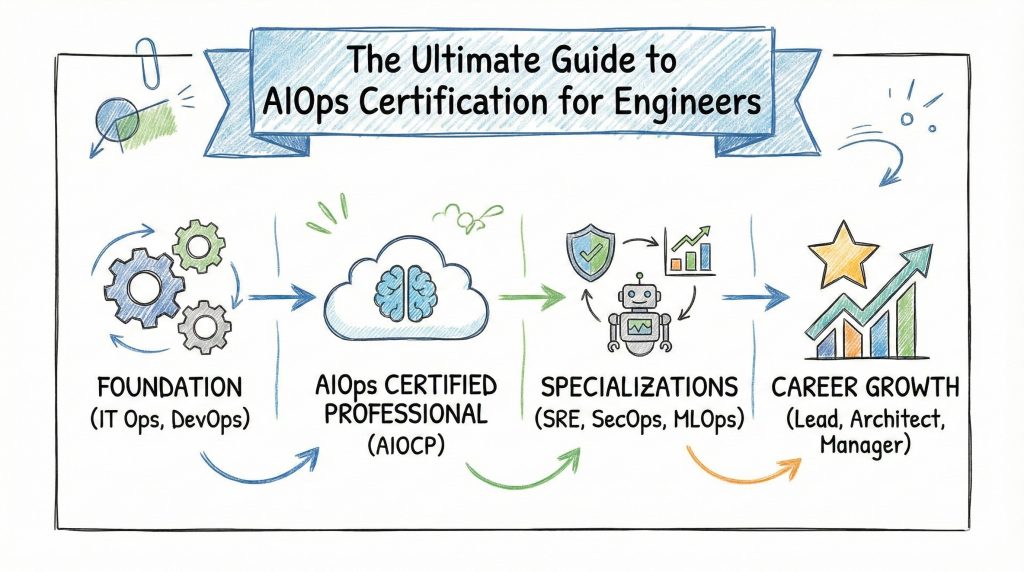
We recommend: DevOps Foundation → AIOCP → SRE or MLOps. - What is the real-world value of this certification?
It marks you as a specialist in the highest-paying sector of IT operations. It shows you can handle the scale of modern “Big Data” in production. - Will this help my career growth in India and globally?
Yes. Major tech hubs from Bangalore to Silicon Valley are actively hiring for “Intelligent Operations” roles. - What is the difference between AIOps and traditional monitoring?
Monitoring tells you a server is down. AIOps uses AI to tell you why it happened and predicts when it might happen again. - Do I need to be a programmer to pass?
You don’t need to be a full-stack developer, but a basic understanding of Python or Shell scripting is essential for the automation labs. - What tools will I learn during the AIOCP training?
You will gain experience with the ELK Stack (Elasticsearch, Logstash, Kibana), Prometheus, Grafana, and various ML frameworks. - How does AIOCP handle “Alert Fatigue”?
One of the core skills you gain is “Event Correlation”—using AI to group thousands of noisy alerts into a single, actionable incident. - Is the exam online or in-person?
The exam is fully online and proctored, allowing you to take it from the comfort of your home or office. - What happens after I get certified?
You become eligible for roles like AIOps Architect, Automation Lead, and Senior SRE. Most professionals see a significant increase in interview calls and salary offers.
FAQs on AIOps Certified Professional (AIOCP)
1. What is the core focus of AIOCP? The primary focus is on integrating Artificial Intelligence and Machine Learning into IT Operations. Unlike traditional DevOps, AIOCP teaches you how to use data-driven algorithms for anomaly detection, automated root cause analysis, and predictive maintenance to handle large-scale, complex infrastructures.
2. Does DevOpsSchool provide study materials? Yes, DevOpsSchool provides a comprehensive set of resources, including a specialized Learning Management System (LMS) with recorded videos, technical blogs, lab guides, and real-world project documentation. You also get access to a community of experts for doubt-clearing.
3. Can I take the exam online? Absolutely. The AIOCP exam is designed for global accessibility and is conducted as an online proctored test. This allows working professionals to schedule and take the exam from their home or office at a convenient time.
4. Is Python mandatory for AIOCP? While you don’t need to be a professional developer, a basic understanding of Python is essential. Python is the primary language used for building AI models and automation scripts within the AIOps framework, so being comfortable with its syntax is a requirement for the labs.
5. How does AIOCP benefit an SRE? For a Site Reliability Engineer (SRE), AIOCP is a game-changer. It helps automate the management of SLIs and SLOs and significantly reduces “toil” (manual, repetitive work). It allows SREs to move from reactive troubleshooting to proactive system management using predictive analytics.
6. What is the passing score for the certification? To earn the AIOCP credential, you must achieve a minimum score of 70% on the official exam. The questions are a mix of theoretical concepts and scenario-based problems that test your practical application skills.
7. Are there retakes available if I don’t pass the first time? Yes, most training partners, including DevOpsSchool, offer support for retakes. Depending on your training package, you may have a secondary attempt included, along with additional coaching sessions to help you clear the exam on your next try.
8. Who is the primary provider of this certification? The AIOps Certified Professional (AIOCP) program is primarily governed and provided by DevOpsSchool. They manage the curriculum, training standards, and the official certification process globally.
Testimonials
“Working as an SRE in a high-traffic e-commerce environment, I was drowning in alert noise. The AIOCP program at DevOpsSchool changed everything. By implementing the event correlation techniques I learned, we managed to cut our incident tickets by 65% in the first month. I finally stopped ‘firefighting’ and started building.”
— Vikram S., Senior SRE, Bangalore
“As an Engineering Manager, I needed to justify our investment in AI tools to the board. The AIOCP curriculum gave me the technical depth to understand the ROI and the leadership skills to guide my team through the migration. It’s the most relevant certification I’ve seen for the current market.”
— Deepika R., Infrastructure Lead, Global Tech Solutions
“The shift from traditional DevOps to AIOps felt intimidating until I took this certification. The hands-on projects, specifically the one on predictive scaling, allowed me to show my company how we could save 20% on our monthly cloud bill. It’s a career-defining credential.”
— Marcus L., Cloud Architect, London
Conclusion
The landscape of software creation and maintenance has shifted permanently. We are no longer in an era where we can rely on manual checks, basic dashboards, and reactive fixes. As systems grow more complex and data becomes more overwhelming, the “human-only” approach to operations is guaranteed to break.The AIOps Certified Professional (AIOCP) is more than just a certificate on your wall—it is your ticket to the future of the IT industry. It represents a commitment to mastering the most advanced tools available and a promise to lead your organization through its digital transformation. By choosing this path, you are choosing to be an architect of intelligent, self-healing systems rather than someone who is constantly putting out fires