Last updated: 29 November 2026
Machine learning drug discovery is already shortening some early-stage steps. The biggest gains so far are in choosing targets, ranking compounds and proposing new molecules. The slowest and costliest stage, clinical testing in people, has not yet been proven faster. This article explains where machine learning helps, what the latest evidence shows as of late November 2026, and where it falls short.
The short answer
Machine learning speeds up drug discovery by letting computers do the narrowing-down work that used to need large physical experiments. A model trained on past data can score millions of molecules in silico. Chemists then test only the most promising few hundred or fewer. That cuts wasted bench work. It does not remove the need for lab validation, safety studies or clinical trials.
How machine learning fits into the discovery pipeline
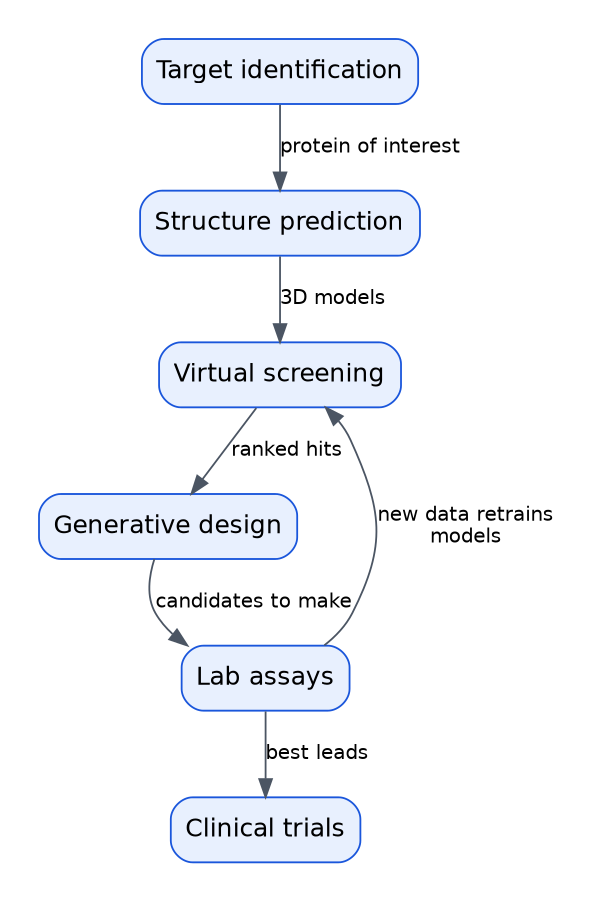
Drug discovery is a loop: pick a biological target, find molecules that act on it, improve them, and test them. Machine learning (ML) helps at several points in that loop.
1. Target identification
Models can mine omics data, literature and disease networks to suggest which protein to hit. Insilico Medicine says its PandaOmics platform identified TNIK as a target in idiopathic pulmonary fibrosis (IPF). That is a company claim, but it illustrates the idea: ML proposes a hypothesis and biology tests it.
2. Structure prediction
Knowing a protein’s 3D shape guides design. AlphaFold 3, described in Nature in 2024, predicts joint structures of proteins, nucleic acids, small molecules and ions in one model. It has known limits. It returns essentially one static structure, it can misplace chirality in small molecules (a 4.4% violation rate on the PoseBusters benchmark, per EMBL-EBI training material), and low-confidence regions need care.
3. Virtual screening and affinity prediction
Here ML ranks huge libraries by predicted binding. A well-known example is the 2020 Cell paper from Stokes and colleagues. They trained a neural network on about 10,000 molecules, screened more than 100 million from ZINC15, and found halicin, a structurally unusual antibacterial that worked in mouse infection models.
A 2024 Nature paper by Wong and colleagues scaled this idea. The team measured 39,312 compounds, used graph neural networks to score about 12 million, and tested 283. They found a structural class active against MRSA that worked in mouse models. Note the ratio: millions scored computationally, hundreds tested physically.
4. Generative design
Generative models propose new molecules tuned for several properties at once: potency, selectivity, solubility and synthesizability. They are most useful when paired with fast design-make-test cycles, where each round of lab data retrains the model.
What the clinical evidence says in 2026
Success rates: promising early, unproven later
A 2024 analysis in Drug Discovery Today (Jayatunga and colleagues, from BCG) looked at AI-native biotech pipelines. Secondary summaries report that 21 of 24 completed Phase I trials were successful, about 80 to 90 percent, higher than the historical norm. For Phase II the rate was about 40 percent, but on only 10 completed molecules, so the authors flagged it as a limited sample comparable to historical averages. I could not read the full paper here, so verify the figures there before quoting them.
The reading is cautious. ML seems to help find molecules that are safe and behave well in early trials. Whether it picks better biology, which is what Phase II and III test, is still open.
The first Phase III for a generative-AI drug
Insilico’s rentosertib, an oral TNIK inhibitor for IPF, is the most-watched case. Its 12-week Phase IIa trial (Nature Medicine, June 2025) enrolled 71 patients. At 60 mg once daily, mean forced vital capacity (FVC) changed by +98.4 mL versus −20.3 mL for placebo. The confidence intervals were wide, the trial’s primary endpoint was safety, and three patients (16.7%) in the 60 mg group had hospitalised acute exacerbations versus one (5.9%) on placebo. The authors concluded larger, longer trials are warranted.
Insilico announced the Phase III, GENESIS-IPF-3, in July 2026 and dosed the first patient on 9 September 2026. It is a 52-week, randomised, double-blind, placebo-controlled study of about 320 participants at 47 centres in China. The primary endpoint is annual FVC decline. ClinicalTrials.gov (NCT07687459) lists an estimated primary completion in October 2029. No Phase III efficacy results exist yet.
Has an AI-discovered drug been approved?
It depends on your definition. In 2026 the FDA granted full approval to lirafugratinib (Lyrfigtu) for FGFR2-rearranged cholangiocarcinoma, according to Relay Therapeutics’ third-quarter 2026 report. Relay calls it the first approved medicine from its Dynamo platform, which it says integrates computational and experimental approaches. That is a computation-driven platform, not clearly an end-to-end ML one. Other 2026 commentary I found says no drug with both target and molecule discovered by AI has been approved. Treat “first AI drug approved” headlines with care and check the definition used.
Comparison: where ML helps most
| Stage | Typical ML role | Maturity | Main risk |
|---|---|---|---|
| Target identification | Rank disease-linked targets | Emerging | Biology still needs proof in patients |
| Structure prediction | Predict protein and complex shapes | Mature, widely used | Static views, errors in ligand geometry |
| Virtual screening | Rank millions of compounds | Useful for triage | Weak ranking among close analogues |
| Molecule design | Propose optimised candidates | Growing | Hard-to-make or off-target molecules |
| Clinical development | Trial design, patient selection | Early | Small evidence base so far |
Where machine learning still struggles
- Affinity ranking is imperfect. A March 2026 arXiv study compared Boltz-2 with docking and physics-based free-energy calculations on two targets. For the top 100 compounds it found essentially no correlation with the physics-based values. It also found overconfident scores and some chemically incorrect structures. The authors judged it good for fast initial screening but not for final lead ranking. Another prospective study on the Mac1 target (an eLife reviewed preprint) found Boltz-2 affinity predictions tracked measured potency best among the tools tested. Results vary by target.
- Benchmarks can flatter models. A 2026 Chemical Science evaluation warned that overlap between training data and benchmark sources may inflate reported screening metrics.
- Data quality limits everything. Public assay data is noisy and biased toward published successes.
- Biology is the bottleneck. A perfect binder to the wrong target still fails.
Regulation and governance
In January 2025 the FDA issued draft guidance on using AI to support regulatory decision-making for drugs and biologics. It proposes a risk-based credibility framework tied to a model’s “context of use.” FDA’s own page still describes it as a 2025 draft, and it is non-binding. In January 2026 the FDA and EMA jointly published ten guiding principles of good AI practice in drug development, covering themes such as risk-based approaches, clear context of use, data governance and life-cycle management. Adoption is voluntary. Note that this guidance concerns AI used to generate evidence for regulatory decisions, not every internal discovery tool.
Best practices for teams using ML in discovery
- Define the decision first. Say what the model decides, such as which 200 compounds to buy, and what error is acceptable.
- Validate prospectively. Retrospective benchmarks are not enough. Test predictions in the lab.
- Use ensembles of methods. Combine ML scoring with docking or free-energy calculations for the shortlist.
- Close the loop. Feed assay results back to retrain the model each cycle.
- Track provenance. Record data sources, model versions and splits so results can be audited.
- Check licences. Model weights have different terms for academic and commercial use. Read the repository licence.
Common mistakes
- Treating a high model confidence score as proof of binding.
- Random train/test splits that leak near-identical molecules into the test set.
- Counting molecules screened instead of hits confirmed.
- Assuming faster discovery means faster approval.
Hands-on exercise: a minimal screening triage
This sketch shows the pattern of training on measured activity, then ranking an unseen library. The code has not been tested here, and the file names are placeholders. It assumes RDKit and scikit-learn are installed.
import pandas as pd, numpy as np
from rdkit import Chem
from rdkit.Chem import AllChem
from sklearn.ensemble import RandomForestClassifier

def fp(smiles):
    m = Chem.MolFromSmiles(smiles)
    return np.array(AllChem.GetMorganFingerprintAsBitVect(m, 2, 2048))

train = pd.read_csv("assay_results.csv")   # columns: smiles, active (0/1)
X = np.vstack([fp(s) for s in train.smiles])
model = RandomForestClassifier(n_estimators=500, random_state=0)
model.fit(X, train.active)

library = pd.read_csv("library.csv")       # column: smiles
Xl = np.vstack([fp(s) for s in library.smiles])
library["score"] = model.predict_proba(Xl)[:, 1]
library.sort_values("score", ascending=False).head(200).to_csv("to_test.csv")
Next, improve it: split training data by molecular scaffold rather than randomly, test the top 200 in an assay, and add those results to the training set.
FAQ
Can machine learning cut drug discovery time?
It can shorten early discovery by reducing physical experiments. Company-reported timelines vary and are hard to compare. Independent evidence of faster approval is still lacking.
Does AI make drugs more likely to succeed?
Early data suggest higher Phase I success. Phase II looks similar to historical averages, on small samples.
Will AI replace medicinal chemists?
No evidence supports that. The successful examples above all relied on lab validation and expert judgement.
What is the biggest limitation?
Biological uncertainty and data quality. Models can propose molecules quickly, but only trials show whether a drug helps patients.
Bottom line
Machine learning accelerates the front half of drug discovery, mainly by triaging options before the lab. The back half, proving safety and efficacy in people, is where the first major tests, such as rentosertib’s Phase III, are only now under way. Judge claims by prospective validation and trial results, not by the number of molecules a model can screen.