Last updated: 29 November 2026
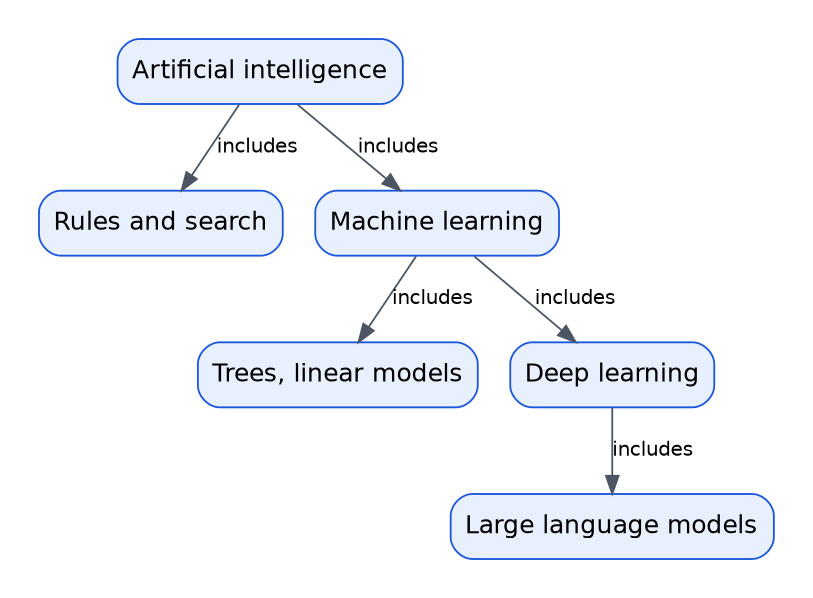
The difference between AI, ML, and deep learning is mainly one of scope. Artificial intelligence (AI) is the broad field of building machine-based systems that perform tasks such as predicting, recommending, deciding or generating content. Machine learning (ML) is a subset of AI in which a model learns from data. Deep learning (DL) is a subset of ML that uses neural networks with multiple hidden layers.
So all deep learning is machine learning, and all machine learning falls under AI. The reverse is not true: some AI uses no learning at all, and much machine learning is not deep.
AI, ML, and Deep Learning Compared
| Aspect | Artificial intelligence | Machine learning | Deep learning |
|---|---|---|---|
| Scope | The whole field | A subset of AI | A subset of ML |
| Core idea | Machines infer how to produce useful outputs | Models learn patterns from data | Layered networks learn representations from data |
| Typical methods | Rules, search, planning, ML | Linear models, decision trees, random forests, boosting, neural networks | Multilayer, convolutional and transformer networks |
| Who designs features | Depends on the method | Often people, especially in classical ML | Many are learned inside the network |
| Common strengths | Depends on the method | Structured, table-like data | Images, audio and text |
| Compute needs | Very wide range | Often modest | Often higher, especially for large models |
| Example | Route planner | Customer churn predictor | Speech recognizer |
The last four rows describe tendencies, not strict rules.
What Is Artificial Intelligence?
AI is the umbrella term. The OECD’s updated definition, approved by member countries in 2023, describes an AI system as a machine-based system that infers from its input how to generate outputs such as predictions, content, recommendations or decisions. Those outputs can influence physical or virtual environments. Systems differ in how autonomous they are and how much they adapt after deployment.
The name is much older. John McCarthy and colleagues used “artificial intelligence” in their 1955 proposal for a summer research workshop held at Dartmouth in 1956.
AI covers more than learning. Expert systems, for example, store specialist knowledge that people have written down and apply it to a problem. Search and planning algorithms explore possible moves or routes to find a good one.
Definitions used in laws and policies can draw the boundary differently from textbooks. If compliance depends on whether something counts as AI, check the wording that applies to you.
What Is Machine Learning?
Google’s introductory course describes machine learning as training software, called a model, to make useful predictions or generate content from data. Instead of writing every decision rule, you supply data and a training procedure adjusts the model.
An early example is Arthur Samuel’s checkers program, which improved through self-play.
Main types of machine learning
- Supervised learning: learns from examples that include the correct answers. Regression predicts a number, such as a house price. Classification predicts a category, such as spam or not spam.
- Unsupervised learning: finds patterns in unlabeled data, for instance by clustering similar customers.
- Reinforcement learning: learns a strategy from rewards and penalties received while acting in an environment.
- Generative AI: creates new content, such as text or images, from user input. Its training often combines several of the approaches above.
“Classical” or “traditional” ML usually means methods other than deep learning, such as logistic regression or tree ensembles. People often choose the input variables, called features. A churn model might use account age, monthly usage and recent support tickets.
What Is Deep Learning?
Google’s glossary defines a deep model, also called a deep neural network, as a neural network with more than one hidden layer. Hidden layers sit between the input and the output.
A well-known 2015 review in Nature by Yann LeCun, Yoshua Bengio and Geoffrey Hinton explains the key idea: models with many processing layers learn representations of data at several levels of abstraction.
In an image task, early layers may respond to simple patterns such as edges. Later layers combine them into shapes and object parts. This is a helpful intuition, although real networks are not always so tidy.
During training, the network makes a prediction and measures the error. Backpropagation then works out how each weight contributed to that error, and an optimizer updates the weights. This repeats over many batches of data.
Today’s large language models are deep neural networks. Generative AI and deep learning are still not synonyms: deep networks also do non-generative work, such as classifying images.
One Problem, Three Approaches
Here is a hypothetical email filtering project.
- Rule-based AI: a person writes rules such as “flag messages from blocked senders that contain certain phrases.” It is easy to inspect, but someone must keep updating it.
- Classical ML: you label past messages, count features such as words and links, and train a classifier. The model learns how much each feature matters.
- Deep learning: you train or fine-tune a neural network on message text. It can use context and word order, usually at greater computing cost and with less transparent decisions.
A real product may combine all three: rules for known threats, a learned model for everything else, and ordinary software around both. AlphaGo is a famous example of combination, pairing machine learning with a search procedure.
How to Choose the Right Approach
- Start with the decision. Define the output, who uses it and what a mistake costs.
- Try rules if the logic is stable, well understood and short enough to maintain.
- Try classical ML if you have historical examples in rows and columns.
- Try deep learning for images, audio or language, ideally starting from a pretrained model.
- Compare against a baseline on data the model never saw. Weigh speed, cost and explainability along with accuracy.
Deep learning does not automatically win. A 2022 benchmark by Grinsztajn, Oyallon and Varoquaux, covering 45 datasets, found that tree-based models still led on medium-sized tabular data (around 10,000 samples).
That picture keeps moving. A 2025 Nature paper on TabPFN, a pretrained transformer for tables, reported that it outperformed gradient-boosted trees in its authors’ benchmarks on datasets of up to 10,000 samples. Treat any such result as a reason to test candidates on your own data.
Hands-On Exercise: Classical ML vs a Deep Network
This exercise uses the small handwritten digits dataset included with scikit-learn. Each image is only 8 by 8 pixels. Install the library with pip install scikit-learn. The code has not been tested here.
from sklearn.datasets import load_digits
from sklearn.model_selection import train_test_split
from sklearn.pipeline import make_pipeline
from sklearn.preprocessing import StandardScaler
from sklearn.linear_model import LogisticRegression
from sklearn.neural_network import MLPClassifier

X, y = load_digits(return_X_y=True)
X_train, X_test, y_train, y_test = train_test_split(
    X, y, test_size=0.25, stratify=y, random_state=42
)

models = {
    "logistic regression": LogisticRegression(max_iter=2000),
    "neural net, 2 hidden layers": MLPClassifier(
        hidden_layer_sizes=(64, 32), max_iter=500, random_state=42
    ),
}

for name, model in models.items():
    pipeline = make_pipeline(StandardScaler(), model)
    pipeline.fit(X_train, y_train)
    print(name, round(pipeline.score(X_test, y_test), 3))
Both models are machine learning. The second also meets the “more than one hidden layer” definition of a deep model, although it is tiny by modern standards.
Now experiment:
- Change
random_statein the network and see how much the score moves. - Use only 10% of the training rows and compare again.
- Remove the scaler. Neural networks are sensitive to feature scaling.
- Time each model’s training, then decide whether any accuracy difference justifies it.
When tuning seriously, use a separate validation set or cross-validation, and keep the test set for the final check.
Common Mistakes and How to Fix Them
- Using the three terms interchangeably. Name the actual method, such as “gradient-boosted classifier,” when precision matters.
- Assuming all AI learns continuously. Many deployed models stay fixed until someone updates or retrains them.
- Starting with the most complex model. Build a simple baseline first.
- High training score, poor test score. This suggests overfitting. Try more data, regularization, a simpler model or early stopping.
- Suspiciously good results. Check for data leakage, such as a feature that reveals the answer or duplicates shared between training and test sets.
- Performance drops after launch. Compare live inputs with training data, monitor outcomes and retrain when justified.
Frequently Asked Questions
Is machine learning the same as AI?
No. Machine learning is one part of AI. Rule-based and search-based systems can be AI without learning from data.
Is every neural network deep learning?
Not under the strict definition above. A network with a single hidden layer is usually called shallow.
Is ChatGPT AI, ML, or deep learning?
All three. It is an AI application built on large language models, which are deep neural networks trained with machine learning. The full product also includes other software.
Should I learn machine learning before deep learning?
It is a sensible order. Data splitting, overfitting, evaluation metrics and baselines apply to both. Add basic Python, statistics and linear algebra as you go.
Does deep learning always need huge datasets and GPUs?
No. Small networks run on ordinary processors, and pretrained models can reduce how much data you need. Training large models from scratch is far more demanding.
The Bottom Line
Think of three nested circles. AI is the goal and the wider field, machine learning is the approach that learns from data, and deep learning is the branch of that approach built on multilayer neural networks. Pick the simplest option that solves your problem reliably, and prove it with data the model has not seen.