Introduction
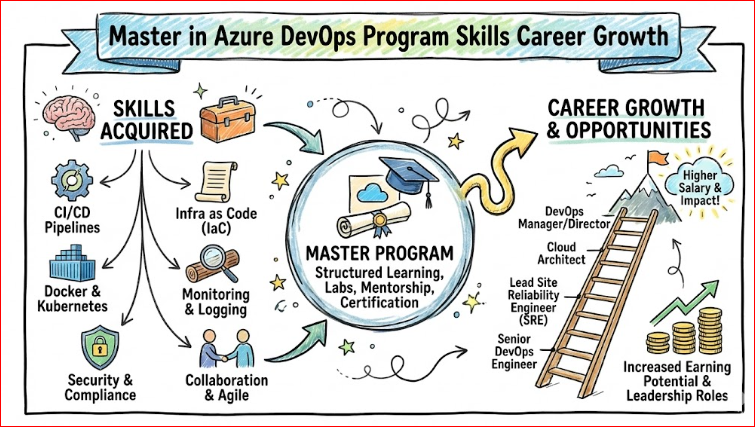
In the world of modern software delivery, there is one skill set that stands above the rest: the ability to combine cloud infrastructure with automated operations. Microsoft Azure is currently a dominant force in the enterprise cloud market, and the demand for professionals who can master its DevOps ecosystem is at an all-time high.The Master in Azure DevOps certification program is not just another course. It is a strategic career accelerator. It is designed to take you from a cloud novice to a highly paid Azure DevOps Engineer Expert. Whether you are a fresh graduate, a manual tester, a system administrator, or a developer, this program bridges the gap between writing code and delivering it reliably to millions of users. This guide provides a complete roadmap to this certification. We will cover the syllabus, the real-world skills you will gain, the projects you will build, and how this specific qualification can redefine your career trajectory in the IT industry.
What is the Master in Azure DevOps Program?
The Master in Azure DevOps is a bundled, expert-level certification track offered by DevOpsSchool. Unlike single-exam certifications that give you a piece of the puzzle, this program gives you the whole picture. It aggregates three critical Microsoft Azure certifications into one cohesive learning journey.
It is designed to solve a major industry problem: “Paper Certified” engineers who know theory but cannot build systems. This program ensures you understand the Cloud (Azure), the Operations (Administration), and the Process (DevOps).
The program consists of three major pillars:
- Azure Fundamentals (AZ-900): This is your entry point. It covers the vocabulary of the cloud, understanding the difference between IaaS, PaaS, and SaaS, and how Azure’s global infrastructure (Regions and Availability Zones) works.
- Azure Administrator (AZ-104): This is the “heavy lifting” module. You learn how to manage the actual resources—spinning up Virtual Machines, managing Storage Accounts, configuring Virtual Networks (VNet), and handling Identity with Azure Active Directory (Entra ID).
- Azure DevOps Engineer Expert (AZ-400): This is the advanced capstone. Here, you learn to automate everything you built in the previous steps. You will master CI/CD pipelines, Source Control strategy, Security integration (DevSecOps), and Site Reliability Engineering (SRE) practices.
Who Should Take This Certification?
This certification is versatile. It is built for anyone who wants to own the software delivery lifecycle on the Microsoft stack.
- System Administrators: If you are managing on-premise servers and want to stop worrying about hardware failures, this course teaches you how to lift and shift to the cloud.
- Software Developers: If you are tired of your code working on your machine but breaking in production, this course teaches you how to create build pipelines that catch errors early.
- Manual Testers/QA: If you want to move into automation and release engineering, this certification provides the technical foundation to become a generic DevOps Engineer.
- IT Managers: If you need to lead cloud transformations, you need to understand the underlying technology to make better architectural and hiring decisions.
- Fresh Graduates: Cloud computing is the standard for new projects. Starting your career with this triple-certification sets you apart from peers who only know programming languages.
Skills You’ll Gain
Upon completion, you will not just “know” Azure; you will be able to operate it. The skills you acquire are strictly aligned with market requirements.
- Cloud Architecture Patterns: You will learn how to design systems that are highly available and scalable, understanding when to use a Virtual Machine versus a Container or a Serverless Function.
- Identity & Access Management (IAM): You will master Azure Active Directory (Entra ID) to secure your resources, implementing Multi-Factor Authentication (MFA) and Conditional Access policies.
- Networking Mastery: You will gain the ability to create secure Virtual Networks, configure subnets, set up VPN gateways, and manage traffic with Load Balancers and Application Gateways.
- Infrastructure as Code (IaC): You will stop clicking buttons in the portal and start writing code to deploy infrastructure using ARM Templates, Bicep, and Terraform.
- CI/CD Pipeline Automation: You will learn to design complex build and release pipelines using Azure DevOps Services and GitHub Actions, automating testing and deployment.
- Container Orchestration: You will gain hands-on experience with Docker and Azure Kubernetes Service (AKS), learning how to deploy and manage microservices applications.
- Observability & Monitoring: You will learn to implement Azure Monitor and Application Insights to visualize system health, set up alerts, and diagnose performance bottlenecks before customers notice them.
- DevSecOps Practices: You will learn to integrate security scanning (SAST/DAST) directly into your pipelines, ensuring that every release is secure by default.
Real-World Projects You Should Be Able to Do
Theory is useless without application. This program focuses on “Project-Based Learning.” After finishing this course, you should be confident enough to add the following projects to your resume:
- Project 1: End-to-End Web App Deployment: Deploy a scalable .NET or Node.js web application using Azure App Service, backed by an Azure SQL Database, with auto-scaling rules configured for high traffic.
- Project 2: Designing a Secure Network Topology: Create a Hub-and-Spoke network architecture with peered VNets, ensuring that database subnets are isolated from the public internet using Network Security Groups (NSGs).
- Project 3: CI/CD Pipeline for Microservices: Build a multi-stage Azure DevOps pipeline that builds Docker images, pushes them to Azure Container Registry (ACR), and deploys them to an Azure Kubernetes Service (AKS) cluster.
- Project 4: Infrastructure Automation with Terraform: Write a Terraform script that automatically provisions a complete Dev/Test environment (VMs, Storage, Networking) and destroys it at night to save costs.
- Project 5: Monitoring Dashboard Implementation: Set up a centralized dashboard using Azure Monitor that displays real-time metrics (CPU, Memory, HTTP Errors) and triggers an email alert to the operations team when thresholds are breached.
Preparation Plan
To master three certifications, you need a disciplined schedule. Here is a breakdown based on different timelines.
7-Day Intensive Plan (For Experienced Cloud Pros)
- Day 1: Blitz through AZ-900. Focus on Azure Governance, SLAs, and Cost Management.
- Day 2-3: Deep dive into AZ-104 Networking. Master VNet Peering and Hybrid connectivity.
- Day 4: Focus on AZ-104 Storage and Compute. specific differences between Blob tiers and VM families.
- Day 5: Switch to AZ-400. Study Branching strategies (GitFlow vs. Trunk-based) and Package Management.
- Day 6: Master AZ-400 Pipelines (YAML syntax) and SRE concepts (Dependency Injection, Blameless post-mortems).
- Day 7: Take mock exams for all three and review incorrect answers.
30-Day Standard Plan (Recommended for Working Professionals)
- Week 1: Complete the AZ-900 syllabus. Spend time playing with the Azure Portal to build muscle memory.
- Week 2: Attack AZ-104. Dedicate 3 days to Networking (it is the hardest part) and 2 days to Identity/RBAC.
- Week 3: Finish AZ-104 with Compute/Storage. Start AZ-400 concepts: Source Control and Basic Pipelines.
- Week 4: Deep dive into Advanced AZ-400: Docker, Kubernetes, Ansible, and Terraform integrations. Spend the weekend building one full project.
60-Day Comprehensive Plan (For Beginners)
- Weeks 1-2: AZ-900. Take it slow. Read official docs. Understand the “Why” of cloud.
- Weeks 3-5: AZ-104. Spend one full week just on Linux/Windows administration basics if you are new to Ops. Do all hands-on labs twice.
- Weeks 6-8: AZ-400. Focus heavily on modern development practices. Learn Git thoroughly. Build pipelines for different languages (Java, Python, .NET).
Common Mistakes to Avoid
- Ignoring the Prerequisites: Do not jump straight to AZ-400. Without the networking and storage knowledge from AZ-104, the DevOps concepts will not make sense.
- Relying on “Dumps”: Memorizing answers might get you a pass, but it will get you rejected in a technical interview. Focus on understanding the concepts.
- Underestimating Networking: Most students fail AZ-104 because they do not understand Subnetting, DNS, or VPNs. Spend extra time here.
- Skipping YAML: The modern cloud runs on YAML. If you are uncomfortable writing YAML files for pipelines or Kubernetes manifests, you will struggle.
- Forgetting Cost Management: In the real world, costs matter. Always learn how to view, predict, and optimize costs for every resource you deploy.
- Not Doing Hands-on Labs: Watching videos is passive. You must log in to the Azure Portal and break things. If you haven’t seen an error message, you haven’t learned.
Best Next Certification After This
Once you have the “Master in Azure DevOps” title, where do you go?
- Same Track (Deepen Expertise): Azure Solutions Architect Expert (AZ-305). This is the natural next step. It moves you from “How do I build this?” to “How do I design this for the enterprise?”
- Cross-Track (Broaden Skills): Certified Kubernetes Administrator (CKA). Since Azure DevOps relies heavily on containers, mastering Kubernetes at a deep level makes you unstoppable.
- Leadership Track: Certified DevOps Manager. If you want to stop coding and start leading teams, this certification helps you understand culture, metrics, and hiring.
Choose Your Path: 6 Learning Tracks
Depending on your interest, you can specialize further after this foundation.
- DevOps Engineer: The generalist. You focus on the smooth flow of code from laptop to production using CI/CD and Configuration Management.
- DevSecOps Engineer: The guardian. You focus on “Shifting Left”—integrating security tools (SonarQube, Checkmarx, WhiteSource) into the pipeline so security is automated, not a bottleneck.
- Site Reliability Engineer (SRE): The fixer. You focus on system stability, latency, and uptime. You write code to automate operations and manage incident responses.
- AIOps/MLOps Engineer: The futurist. You apply DevOps principles to Machine Learning models, automating the training, testing, and deployment of AI models.
- DataOps Engineer: The data wrangler. You use DevOps techniques to manage big data pipelines, ensuring data quality and availability for data scientists.
- FinOps Practitioner: The accountant. You bridge the gap between engineering and finance, optimizing cloud spend and ensuring the company isn’t wasting money on idle resources.
Role → Recommended Certifications Mapping
Use this table to find the exact certification match for your current or desired job role.
| Role | Recommended Certifications |
|---|---|
| DevOps Engineer | Master in Azure DevOps, CKA (Kubernetes), Terraform Associate |
| SRE | Master in Azure DevOps, Certified SRE, AZ-305 (Architect) |
| Platform Engineer | Master in Azure DevOps, CKA, CKAD, AWS Solutions Architect |
| Cloud Engineer | Master in Azure DevOps, AZ-104, Linux+ |
| Security Engineer | Master in Azure DevOps, AZ-500 (Azure Security), CISSP |
| Data Engineer | Master in Azure DevOps, DP-203 (Azure Data Engineer) |
| FinOps Practitioner | Master in Azure DevOps, FinOps Certified Practitioner |
| Engineering Manager | Master in Azure DevOps, PMP, Certified Agile Leadership |
List of Top Institutions for Training & Certification
Here are the premier institutions that provide training for the Master in Azure DevOps program.
- DevOpsSchool:
The market leader in this space. They offer a “Master in Azure DevOps” program that is specifically bundled to cover AZ-900, AZ-104, and AZ-400. Their standout feature is the inclusion of real-time projects and a focus on interview preparation, ensuring you are job-ready, not just exam-ready. - Cotocus:
Known for their consultancy-led training approach. Their trainers are often working consultants who bring fresh, day-to-day industry challenges into the classroom. They are excellent for professionals who want to understand high-level architectural scenarios and complex troubleshooting. - Scmgalaxy:
A community-driven platform that has been around for years. They offer deep-dive materials specifically on Source Code Management (SCM) and build tools. Their Azure DevOps training is very strong on the tooling side, making it great for developers who want to master the “Dev” in DevOps. - BestDevOps:
As the name suggests, they focus purely on DevOps tools and methodologies. Their curriculum is updated frequently to match the changing exam patterns of Microsoft. They are a great choice if your primary goal is passing the certification exams quickly and efficiently. - DevSecOpsSchool:
If security is your priority, this is the place. While they teach Azure DevOps, every lesson has a security layer added to it. You won’t just learn to deploy a VM; you’ll learn to deploy a compliant, hardened VM. Perfect for aspirants in banking or healthcare sectors. - SRESchool:
Focused on stability and reliability. Their version of the Azure DevOps training emphasizes Azure Monitor, Log Analytics, and Auto-scaling strategies. If you want to be an SRE who uses Azure, their curriculum is tailored exactly to that outcome. - AIOpsSchool:
A niche provider focusing on the intersection of AI and IT Ops. Their Azure training includes unique modules on using Azure’s AI services to predict failures. This is advanced training for those looking to future-proof their careers in intelligent operations. - DataOpsSchool:
Tailored for data professionals. They teach Azure DevOps with a focus on Data Factory, Databricks, and SQL pipelines. If you are a Data Engineer wanting to learn DevOps, their curriculum bridges that specific gap better than a generic course. - FinOpsSchool:
The go-to for cost optimization. Their training highlights the financial aspects of Azure—Cost Management + Billing, Budgets, and tagging strategies. This is crucial for managers and architects who are responsible for the cloud budget.
Certification Overview Table
| Certification | Track | Level | Who it’s for | Prerequisites | Skills Covered | Recommended Order |
|---|---|---|---|---|---|---|
| Master in Azure DevOps | Cloud & DevOps | Expert | Engineers, Architects, Managers | Basic IT knowledge | Cloud Infra, CI/CD, Security, SRE | Complete Program |
| AZ-900 | Cloud | Fundamental | Non-tech & Beginners | None | Cloud Concepts, SLAs, Pricing | 1 |
| AZ-104 | Cloud | Associate | Admins & Engineers | AZ-900 (Recommended) | Storage, VNet, Identity, Compute | 2 |
| AZ-400 | DevOps | Expert | DevOps Engineers | AZ-104 | Pipelines, IaC, Monitoring, SRE | 3 |
Frequently Asked Questions (FAQs)
1. Is coding required for the Master in Azure DevOps certification?
Yes, but you don’t need to be a software developer. You need to understand scripting languages like PowerShell or Bash, and markup languages like YAML and JSON. You won’t be writing applications, but you will be writing code to manage infrastructure.
2. How difficult is the AZ-400 exam compared to AZ-104?
Most students find AZ-104 (Administration) harder because it is very broad and focuses on detailed implementation. AZ-400 (DevOps) focuses more on processes and workflows. If you master AZ-104, AZ-400 becomes significantly easier to grasp.
3. Can I skip AZ-900 and AZ-104 and go straight to AZ-400?
You can physically take the AZ-400 exam, but Microsoft will not grant you the “DevOps Engineer Expert” badge until you also pass AZ-104. Additionally, without the admin knowledge from AZ-104, you will likely fail the AZ-400 exam.
4. What is the validity of these certifications?
Microsoft Role-based certifications (like AZ-104 and AZ-400) are valid for one year. However, you can renew them for free by passing a short online assessment on Microsoft Learn before they expire. You do not need to pay for the exam again.
5. Does this program cover AWS or Google Cloud?
No. This is a specialized program for the Microsoft Azure stack. However, the DevOps concepts you learn (CI/CD, Containers, IaC) are universal and can be easily applied to other cloud providers with minor syntax changes.
6. What is the average salary of an Azure DevOps Engineer in India?
As of 2026, entry-level Azure DevOps engineers can expect packages between ₹8-12 LPA. Experienced professionals (5+ years) with this certification often command salaries upwards of ₹25-40 LPA, depending on the company and location.
7. Do I need a powerful laptop for the labs?
Not really. Since you are building everything in the Cloud, the heavy lifting is done by Azure. A basic laptop with a good internet connection and a modern browser (Chrome/Edge) is sufficient.
8. How much time should I dedicate daily for preparation?
Consistency is key. If you can dedicate 2 hours every day, you can realistically complete the entire Master track (AZ-900 + AZ-104 + AZ-400) in about 2 to 3 months. Weekend-only study will double that time.
9. Will I get a job immediately after this certification?
A certification gets your resume shortlisted, but skills get you the job. This is why the “Master in Azure DevOps” program emphasizes projects. Employers hire based on what you have built, not just the badge you hold.
10. What happens if I fail an exam?
Microsoft has a retake policy. You must wait 24 hours after the first attempt. If you fail again, you must wait 14 days. You have to pay the exam fee for every attempt, which is why thorough preparation is essential.
11. Is the training live or recorded?
Institutions like DevOpsSchool offer both. Live instructor-led training is highly recommended because you can ask questions in real-time and get unblocked immediately during labs. Recorded sessions are good for revision.
12. How does this compare to the AWS DevOps certification?
Both are excellent. AWS has a larger market share, so there are more jobs, but there is also more competition. Azure is dominant in the enterprise/corporate space. If you come from a Windows/C# background, Azure DevOps is the better choice.
Frequently Asked Questions (FAQs) — Master in Azure DevOps (8)
1) What do I learn in Master in Azure DevOps?
You learn Azure basics, how to manage Azure environments, and how to build CI/CD pipelines so software can be released safely and repeatedly.
2) What is the correct order to follow in this program?
Start with Azure Fundamentals (AZ-900), then Azure Administrator (AZ-104), and finally Azure DevOps (AZ-400). This order reduces confusion and builds skills step by step.
3) Is this program useful for working professionals?
Yes. It is useful because it focuses on real work like pipelines, approvals, deployments, and release control—things used in daily jobs.
4) Do I need strong coding skills for this?
You do not need advanced coding, but you should understand Git basics and be comfortable reading build and deployment steps.
5) How much time should I give daily?
Even 60–90 minutes daily is enough if you stay consistent. The key is regular hands-on practice, not long weekend-only study.
6) What is one must-have project after finishing?
A full CI + CD setup that deploys to dev, staging, and production with approvals, post-deploy checks, and a rollback plan.
7) How do I know I am ready for interviews?
If you can explain your pipeline flow, show your project, explain failures you fixed, and describe how you keep production safe, you are ready.
8) What should I do after completing this program?
Pick one direction based on your role: deeper Azure architecture, security-focused DevOps, reliability/SRE skills, or delivery leadership skills.
Testimonials
Suresh K., Senior System Admin, Bangalore:
“I was stuck in a traditional support role for 8 years. The Master in Azure DevOps program completely changed my mindset. The AZ-104 module gave me confidence in cloud infra, and AZ-400 helped me automate my daily tasks. I successfully switched to a DevOps role within 3 months of completion.”
Priya M., Java Developer, Hyderabad:
“I knew how to code, but I had no idea how my code was deployed. This course opened my eyes. Learning to write my own pipelines and managing Kubernetes clusters has made me a much better developer. The real-world projects were the best part—very practical.”
Amit V., IT Manager, Pune:
“I took this course not to become an engineer, but to understand what my team does. It was excellent. The trainer explained complex concepts in simple English. Now I can actually participate in architectural discussions and make better decisions for my company.”
Conclusion
The Master in Azure DevOps is more than just a certification; it is a validation of your ability to deliver value in a modern IT environment. By combining the foundational strength of AZ-900, the administrative power of AZ-104, and the automation expertise of AZ-400, you are building a profile that is recession-proof and highly scalable. The industry does not need more people who can just click buttons. It needs engineers who can architect, automate, and secure complex systems. This program gives you that power.
