Introduction
In the world of cloud computing, the difference between a good engineer and a great one often comes down to one thing: the ability to deliver software reliably at scale. The AWS DevOps Engineer – Professional certification is the gold standard for proving you have that ability. It doesn’t just test if you know the names of AWS services; it tests if you can design systems that heal themselves, pipelines that catch errors before they reach production, and security that moves as fast as your developers. For working engineers, this certification is a career accelerator. It signals to employers that you can handle high-stakes production environments where downtime isn’t an option. For managers, understanding this path is key to building teams that ship faster and break fewer things.
Certification list
| Certification | Track | Level | Who it’s for | Prerequisites | Skills covered | Recommended order |
|---|---|---|---|---|---|---|
| AWS DevOps Engineer – Professional | AWS DevOps | Professional | DevOps, Cloud, Platform engineers; senior software engineers owning CI/CD and operations; managers who want strong delivery and ops understanding | Comfortable with AWS fundamentals, CI/CD, IaC concepts, and monitoring basics; hands-on production exposure recommended | Advanced CI/CD, release strategies, operations automation, observability, governance-minded delivery | Take after strong AWS fundamentals + real CI/CD/IaC practice in a project |
What to expect before you start
The real focus: decisions under constraints
Professional-level prep is less about remembering service names and more about choosing the best approach under constraints like cost, risk, time, and operational overhead. You’ll repeatedly practice trade-offs: “fast vs safe,” “simple vs scalable,” and “managed vs custom.”
This is why hands-on practice matters so much. If you have built pipelines, handled failed deployments, or debugged alert noise, you will recognize the patterns quickly and learn faster.
What “good” looks like in the job
A strong DevOps engineer builds a delivery system that teams can trust. That means fewer broken releases, faster recovery, clear audit trails, and a stable path from commit to production.
From a manager’s view, “good” also means predictability. Releases become planned events, not heroic firefights, because the system supports safe change by design.
AWS DevOps Engineer – Professional (full guide)
What it is
AWS Certified DevOps Engineer – Professional is intended for people performing a DevOps engineer role, validating skills to provision, operate, and manage distributed application systems on AWS.
On the program page, the exam is referenced as “AWS Certified DevOps Engineer – Professional (DOP-CO1).”
Who should take it
This is a strong fit if you are already working with AWS delivery or operations and want a formal validation that maps to real responsibilities. You do not need to be “only DevOps” by title—many software engineers and cloud engineers do DevOps work in practice.
It is also useful if your role includes incident response, reliability ownership, platform enablement, or standardizing how teams ship software. If you regularly touch pipelines, infrastructure provisioning, or observability, this certification aligns well.
Skills you’ll gain
- CI/CD system design: You learn how to structure pipelines so releases are repeatable, auditable, and easy to operate. In practice, that means automated tests, approvals where needed, clear artifacts, and reliable deployment workflows.
- Infrastructure as Code thinking: You practice making environments reproducible, reducing drift, and managing changes safely. That helps teams avoid “works in staging but not in prod” because environments become consistent.
- Observability and operational readiness: You learn to connect metrics, logs, and alerts to real actions. The goal is fewer noisy alerts and more “this tells me what to do next” signals.
- Automation mindset: You build habits around eliminating manual steps that create risk. Mature DevOps is mostly about system improvements that reduce toil and lower failure rates.
Real-world projects you should be able to do after it
- End-to-end pipeline for a service: Build a pipeline that compiles, tests, packages, and deploys to multiple environments. Make it easy to trace “what version is running” and “who approved it” for operational clarity.
- Safe deployment strategy: Implement blue/green or canary releases with health checks and rollback. This moves you from “deploy and pray” to controlled change, where the system can stop or reverse a bad release quickly.
- Standardized environment provisioning: Create reusable templates/modules so teams can create dev/test/prod consistently. This is how platform teams reduce setup time and remove environment-specific surprises.
- Monitoring + incident runbooks: Create dashboards and actionable alerts, then attach runbooks that explain what to check first. This is the difference between “alert fatigue” and fast incident response.
Preparation plan (7–14 days / 30 days / 60 days)
7–14 days (fast revision plan)
This plan works when you already do AWS DevOps work frequently and mostly need structure and exam-style practice.
- Days 1–2: List your weak areas (CI/CD, IaC, monitoring, operations, security automation) and pick the top two that cause the most confusion. Create a simple checklist of what you must be able to build and explain.
- Days 3–10: Do focused hands-on labs only on weak areas, and document what you built in short notes. For each lab, write down: goal, steps, failure points, and rollback/recovery approach.
- Days 11–14: Practice scenario questions, then review mistakes by category (not just by question). Your goal is to learn the “selection logic” behind the right answers, not to memorize.
30 days (best for working engineers)
This plan balances depth with a realistic schedule and builds skill through one continuous project.
- Week 1: CI/CD + release patterns; build a working pipeline and improve it daily. Add quality gates, artifact handling, and environment promotion so you feel the full lifecycle.
- Week 2: Infrastructure as Code + configuration; standardize how environments are created. Focus on repeatability, secrets handling approach, and how changes get reviewed and applied safely.
- Week 3: Monitoring/logging + ops automation; build dashboards and alerts tied to user impact. Add at least one automated action for a known operational issue (for example, a remediation workflow).
- Week 4: Security + revision; practice full scenarios and fix recurring gaps. End with timed practice and a short “mistake journal” you review twice.
60 days (career-building plan)
This plan is ideal if your AWS exposure is partial or if you want strong retention and confidence.
- Weeks 1–2: Strengthen fundamentals you will rely on in every scenario: networking basics, permissions model thinking, and deployment building blocks. Avoid shallow reading—build small examples and explain them back to yourself.
- Weeks 3–4: Build delivery depth: pipelines, testing strategy, rollout methods, and failure handling. Your target is to be able to explain “what happens when X fails” and how your design reduces blast radius.
- Weeks 5–6: Build operations maturity: observability, on-call readiness, incident flow, and reducing toil through automation. Practice a few controlled “failure drills” so you learn recovery patterns.
- Weeks 7–8: Consolidate into a capstone project and revise with exam-style scenarios. The capstone is also your interview asset because it proves you can build, not just answer questions.
Common mistakes
- Treating it like a memory exam: People focus on service trivia and miss the core skill: choosing the best design for a scenario. The exam style rewards clear reasoning and trade-offs.
- Skipping hands-on practice: Reading alone rarely teaches operational behavior like rollback, recovery, and troubleshooting. You need to build and break things in a safe lab environment.
- Weak IAM thinking: Many solutions fail because permissions are either too broad or not aligned with automation. Get comfortable with least privilege mindset and how automation should be authorized.
- Alert noise and dashboard-only monitoring: Monitoring must drive action; otherwise it becomes decoration. Practice turning “signals” into clear response steps.
Best next certification after this
- AWS Certified Solutions Architect – Professional (Same Track)
This is the natural next step for deepening your architectural expertise. While the DevOps Pro focuses on how to build and operate, the Solutions Architect Pro focuses on what to build. It covers complex multi-account strategies, hybrid connectivity, and large-scale migration planning, making you a complete cloud expert. - AWS Certified Security – Specialty (Cross-Track)
In modern cloud environments, security is everyone’s responsibility, but deep expertise is rare. This certification pivots you towards DevSecOps, teaching you advanced IAM policies, data protection techniques, and automated threat detection. It turns you into the engineer who not only builds the pipeline but ensures it’s unbreachable. - Certified Kubernetes Administrator (CKA) (Technical Depth)
AWS DevOps covers container basics, but the industry runs on Kubernetes. The CKA is a rigorous, hands-on exam that proves you can manage the internal workings of K8s clusters. Combining AWS DevOps Pro with CKA makes you incredibly valuable for any role involving modern, cloud-native infrastructure. - Project Management Professional (PMP) or Certified ScrumMaster (CSM) (Leadership)
If your goal is to move into management or lead large-scale transformations, technical skills alone aren’t enough. These certifications validate your ability to manage people, processes, and timelines. They signal that you can lead the team that builds the automation, not just write the scripts yourself.
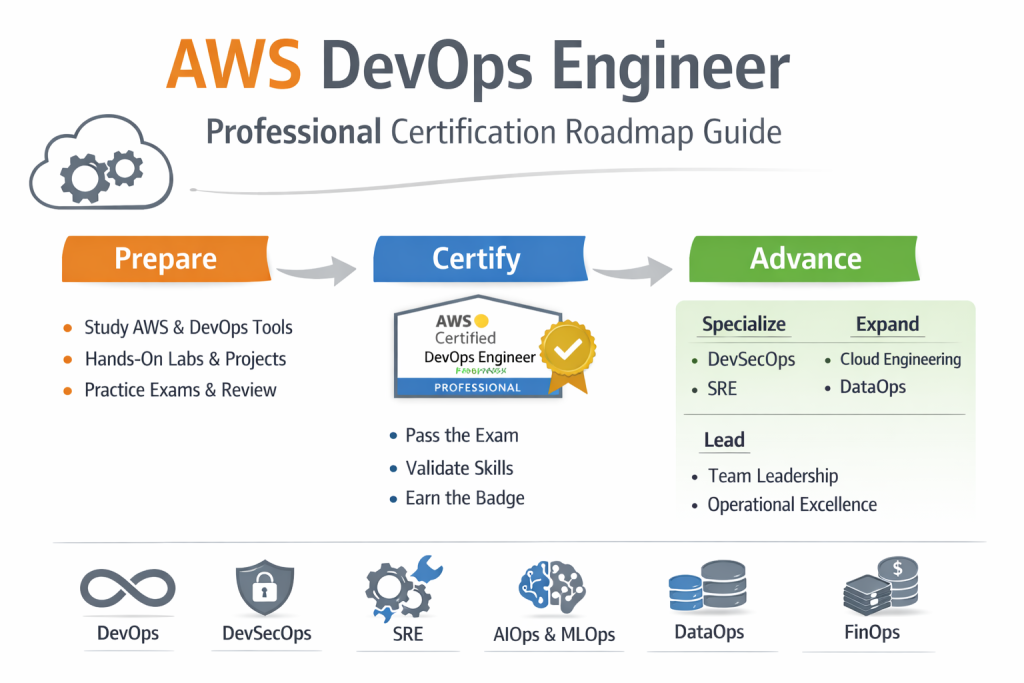
Choose your path (6 learning paths)
DevOps
This path is for engineers who want to master delivery end-to-end: build, test, deploy, observe, and improve. You focus on pipeline reliability, release strategies, infrastructure repeatability, and fast recovery when something breaks.
Over time, you become the person who removes friction from engineering teams. That usually translates to faster delivery, fewer failed releases, and better developer experience.
DevSecOps
This path is for engineers who want security built into delivery, not bolted on at the end. You focus on secure defaults, access controls that fit automation, and pipeline checks that catch risk early without slowing teams.
The goal is to make secure behavior the easiest behavior. Mature DevSecOps feels like “guardrails,” not “gates.”
SRE
This path is for engineers who care deeply about reliability and operational discipline. You focus on observability, incident response quality, reducing toil, and building systems that degrade gracefully under load or failure.
SRE-style work is highly measurable. You tie engineering effort to outcomes like recovery time, incident frequency, and change failure rate.
AIOps / MLOps
This path is for teams that want smarter operations and more automation using data-driven techniques. You focus on signal quality, event correlation, anomaly detection concepts, and running ML workloads/pipelines reliably where applicable.
Even without deep ML work, AIOps thinking helps you manage complexity. It pushes you to reduce noise and detect problems earlier through better data.
DataOps
This path is for engineers who want the same delivery discipline for data pipelines. You focus on versioning, automated checks, repeatable environments, and monitoring for freshness and quality—not just “pipeline succeeded.”
DataOps helps organizations trust their analytics and ML outputs. It reduces surprises like broken dashboards or silent data drift.
FinOps
This path is for engineers and managers who want cost to be visible and controllable. You focus on cost allocation, usage visibility, and operational processes that prevent waste without slowing engineering.
Good FinOps is not “cost cutting only.” It is cost-aware engineering that supports growth sustainably.
Role → Recommended Certifications Mapping
| Role | Primary Certification | Why it fits | Next Best Certification |
|---|---|---|---|
| DevOps Engineer | AWS DevOps Engineer – Professional | Validates core skills: pipelines, IaC, automation, and release strategies. | Certified Kubernetes Administrator (CKA) (for container orchestration depth) |
| SRE (Site Reliability Engineer) | AWS DevOps Engineer – Professional | Covers operational automation, monitoring/logging, and incident response fundamentals. | AWS Certified Advanced Networking – Specialty (crucial for debugging complex outages) |
| Platform Engineer | AWS DevOps Engineer – Professional | Proves you can build standardized, self-service infrastructure and governance. | AWS Certified Solutions Architect – Professional (for broad, scalable platform design) |
| Cloud Engineer | AWS DevOps Engineer – Professional | Shifts focus from just “building infra” to “automating and operating” it reliably. | HashiCorp Certified: Terraform Associate (for multi-cloud IaC mastery) |
| Security Engineer | AWS Certified Security – Specialty | (Primary focus) Deep dives into IAM, data protection, and threat detection. | AWS DevOps Engineer – Professional (to understand how to secure CI/CD pipelines) |
| Data Engineer | AWS Certified Data Engineer – Associate | (Primary focus) Validates big data processing and analytics skills. | AWS DevOps Engineer – Professional (to master DataOps: automated pipelines & reliability) |
| FinOps Practitioner | AWS DevOps Engineer – Professional | Teaches the operational side of cost: tagging, auto-scaling, and resource lifecycle. | FinOps Certified Practitioner (to align technical ops with financial strategy) |
| Engineering Manager | AWS DevOps Engineer – Professional | (Knowledge focus) Helps you estimate delivery risks, resource needs, and operational maturity. | Certified ScrumMaster (CSM) / PMP (for process and people leadership) |
Top institutions that help with training + certifications
DevOpsSchool
DevOpsSchool is the provider linked with the official program page in this guide and positions the offering as hands-on, including labs, scenario projects, and interview-focused preparation. It is a practical fit if you want a structured plan and guided support rather than self-study only.
Cotocus
Cotocus is commonly listed alongside DevOps and cloud training brands and is often chosen by teams that want guided upskilling. It tends to be relevant when learners want mentorship-style help, structured assignments, and support that maps learning to workplace implementation.
ScmGalaxy
ScmGalaxy is usually associated with disciplined DevOps foundations such as source control, automation mindset, and release workflow thinking. It can work well if your gaps are in the fundamentals: how changes flow safely through environments and how teams standardize delivery.
BestDevOps
BestDevOps is generally positioned for job-oriented learning with a practical focus. It can be useful if you want a guided path that emphasizes hands-on tasks, clear outcomes, and interview readiness.
devsecopsschool
devsecopsschool is relevant when you want to specialize toward DevSecOps and integrate security into delivery workflows. This is a good choice if your career path is moving toward pipeline security, governance, and compliance automation.
sreschool
sreschool fits engineers focusing on reliability and production ownership. It aligns well when your priorities are incident response maturity, observability, and reducing toil through automation.
aiopsschool
aiopsschool is relevant when teams want operations at scale with smarter automation. It is useful if you want to learn how operational data can drive better detection and faster response.
dataopsschool
dataopsschool suits engineers who want to apply CI/CD discipline to data pipelines. If you work with analytics or ML teams, DataOps helps you stabilize data delivery like software delivery.
finopsschool
finopsschool is relevant when cost and cloud governance become top priorities. It is helpful for engineers and managers who want cost visibility, allocation discipline, and automation practices that prevent waste.
FAQs
1) Is AWS DevOps Engineer – Professional difficult?
It is considered challenging because it tests scenario reasoning, not only basic service knowledge. You must choose designs that work reliably in real operations, not just in theory. The difficulty drops sharply once you have built and operated pipelines and handled failures.
2) How long does it take to prepare?
Time depends on your exposure to AWS delivery and operations. Many working engineers do well with a 30-day plan if they already run pipelines and use IaC, while others benefit from 60 days to build hands-on confidence. The key is consistent practice, not long weekend cramming.
3) What are the prerequisites?
There is no single “official” prerequisite listed in your prompt, but in practice you should be comfortable with AWS fundamentals, CI/CD concepts, IaC basics, and monitoring/logging. If those areas are weak, start by building a simple project and then scale it up.
4) Should managers take this certification?
Managers do not need to become tool operators, but understanding delivery and operations improves decision-making. It helps you ask better questions about release risk, readiness, and operational maturity. It also helps you coach teams on process improvements that reduce firefighting.
5) Should I learn by reading or building?
Build first, then read to fill gaps. DevOps is operational by nature—rollback design, alert tuning, and deployment safety are learned through practice. Even small labs will teach you more than long notes.
6) What kind of projects best match the exam style?
Projects that include delivery, infrastructure, and operations together. A good project has a pipeline, environment provisioning, monitoring, and at least one deployment strategy with rollback. The exam rewards integrated thinking across the lifecycle.
7) What is the best sequence for certifications?
Start with a base of AWS fundamentals and a strong understanding of delivery basics, then move to this Professional-level credential when you can build and operate an end-to-end system. After that, choose specialization: security, reliability, data, or cost.
8) What is the biggest learning trap?
The biggest trap is learning tools in isolation. Real scenarios combine multiple concerns: security + automation + reliability + cost. Practice connecting these concerns in one solution.
9) How do I stay consistent while working full-time?
Use a simple routine: 60–90 minutes on weekdays and a longer hands-on block once per week. Keep a “mistake journal” of things you misunderstand and revisit it every 3–4 days. Consistency beats intensity.
10) What should I focus on in the final week?
Focus on scenario practice and revision of weak categories. Do not start entirely new topics late unless they are critical gaps. Use your notes to sharpen decision logic and remove confusion.
11) Will this help career growth in India and globally?
Yes, because AWS DevOps skills map to similar responsibilities across regions: deployment automation, reliability practices, and operational excellence. What changes by geography is the role title, not the underlying work. Strong projects plus this certification improves credibility in interviews.
12) What career outcomes are realistic?
Common outcomes include moving from “support-driven ops” to “engineering-driven ops,” taking ownership of pipelines/platform work, and leading reliability and delivery improvements. For managers, it often improves planning accuracy and reduces delivery risk through better system thinking.
FAQs on AWS DevOps Engineer – Professional (program-specific)
1) Is the program designed for non-developers?
Yes, the program page states it is designed for developers and non-developers. That means operations-focused engineers can also use it, as long as they are comfortable with automation concepts.
2) Is there an online option?
Yes, the page presents instructor-led online training and highlights “30 Hours.” This can be useful for working professionals who need a structured schedule.
3) Is there a classroom option in India?
Yes, the page states classroom training is available in Bangalore, Hyderabad, Chennai, and Delhi. It also notes other locations may be possible if there are enough participants.
4) Does it include lab work?
Yes, the program page mentions 100+ lab assignments. Labs are essential because DevOps learning improves fastest when you build and troubleshoot real flows.
5) Does it include real projects?
Yes, it mentions real-time scenario-based projects. Scenario work is important because Professional-level readiness depends on operational judgment, not only definitions.
6) Does it include interview preparation content?
Yes, the page states it provides 250+ real-time interview questions. This helps you practice explaining decisions, which matters as much as tool knowledge in interviews.
7) Do learners get post-training support?
Yes, the page lists lifetime LMS access and lifetime technical support. That is helpful when you revisit topics later while applying them on the job.
8) Is there a completion certificate?
The page says DevOpsSchool provides a “DevOps Certified Professional (DCP)” certificate and references accreditation by DevOpsCertificaiton.co, awarded based on projects, assignments, and an evaluation test.
Testimonials
A learner testimonial on the program page describes the training as interactive and says it improved confidence, also appreciating the trainer’s support.
Another testimonial highlights effective doubt resolution and the value of hands-on examples.
A project manager testimonial describes the training as well organized and helpful for understanding DevOps concepts and tools.
Conclusion
AWS DevOps Engineer – Professional is a strong choice if you want to prove you can build and operate delivery systems on AWS with real-world discipline. The best approach is to learn through one integrated project: pipeline + IaC + observability + safe deployments, then practice scenario questions until your trade-off thinking becomes natural.
