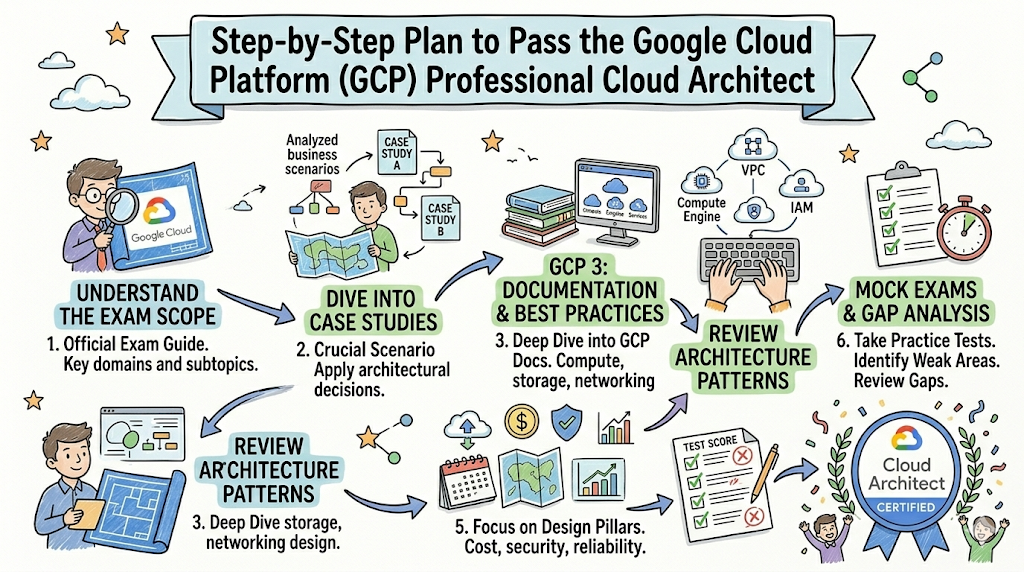
Introduction
As a professional who has navigated the shifting tides of the technology landscape, I have seen that true expertise lies in the ability to design systems that are as resilient as they are scalable. The transition into cloud architecture is a defining milestone for any engineer or manager, shifting the focus from simply writing code to building the foundational pillars of a global digital business. Earning the GCP Professional Cloud Architect credential is a rigorous validation of this high-level skill, proving that you can take a complex business problem and transform it into a secure, cost-effective, and highly available solution. This guide is designed to provide you with the seasoned perspective and technical roadmap needed to master the “Google Way” of architecting, ensuring you have the depth of knowledge to lead major projects and drive innovation in an increasingly cloud-centric world.
Understanding the GCP Certification Hierarchy
Google Cloud has carefully designed its certification path to help professionals grow in a logical way. It starts with foundational knowledge and moves into deep, specialized technical skills that are required for modern infrastructure. By following this structured path, you ensure that you don’t have any gaps in your knowledge that could cause problems later in a real-world project.
Google Cloud Certification Overview
| Track | Level | Who it’s for | Prerequisites | Skills Covered | Recommended Order |
| Cloud Digital Leader | Foundational | Business users, managers | None | Cloud basics, GCP products | 1st |
| Associate Cloud Engineer | Associate | System admins, developers | 6+ months GCP exp | Deploying apps, monitoring | 2nd |
| Professional Cloud Architect | Professional | Solutions architects | 3+ years industry exp | Design, plan, manage infra | 3rd |
| Professional Data Engineer | Professional | Data scientists, engineers | 3+ years industry exp | ML, data processing | Optional |
| Professional Cloud Security Engineer | Professional | Security specialists | 3+ years industry exp | Identity, compliance, ops | Optional |
Deep Dive: GCP Professional Cloud Architect
Defining the Role
The Professional Cloud Architect is someone who takes a look at a business problem and designs a digital solution that is safe, fast, and cost-effective. It is a high-level role that requires you to understand everything from networking to security and database management. You are essentially the lead builder who ensures the entire technical house is built on a solid foundation.
Who Should Pursue This?
This path is perfect for those who have spent several years in engineering and are ready to take on more design responsibility. If you enjoy solving complex puzzles and want to be the person who makes the big technical decisions for a company, this is for you. It is also a great fit for managers who need to stay technically sharp to lead their teams effectively.
Skills You Will Master
- You will learn how to design architectures that can handle millions of users without breaking.
- You will gain a deep understanding of how to protect sensitive data using Google’s world-class security tools.
- You will become an expert at optimizing costs, ensuring the company only pays for what it actually uses.
- You will master the art of choosing the right service for the right job, which is the hallmark of a true expert.
Real-World Projects You Can Lead
- Moving an entire corporate data center into the cloud while keeping the website running smoothly for customers.
- Building a global content delivery system that makes sure a video or app loads instantly anywhere in the world.
- Designing a disaster recovery plan that can bring a company back online in minutes after a major technical failure.
- Creating an automated system that updates software across thousands of servers without a single second of downtime.
Tailored Preparation Plans
The 7–14 Day Sprint (Fast Track)
This plan is for the seasoned pro who lives and breathes Google Cloud every single day. You should focus your limited time on reading the official case studies and understanding the “why” behind the solutions. Take as many mock exams as possible to get used to the wording of the questions and to find any small gaps in your knowledge.
The 30-Day Balanced Approach
This is the most common path for working engineers who can dedicate a few hours each evening. Spend the first two weeks going through high-quality training videos and the next week doing hands-on labs to build muscle memory. Use the final week to review your notes and take practice tests to build your confidence before the big day.
The 60-Day Deep Dive
If you are new to the Google ecosystem, this longer path will ensure you truly understand the platform rather than just memorizing facts. The first month should be spent exploring every service in the console and building small, personal projects. In the second month, focus on how these services connect and how to solve the complex business problems presented in the exam.
Common Mistakes to Avoid
- Reading but not doing: You cannot pass this exam by just watching videos; you must get your hands dirty in the GCP console.
- Skimming the Case Studies: Many questions are based on specific stories provided by Google, and if you don’t know the story, the question will be much harder.
- Focusing only on Tech: Remember, this is an Architect exam, so you must think about the business impact and costs, not just the code.
Your Best Next Step
Once you have this certification, the Professional Cloud Security Engineer is the most logical next step. Security is the number one concern for most companies today, and having both architecture and security skills makes you an incredibly valuable asset to any organization.
Choose Your Path: Learning Specializations
The cloud is vast, and you can choose a direction that matches your personal interests and career goals. Whether you love automation, data, or security, there is a specialized path that will allow you to become a go-to expert in that niche.
- DevOps Path: This is about speed and reliability, focusing on how to get code from a developer’s laptop to a live server as fast as possible.
- DevSecOps Path: This adds a layer of safety to the DevOps process, ensuring that security is checked automatically at every single step of the way.
- SRE (Site Reliability Engineering): This is for those who love making things run perfectly, using math and automation to keep websites up and running 24/7.
- AIOps/MLOps Path: This is the future, using artificial intelligence to manage servers and ensuring that machine learning models are working correctly in production.
- DataOps Path: If you love data, this path focuses on building the pipelines that move and clean data so that businesses can make better decisions.
- FinOps Path: This is a growing field that focuses on the money, helping companies understand and control their cloud spending so they don’t get a surprise bill.
Role → Recommended Certifications Mapping
| If you are a… | Take these Certifications |
| DevOps Engineer | Associate Cloud Engineer + Professional Cloud DevOps Engineer |
| SRE | Professional Cloud Architect + Professional Cloud DevOps Engineer |
| Platform Engineer | Professional Cloud Architect + Professional Cloud Network Engineer |
| Cloud Engineer | Associate Cloud Engineer + Professional Cloud Architect |
| Security Engineer | Professional Cloud Architect + Professional Cloud Security Engineer |
| Data Engineer | Professional Data Engineer + Professional Cloud Architect |
| FinOps Practitioner | Cloud Digital Leader + Professional Cloud Architect |
| Engineering Manager | Cloud Digital Leader + Professional Cloud Architect |
Why Choose DevOpsSchool?
In my years of mentoring, I’ve found that the right guidance is the difference between struggling for months and succeeding in weeks. DevOpsSchool offers a human-centric approach to learning where you aren’t just another student in a crowded room. They provide access to mentors who have worked on real, high-stakes projects and can explain complex topics in simple terms. Their curriculum is always kept fresh, ensuring you are learning what is relevant in the industry right now. Choosing a platform like this means you are investing in a community that will support your growth long after you pass your exam.
Where to Get Help: Top Institutions
DevOpsSchool I highly recommend DevOpsSchool for mastering cloud architecture. They offer a deep, hands-on training program that covers everything you need for the GCP Professional Cloud Architect exam. Their trainers use real-world projects to make sure you truly understand the core concepts. You get great support and study materials to help you pass with total confidence.
Cotocus Cotocus is a great place to learn if you want to focus on practical skills. They guide you through the tough topics of Google Cloud so that the exam feels much easier. Their classes are built to bridge the gap between basic knowledge and expert-level system design. You will get clear instructions on how to build reliable cloud systems from the ground up.
Scmgalaxy Scmgalaxy is a wonderful community-driven platform that offers solid training for cloud professionals. They provide easy-to-understand tutorials and direct guidance for the GCP Cloud Architect certification. The active forums and expert advice help you solve problems quickly when you get stuck in a lab. It is a very helpful space for learning together with others.
BestDevOps If you want a clear and direct path to getting certified, BestDevOps is a strong choice. Their courses cut out the extra noise and focus straight on what you need to know for the Google Cloud exam. They provide simple, high-quality lessons that save you time and effort. This is a perfect fit for busy engineers who want to learn fast.
devsecopsschool.com Security is a huge part of cloud architecture, and this school focuses heavily on that specific area. They help you understand how to build safe Google Cloud environments while preparing for your certification. Their training ensures you know how to protect user data and follow strict compliance rules. It is a great option if you want to be a security-minded cloud architect.
sreschool.com This platform is perfect if you want to learn how to keep cloud systems running smoothly all the time. They teach the GCP Cloud Architect syllabus with a strong focus on site reliability. You will learn how to balance new software releases with total system stability. Their real-world examples make complex networking topics very easy to grasp.
aiopsschool.com As cloud systems grow larger, using smart tools to manage them is becoming very important. This school blends standard GCP architect training with helpful automation techniques. They show you how to design cloud environments that are easier to monitor and fix. It is a unique place to learn if you want to build systems that work smarter.
dataopsschool.com For those who love working with databases, this institution is a perfect match. They cover the GCP Cloud Architect material while teaching you how to build strong data pipelines. You will learn how to design systems that handle massive amounts of information without slowing down. Their trainers make sure you understand both the architecture and the data flow.
finopsschool.com Managing cloud costs is a big job for any architect, and this school makes it their main focus. They prepare you for the GCP exam while teaching you how to keep cloud bills as low as possible. You will learn how to design systems that are both powerful and cheap to run. This is a highly requested skill set that every company wants right now.
FAQ: GCP Professional Cloud Architect
- How does the case study format work during the actual exam?
The exam typically provides two or more business case studies (like “Mountkirk Games” or “TerramEarth”) that describe a company’s current state and future goals. You will be asked multiple questions based on these scenarios, requiring you to choose the best GCP services to meet their specific technical and business requirements. It is vital to read these cases thoroughly on the official Google Cloud site before your exam date. - Is it necessary to have a background in coding to pass this certification?
While you do not need to be a full-stack developer, you should be comfortable with basic scripting and understanding how applications interact with infrastructure. You’ll need to recognize code snippets for Cloud Functions or understand how an application communicates with a database. A basic grasp of Python or Go, and familiarity with YAML for configuration, will go a long way in making the technical sections feel more natural. - What is the “Google Way” of designing architecture compared to AWS or Azure?
Google emphasizes global scalability and data-driven decision-making. Unlike some other providers that might focus on virtual machine management, Google pushes for serverless options (like Cloud Run) and managed services (like BigQuery) whenever possible. To think like a Google Architect, you must prioritize automation, global networking (VPC), and managed security over manual infrastructure “hand-holding.” - How much focus should I put on Google’s networking products?
Networking is often the “make or break” section of the Professional Cloud Architect exam. You must deeply understand the difference between Shared VPC, VPC Network Peering, and Cloud Interconnect. Being able to design a secure, private network that connects an on-premises data center to a Google Cloud region is a fundamental skill that will be tested repeatedly. - Can I rely solely on practice exams to pass?
Practice exams are excellent for getting used to the question format, but they are rarely enough on their own. The real exam tests your ability to apply logic to new problems, not just your memory of old questions. I always recommend combining practice tests with hands-on labs (like those at DevOpsSchool) to ensure you understand the “why” behind each correct answer. - What are the most common “distractor” answers to watch out for?
Google often includes answers that are technically possible but not “best practice” or cost-effective. For example, a question might ask for a way to store data; one answer might suggest a high-performance SSD (expensive), while the better answer for that specific scenario might be a lower-cost Object Storage bucket. Always look for the solution that balances performance with the business constraints mentioned in the prompt. - How long does the certification stay valid, and why? The certification is valid for two years. This might seem short, but the cloud moves incredibly fast. New services are launched, and best practices evolve every few months. Recertifying every two years ensures that you remain at the top of your game and are aware of the latest security protocols and architectural patterns that Google recommends.
- Does this certification focus on hybrid and multi-cloud strategies? Yes, increasingly so. In today’s market, most large companies don’t use just one cloud. You will likely see questions about Anthos or how to manage resources across different environments. Understanding how Google Cloud plays with others—and how to move data safely between them—is a key part of the modern Professional Cloud Architect’s toolkit.
Career & Certification: Frequently Asked Questions
- How difficult is the GCP Professional Cloud Architect exam for a senior engineer?
Even for those with deep technical roots, this is a challenging exam because it moves beyond “how to build” into “why to build.” It requires you to weigh business trade-offs—like cost versus performance—under pressure. It is widely considered one of the most rigorous professional-level certifications in the cloud industry today. - How much time should I realistically set aside for preparation?
If you are working full-time, a period of 6 to 8 weeks is usually the “sweet spot.” This allows for about 10–12 hours of study per week. Attempting to cram everything into a single weekend often leads to a lack of depth in understanding the complex networking and security layers. - Are there any mandatory prerequisites before I can book the exam?
There are no formal “gatekeeper” certifications required by Google to sit for the Professional exam. However, jumping straight into it without passing the Associate Cloud Engineer exam first is a common pitfall. Having a solid grasp of the command-line tools and basic console navigation is essential for success. - What is the recommended sequence for someone starting from scratch?
The most logical path is to start with the Cloud Digital Leader to understand the business value, move to the Associate Cloud Engineer to learn the “hands-on” tools, and finally tackle the Professional Cloud Architect. This building-block approach ensures you don’t feel overwhelmed by the high-level architectural concepts later on. - What is the actual market value of holding this certification?
In the global market, this credential acts as a high-level trust signal. It proves to employers that you can handle the responsibility of a multi-million dollar cloud budget and design systems that won’t fail during peak traffic. It consistently ranks as one of the highest-paying certifications in technical surveys. - How will this certification change my daily career outcomes?
Beyond a potential salary increase, it often shifts your role from “executing tasks” to “leading strategy.” You will likely find yourself invited to higher-level design meetings and given the authority to make critical decisions about a company’s digital infrastructure. It turns you from a specialized engineer into a broad-thinking architect. - Is the exam more focused on Google-specific tools or general architecture?
It is a blend of both. You need to know the specific limits and features of Google products (like BigQuery or Cloud Spanner), but you must also understand general principles like the 12-factor app methodology, microservices, and disaster recovery patterns that apply to any cloud environment. - Can I pass the exam if I only have experience with AWS or Azure?
Your existing cloud knowledge will help with the “concepts,” but Google has a very specific way of handling networking and identity management. You will need to spend significant time unlearning some habits from other clouds and mastering the “Google Way,” particularly regarding their global VPC and project-based hierarchy. - Does the certification help in securing leadership roles in India?
Absolutely. Many Indian tech hubs and global capability centers (GCCs) are rapidly adopting GCP. Having this certification on your profile makes you a prime candidate for Lead Engineer, Solution Architect, or Engineering Manager positions within these growing organizations. - How important is the “Hands-on” experience versus theoretical study?
Theory will help you understand the definitions, but hands-on experience helps you understand the “errors.” The exam often asks what to do when something goes wrong. If you haven’t actually built a VPC or deployed a cluster in a lab environment, those scenario-based questions will be very difficult to answer correctly. - Will I need to renew this certification, and what is the process?
Yes, it is valid for two years. To renew it, you must take the full exam again. While this may seem like a chore, it is actually a benefit; it forces you to stay current with the latest security updates and new services that Google releases constantly. - Does this certification cover DevOps and Automation?
Yes, quite heavily. An architect must know how to automate the infrastructure they design. You should expect questions on Infrastructure as Code (using tools like Terraform or Deployment Manager) and how to integrate CI/CD pipelines into your cloud architecture to ensure reliable deployments.
Testimonials
“The mentorship I received helped me look at cloud design in a completely new way. I no longer just follow instructions; I understand the strategy behind every choice.”
— Rohan
“I was worried about the networking part of the exam, but the simple way the concepts were explained made everything click. I passed on my first attempt!”
— Sonal
“After years of coding, this was exactly what I needed to move into a leadership role. The training was practical and focused on what actually matters in a real job.”
— Amit
“The practice tests and case study deep-dives were the key to my success. I felt completely prepared when I walked into the exam center.”
— Megha
“I’ve taken many courses, but the focus on real-world application here is what sets it apart. It’s not just about the certificate; it’s about the actual skill.”
— Karan
“The community support was amazing. Whenever I got stuck on a lab, there was someone there to help me understand what I was doing wrong.”
— Deepa
“This training helped me transition from a system admin to a cloud architect in just a few months. It was the best career move I’ve ever made.”
— Vikas
“I appreciated the simple English used in the lessons. It made complex topics like Kubernetes and IAM much easier to digest and remember.”
— Pooja
Next Certifications to Consider
- Direct Growth: Professional Cloud Network Engineer (to truly master how data moves within your architecture).
- Broaden Your Skills: Professional Data Engineer (to learn how to build the systems that process and analyze massive amounts of data).
- Lead the Way: If you are moving into a director or manager role, the Cloud Digital Leader can help you learn how to talk about cloud value to non-technical executives.
Final Thoughts
The path to becoming a GCP Professional Cloud Architect is one of the most rewarding journeys you can take in the tech world. It challenges you to grow, think differently, and master a platform that is powering some of the biggest companies on the planet. By focusing on practical skills, seeking out good mentorship, and staying consistent with your studies, you will find that the goals you have for your career are well within reach.

The step-by-step approach makes it easy for beginners to understand how to start and progress. It gives a clear roadmap for effective preparation.