Introduction
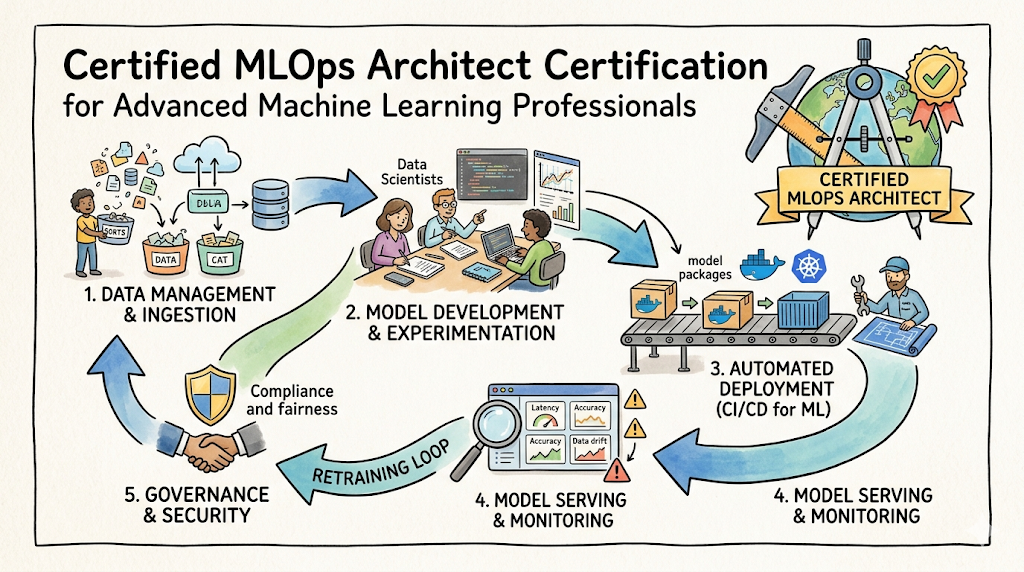
The Certified MLOps Architect is a specialized professional track designed for engineers who want to master the lifecycle of machine learning. In a world where artificial intelligence is becoming the backbone of every enterprise, understanding how to deploy and scale models is no longer optional. This guide provides a clear path for professionals to transition from traditional software management to modern AI infrastructure.
By choosing to study through aiopsschool.com, engineers can gain hands-on experience with the latest automation and monitoring tools. This program is built to help you navigate the complexities of data pipelines, model governance, and production stability. Whether you are looking to advance in your current role or pivot to a new career, this guide simplifies the decision-making process for your learning journey.
What is the Certified MLOps Architect?
The Certified MLOps Architect represents a standard of excellence for those managing the intersection of data science and IT operations. It exists to solve the “last mile” problem in machine learning, where models often fail to reach production due to infrastructure gaps. This program focuses on building reliable, repeatable, and automated systems for the entire machine learning lifecycle.
Instead of focusing purely on mathematical theory, this certification emphasizes real-world engineering and production-grade workflows. It aligns with modern enterprise practices like GitOps, continuous training, and infrastructure as code. By completing this program, you demonstrate that you can manage machine learning projects with the same discipline and reliability as standard software applications.
Who Should Pursue Certified MLOps Architect?
This program is designed for a variety of technical roles, including DevOps engineers, site reliability engineers, and platform architects. Data scientists who want to understand the operational side of their models will also find the curriculum highly valuable. It bridges the gap between the people who build models and the people who keep the servers running.
In both the global and Indian technology markets, there is a massive demand for professionals who can bridge this gap. Beginners can use the foundation tracks to learn the vocabulary, while experienced engineers can use the advanced tracks to master complex orchestration. Even engineering managers can benefit by learning how to structure their teams for machine learning success in an enterprise environment.
Why Certified MLOps Architect is Valuable and Beyond
The value of this certification lies in its focus on longevity and tool-agnostic principles. While specific tools may change, the core principles of MLOps—such as versioning, monitoring, and automation—remain the same. This ensures that the skills you learn today will continue to be relevant as the artificial intelligence landscape evolves over the next decade.
Enterprises are shifting away from experimental AI and moving toward production-scale implementations. This shift requires architects who can manage costs, security, and performance at scale. By earning this certification, you position yourself as a leader who can deliver tangible business value. It is a high-return investment for any professional looking to stay ahead of the technical curve in a competitive job market.
Certified MLOps Architect Certification Overview
The program is officially delivered through the main learning platform and is hosted on aiopsschool.com. It is structured to provide a logical progression from basic concepts to complex architectural design. The assessment approach is designed to test practical knowledge through scenarios and projects rather than simple memorization of facts.
The certification is owned and maintained by industry practitioners who ensure the content is always updated with current best practices. It covers a wide range of topics, including model registries, feature stores, and automated retraining pipelines. This comprehensive structure ensures that you have a holistic understanding of how machine learning fits into the broader enterprise technology stack.
Certified MLOps Architect Certification Tracks & Levels
The certification is divided into three distinct levels: Foundation, Professional, and Advanced. Each level is tailored to a specific stage of career growth and technical expertise. The Foundation level is an entry point for those new to the field, focusing on definitions and the overall machine learning lifecycle.
The Professional level dives deep into the implementation of automation and monitoring tools. Finally, the Advanced level is designed for senior architects who are responsible for designing entire MLOps ecosystems for large organizations. This tiered approach allows professionals to learn at their own pace and align their training with their specific job requirements.
Complete Certified MLOps Architect Certification Table
| Track | Level | Who it’s for | Prerequisites | Skills Covered | Recommended Order |
| MLOps Core | Foundation | Beginners, Managers | Basic IT awareness | Lifecycle, Glossary | Step 1 |
| Engineering | Professional | DevOps, Data Engineers | Python, Linux, CI/CD | Automation, Monitoring | Step 2 |
| Strategy | Advanced | Senior Leads, Architects | Professional Level | Governance, Security | Step 3 |
Detailed Guide for Each Certified MLOps Architect Certification
Certified MLOps Architect – Foundation
What it is
This certification serves as the baseline for anyone entering the machine learning operations space. It validates your understanding of the core phases of a model’s life, from data ingestion to retirement.
Who should take it
It is ideal for project managers, junior developers, and IT recruiters who need a solid grasp of MLOps terminology. No prior coding experience is necessary to pass this level.
Skills you’ll gain
- Defining the difference between DevOps and MLOps.
- Understanding the stages of the machine learning pipeline.
- Identifying key roles and responsibilities in an ML team.
- Learning about the common challenges in model deployment.
Real-world projects you should be able to do
- Mapping out a high-level MLOps workflow for a business case.
- Explaining the importance of data versioning to stakeholders.
Preparation plan
- 7–14 days: Focus on learning the glossary and the overall lifecycle diagram.
- 30 days: Review case studies of successful MLOps implementations in various industries.
- 60 days: Generally not required for this introductory level.
Common mistakes
- Underestimating the importance of data governance in the early stages.
- Confusing traditional software CI/CD with machine learning continuous training.
Best next certification after this
- Same-track option: Certified MLOps Architect – Professional
- Cross-track option: AIOps Foundation
- Leadership option: Digital Transformation Manager
Certified MLOps Architect – Professional
What it is
The Professional level is a hands-on certification that focuses on the technical execution of machine learning pipelines. It validates that you can use automation tools to manage models in a production environment.
Who should take it
This level is perfect for DevOps engineers and data engineers with at least two years of experience. You should be comfortable with containerization and basic cloud infrastructure.
Skills you’ll gain
- Building automated pipelines for model training and testing.
- Setting up model monitoring and drift detection systems.
- Managing model registries and deployment strategies.
- Implementing security best practices for ML endpoints.
Real-world projects you should be able to do
- Deploying a model using a blue-green or canary strategy.
- Automating the retraining of a model based on performance triggers.
Preparation plan
- 7–14 days: Refresh your knowledge of Docker and Kubernetes.
- 30 days: Perform hands-on labs with pipeline orchestration tools.
- 60 days: Build a complete end-to-end MLOps pipeline from scratch.
Common mistakes
- Neglecting to monitor data quality before it reaches the model.
- Failing to document the infrastructure as code.
Best next certification after this
- Same-track option: Certified MLOps Architect – Advanced
- Cross-track option: SRE Professional
- Leadership option: Technical Lead – AI Infrastructure
Certified MLOps Architect – Advanced
What it is
This is the highest level of certification, designed for those who design and govern large-scale machine learning platforms. It focuses on strategy, complex architecture, and organizational standards.
Who should take it
Senior architects and principal engineers who lead digital transformation initiatives should pursue this. Extensive experience in cloud-native design is a prerequisite.
Skills you’ll gain
- Designing multi-cloud and hybrid-cloud MLOps architectures.
- Establishing governance and compliance frameworks for AI.
- Optimizing resource costs and performance for massive models.
- Leading cross-functional teams toward MLOps maturity.
Real-world projects you should be able to do
- Designing a platform that supports hundreds of models across different business units.
- Creating a disaster recovery plan for mission-critical AI systems.
Preparation plan
- 7–14 days: Review advanced architectural patterns and security standards.
- 30 days: Analyze complex enterprise scenarios and design solutions.
- 60 days: Conduct a full maturity assessment of an existing MLOps environment.
Common mistakes
- Building overly complex systems that are difficult for teams to use.
- Ignoring the long-term maintenance costs of proprietary tools.
Best next certification after this
- Same-track option: Specialized Generative AI Operations
- Cross-track option: FinOps Architect
- Leadership option: Chief Technology Officer (CTO)
Choose Your Learning Path
DevOps Path
Engineers on this path focus on bringing the discipline of software engineering to machine learning. You will learn how to treat models as code and integrate them into existing delivery pipelines. This path emphasizes automation, version control, and standardizing the development environment. It is the most common starting point for professionals moving into the MLOps space.
DevSecOps Path
The DevSecOps path is centered on the security and integrity of the machine learning lifecycle. You will learn how to protect sensitive data and secure model endpoints from malicious attacks. This involves implementing automated security scans and ensuring that compliance standards are met at every stage. It is a critical path for those working in highly regulated industries like banking.
SRE Path
This path focuses on the reliability, availability, and performance of machine learning systems. You will learn how to set up robust monitoring and alerting systems to ensure that models perform as expected in production. This path involves managing incidents and identifying the root causes of model failures. It is perfect for those who enjoy troubleshooting and optimizing high-traffic systems.
AIOps Path
The AIOps path teaches you how to use artificial intelligence to improve the management of IT infrastructure. This is different from managing machine learning models themselves, as the goal is to automate operations tasks like log analysis and incident response. You will learn how to use data to predict system failures before they happen. This is a rapidly growing field for modern operations teams.
MLOps Path
This is the core path that focuses entirely on the lifecycle of machine learning models. It covers everything from data preparation and feature engineering to model deployment and monitoring. You will learn how to create a seamless workflow for data scientists and engineers to collaborate effectively. This path is essential for any organization that wants to scale its AI initiatives.
DataOps Path
DataOps is focused on the health and movement of the data that feeds into machine learning models. You will learn how to build automated data pipelines that ensure high-quality information is always available. This path addresses the “garbage in, garbage out” problem by focusing on data cleansing and versioning. It is the foundation upon which all successful MLOps strategies are built.
FinOps Path
The FinOps path deals with the financial management of machine learning in the cloud. Training and running large models can be extremely expensive, and this path teaches you how to optimize those costs. You will learn how to track spending and identify areas where resources can be used more efficiently. It is a vital skill for managers who need to justify their AI budgets.
Role → Recommended Certified MLOps Architect Certifications
| Role | Recommended Certifications |
| DevOps Engineer | MLOps Foundation, MLOps Professional |
| SRE | MLOps Professional, SRE Professional |
| Platform Engineer | MLOps Professional, MLOps Advanced |
| Cloud Engineer | MLOps Foundation, Professional Architect |
| Security Engineer | MLOps Professional, DevSecOps Professional |
| Data Engineer | MLOps Professional, DataOps Foundation |
| FinOps Practitioner | MLOps Foundation, FinOps Professional |
| Engineering Manager | MLOps Foundation, Leadership Track |
Next Certifications to Take After Certified MLOps Architect
Same Track Progression
Once you have mastered the core MLOps architect levels, you can specialize in specific areas like Generative AI operations or specialized model optimization. Deepening your knowledge in niche tools like Kubeflow or MLflow can also provide a competitive edge. The goal is to move from a generalist to a recognized expert in a specific segment of the AI lifecycle.
Cross-Track Expansion
Broadening your skills into other areas like DevSecOps or DataOps will make you a more versatile professional. Understanding how security and data quality impact the machine learning pipeline allows you to design better systems. This cross-training is essential for anyone looking to move into senior leadership or consulting roles in the future.
Leadership & Management Track
For those who want to transition into management, the leadership track focuses on strategy, budgeting, and team building. You will learn how to align technical projects with business goals and how to hire the right talent for your team. This path is designed to prepare you for executive roles like Director of Infrastructure or Head of AI.
Training & Certification Support Providers for Certified MLOps Architect
DevOpsSchool
DevOpsSchool is a leading provider of technical training with a focus on automation and modern engineering. They offer comprehensive courses that cover the entire MLOps lifecycle, providing students with the practical skills needed for the industry. Their programs are designed by experts with over a decade of experience in the field. Students benefit from hands-on labs and real-world projects that simulate production environments. The organization also provides extensive support for certification exams and career placement. By focusing on the “humanized” approach to learning, they ensure that complex topics are easy to understand. Their global reach makes them a popular choice for engineers in India and beyond.
Cotocus
Cotocus specializes in high-end consulting and training for cloud-native technologies and modern infrastructure. They provide deep-dive sessions into the architectural aspects of machine learning and operations. Their instructors are seasoned professionals who bring years of industry knowledge into the classroom. Cotocus is known for its ability to handle complex enterprise requirements and provide tailored training solutions. They emphasize the importance of understanding the underlying principles of technology rather than just learning specific tools. This approach prepares students for long-term career success in a rapidly changing market. Their training programs are highly respected by major technology firms looking for skilled architects.
Scmgalaxy
Scmgalaxy is a prominent community-driven platform that offers a wealth of resources for DevOps and MLOps professionals. They provide detailed tutorials, blogs, and training programs that are updated regularly with the latest trends. The platform serves as a hub for engineers who want to stay informed about the evolving landscape of software delivery. Their training sessions are practical and focus on solving the day-to-day challenges faced by engineering teams. Scmgalaxy also hosts webinars and community events where professionals can network and share their experiences. This makes them an excellent resource for both individual learning and professional networking within the tech industry.
BestDevOps
BestDevOps focuses on providing streamlined and efficient training for individuals who want to master automation quickly. They pride themselves on their ability to simplify complex technical topics into easy-to-follow modules. Their curriculum is designed for busy professionals who need to gain new skills without taking significant time away from work. BestDevOps offers a variety of certification prep courses that are known for their high success rates. They provide a supportive learning environment with access to mentors who can guide students through difficult concepts. This provider is an excellent choice for those who want a direct and focused path to certification.
devsecopsschool.com
This provider is a specialist in the intersection of security and operations. They offer dedicated training on how to integrate security best practices into every stage of the machine learning lifecycle. Their courses cover a wide range of topics, including container security, vulnerability scanning, and automated compliance. They believe that security should be a shared responsibility across the entire engineering team. By providing hands-on training with modern security tools, they empower engineers to build safer and more resilient systems. Their certifications are highly valued by organizations that prioritize data privacy and system integrity in their AI projects.
sreschool.com
SRESchool is dedicated to the principles of Site Reliability Engineering and system stability. They provide in-depth training on how to build and maintain high-availability systems for machine learning. Their curriculum includes topics like monitoring, incident management, and performance optimization. Students learn how to use data to improve system reliability and reduce manual intervention. The programs are designed for engineers who want to move from traditional operations into a more proactive and automated role. SRESchool is a leader in teaching the skills needed to keep complex AI environments running smoothly at any scale.
As the primary host for these certifications, aiopsschool.com offers a comprehensive ecosystem for machine learning and AI education. They provide a structured learning path that takes students from foundational concepts to advanced architectural design. Their platform is designed to be production-focused, ensuring that every lesson has a practical application. They offer a wide range of resources, including lab environments, practice exams, and community forums. The platform is continuously updated to reflect the latest advancements in the MLOps and AIOps fields. It is the central resource for anyone looking to earn a recognized credential in the AI operations space.
dataopsschool.com
DataOpsSchool addresses the critical need for better data management in the age of artificial intelligence. They provide specialized training on how to build automated and reliable data pipelines. Their courses cover topics like data quality, versioning, and orchestration, which are essential for successful machine learning. They focus on the collaboration between data engineers and data scientists to ensure a smooth flow of information. By mastering DataOps, professionals can ensure that their AI models are always fed with high-quality data. This provider is essential for anyone who wants to master the fundamental building blocks of the AI lifecycle.
finopsschool.com
FinOpsSchool is the leading provider of education for the financial management of cloud and AI resources. They offer training on how to track, manage, and optimize the costs associated with machine learning. Their curriculum is designed for both engineers and managers who need to ensure that their technical projects are cost-effective. They teach students how to use modern cloud billing tools and how to build a culture of financial accountability. By mastering FinOps, professionals can provide significant value to their organizations by reducing waste and improving the return on investment. This unique combination of technical and financial training is highly sought after in the enterprise market.
Frequently Asked Questions (General)
- How long does it take to complete the Foundation level?
Most professionals can finish the Foundation level in two to four weeks depending on their prior experience. - Do I need to be an expert in Python to start?
No, the Foundation level does not require coding. However, basic Python is recommended for the Professional level. - Can I take the exams online?
Yes, all certification exams are delivered through a secure online platform that you can access from anywhere. - Is there a physical certificate provided?
Yes, upon successful completion, you will receive a digital certificate that can be printed or shared on professional networks. - What happens if I fail the exam on my first try?
Most providers offer a retake policy, though there may be a small fee or a required waiting period. - Is this certification valid for life?
Technical certifications usually require renewal every few years to ensure you are up to date with new technology. - Are there any labs included in the training?
Yes, the training programs from authorized providers include hands-on labs to practice the skills you learn. - Is the exam multiple-choice?
The exams are a mix of multiple-choice questions and scenario-based problems to test your practical knowledge. - Do companies in India recognize this certification?
Yes, many major tech firms and startups in India value these credentials when hiring for MLOps roles. - Can I get a refund if I change my mind?
Refund policies vary by provider, so it is important to check the terms and conditions before purchasing. - Is there a community for students to help each other?
Yes, students have access to forums and chat groups where they can ask questions and share resources. - Does the course cover specific cloud providers like AWS or Azure?
The principles taught are tool-agnostic, but most labs use popular cloud platforms to demonstrate the concepts.
FAQs on Certified MLOps Architect
- How is MLOps different from traditional DevOps in this course?
The course explains that while DevOps focuses on application code, MLOps adds the complexity of data versioning and model decay. - What is the most difficult part of the Professional exam?
Most students find the sections on automated model monitoring and drift detection to be the most challenging aspects. - Will this certification help me move from data science to engineering?
Yes, it is specifically designed to give data scientists the engineering skills they need to manage production systems. - Are there any prerequisites for the Advanced level?
You must have a solid understanding of cloud-native architecture and preferably hold the Professional level certification. - How often is the curriculum updated?
The content is reviewed and updated at least once a year to include new tools and industry best practices. - Does the certification cover Generative AI and LLM operations?
The core principles apply to all models, and there are specific modules that address the unique needs of large language models. - Is the certification focused on open-source or proprietary tools?
The focus is on open-source standards like Kubernetes and MLflow, but it also discusses how these integrate with cloud services. - Can I study for this while working a full-time job?
Yes, the self-paced nature of the training makes it ideal for working professionals to fit into their schedules.
Final Thoughts
If you are looking for a way to stand out in the crowded IT job market, the Certified MLOps Architect program is a solid choice. It offers a structured way to learn some of the most in-demand skills in the industry today. By moving beyond basic automation and into the world of AI infrastructure, you are positioning yourself for long-term career growth.
This program provides the practical, hands-on experience that employers are looking for. It is not just about having a certificate; it is about having the confidence to design and manage complex systems that drive real business value. For any engineer or manager who wants to be at the forefront of the artificial intelligence revolution, this is a path worth taking.
