Introduction
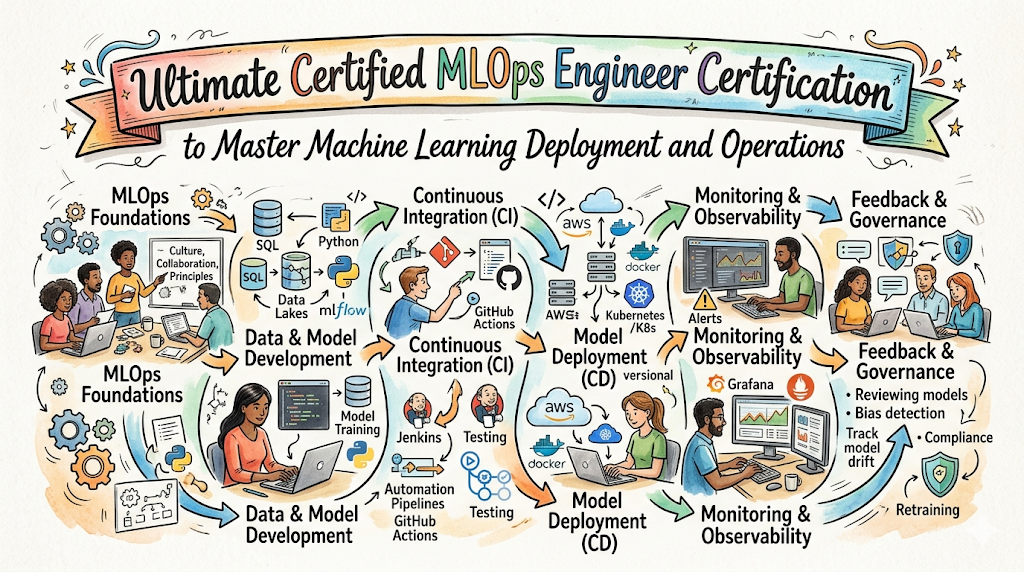
The Certified MLOps Engineer program is designed for technical professionals who aim to master the intersection of machine learning and operational excellence. This comprehensive guide is intended for engineers and managers who are navigating the transition toward automated, production-grade AI systems. The certification and resources are hosted on aiopsschool to ensure a standardized learning path for global talent.
Strategic career decisions are supported by the insights provided in this document regarding cloud-native and platform engineering roles. A clear roadmap is established to help professionals bridge the gap between experimental data science and scalable industrial applications. Value is added to the engineering career by aligning technical skills with enterprise-level operational requirements.
What is the Certified MLOps Engineer?
The Certified MLOps Engineer designation represents a specialized standard for automating the lifecycle of machine learning models. It exists to address the growing need for reliability, scalability, and security in AI-driven applications. Practical, production-focused learning is prioritized over abstract theory to ensure that engineers can handle real-world deployment challenges.
Alignment with modern engineering workflows and enterprise practices is maintained throughout the curriculum. The program describes how models are integrated into existing CI/CD pipelines to ensure continuous delivery and monitoring. It is established as a critical credential for those responsible for the stability of AI platforms in large-scale environments.
Who Should Pursue Certified MLOps Engineer?
The roles that benefit most from this certification include DevOps engineers, SREs, cloud architects, and data professionals. It is also highly relevant for security engineers who must govern AI workloads and data scientists who want to understand production constraints. Beginners find a structured entry point, while experienced engineers use it to validate their expertise in specialized automation.
Technical leaders and engineering managers pursue this path to better oversee the integration of AI into their product roadmaps. Relevance is maintained across both global markets and the specific needs of the technology sector in India. Professionals are equipped to handle the unique infrastructure requirements of data-heavy organizations across various industries.
Why Certified MLOps Engineer is Valuable and Beyond
Longevity in the engineering field is secured by mastering the principles of automation that remain relevant despite frequent tool changes. Enterprise adoption of MLOps is increasing rapidly as companies move from AI experimentation to full-scale production. A strong demand is observed for professionals who can reduce the time-to-market for machine learning models.
The return on time and career investment is maximized by focusing on high-impact operational skills. Professionals are helped to stay relevant in a competitive market by adopting a platform-centric view of machine learning. The expertise gained through this program ensures that engineers can contribute to the long-term strategic goals of their organizations.
Certified MLOps Engineer Certification Overview
The program is delivered through a structured curriculum that covers the entire machine learning operations lifecycle. Assessment approaches are designed to be practical, requiring candidates to demonstrate their ability to manage production clusters and pipelines. Ownership and structure are clearly defined to provide a rigorous yet accessible learning experience for all participants.
Different levels of certification are provided to accommodate various stages of professional growth. The framework is built on industry best practices and is hosted on the specified educational platform. Practical terms are used to explain complex architectural concepts, ensuring that the knowledge is immediately applicable to the workplace.
Certified MLOps Engineer Certification Tracks & Levels
Foundation, professional, and advanced levels are offered to create a logical progression for career development. The foundation level is used to establish a common language and understanding of the MLOps lifecycle. Professional tracks are aimed at implementation and the automation of complex data workflows.
Advanced levels are reserved for those who design and lead the architecture of large-scale AI platforms. Specialization tracks allow engineers to focus on specific areas such as security, reliability, or cost optimization. Each level is aligned with increasing responsibilities and higher-tier roles within the engineering hierarchy.
Complete Certified MLOps Engineer Certification Table
| Track | Level | Who it’s for | Prerequisites | Skills Covered | Recommended Order |
| Core Operations | Foundation | Beginners, Managers | IT Fundamentals | MLOps Lifecycle | First |
| Automation | Professional | DevOps, SREs | Python, Docker | CI/CD Pipelines | Second |
| Infrastructure | Advanced | Lead Engineers | Kubernetes | Scalability | Third |
| Governance | Specialist | Security Team | Core Foundation | Model Security | Optional |
| Efficiency | Specialist | FinOps, Leads | Core Foundation | Cost Management | Optional |
Detailed Guide for Each Certified MLOps Engineer Certification
Certified MLOps Engineer – Foundation
What it is
A fundamental understanding of the collaboration between data science and operations teams is validated by this certification. It covers the core concepts required to participate in machine learning projects.
Who should take it
This exam should be taken by entry-level engineers, recruiters, and technical project managers. It is designed for those who need a high-level overview of the MLOps ecosystem.
Skills you’ll gain
- Knowledge of the MLOps lifecycle stages.
- Understanding of model versioning and tracking.
- Ability to identify common bottlenecks in AI production.
- Familiarity with cloud-native terminology.
Real-world projects you should be able to do
- Create a workflow diagram for a machine learning pipeline.
- Explain the roles and responsibilities within an MLOps team.
Preparation plan
- 7–14 days: Focus on terminology and high-level architectural patterns.
- 30 days: Review all training modules and complete foundational quizzes.
- 60 days: This duration is typically not required for the foundation level.
Common mistakes
- Overcomplicating the technical requirements.
- Ignoring the importance of team collaboration.
Best next certification after this
- Same-track option: Certified MLOps Engineer Professional.
- Cross-track option: AIOps Foundation.
- Leadership option: AI Project Management.
Certified MLOps Engineer – Professional
What it is
The technical ability to build and maintain automated machine learning pipelines is validated at this level. It focuses on the practical implementation of engineering tools.
Who should take it
System administrators and DevOps engineers who are actively managing AI infrastructure should pursue this certification. It requires hands-on experience with automation tools.
Skills you’ll gain
- Implementation of CI/CD for ML models.
- Configuration of monitoring and alerting systems.
- Automated testing of data and model performance.
- Infrastructure as Code for AI platforms.
Real-world projects you should be able to do
- Deploy a containerized model to a production environment.
- Set up a drift detection system for a live model.
Preparation plan
- 7–14 days: Intensive practice with pipeline automation tools.
- 30 days: Deep dive into container orchestration and monitoring.
- 60 days: Comprehensive review of production troubleshooting.
Common mistakes
- Focusing only on the model while ignoring the data quality.
- Failing to implement proper logging and audit trails.
Best next certification after this
- Same-track option: Certified MLOps Engineer Advanced.
- Cross-track option: Site Reliability Engineering.
- Leadership option: MLOps Architect.
Choose Your Learning Path
DevOps Path
The transition from standard software delivery to machine learning operations is facilitated by this path. Existing skills in automation and CI/CD are applied to the unique requirements of model training and deployment. A focus is placed on creating repeatable processes for data-driven applications. Stability and deployment speed are treated as the primary indicators of success.
DevSecOps Path
Security is integrated into every stage of the machine learning lifecycle through this specialized route. Vulnerabilities in datasets and model libraries are identified and mitigated using automated tools. Compliance requirements and governance standards are maintained without slowing down the development process. This path is essential for engineers working in security-sensitive industries.
SRE Path
The reliability and availability of machine learning services are managed through the application of SRE principles. Concepts such as error budgets and SLOs are used to measure the health of production AI systems. Automated recovery and scaling strategies are implemented to handle fluctuating workloads. High uptime and consistent performance are the ultimate goals of this engineering path.
AIOps Path
The use of machine learning to enhance and automate IT operations is the core focus of the AIOps path. Large volumes of operational data are analyzed to identify patterns and predict potential system failures. Root cause analysis is accelerated through the use of AI-driven insights and noise reduction in alerts. It is designed for engineers who want to optimize complex infrastructure management.
MLOps Path
The construction and maintenance of platforms specifically for machine learning models are handled in this path. It encompasses everything from data ingestion and processing to model inference and monitoring. Automation is used to bridge the gap between data science research and production engineering. This path is intended for those who wish to specialize in the operational lifecycle of AI.
DataOps Path
The efficiency and quality of data flows are optimized through the principles of the DataOps pathway. Data is treated as a first-class citizen, ensuring that it is clean, versioned, and accessible for model training. Automated pipelines are built to manage data transformations and migrations with high reliability. It is a critical path for ensuring the integrity of any machine learning project.
FinOps Path
The financial management of cloud resources used for machine learning is the primary focus here. Cost visibility and optimization strategies are implemented to ensure that AI initiatives remain economically viable. Strategies for managing expensive GPU and TPU resources are explored to maximize the return on investment. This path is vital for leaders who manage large-scale cloud budgets.
Role → Recommended Certified MLOps Engineer Certifications
| Role | Recommended Certifications |
| DevOps Engineer | Foundation + Professional Engineering |
| SRE | Foundation + SRE Specialist |
| Platform Engineer | Foundation + Advanced Architecture |
| Cloud Engineer | Foundation + Professional Engineering |
| Security Engineer | Foundation + DevSecOps Specialist |
| Data Engineer | Foundation + DataOps Specialist |
| FinOps Practitioner | Foundation + FinOps Specialist |
| Engineering Manager | Foundation + Leadership Track |
Next Certifications to Take After Certified MLOps Engineer
Same Track Progression
A deeper level of mastery is achieved by progressing through the specialized MLOps levels. Complex architectural challenges are solved as the professional moves toward an expert status. This ensures that the individual is seen as a primary authority within their organization for all AI-related infrastructure.
Cross-Track Expansion
Breadth of knowledge is gained by expanding into related domains like SRE or DataOps. A more versatile skill set is built, allowing the engineer to solve a wider range of technical problems. This cross-pollination of skills is highly valued in modern, cross-functional engineering teams.
Leadership & Management Track
The transition from individual contributor to a leadership role is supported by management-focused certifications. Strategy, budget management, and team building are emphasized to prepare engineers for executive roles. This path is designed for those who want to drive the technical direction of their entire company.
Training & Certification Support Providers for Certified MLOps Engineer
DevOpsSchool
A wide array of technical training programs is provided by DevOpsSchool to help professionals advance in the IT industry. Their curriculum is known for being comprehensive and highly practical, focusing on the tools and methodologies used in modern software delivery. Students are given access to expert instructors who have significant experience in managing production environments. The institution emphasizes hands-on labs to ensure that theoretical concepts are reinforced with real-world practice. Extensive study materials and post-training support are provided to ensure that every candidate is prepared for their certification exams. A strong community of learners and alumni is maintained for continuous networking.
Cotocus
Specialized consulting and training solutions are delivered by Cotocus to assist organizations in their digital transformation journeys. Their courses are designed to address the specific needs of enterprise-level engineering teams who require scalable and secure solutions. A deep focus on cloud-native technologies and container orchestration is maintained across all their training programs. The instructors at Cotocus are senior professionals who provide valuable insights into architectural design and implementation. Practical workshops are conducted to simulate complex technical challenges and provide students with the skills needed to solve them. The company is recognized for its ability to improve the technical maturity of organizations.
Scmgalaxy
Extensive resources and community-driven support for configuration management and DevOps are offered by Scmgalaxy. The platform serves as a major information hub where engineers can find tutorials, blogs, and technical guides. Training programs are structured to help professionals master a wide range of automation tools and infrastructure practices. A focus on practical problem-solving is maintained, making the content highly relevant for daily engineering tasks. Scmgalaxy has established itself as a trusted name in the engineering community through years of consistent knowledge sharing. Their certifications are designed to reflect the skills actually needed in the current job market.
BestDevOps
Clear and effective learning paths for individuals looking to specialize in DevOps and SRE are provided by BestDevOps. The training programs are designed to be accessible, moving from foundational concepts to advanced technical implementations. Hands-on learning is a priority, with numerous labs provided to help students build confidence in their skills. The mentors at BestDevOps are active industry professionals who offer guidance based on current market trends. A variety of certification preparation courses are available to suit different career levels and goals. The platform is dedicated to helping engineers achieve measurable career growth through high-quality education.
devsecopsschool.com
The critical integration of security into the DevOps lifecycle is the central focus of devsecopsschool.com. Specialized courses are provided to teach engineers how to build secure pipelines and maintain compliance as code. The training covers a broad range of security tools and best practices for cloud-native environments. Students are taught how to automate security checks and identify vulnerabilities early in the development process. The programs are designed to meet the growing demand for security expertise within engineering teams. A practical, lab-based approach is used to ensure that security skills are applied correctly in real-world scenarios.
sreschool.com
The principles of Site Reliability Engineering are taught with an emphasis on system stability and performance at sreschool.com. The curriculum is designed to help engineers balance the need for new features with the requirement for high availability. Concepts such as incident management, monitoring, and capacity planning are explored in detail. Practical exercises are used to demonstrate how to manage large-scale systems under pressure. The training is delivered by experts who have managed some of the world’s most complex infrastructures. sreschool.com is dedicated to producing reliable engineers who can lead their organizations toward better operational health.
The application of artificial intelligence to optimize IT operations is the primary educational focus at aiopsschool.com. The platform offers specialized certifications that validate an engineer’s ability to implement AIOps solutions. Training modules cover data analysis, anomaly detection, and automated root cause analysis. Professionals are helped to stay ahead of the curve as more organizations adopt AI-driven management tools. The courses are practical and designed for immediate application in enterprise environments. aiopsschool.com is recognized as a leader in providing the skills necessary for the future of automated operations.
dataopsschool.com
The principles of DataOps are taught at dataopsschool.com to help professionals build better data supply chains. The training focuses on the automation of data pipelines and the improvement of data quality across the organization. Students are shown how to bridge the gap between data engineering and business requirements. Practical projects are used to teach the implementation of version control and automated testing for data. The school provides the tools and knowledge needed to manage large-scale data environments efficiently. dataopsschool.com is a vital resource for anyone looking to specialize in the operational aspects of data management.
finopsschool.com
The financial management and optimization of cloud services are addressed at finopsschool.com. Their training programs are designed to help professionals bring accountability and visibility to cloud spending. The curriculum follows the established FinOps framework, covering the phases of inform, optimize, and operate. Students are taught how to collaborate with finance and engineering teams to achieve business goals. Practical techniques for reducing cloud waste and managing reserved instances are provided. finopsschool.com helps organizations scale their cloud usage sustainably and cost-effectively. Their certifications are highly valued by businesses looking to optimize their digital infrastructure costs.
Frequently Asked Questions (General)
1. How difficult is the Certified MLOps Engineer exam?
The exam is considered moderately difficult and requires a combination of theoretical knowledge and practical skills. It is designed to test how well a candidate can apply MLOps principles to real-world engineering problems.
2. Is coding experience required for this certification?
Yes, a basic to intermediate understanding of Python and shell scripting is necessary for the professional and advanced tracks. Automation is a core component of the certification.
3. What is the typical duration for preparing for this exam?
Most professionals spend between 30 and 60 days preparing, depending on their existing background in DevOps and cloud technologies. Consistency in study is the key to success.
4. Does the certification focus on a specific cloud provider?
The certification is cloud-agnostic, meaning the principles taught can be applied to AWS, Azure, Google Cloud, or on-premises environments. This provides maximum flexibility for your career.
5. Are there any prerequisites for the foundation level?
There are no formal prerequisites for the foundation level, making it accessible to anyone interested in learning about machine learning operations. A basic understanding of IT is helpful.
6. How long is the certification valid?
The certification is generally valid for two to three years, after which renewal is required to ensure your skills stay current. Technology changes quickly, so keeping your credentials updated is important.
7. Can I take the exam online?
Yes, the assessment is typically conducted through a secure, proctored online platform. This allows candidates from all over the world to earn their credentials conveniently.
8. Is Kubernetes experience necessary?
Kubernetes is a key tool used in the professional and advanced tracks for scaling machine learning models. Familiarity with container orchestration is highly recommended.
9. What are the benefits of being a Certified MLOps Engineer?
Certified professionals often see increased job opportunities, higher salaries, and more recognition within the technical community. It validates your expertise in a high-demand field.
10. Are training materials provided with the certification fee?
This depends on the package selected, but most authorized training providers include comprehensive study guides and lab access as part of their programs.
11. Is there a community for certified professionals?
Yes, holders of the certification often gain access to exclusive forums and networking events where they can connect with other experts in the field.
12. How does this differ from a Data Science certification?
A Data Science certification focuses on model creation and mathematics, whereas MLOps focuses on the infrastructure, automation, and maintenance of those models in production.
## FAQs on Certified MLOps Engineer
1. What is the core focus of the Certified MLOps Engineer program?
The primary focus is on building automated systems that can deploy, monitor, and manage machine learning models at scale. It emphasizes the operational lifecycle rather than just model building.
2. How does this certification help an SRE?
It provides SREs with the specific tools and patterns needed to manage the reliability of AI services. It covers unique challenges like data drift and non-deterministic model behavior.
3. Is there a focus on security in this certification?
Yes, security is a major component, particularly in the DevSecOps track, which covers data privacy and model governance. Protecting the integrity of the AI pipeline is a priority.
4. Can I skip the professional level and go straight to advanced?
It is generally recommended to follow the levels in order to ensure a solid foundation is built. However, candidates with significant proven experience may sometimes bypass lower levels.
5. What kind of labs are included in the training?
Labs typically involve setting up CI/CD pipelines, deploying models to Kubernetes, and configuring monitoring dashboards for live services. The focus is on practical, hands-on tasks.
6. Does the program cover Large Language Models (LLMs)?
Yes, the modern curriculum includes the operational requirements for managing and deploying large-scale AI models. It addresses the infrastructure needs of generative AI.
7. How is the return on investment measured for this certification?
ROI is measured through career advancement, the ability to lead complex projects, and the efficiency gains brought to your organization’s AI operations. It is a long-term career asset.
8. What is the difference between AIOps and MLOps in this context?
MLOps is about managing the lifecycle of machine learning models, while AIOps is about using machine learning to improve the operations of general IT infrastructure.
Final Thoughts: Is Certified MLOps Engineer Worth It?
The decision to earn a professional credential should be guided by the reality of the current job market and your own career aspirations. As machine learning becomes a standard part of enterprise software, the need for engineers who can manage these systems will only continue to grow. A Certified MLOps Engineer status provides the verification needed to stand out in a crowded technical landscape.
An honest assessment of the skills gained suggests that the program offers significant value for those dedicated to the operational side of AI. It is not a shortcut to success, but rather a structured path toward mastering a complex and rewarding discipline. Realistic expectations and a commitment to continuous learning will ensure that this certification serves as a powerful catalyst for your professional journey.
