Introduction
The Certified MLOps Professional program is an essential credential for engineers looking to master the intersection of machine learning and system operations. As organizations shift from experimental AI to production-grade deployments, the demand for structured operational frameworks has never been higher. This guide serves as a career roadmap for professionals navigating the complexities of model lifecycles and infrastructure.
By leveraging resources from Aiopsschool, technical practitioners can gain the skills necessary to bridge the gap between data science and platform engineering. This certification path helps you move beyond manual workflows toward automated, scalable, and reliable machine learning systems. This guide will provide you with the insights needed to make an informed decision about your professional development and long-term career trajectory.
What is the Certified MLOps Professional?
The Certified MLOps Professional designation represents a standardized approach to managing the machine learning lifecycle through the lens of DevOps principles. It exists to address the unique challenges of machine learning, such as data versioning, model drift, and complex compute requirements. This certification focuses on practical, production-ready skills that allow engineers to deploy and maintain models with high confidence.
Unlike general data science programs, this certification prioritizes the operational health of the system rather than just the mathematical accuracy of a model. It aligns with modern enterprise engineering workflows where reproducibility and scalability are non-negotiable. By mastering these concepts, professionals can ensure that machine learning projects transition from local notebooks to global production environments smoothly and efficiently.
Who Should Pursue Certified MLOps Professional?
This certification is primarily designed for DevOps engineers, Site Reliability Engineers, and Platform Engineers who are tasked with supporting machine learning workloads. It is also an excellent fit for Data Engineers who want to automate their pipelines and ensure data quality at scale. Security and compliance professionals will find value in learning how to secure the ML supply chain and model endpoints.
Technical leaders and engineering managers should also pursue this track to better understand the resource requirements and architectural shifts needed for AI-driven products. Whether you are working in established tech hubs in India or for a global enterprise, these skills are universally applicable. Beginners with a strong grasp of Python and cloud fundamentals can use this as a definitive pathway into a high-growth engineering niche.
Why Certified MLOps Professional is Valuable and Beyond
The value of the Certified MLOps Professional lies in its focus on core engineering principles that survive fast-moving tool changes. While specific libraries and frameworks may come and go, the need for automated testing, continuous deployment, and robust monitoring for ML remains constant. This certification ensures that you are building your career on a foundation of durable industry practices.
As enterprises continue to adopt artificial intelligence across all business functions, the role of the MLOps professional becomes critical for maintaining a competitive edge. It helps professionals stay relevant by shifting their expertise toward high-value automation and intelligent system management. The return on investment is clear: certified professionals are better equipped to lead digital transformation projects and command higher roles in the job market.
Certified MLOps Professional Certification Overview
The program is delivered via the official course platform and is hosted on the primary provider website. The assessment approach is designed to be highly practical, utilizing a combination of objective evaluations and hands-on laboratory work. This ensures that candidates can demonstrate their ability to solve real-world problems in a simulated production environment.
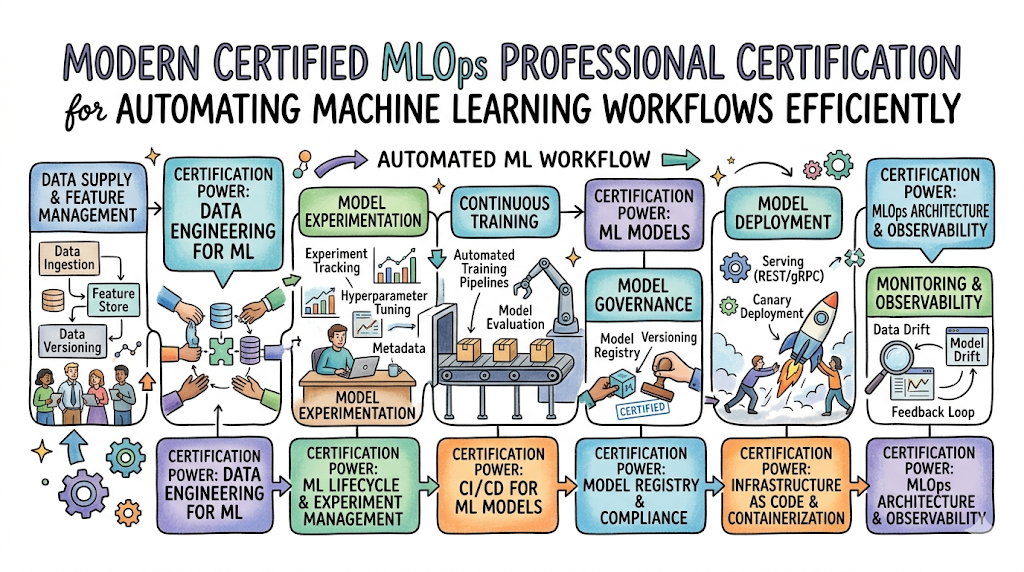
The certification structure covers the entire MLOps maturity model, from manual processes to fully automated continuous training. It provides a clear framework for understanding how different components, like feature stores and model registries, fit into a larger ecosystem. This structured approach allows organizations to benchmark the skills of their technical teams against industry standards for reliability and efficiency.
Certified MLOps Professional Certification Tracks & Levels
The certification is organized into three distinct levels to support career progression at every stage. The foundation level focuses on the basic terminology, the ML lifecycle, and the role of containers in modern deployments. It is designed for those transitioning into the field or for stakeholders who need to understand the high-level operational requirements of machine learning.
The professional and advanced levels dive much deeper into the engineering and architectural aspects of the field. The professional level covers the automation of pipelines and monitoring systems, while the advanced level focuses on large-scale governance and multi-cloud strategies. These tracks allow engineers to specialize in areas like security or cost optimization depending on their specific career interests and organizational needs.
Complete Certified MLOps Professional Certification Table
| Track | Level | Who it’s for | Prerequisites | Skills Covered | Recommended Order |
| Core MLOps | Foundation | Beginners / Managers | Basic Cloud Knowledge | Pipelines, Containers, Lifecycle | 1 |
| Engineering | Professional | DevOps / SRE / Data Eng | Python, Docker, Git | CI/CD, Model Tracking, Feature Stores | 2 |
| Architecture | Advanced | Lead Engineers / Architects | Professional Level | Governance, Scaling, Multi-cloud | 3 |
| Security | Specialist | Security / Compliance | Core MLOps | MLSecOps, Data Encryption | Optional |
| Optimization | Specialist | FinOps / Platform Eng | Core MLOps | Cost Mgmt, Resource Tuning | Optional |
Detailed Guide for Each Certified MLOps Professional Certification
Certified MLOps Professional – Foundation
What it is
This certification validates a professional’s understanding of the basic concepts of machine learning operations and how they differ from traditional software development.
Who should take it
It is ideal for junior engineers, project managers, and recruiters who need to speak the language of MLOps and understand the workflow of a data science team.
Skills you’ll gain
- Understanding the ML lifecycle stages
- Basics of model containerization
- Overview of data versioning requirements
- Identification of key MLOps tools
Real-world projects you should be able to do
- Create a documentation map for an ML pipeline
- Audit a basic manual deployment process
- Set up a simple model registry folder structure
Preparation plan
- 7-14 Days: Review core definitions and high-level architectural patterns.
- 30 Days: Study case studies on the differences between DevOps and MLOps.
- 60 Days: Experiment with basic managed ML services on major cloud providers.
Common mistakes
- Focusing on model algorithms rather than the pipeline infrastructure.
- Ignoring the importance of data quality in the early stages.
Best next certification after this
- Same-track option: Professional Certified MLOps Professional
- Cross-track option: DataOps Foundation
- Leadership option: Engineering Management Fundamentals
Certified MLOps Professional – Professional
What it is
This level confirms the technical ability to build, automate, and monitor production-grade machine learning pipelines and infrastructure.
Who should take it
Active DevOps engineers, SREs, and Data Engineers who are responsible for the daily operation and reliability of machine learning models.
Skills you’ll gain
- Automated CI/CD for machine learning models
- Implementing feature stores and model registries
- Advanced observability and drift detection
- Infrastructure as Code for ML platforms
Real-world projects you should be able to do
- Build an automated retraining pipeline triggered by data drift
- Implement a scalable feature engineering workflow
- Design an alerting system for model performance degradation
Preparation plan
- 7-14 Days: Deep dive into tools like Kubernetes, MLflow, and Kubeflow.
- 30 Days: Build three distinct end-to-end automated ML pipelines.
- 60 Days: Focus on optimization and troubleshooting of distributed ML training.
Common mistakes
- Failing to account for data security within the pipeline.
- Over-automating before the manual process is fully understood.
Best next certification after this
- Same-track option: Advanced MLOps Architect
- Cross-track option: DevSecOps Professional
- Leadership option: Platform Engineering Lead
Certified MLOps Professional – Advanced
What it is
This certification is for experts who design the overarching strategy, governance, and architecture for enterprise-scale machine learning environments.
Who should take it
Senior architects, principal engineers, and technical directors who make strategic decisions regarding toolsets, compliance, and large-scale infrastructure.
Skills you’ll gain
- Enterprise-wide ML platform design
- Governance and compliance frameworks for AI
- Multi-cloud and hybrid-cloud ML strategies
- Cost-effective scaling of GPU resources
Real-world projects you should be able to do
- Design a multi-tenant ML platform for a global organization
- Create a compliance framework for automated model auditing
- Optimize resource allocation for massive distributed training jobs
Preparation plan
- 7-14 Days: Focus on enterprise design patterns and organizational governance.
- 30 Days: Perform a complete audit and redesign of an existing ML architecture.
- 60 Days: Document a comprehensive scaling strategy for global model serving.
Common mistakes
- Choosing tools based on hype rather than specific business needs.
- Neglecting the financial impact of architectural decisions.
Best next certification after this
- Same-track option: Specialized ML Governance
- Cross-track option: FinOps Certified Professional
- Leadership option: CTO / VP of Engineering Track
Choose Your Learning Path
DevOps Path
The DevOps path centers on integrating machine learning into established software delivery lifecycles. Engineers will learn how to treat models as artifacts and implement rigorous testing for both code and data. This path emphasizes the use of traditional CI/CD tools to orchestrate complex machine learning workflows. It is the most efficient route for those already skilled in general automation and platform management.
DevSecOps Path
The DevSecOps path focuses on securing the machine learning supply chain against modern threats. This includes scanning data for sensitive information and protecting models from adversarial attacks or extraction. You will learn how to implement automated compliance checks and secure model endpoints. This path is vital for professionals working in highly regulated industries where data privacy is paramount.
SRE Path
The SRE path is dedicated to ensuring the high availability and performance of machine learning services in production. You will apply site reliability principles, such as SLIs and SLOs, specifically to model inference and latency. This path teaches you how to build robust monitoring that distinguishes between hardware failures and model performance issues. It is ideal for engineers who enjoy maintaining complex, high-traffic systems.
AIOps Path
The AIOps path focuses on using artificial intelligence to improve the management of IT infrastructure. While MLOps focuses on the models, AIOps uses models to analyze logs, traces, and metrics for predictive maintenance. You will learn to build systems that automatically detect anomalies and respond to incidents before they impact users. This path is perfect for those looking to revolutionize how data centers are managed.
MLOps Path
The pure MLOps path is a deep dive into the unique challenges of machine learning engineering and platform development. You will master the coordination between data science and operations to ensure seamless model handoffs. This path covers the implementation of feature stores, model registries, and automated experiment tracking. It is the primary path for anyone wanting to become a specialized MLOps Engineer.
DataOps Path
The DataOps path focuses on the automation and quality control of the data pipelines that feed machine learning models. You will learn how to apply DevOps principles to data management, ensuring that data is always fresh, accurate, and secure. This path addresses the foundational requirement of “data first” in any successful AI project. It is best suited for those who enjoy working with large-scale data architecture.
FinOps Path
The FinOps path addresses the financial aspects of machine learning, focusing on the high costs of compute and storage. You will learn how to track ML-related spending, optimize resource usage, and implement cost-allocation frameworks. This path ensures that the machine learning initiatives of an organization are economically sustainable. It is an essential track for senior leaders and cloud economic specialists.
Role → Recommended Certified MLOps Professional Certifications
| Role | Recommended Certifications |
| DevOps Engineer | Certified MLOps Professional (Professional) |
| SRE | Professional MLOps + SRE Specialist |
| Platform Engineer | Advanced MLOps Architect |
| Cloud Engineer | Core MLOps + Optimization Specialist |
| Security Engineer | MLOps Security Specialist |
| Data Engineer | Professional MLOps + DataOps |
| FinOps Practitioner | MLOps Optimization Specialist |
| Engineering Manager | Certified MLOps Professional (Foundation) |
Next Certifications to Take After Certified MLOps Professional
Same Track Progression
After completing the professional certification, you should aim for the advanced architect level. This progression allows you to move from individual contributor roles to strategic leadership positions. Staying current with new releases in the MLOps ecosystem is critical as the field matures. Deepening your expertise in specific tools like Kubernetes or cloud-native ML services will further solidify your status as an expert.
Cross-Track Expansion
Expanding your knowledge into DevSecOps or SRE provides a broader perspective on modern system management. A “T-shaped” skill set, where you have deep MLOps expertise and broad knowledge of other “Ops” disciplines, is highly desirable. This versatility allows you to lead multi-disciplinary teams and tackle complex organizational challenges. You might also consider exploring DataOps to gain a better understanding of the data supply chain.
Leadership & Management Track
For those interested in moving into management, certifications focused on technical leadership and strategy are the next step. These programs help you develop the soft skills and business acumen required to lead engineering departments. You will learn about talent management, budget oversight, and aligning technical roadmaps with corporate goals. This transition is ideal for senior engineers looking to have a wider impact on their organizations.
Training & Certification Support Providers for Certified MLOps Professional
DevOpsSchool
DevOpsSchool is a leading global provider of technical training focused on the entire software delivery lifecycle. They offer extensive resources for professionals looking to master automation, cloud-native technologies, and operational efficiency. Their curriculum is developed by industry practitioners who bring real-world experience into the training environment, ensuring that students learn practical skills that are immediately applicable. DevOpsSchool provides a variety of learning formats, including live instructor-led sessions and flexible self-paced options, making it accessible to busy professionals. Their support extends beyond the classroom, offering career guidance and project assistance to help candidates achieve their certification goals. By focusing on the foundational principles of DevOps, they provide a strong starting point for any MLOps journey.
Cotocus
Cotocus specializes in high-end technical training and workforce transformation for enterprise organizations. They focus on bridging the gap between emerging technologies and practical business applications. Their training methodology is highly immersive, utilizing lab-based learning and production-grade simulations to prepare students for real-world challenges. Cotocus instructors are recognized experts in their fields, providing deep insights into the complexities of cloud architecture and data operations. Their courses are regularly updated to reflect the latest industry trends, ensuring that learners are always at the forefront of technical innovation. For those pursuing advanced certifications, Cotocus offers the depth and rigor required to master complex systems and lead successful digital transformation projects within their organizations.
Scmgalaxy
Scmgalaxy is a massive community-driven platform and training provider dedicated to configuration management and automation. They offer a wealth of free tutorials, documentation, and forums that support continuous learning for IT professionals. Their formal training programs are built on years of community expertise and are designed to provide a comprehensive understanding of the automation ecosystem. Scmgalaxy emphasizes the importance of source code management as the backbone of all modern operations. Their courses take students from basic version control to advanced orchestration and pipeline management. For MLOps candidates, Scmgalaxy provides the essential automation background needed to manage machine learning assets as code, ensuring consistency and reproducibility across all environments.
BestDevOps
BestDevOps focuses on delivering high-quality, streamlined training for the most in-demand skills in the cloud and automation market. Their goal is to provide a focused and efficient path to certification by teaching only the best practices and tools used in the industry. The training environment at BestDevOps is designed to mimic actual production scenarios, giving students hands-on experience with the challenges they will face in their roles. Their instructors are experienced engineers who focus on the practical application of technology to solve business problems. BestDevOps is an ideal choice for professionals who want a results-oriented training program that prioritizes immediate workplace value and career advancement in a competitive landscape.
devsecopsschool.com
DevSecOpsSchool is a specialized training center dedicated to integrating security into every phase of the development and operations lifecycle. As security becomes a critical component of machine learning, this provider offers essential knowledge for protecting data and models. Their curriculum covers topics such as automated security testing, compliance as code, and securing cloud-native infrastructure. Students gain hands-on experience with industry-standard security tools, learning how to build resilient systems that meet strict regulatory requirements. DevSecOpsSchool ensures that security is seen as a shared responsibility across the entire engineering team. For MLOps practitioners, this training is vital for securing the machine learning supply chain against adversarial threats and data breaches.
sreschool.com
SRESchool focuses on the principles and practices of Site Reliability Engineering, teaching students how to build and maintain highly available systems. Their training covers essential topics such as service level objectives, error budgets, and automated incident response. This focus on reliability is critical for managing machine learning models that must perform consistently under production loads. SRESchool provides a deep understanding of observability and performance tuning, helping engineers identify and resolve issues before they impact users. Their approach is highly analytical, encouraging students to use data to drive operational decisions. For MLOps professionals, SRESchool offers the tools and methodologies needed to ensure that intelligent services meet the high standards of enterprise-level reliability.
aiopsschool.com
AIOpsSchool is at the forefront of training for the next generation of IT operations, focusing on the use of artificial intelligence to automate infrastructure management. They offer specialized programs that teach how to implement machine learning for log analysis, predictive maintenance, and automated root cause analysis. Their curriculum is designed for forward-thinking engineers who want to lead the adoption of intelligent operations within their organizations. AIOpsSchool provides a practical understanding of how to use ML to solve complex operational problems at scale. Their training is highly relevant for those pursuing MLOps certifications, as it provides the broader context of how AI is transforming the way we manage and monitor modern cloud-native environments.
dataopsschool.com
DataOpsSchool addresses the growing demand for professionalized data management by applying DevOps principles to the data lifecycle. Their training focuses on automating data pipelines, ensuring data quality, and managing data environments with the same rigor as software code. This is a critical foundation for successful MLOps, as high-quality data is the primary requirement for any machine learning model. DataOpsSchool teaches students how to implement end-to-end data lineage and automated testing, reducing errors and increasing the speed of data delivery. Their courses are ideal for data engineers and architects who want to build stable and scalable data foundations that support the most demanding machine learning and analytics workloads.
finopsschool.com
FinOpsSchool is dedicated to the discipline of cloud financial management, helping organizations optimize their cloud spending and drive maximum business value. As machine learning involves significant compute and storage costs, mastering FinOps is essential for any MLOps professional. Their curriculum covers cost optimization strategies, budgeting, and the cultural shifts needed to manage cloud finances effectively across an organization. Students learn how to track spending at a granular level and implement frameworks for financial accountability. FinOpsSchool provides the knowledge required to ensure that machine learning projects are not only technically successful but also economically sustainable. This training is vital for senior technical leaders who are responsible for the financial health of their platforms.
Frequently Asked Questions (General)
- How difficult is the Certified MLOps Professional exam?
The exam is designed to be challenging and requires a deep understanding of both engineering and operational principles. It tests your ability to apply concepts to real-world scenarios rather than just memorizing facts.
- What is the recommended study time for this certification?
Most candidates with a technical background spend between 30 and 60 days preparing. This allows enough time to go through the curriculum and complete the necessary hands-on laboratory exercises.
- Are there any specific prerequisites for the program?
While there are no mandatory prerequisites, having a strong foundation in Python, Docker, and basic cloud services is highly recommended. Familiarity with the machine learning lifecycle will also give you an advantage.
- What is the return on investment for this certification?
The ROI is significant as MLOps is one of the fastest-growing niches in tech. Certified professionals often see increased salary potential and access to high-impact roles in top-tier organizations.
- Should I start with the foundation or professional level?
If you are a working engineer, you should start with the professional level. If you are in a management or non-technical role, the foundation level is the best place to begin.
- Is the certification recognized by global employers?
Yes, the program is based on industry standards that are used by major technology companies worldwide. It is a respected credential that demonstrates a high level of operational expertise.
- How long does the certification remain valid?
The certification is typically valid for two to three years. Due to the fast pace of the industry, recertification ensures that your skills remain current with the latest technologies.
- Does the training include access to hands-on labs?
Yes, hands-on labs are a core part of the training program. These labs provide a safe environment to practice building and managing production-grade machine learning pipelines.
- Which cloud providers are covered in the curriculum?
The curriculum is designed to be cloud-agnostic, focusing on principles that apply to AWS, Azure, and Google Cloud Platform. This ensures your skills are transferable across different environments.
- How does MLOps differ from standard DevOps?
MLOps includes everything in DevOps but adds specific requirements for data versioning, model tracking, and monitoring for performance decay, which are unique to machine learning.
- Can I take the certification exam online?
Yes, the exams are available through a secure online proctoring service, allowing you to complete your certification from anywhere in the world at your convenience.
- Are there community resources available for candidates?
Yes, candidates have access to a wide range of community forums, study groups, and documentation to support them throughout their learning and certification journey.
FAQs on Certified MLOps Professional
- What is the most critical skill learned in the Certified MLOps Professional track?
The most critical skill is the ability to automate the entire machine learning lifecycle. This ensures that models are not just built once but can be retrained and redeployed continuously as data changes.
- How does this certification benefit a Senior DevOps Engineer?
It allows a Senior DevOps Engineer to specialize in a high-demand field. It provides the specific knowledge needed to handle the complex dependencies and compute requirements of machine learning workloads.
- Does the program cover model governance and ethical AI?
Yes, the advanced tracks include modules on governance and compliance. This ensures that models are deployed in a way that is transparent, explainable, and follows enterprise safety standards.
- Is knowledge of deep learning required for this certification?
A deep mathematical understanding of deep learning is not required. However, you must understand how deep learning models are containerized, trained at scale, and served to users.
- How does MLOps address the issue of model drift?
The certification teaches you how to implement automated monitoring systems that detect when a model’s performance starts to drop. It then triggers an automated retraining pipeline to fix the issue.
- What role does Kubernetes play in the MLOps certification?
Kubernetes is a central tool in the curriculum for orchestrating containers. You will learn how to use it to manage scalable training jobs and serve models with high availability.
- Can this certification help me transition from Data Science to Engineering?
Yes, it is the perfect bridge for data scientists who want to move into more technical, engineering-focused roles. it provides the operational rigor that is often missing in research-focused positions.
- Why is the feature store emphasized in the professional level?
Feature stores are critical for ensuring that the same data used for training is available for inference. Mastering feature stores is a key part of building reliable, production-ready systems.
Final Thoughts
I can confidently say that the Certified MLOps Professional is one of the most practical investments you can make in your career today. The industry has moved past the “hype” phase of AI and is now focused on the “how” of making these systems work at scale. This certification provides the answer to that question. By following this structured path, you are not just learning a tool; you are learning a methodology that will serve you for years to come. Whether you want to remain an individual contributor or move into leadership, having a deep understanding of how to operationalize machine learning will make you an invaluable asset to any organization. The transition is challenging, but the career rewards are well worth the effort.
