Introduction
Nonprofit organizations rely on strong relationships with donors, volunteers, partners, and constituents to achieve their mission. Nonprofit CRM Systems are software platforms specifically designed to manage these relationships, centralize data, automate communication, and optimize fundraising and engagement efforts. Unlike generic CRMs, these systems include specialized features such as donor tracking, pledge management, volunteer scheduling, event registration, and campaign analytics.
In , with increased digital engagement and tighter budgets, nonprofit CRMs have become essential tools to improve operational efficiency, enhance donor retention, and provide actionable insights for decision-making. They allow teams to focus on mission-critical activities rather than manual data entry, making it easier to demonstrate impact and accountability.
Real-World Use Cases
- Fundraising Campaigns: Manage gifts, recurring donations, and pledge tracking while automating donor communications.
- Donor Retention & Stewardship: Use analytics to segment donors, track engagement, and improve lifetime giving.
- Volunteer Management: Schedule shifts, track hours, and communicate with volunteers effectively.
- Event Management: Handle registrations, ticketing, sponsorships, and post-event follow-ups.
- Grant Management: Monitor proposal deadlines, fund allocation, and reporting for compliance and transparency.
Evaluation Criteria for Buyers
Best for: Nonprofits of all sizes seeking an integrated solution for donor engagement, fundraising, volunteer coordination, and event management. Ideal for development teams, volunteer managers, and executive staff.
Not ideal for: Organizations needing highly specialized industry-specific CRMs (e.g., healthcare patient CRMs) or very small groups with minimal donor or volunteer activity.
Key Trends in Nonprofit CRM Systems
- AI-powered donor insights for retention and campaign optimization.
- Automation of recurring donations, workflows, and engagement communications.
- Mobile-first platforms for field staff and volunteers.
- Deep integration with payment gateways, marketing, and finance systems.
- Enhanced analytics for impact measurement and reporting.
- Cloud-based and hybrid deployments for flexibility and cost efficiency.
- Increased focus on data privacy, encryption, and regulatory compliance.
- Personalized donor journeys with omnichannel communications.
- Subscription-based pricing with nonprofit-friendly tiers and discounts.
How We Selected These Tools (Methodology)
- Analyzed market adoption and brand mindshare in the nonprofit sector.
- Evaluated feature completeness for fundraising, donor management, and volunteer coordination.
- Reviewed reliability and performance metrics from user reviews and case studies.
- Considered security posture, encryption, and compliance standards.
- Assessed integrations and ecosystem support with common nonprofit tools.
- Measured suitability across small, mid-sized, and large nonprofit segments.
- Verified the presence of mobile support and automation capabilities.
- Compared cost/value relative to features and nonprofit budgets.
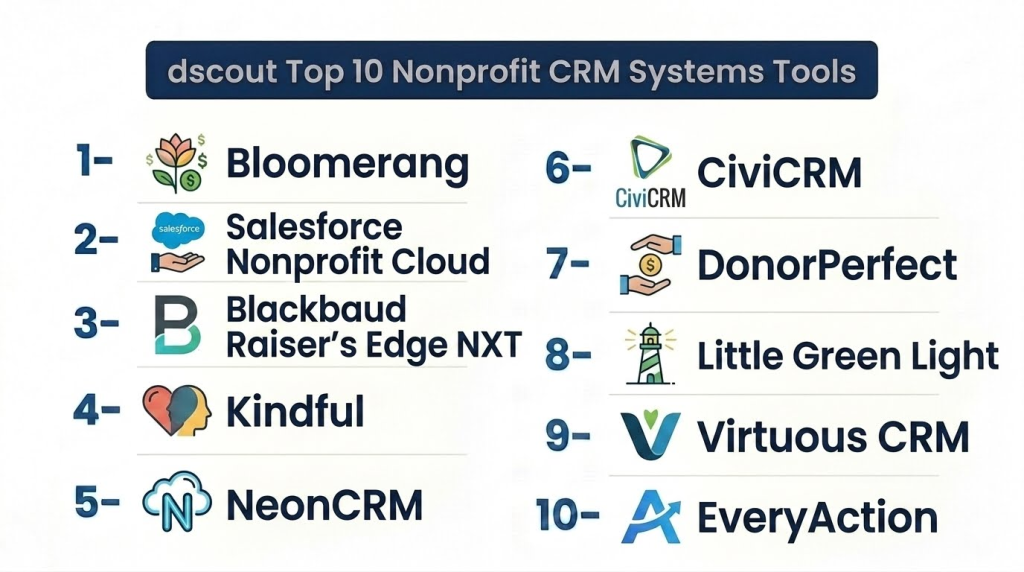
Top 10 Nonprofit CRM Systems Tools
1- Bloomerang
Short description :
Bloomerang is designed for small to mid-sized nonprofits to manage donors, track engagement, and increase retention. Its intuitive dashboards and donor health scores help organizations streamline fundraising efforts without extensive technical resources.
Key Features
- Donor lifecycle management
- Retention analytics and health scoring
- Email and communication integration
- Campaign tracking and reporting
- Event management tools
- Recurring donation management
Pros
- Easy to adopt and navigate
- Focused on donor retention and engagement
- Responsive customer support
Cons
- Limited advanced automation
- Less suitable for complex multi-channel campaigns
Platforms / Deployment
- Web / iOS / Android
- Cloud
Security & Compliance
- Not publicly stated
Integrations & Ecosystem
Supports major email platforms, payment processors, and has API extensibility.
- Stripe/PayPal integration
- Mailchimp, Constant Contact
- Event management connectors
Support & Community
Strong documentation, onboarding support, and responsive team; active online community forums.
2- Salesforce Nonprofit Cloud
Short description:
Salesforce Nonprofit Cloud offers a highly customizable CRM for nonprofits of all sizes. It enables deep automation, flexible workflows, and robust reporting, ideal for organizations managing complex donor and volunteer programs.
Key Features
- Customizable constituent objects
- Advanced reporting and dashboards
- Automation of campaigns and workflows
- Fundraising and grant tracking
- Volunteer and event management
- AI-powered Einstein analytics
Pros
- Extremely flexible and scalable
- Extensive integration ecosystem
- Strong analytics and AI insights
Cons
- Steep learning curve
- Requires technical resources for full customization
Platforms / Deployment
- Web / Windows / macOS / iOS / Android
- Cloud
Security & Compliance
- SSO/SAML, MFA, encryption, RBAC
- GDPR and SOC 2 compliance
Integrations & Ecosystem
Broad integrations with finance, marketing, and fundraising apps.
- Mailchimp, HubSpot
- Payment gateways
- Custom APIs
Support & Community
Comprehensive documentation, professional services, training modules, and vibrant user community.
3- Blackbaud Raiser’s Edge NXT
Short description :
Raiser’s Edge NXT is an enterprise-grade CRM for nonprofits, focusing on fundraising, analytics, and donor management. It provides detailed reporting and peer-to-peer fundraising capabilities for large organizations.
Key Features
- Advanced donor management
- Campaign and event fundraising tools
- Major gift and pledge tracking
- Peer-to-peer fundraising
- Dashboards and analytics
- Mobile access
Pros
- Robust fundraising capabilities
- Detailed reporting and insights
- Scalable for large nonprofits
Cons
- Higher cost for small nonprofits
- Complexity can require professional support
Platforms / Deployment
- Web / iOS / Android
- Cloud
Security & Compliance
- Not publicly stated
Integrations & Ecosystem
Integrates with Blackbaud ecosystem and third-party tools.
- Payment gateways
- Email marketing
- Accounting software
Support & Community
Offers comprehensive onboarding, user training, and community forums for networking.
4- Kindful
Short description :
Kindful is a user-friendly CRM for mid-sized nonprofits, focusing on donor management and campaign tracking. It simplifies data entry and reporting while offering integrations with key nonprofit tools.
Key Features
- Donor profiles and engagement tracking
- Campaign and donation reporting
- Dashboard analytics
- Event registration and ticketing
- Recurring gift management
- Integration with email platforms
Pros
- Intuitive interface
- Streamlined fundraising management
- Strong integration options
Cons
- Limited advanced analytics
- Less customization than enterprise systems
Platforms / Deployment
- Web / iOS / Android
- Cloud
Security & Compliance
- Not publicly stated
Integrations & Ecosystem
Connects with major payment and email platforms.
- Stripe/PayPal
- Mailchimp
- Eventbrite
Support & Community
Good documentation and responsive customer support; active knowledge base.
5- NeonCRM
Short description :
NeonCRM provides an all-in-one platform for fundraising, membership, and volunteer management. Suitable for mid-sized nonprofits seeking robust features without enterprise complexity.
Key Features
- Donor and member management
- Event and volunteer coordination
- Email campaigns and automation
- Donation tracking
- Analytics dashboards
Pros
- Comprehensive all-in-one tool
- Flexible reporting
- Good customer support
Cons
- Advanced features may require training
- Interface may feel dated for some users
Platforms / Deployment
- Web / iOS / Android
- Cloud
Security & Compliance
- Not publicly stated
Integrations & Ecosystem
Offers payment and email integrations, API support.
- Mailchimp
- Payment processors
- Accounting connectors
Support & Community
Varies / N/A
6- CiviCRM
Short description:
CiviCRM is an open-source, flexible CRM for nonprofits. Ideal for organizations with technical resources who want control over deployment and customization.
Key Features
- Contact and constituent management
- Contribution and donation tracking
- Event and volunteer management
- Membership management
- Customizable reports
- Open-source extensions
Pros
- Free core software
- High customization potential
- Community-driven support
Cons
- Requires hosting and IT support
- Learning curve for configuration
Platforms / Deployment
- Web
- Self-hosted / Cloud via partners
Security & Compliance
- Not publicly stated
Integrations & Ecosystem
Supports extensions and APIs for email, finance, and web forms.
- Payment processors
- Email platforms
- Reporting plugins
Support & Community
Strong open-source community, forums, and documentation.
7- DonorPerfect
Short description :
DonorPerfect is a scalable CRM with donor management, fundraising, and reporting tools. Suitable for growing nonprofits needing flexible data management and automation features.
Key Features
- Donor and contribution tracking
- Pledge management
- Reporting and analytics
- Email integration
- Event and volunteer management
- Automated workflows
Pros
- Scalable for growth
- Good support
- Flexible reporting
Cons
- Interface can feel outdated
- Advanced features may require setup support
Platforms / Deployment
- Web / iOS / Android
- Cloud
Security & Compliance
- Not publicly stated
Integrations & Ecosystem
Connects with payments, email, and fundraising tools.
- Mailchimp
- Stripe/PayPal
- Accounting integrations
Support & Community
Responsive support and documentation; moderate user community.
8- Little Green Light
Short description :
Little Green Light offers simple, affordable donor management for small nonprofits. Focused on core fundraising, it provides easy-to-use tools without overwhelming complexity.
Key Features
- Donor tracking
- Gift entry and reporting
- Email communication
- Event management
- Segmentation tools
Pros
- Affordable and simple
- Quick setup
- Good for small teams
Cons
- Limited automation
- Not ideal for complex campaigns
Platforms / Deployment
- Web
- Cloud
Security & Compliance
- Not publicly stated
Integrations & Ecosystem
Supports basic payment and email integrations.
- Stripe/PayPal
- Mailchimp
- Event management platforms
Support & Community
Responsive support; moderate documentation; small community.
9- Virtuous CRM
Short description :
Virtuous CRM focuses on donor engagement with journey automation and analytics. Ideal for nonprofits emphasizing personalized communication and AI-driven insights.
Key Features
- Donor journey automation
- Predictive donor insights
- Segmentation and reporting
- Event and volunteer management
- Campaign tracking
Pros
- Modern, intuitive interface
- Strong automation
- AI-driven insights
Cons
- Higher cost
- Learning curve for advanced features
Platforms / Deployment
- Web / iOS / Android
- Cloud
Security & Compliance
- Not publicly stated
Integrations & Ecosystem
Integrates with payments, marketing, and analytics tools.
- Stripe/PayPal
- Mailchimp
- Event management platforms
Support & Community
Comprehensive support, documentation, and active user community.
10- EveryAction
Short description:
EveryAction combines fundraising, advocacy, and constituent management into one platform. Best for nonprofits integrating campaigns, donor management, and volunteer coordination.
Key Features
- Fundraising and advocacy tools
- Donor and volunteer management
- Event registration
- Analytics dashboards
- Email and marketing automation
Pros
- Broad constituent management
- Integrated advocacy capabilities
- Strong reporting
Cons
- Complexity for purely fundraising-focused organizations
- May require training for full adoption
Platforms / Deployment
- Web / iOS / Android
- Cloud
Security & Compliance
- Not publicly stated
Integrations & Ecosystem
Supports payment gateways, marketing, and analytics platforms.
- Stripe/PayPal
- Mailchimp
- Campaign integrations
Support & Community
Varies / N/A
Comparison Table (Top 10)
| Tool Name | Best For | Platform(s) Supported | Deployment | Standout Feature | Public Rating |
|---|---|---|---|---|---|
| Bloomerang | Donor retention | Web, iOS, Android | Cloud | Donor health scoring | N/A |
| Salesforce Nonprofit Cloud | Enterprise nonprofits | Web, Windows, macOS, iOS, Android | Cloud | Customizable workflows | N/A |
| Raiser’s Edge NXT | Large fundraising teams | Web, iOS, Android | Cloud | Peer-to-peer fundraising | N/A |
| Kindful | Mid-sized nonprofits | Web, iOS, Android | Cloud | Intuitive donor tracking | N/A |
| NeonCRM | Mid-sized nonprofits | Web, iOS, Android | Cloud | Membership and event management | N/A |
| CiviCRM | Open-source | Web | Self-hosted / Cloud | Customizable modules | N/A |
| DonorPerfect | Growing nonprofits | Web, iOS, Android | Cloud | Pledge and donation tracking | N/A |
| Little Green Light | Small nonprofits | Web | Cloud | Simple donor management | N/A |
| Virtuous CRM | Donor engagement focused | Web, iOS, Android | Cloud | Automated donor journeys | N/A |
| EveryAction | Advocacy + fundraising | Web, iOS, Android | Cloud | Integrated fundraising & advocacy | N/A |
Evaluation & Scoring of Nonprofit CRM Systems
| Tool Name | Core (25%) | Ease (15%) | Integrations (15%) | Security (10%) | Performance (10%) | Support (10%) | Value (15%) | Weighted Total (0–10) |
|---|---|---|---|---|---|---|---|---|
| Salesforce Nonprofit Cloud | 10 | 8 | 10 | 9 | 9 | 9 | 8 | 9.3 |
| Raiser’s Edge NXT | 10 | 7 | 9 | 8 | 9 | 8 | 7 | 8.6 |
| Virtuous CRM | 9 | 9 | 8 | 8 | 8 | 8 | 7 | 8.3 |
| NeonCRM | 9 | 8 | 8 | 8 | 8 | 8 | 7 | 8.1 |
| Bloomerang | 8 | 9 | 7 | 7 | 8 | 8 | 8 | 7.9 |
| DonorPerfect | 8 | 8 | 8 | 7 | 8 | 8 | 7 | 7.8 |
| Kindful | 8 | 9 | 7 | 7 | 7 | 8 | 7 | 7.7 |
| EveryAction | 8 | 8 | 8 | 8 | 7 | 7 | 7 | 7.6 |
| CiviCRM | 8 | 7 | 7 | 7 | 7 | 7 | 8 | 7.4 |
| Little Green Light | 7 | 9 | 6 | 7 | 7 | 7 | 8 | 7.2 |
Interpretation: Higher weighted scores indicate stronger overall suitability for diverse nonprofit operations. Scores are comparative and help identify the best fit based on core capabilities, usability, integrations, and value.
Which Nonprofit CRM Tool Is Right for You?
Solo / Freelancer
- Little Green Light or Bloomerang provide simple, affordable donor tracking and lightweight reporting.
SMB
- Kindful or NeonCRM balance usability with robust fundraising and volunteer features.
Mid-Market
- Virtuous CRM or EveryAction are ideal for automation, donor engagement, and integrated campaigns.
Enterprise
- Salesforce Nonprofit Cloud or Raiser’s Edge NXT handle complex workflows, large donor databases, and extensive reporting.
Budget vs Premium
- Small nonprofits benefit from lower-cost tools like Little Green Light.
- Larger organizations gain more ROI from premium solutions with advanced automation and AI insights.
Feature Depth vs Ease of Use
- Virtuous CRM and NeonCRM balance rich features with user-friendly design.
- Salesforce and Raiser’s Edge offer deep functionality at the cost of learning complexity.
Integrations & Scalability
- Salesforce, Raiser’s Edge, and EveryAction offer broad ecosystems for growth.
- Open-source CiviCRM offers flexible integrations with developer support.
Security & Compliance Needs
- Enterprise platforms prioritize advanced security and regulatory compliance.
- Smaller tools still provide standard encryption and access control suitable for typical nonprofit use.
Frequently Asked Questions (FAQs)
1. What is the typical pricing model for nonprofit CRMs?
Most operate on subscription tiers based on contact count or users. Some open-source solutions are free with optional paid support.
2. How long does it take to implement a nonprofit CRM?
Simple setups can take a few weeks; complex enterprise deployments with integrations may require several months.
3. Can these systems handle volunteers?
Yes. Most include scheduling, communication tools, hour tracking, and integration with events.
4. Are AI features commonly available?
Yes, platforms like Salesforce, Virtuous, and Bloomerang offer predictive analytics and automated donor insights.
5. How do I migrate existing donor data?
Plan for data cleaning, mapping fields, and testing before full migration to prevent errors.
6. Can small nonprofits use enterprise solutions?
Yes, but costs and complexity may outweigh benefits; smaller tools often provide better value and ease of adoption.
7. Are integrations easy to set up?
Most cloud CRMs have prebuilt connectors for email, payment, and event management. API access allows custom integrations.
8. How is security handled?
Enterprise solutions include encryption, access controls, SSO/SAML, and audit logs. Smaller tools provide standard encryption.
9. Do these platforms support reporting and analytics?
Yes, dashboards, donor retention reports, fundraising insights, and exportable data are standard features.
10. What are common mistakes nonprofits make?
Skipping needs analysis, poor data hygiene, inadequate training, and over-customizing too early can limit CRM success.
Conclusion
Selecting the right nonprofit CRM depends on organizational size, fundraising complexity, volunteer needs, and budget. Small nonprofits benefit from simple, affordable tools, while enterprise-level organizations gain from robust, customizable platforms with AI-driven insights. Begin by shortlisting 2–3 options, run a pilot to evaluate workflow fit, validate integrations and security, and scale adoption based on performance. The best CRM streamlines operations, strengthens relationships, and enhances mission impact.
