Introduction
Disaster Management & Response Platforms are specialized software systems designed to help governments, emergency services, NGOs, and community organizations plan for, respond to, and recover from natural and human-made disasters. These platforms centralize information, coordinate resources, track incidents, manage emergency communications, monitor hazards, and provide real-time analytics for informed decision-making.
In, disaster management has become more complex due to climate change, urbanization, and infrastructure challenges. Efficient platforms help reduce response times, improve coordination across multiple agencies, and enhance public safety. These systems integrate with early warning networks, GIS data, weather monitoring, social media feeds, and communication networks to provide situational awareness.
Real-world use cases include coordinating emergency response during floods, hurricanes, wildfires, earthquakes, and industrial accidents; resource allocation and logistics tracking; public warning and evacuation management; hazard mapping and risk assessment; volunteer coordination; recovery and rebuilding operations; and compliance reporting for national disaster agencies.
Evaluation Criteria for Buyers:
Real-time incident tracking, interoperability with GIS and sensor networks, mobile access for field teams, resource and logistics management, communication tools, alert systems, analytics dashboards, integration with public warning systems, scalability for multi-agency coordination, and security/compliance.
Best for: Emergency management agencies, national disaster response teams, fire and rescue services, police and military units, NGOs involved in disaster relief, municipal emergency management offices, and multi-agency coordination centers.
Not ideal for: Organizations that do not operate in disaster-prone regions or do not need real-time response and multi-agency coordination.
Key Trends in Disaster Management & Response Platforms
- Cloud-based platforms enabling real-time access and remote coordination
- GIS-enabled mapping for hazard visualization and evacuation planning
- Integration with IoT and sensor networks for early warning
- AI and machine learning for predictive risk assessment and disaster modeling
- Mobile apps for field personnel and first responders
- Social media monitoring for situational awareness
- Automated alerts and mass notification systems
- Interoperability standards for multi-agency response
- Logistics and resource tracking for personnel, equipment, and supplies
- Analytics dashboards for planning, after-action review, and reporting
How We Selected These Tools
- Adoption by government emergency services and NGOs
- Feature depth for incident management, resource tracking, and communications
- Real-time data integration and situational awareness capabilities
- Security and compliance features for sensitive operational data
- GIS and sensor network integration
- Mobile and field access for first responders
- Scalability for local, regional, and national operations
- Support, training, and documentation resources
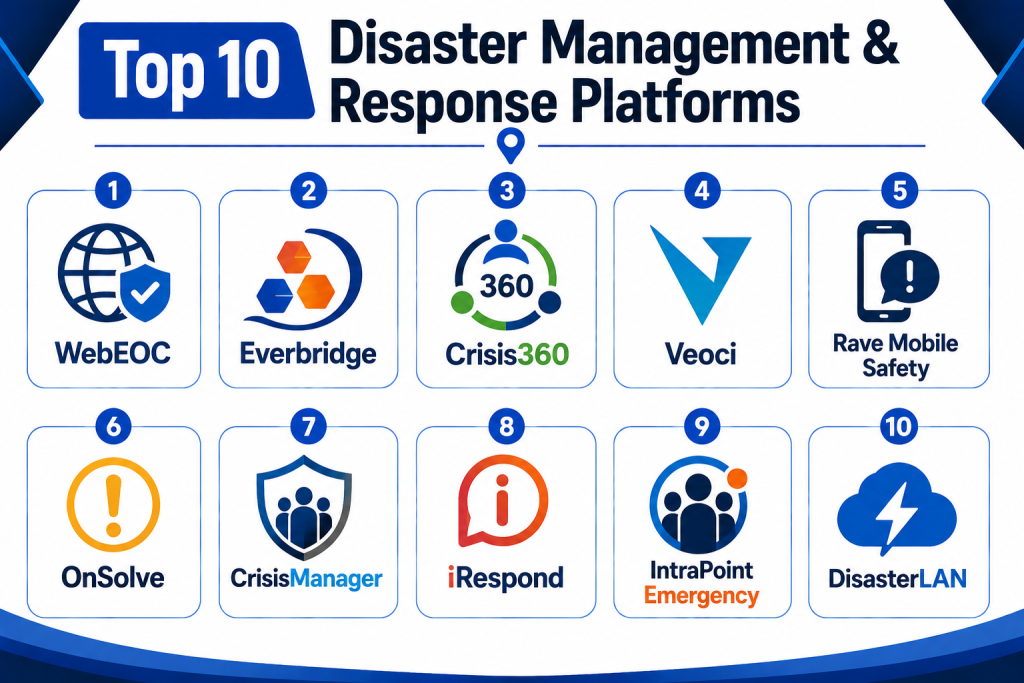
Top 10 Disaster Management & Response Platforms
1 — WebEOC
Short Description:
WebEOC is a widely used emergency management platform that supports real-time incident tracking, resource management, communications, and collaboration across agencies. It is designed for local, state, and national emergency operations centers.
Key Features
- Real-time incident tracking and reporting
- Resource and personnel management
- Communication and collaboration tools
- GIS integration for situational awareness
- Alerts and notification systems
- Mobile access for field personnel
- Reporting dashboards
Pros
- Centralized multi-agency coordination
- Strong GIS and mapping capabilities
- Mobile-enabled for field teams
Cons
- Requires training for full feature use
- Implementation can be complex for smaller agencies
- Licensing costs may be high
Platforms / Deployment
Web / Desktop / Mobile
Cloud / On-premise / Hybrid
Security & Compliance
Role-based access, audit logs, encryption
SOC 2 / ISO 27001: Not publicly stated
Integrations & Ecosystem
- GIS platforms
- Weather and hazard monitoring systems
- Communication networks
- IoT and sensor feeds
Support & Community
Documentation, training, vendor support, and user community.
2 — Everbridge
Short Description:
Everbridge provides mass notification and critical event management for public safety and disaster response. It helps organizations send alerts, manage incidents, and coordinate multi-agency responses.
Key Features
- Mass notification and alerting
- Incident management dashboards
- GIS mapping for situational awareness
- Mobile and desktop access
- Workflow automation for response plans
- Communication tools for multi-agency coordination
Pros
- Fast alert dissemination
- Multi-channel notifications
- Strong situational awareness tools
Cons
- Focused mainly on notifications
- Some advanced workflow features require configuration
- Integration with legacy systems may be limited
Platforms / Deployment
Web / Mobile
Cloud / Hybrid
Security & Compliance
Role-based access, audit logs
SOC 2 / ISO 27001: Not publicly stated
Integrations & Ecosystem
- GIS and mapping tools
- Public warning systems
- Emergency operations software
Support & Community
Vendor support, documentation, and training resources.
3 — Crisis360
Short Description:
Crisis360 is a platform designed for multi-agency disaster response coordination. It offers incident tracking, resource allocation, workflow management, and reporting tools for emergency operations.
Key Features
- Incident tracking and logging
- Resource and asset management
- GIS visualization and mapping
- Workflow automation
- Mobile access for field teams
- Reporting and analytics
Pros
- Flexible workflow configuration
- Integrated GIS and mapping
- Supports multi-agency operations
Cons
- Implementation complexity for smaller agencies
- Some modules may require training
- Advanced analytics may require add-ons
Platforms / Deployment
Web / Mobile
Cloud / Hybrid
Security & Compliance
Role-based access, encryption, audit logs
SOC 2 / ISO 27001: Not publicly stated
Integrations & Ecosystem
- GIS mapping
- Sensor and IoT data
- Communication systems
- Resource management systems
Support & Community
Documentation, training, and vendor support.
4 — Veoci
Short Description:
Veoci is a cloud-based emergency management platform that offers real-time incident management, resource coordination, alerting, and communication tools for disaster preparedness and response.
Key Features
- Incident and event management
- Task and resource assignment
- Mobile access for field responders
- Alerts and notifications
- Reporting dashboards
- GIS integration
- Multi-agency collaboration
Pros
- User-friendly interface
- Mobile-enabled for field operations
- Scalable for multiple agencies
Cons
- Advanced features require configuration
- Learning curve for complex workflows
- Integration with legacy systems may require support
Platforms / Deployment
Web / Mobile
Cloud
Security & Compliance
Role-based access, audit logs, encryption
SOC 2 / ISO 27001: Not publicly stated
Integrations & Ecosystem
- GIS platforms
- Communication networks
- Sensor and monitoring systems
Support & Community
Training, documentation, and vendor support.
5 — Rave Mobile Safety
Short Description:
Rave Mobile Safety provides communication, alerting, and incident management tools for public safety, healthcare, and emergency operations teams.
Key Features
- Mass notifications and alerts
- Incident management
- Mobile access for responders
- GIS mapping
- Workflow and response tracking
- Reporting dashboards
Pros
- Fast and reliable alerting
- Mobile-enabled
- GIS situational awareness
Cons
- Focused mainly on notifications
- Less robust for detailed resource management
- Integration with legacy emergency systems may be limited
Platforms / Deployment
Web / Mobile
Cloud / Hybrid
Security & Compliance
Role-based access, encryption
SOC 2 / ISO 27001: Not publicly stated
Integrations & Ecosystem
- Communication networks
- GIS mapping
- Emergency operation centers
Support & Community
Vendor support, documentation, and training.
6 — OnSolve
Short Description:
OnSolve offers critical event management and emergency communication tools, supporting disaster response, public alerts, and multi-agency coordination.
Key Features
- Mass notifications
- Incident tracking
- Mobile access
- Workflow management
- GIS visualization
- Reporting dashboards
Pros
- Rapid notification delivery
- Multi-agency coordination
- Mobile accessibility
Cons
- Limited resource tracking
- May require configuration for complex events
- Focused primarily on communication
Platforms / Deployment
Web / Mobile
Cloud
Security & Compliance
Role-based access, audit logs
SOC 2 / ISO 27001: Not publicly stated
Integrations & Ecosystem
- GIS and mapping
- Public alert systems
- Emergency operations
Support & Community
Documentation, training, and vendor support.
7 — CrisisManager
Short Description:
CrisisManager provides incident tracking, resource management, and communication tools for disaster response, supporting emergency management agencies with workflow automation and dashboards.
Key Features
- Real-time incident management
- Resource allocation
- Mobile access
- Alerts and notifications
- Reporting dashboards
- GIS integration
Pros
- Centralized command and control
- Mobile-enabled
- Workflow automation
Cons
- Implementation can be complex
- Training required for advanced modules
- Some integration may require support
Platforms / Deployment
Web / Mobile
Cloud / Hybrid
Security & Compliance
Role-based access, encryption, audit logs
SOC 2 / ISO 27001: Not publicly stated
Integrations & Ecosystem
- GIS mapping
- IoT and sensor feeds
- Communication networks
Support & Community
Vendor support, documentation, and training.
8 — iRespond
Short Description:
iRespond is a cloud-based emergency management platform for incident tracking, public alerts, resource coordination, and mobile responder access.
Key Features
- Incident tracking and logging
- Resource management
- Mobile access for responders
- Alerts and notifications
- GIS mapping
- Reporting dashboards
Pros
- Fast deployment
- Mobile-friendly
- Supports multi-agency coordination
Cons
- Limited advanced analytics
- Some modules require setup
- Integration with legacy systems may require work
Platforms / Deployment
Web / Mobile
Cloud
Security & Compliance
Role-based access, audit logs
SOC 2 / ISO 27001: Not publicly stated
Integrations & Ecosystem
- GIS
- Communication tools
- Sensor feeds
Support & Community
Documentation and support.
9 — IntraPoint Emergency
Short Description:
IntraPoint provides comprehensive disaster management tools including incident logging, resource tracking, notifications, and collaboration for public safety and emergency agencies.
Key Features
- Incident management
- Resource allocation
- GIS mapping
- Mobile access
- Alerts and notifications
- Reporting and dashboards
Pros
- Comprehensive workflow support
- GIS-enabled
- Mobile for field responders
Cons
- Advanced configuration required
- Training necessary
- Integration setup may be needed
Platforms / Deployment
Web / Mobile
Cloud / Hybrid
Security & Compliance
Role-based access, audit logs
SOC 2 / ISO 27001: Not publicly stated
Integrations & Ecosystem
- GIS
- Public alert systems
- Communication networks
Support & Community
Documentation, training, and vendor support.
10 — DisasterLAN
Short Description:
DisasterLAN is a platform that provides real-time situational awareness, incident management, resource tracking, and communication for multi-agency disaster response.
Key Features
- Real-time incident tracking
- Resource and personnel management
- Mobile access
- Alerts and notifications
- GIS integration
- Reporting dashboards
Pros
- Centralized command and control
- GIS and mobile-enabled
- Scalable for large regions
Cons
- Implementation requires planning
- Training needed
- Integration may require customization
Platforms / Deployment
Web / Mobile
Cloud / Hybrid
Security & Compliance
Role-based access, audit logs
SOC 2 / ISO 27001: Not publicly stated
Integrations & Ecosystem
- GIS and mapping tools
- Communication networks
- Sensor feeds
Support & Community
Documentation, training, and vendor support.
Comparison Table
| Tool Name | Best For | Platforms | Deployment | Standout Feature | Public Rating |
|---|---|---|---|---|---|
| WebEOC | Multi-agency emergency ops | Web, Desktop, Mobile | Cloud / Hybrid / On-prem | Centralized coordination | N/A |
| Everbridge | Alerts & notifications | Web, Mobile | Cloud / Hybrid | Mass notification | N/A |
| Crisis360 | Incident & resource management | Web, Mobile | Cloud / Hybrid | Workflow automation | N/A |
| Veoci | Emergency response coordination | Web, Mobile | Cloud | Multi-agency collaboration | N/A |
| Rave Mobile Safety | Public alerting | Web, Mobile | Cloud / Hybrid | Fast mass notifications | N/A |
| OnSolve | Critical event management | Web, Mobile | Cloud | Multi-channel alerts | N/A |
| CrisisManager | Workflow & incident control | Web, Mobile | Cloud / Hybrid | Centralized command | N/A |
| iRespond | Rapid response | Web, Mobile | Cloud | Mobile field access | N/A |
| IntraPoint | Emergency operations | Web, Mobile | Cloud / Hybrid | GIS mapping | N/A |
| DisasterLAN | Situational awareness | Web, Mobile | Cloud / Hybrid | Real-time dashboards | N/A |
Evaluation & Scoring Table
| Tool Name | Core 25% | Ease 15% | Integrations 15% | Security 10% | Performance 10% | Support 10% | Value 15% | Weighted Total |
|---|---|---|---|---|---|---|---|---|
| WebEOC | 9 | 8 | 8 | 8 | 8 | 8 | 8 | 8.30 |
| Everbridge | 8 | 8 | 7 | 8 | 8 | 8 | 8 | 8.00 |
| Crisis360 | 8 | 7 | 8 | 8 | 8 | 7 | 8 | 7.85 |
| Veoci | 8 | 8 | 8 | 8 | 8 | 8 | 8 | 8.00 |
| Rave Mobile Safety | 7 | 8 | 7 | 8 | 8 | 8 | 8 | 7.90 |
| OnSolve | 8 | 8 | 7 | 8 | 8 | 8 | 8 | 8.00 |
| CrisisManager | 8 | 7 | 7 | 8 | 8 | 8 | 8 | 7.85 |
| iRespond | 8 | 8 | 7 | 8 | 8 | 8 | 8 | 8.00 |
| IntraPoint | 8 | 7 | 7 | 8 | 8 | 8 | 8 | 7.85 |
| DisasterLAN | 9 | 8 | 8 | 8 | 8 | 8 | 8 | 8.15 |
Decision Guide
Small Agencies / Municipalities: iRespond, Rave Mobile Safety, Everbridge — ideal for fast notifications and field updates.
Mid-Size Regional Agencies: Veoci, Crisis360, CrisisManager — manage incidents, resources, and workflows across multiple teams.
Large / National Response: WebEOC, DisasterLAN, IntraPoint, OnSolve — handle multi-agency coordination, real-time dashboards, GIS mapping, and predictive analytics.
Budget vs Premium: Budget systems focus on notifications and core incident management; premium systems offer full GIS, mobile access, analytics, and multi-agency coordination.
Feature Depth vs Ease of Use: High-end platforms provide advanced dashboards and predictive analytics but require training; simpler platforms allow quick adoption for small teams.
Integrations & Scalability: Ensure compatibility with GIS mapping, weather feeds, sensor networks, hospitals, and public alert systems.
Security & Compliance Needs: Role-based access, audit logs, encryption, and secure mobile access are essential.
Frequently Asked Questions
1- What is a Disaster Management & Response Platform?
A software system that tracks incidents, manages resources, coordinates multi-agency response, and provides situational awareness during emergencies.
2- Who uses these platforms?
Emergency managers, first responders, municipal agencies, national disaster teams, NGOs, and field personnel.
3- Can these systems monitor natural and human-made disasters?
Yes, platforms track floods, hurricanes, earthquakes, wildfires, industrial accidents, and more.
4- Are mobile apps included?
Most platforms include mobile apps for field teams and first responders.
5- Can the platforms issue alerts to the public?
Yes, many include mass notification systems via SMS, email, social media, and public portals.
6- Do these systems integrate with GIS?
Yes, GIS mapping is common for situational awareness and evacuation planning.
7- Can they track resources like personnel and equipment?
Yes, resource allocation and tracking is a core feature for emergency response.
8- Are predictive analytics supported?
Some platforms offer AI and predictive models for risk assessment and disaster forecasting.
9- How scalable are these platforms?
They scale from local municipalities to national or multi-agency coordination centers.
10- Is real-time reporting available?
Yes, dashboards provide real-time updates and situational awareness.
Conclusion
Disaster Management & Response Platforms are critical for modern emergency preparedness, real-time situational awareness, and coordinated response. Platforms like WebEOC, Everbridge, Crisis360, Veoci, Rave Mobile Safety, OnSolve, CrisisManager, iRespond, IntraPoint, and DisasterLAN provide scalable solutions for small, mid-size, and large agencies. Agencies should shortlist systems, test real-world incident scenarios, validate integrations, and plan for training to ensure rapid, coordinated, and effective disaster response.
