Introduction
Air quality monitoring software is a specialized category of environmental technology used to collect, visualize, analyze, report, and predict air pollution levels both indoors and outdoors. These platforms ingest data from sensors, stations, satellites, mobile field units, and third‑party data sources to provide reliable insights on pollutants such as particulate matter (PM2.5, PM10), ozone (O₃), nitrogen dioxide (NO₂), sulfur dioxide (SO₂), carbon monoxide (CO), volatile organic compounds (VOCs), and other air contaminants.
Air quality monitoring matters because air pollution significantly impacts public health, regulatory compliance, industrial operations, urban planning, and environmental justice. Governments, industries, researchers, and community groups use these platforms to understand pollutant patterns, support policy decisions, measure compliance with air quality standards, and issue alerts for air quality risks.
Real‑world use cases include:
- Urban air quality dashboards for city governments
- Industrial emissions tracking for compliance
- Indoor air quality monitoring in schools and workplaces
- Early warning systems for smog, wildfires, or dust events
- Exposure tracking for vulnerable populations
- Health advisory alerting for asthma or respiratory illness risks
- Integration with smart city sensor networks
- Research analysis for climate and environmental studies
What buyers should evaluate: sensor compatibility, real‑time data ingestion, analytics and visualization tools, alerting and reporting features, integration with GIS and mobile apps, predictive modeling, regulatory compliance workflows, data quality controls, scalability, API access, and support services.
Best for: city and environmental agencies, industrial operators, research institutions, health departments, smart cities, consulting firms, and sustainability teams.
Not ideal for: users who only require static data snapshots or basic mapping with no real‑time monitoring or analytics.
Key Trends in Air Quality Monitoring Software
- Cloud‑based platforms enabling high‑volume data ingestion and scalability
- AI and machine learning for predictive air quality modeling
- Mobile dashboards and field data capture
- Integration with IoT, low‑cost sensors, satellite sources, and historical datasets
- Public dashboards for transparency and community engagement
- APIs for integration with third‑party apps and enterprise systems
- GIS and spatial analysis for pollutant mapping
- Health impact indices and advisory alerting
- Automated regulatory reporting
- Decision support tools for mitigation and policy planning
How We Selected These Tools (Methodology)
- Feature completeness: real‑time ingestion, dashboards, alerts, analytics
- Data sources supported: sensor networks, satellite, mobile, third‑party
- Integration capabilities: GIS, mobile apps, API access
- Scalability: cloud readiness and high‑volume data handling
- Security: access control, encryption, and privacy safeguards
- Ease of use: interface design and data accessibility
- Reporting and compliance: supports environmental regulation needs
- Support & documentation: quality of onboarding, guides, and help
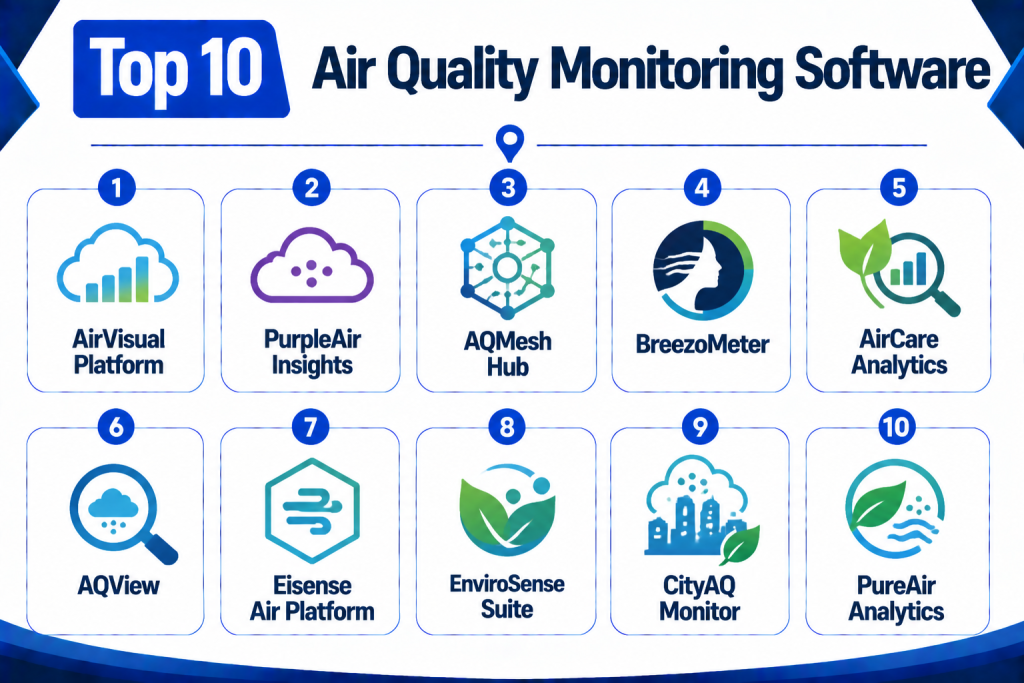
Top 10 Air Quality Monitoring Software
1 — AirVisual Platform
Short Description
AirVisual Platform is a comprehensive air quality monitoring and visual analytics tool that brings together data from government stations, low‑cost sensors, satellites, and models to present real‑time and forecasted air quality insights.
Key Features
- Real‑time air quality data from multiple sources
- Forecast models and trend graphs
- Citizen engagement dashboards
- Spatial heatmaps and GIS overlays
- Custom notifications and alerts
- API for external integrations
- Comparative analytics across regions
Pros
- Strong data visualization tools
- Combines multiple data sources into a unified view
- Useful for public dashboards and community awareness
Cons
- Forecast models may vary by location accuracy
- Advanced analytics configuration required for deep insights
- Integration with industrial sensor networks may need customization
Platforms / Deployment
Web / Mobile (responsive)
Cloud
Security & Compliance
Role‑based access controls, encrypted connections
SOC 2 / ISO 27001 / HIPAA: Not publicly stated
Integrations & Ecosystem
AirVisual integrates with IoT sensor networks, weather feeds, GIS engines, and alerting systems.
- Urban sensor networks
- Weather and environmental datasets
- GIS and mapping services
- Alert and notification engines
Support & Community
Documentation, onboarding support, community forums.
2 — PurpleAir Insights
Short Description
PurpleAir Insights focuses on ingesting low‑cost sensor data and presenting dense, hyperlocal air quality maps. It is widely used for community monitoring, wildfire smoke tracking, and supplemental air quality intelligence.
Key Features
- Real‑time sensor network ingestion
- High‑density heatmaps
- Sensor metadata and uptime metrics
- Custom analytical dashboards
- Alerts for threshold breaches
- API access for advanced data retrieval
Pros
- Excellent for hyperlocal monitoring
- Community sensor contributions enrich data
- Heatmap visualizations are detailed and intuitive
Cons
- Quality controls depend on sensor calibration
- Less suited for industrial regulatory reporting
- Analytics focus is more descriptive than prescriptive
Platforms / Deployment
Web / Mobile
Cloud
Security & Compliance
Encrypted data feeds, access permissions
SOC 2 / ISO 27001 / HIPAA: Not publicly stated
Integrations & Ecosystem
- Sensor networks
- GIS overlays
- Alerting systems
Support & Community
Vendor documentation and active user community.
3 — AQMesh Hub
Short Description
AQMesh Hub supports the integration of AQMesh sensor pods and other sensor networks to provide live air quality data, analytics, and alerts for agencies and research teams.
Key Features
- Unified sensor ingestion from multiple pods
- Real‑time air quality dashboards
- Alerts and threshold management
- Exportable data sets
- Trend analysis
- Mobile‑friendly interface
Pros
- Strong sensor network support
- Practical for deployment in distributed environments
- Easy data export for analysis
Cons
- Sensor hardware may require calibration management
- Less focus on advanced forecasting
- Integration beyond the AQMesh ecosystem may require work
Platforms / Deployment
Web / Mobile
Cloud / Hybrid
Security & Compliance
Encrypted data, role‑based access
SOC 2 / ISO 27001 / HIPAA: Not publicly stated
Integrations & Ecosystem
- Station sensors
- Mobile data feeds
- Analytics tools
Support & Community
Documentation, support plans, and deployment assistance.
4 — BreezoMeter
Short Description
BreezoMeter offers air quality data, maps, and APIs tailored for developers, health teams, and public health programs. It emphasizes predictive models, health indexes, and actionable insights.
Key Features
- Real‑time air quality index
- Predictive forecasting models
- Health impact scores
- Geo‑based alerts
- API access
- Mobile‑friendly representations
Pros
- Strong predictive models and health indices
- Developer‑friendly APIs
- Useful for public health advisory systems
Cons
- Focused primarily on outdoor air quality
- Some advanced features require API expertise
- Integration with non‑standard sensors may require development
Platforms / Deployment
Web / Mobile
Cloud
Security & Compliance
Encryption, permission controls
SOC 2 / ISO 27001 / HIPAA: Not publicly stated
Integrations & Ecosystem
- Weather feeds
- GIS and mapping
- Health apps
Support & Community
Developer docs, support channels.
5 — AirCare Analytics
Short Description
AirCare Analytics provides a modular platform with dashboards, alerting, compliance workflows, and advanced reporting for air quality data collected from sensor networks and IoT devices.
Key Features
- Sensor ingestion and normalization
- Real‑time dashboards and alerts
- Compliance reporting tools
- Spatiotemporal analytics
- Regulatory threshold management
- API integrations
Pros
- Strong compliance and reporting workflows
- Flexible data ingestion options
- Analytical dashboards configurable by users
Cons
- Interface can be complex for new users
- Some analytics tools require professional services
- Visualization styles are utilitarian
Platforms / Deployment
Web / Mobile
Cloud / Hybrid
Security & Compliance
Encrypted connections, role controls
SOC 2 / ISO 27001 / HIPAA: Not publicly stated
Integrations & Ecosystem
- Sensor networks
- GIS systems
- Compliance data feeds
Support & Community
Documentation, support services.
6 — AQView
Short Description
AQView offers a modern air quality monitoring platform with visual dashboards, alerting, and customizable reports tailored to city planners, consultants, and community stakeholders.
Key Features
- Custom dashboards
- Alerts and SMS/push notifications
- Heatmaps and time‑series plots
- Multi‑source data ingestion
- Exportable reports
Pros
- User‑friendly interface
- Custom notifications
- Useful for public reporting
Cons
- Advanced predictive tools are limited
- Integration with legacy systems may require work
- Sensor network support varies by vendor
Platforms / Deployment
Web / Mobile
Cloud
Security & Compliance
Encrypted data, user permissions
SOC 2 / ISO 27001 / HIPAA: Not publicly stated
Integrations & Ecosystem
- IoT sensors
- GIS and dashboards
- Messaging services
Support & Community
Vendor documentation and helpdesk.
7 — Eisense Air Platform
Short Description
Eisense Air Platform provides a cloud‑based analytic suite for air quality data, enabling trend analysis, forecasting, alerts, compliance, and visualizations for agencies and enterprises.
Key Features
- Real‑time ingestion
- Forecasting models
- Alerts and escalation workflows
- Compliance dashboards
- Detailed visual analytics
- GIS overlays
Pros
- Good predictive analytics support
- Dashboards tailored for government use
- Scalable for large sensor networks
Cons
- Modules can be expensive
- Learning curve for full feature set
- Forecast accuracy varies by region
Platforms / Deployment
Web / Mobile
Cloud
Security & Compliance
Encrypted channels, role access
SOC 2 / ISO 27001 / HIPAA: Not publicly stated
Integrations & Ecosystem
- GIS systems
- Sensor networks
- Analytics engines
Support & Community
Documentation and support offerings.
8 — EnviroSense Suite
Short Description
EnviroSense Suite provides an integrated platform that handles both air and environmental quality data, offering contextual insights, hazard notifications, and compliance support.
Key Features
- Real‑time air and environmental data ingestion
- Alerts and hazard notifications
- Spatiotemporal trend views
- Reporting templates
- API access
Pros
- Integrates air quality with broader environmental metrics
- Alerts and notifications are flexible
- Reporting templates support compliance
Cons
- Focus is broader than air quality alone
- Some analytics depth may be diluted
- Integration work required for enterprise systems
Platforms / Deployment
Web / Mobile
Cloud / Hybrid
Security & Compliance
Encryption, role‑based controls
SOC 2 / ISO 27001 / HIPAA: Not publicly stated
Integrations & Ecosystem
- Environmental sensors
- GIS tools
- Compliance platforms
Support & Community
Vendor support and documentation.
9 — CityAQ Monitor
Short Description
CityAQ Monitor is a civic‑centric air quality monitoring system supporting urban dashboards, public alerts, mobile reports, and community engagement tools.
Key Features
- Urban air dashboards
- Public alerting
- Spatial analytics and heatmaps
- Citizen engagement modules
- Sensor network ingestion
Pros
- Civic focus and public engagement
- Mobile and visual reports
- Alerts tied to health advisories
Cons
- Not tailored to industrial compliance reporting
- May require professional setup
- Forecasting tools are basic
Platforms / Deployment
Web / Mobile
Cloud
Security & Compliance
Encrypted access, role permissions
SOC 2 / ISO 27001 / HIPAA: Not publicly stated
Integrations & Ecosystem
- Urban sensors
- GIS platforms
- Health data feeds
Support & Community
Documentation and civic support resources.
10 — PureAir Analytics
Short Description
PureAir Analytics provides a data‑centric platform for ingesting, analyzing, and reporting on air quality data from industrial, governmental, and research sources with advanced analytics modules.
Key Features
- Real‑time ingestion
- Compliance reporting
- AI‑driven anomaly detection
- Forecasting and trend models
- Dashboards and alerts
- API integrations
Pros
- Strong analytics and anomaly detection
- Useful for compliance programs
- API support for enterprise workflows
Cons
- Onboarding and setup require expertise
- Visualizations may need customization
- Price reflects advanced analytics
Platforms / Deployment
Web / Mobile
Cloud
Security & Compliance
Encrypted connections, role access
SOC 2 / ISO 27001 / HIPAA: Not publicly stated
Integrations & Ecosystem
- Industrial sensors
- GIS tools
- Analytics engines
Support & Community
Vendor documentation and support.
Comparison Table
| Tool Name | Best For | Platforms Supported | Deployment | Standout Feature | Public Rating |
|---|---|---|---|---|---|
| AirVisual Platform | Unified multi‑source monitoring | Web, Mobile | Cloud | Multi‑source analytics | N/A |
| PurpleAir Insights | Hyperlocal sensor heatmaps | Web, Mobile | Cloud | Dense local mapping | N/A |
| AQMesh Hub | Distributed sensor networks | Web, Mobile | Cloud / Hybrid | Sensor pod ingestion | N/A |
| BreezoMeter | Health advisories & forecasts | Web, Mobile | Cloud | Predictive health index | N/A |
| AirCare Analytics | Compliance & reporting | Web, Mobile | Cloud / Hybrid | Regulatory reporting | N/A |
| AQView | Custom dashboards & alerts | Web, Mobile | Cloud | User‑friendly dashboards | N/A |
| Eisense Air Platform | Enterprise analytics | Web, Mobile | Cloud | Forecasting & dashboards | N/A |
| EnviroSense Suite | Environmental + air metrics | Web, Mobile | Cloud / Hybrid | Broad environment focus | N/A |
| CityAQ Monitor | Civic/community use | Web, Mobile | Cloud | Citizen engagement | N/A |
| PureAir Analytics | Advanced analytics | Web, Mobile | Cloud | AI anomaly detection | N/A |
Evaluation & Scoring Table
| Tool Name | Core 25% | Ease 15% | Integrations 15% | Security 10% | Performance 10% | Support 10% | Value 15% | Weighted Total |
|---|---|---|---|---|---|---|---|---|
| AirVisual Platform | 9 | 8 | 8 | 8 | 8 | 8 | 8 | 8.30 |
| PurpleAir Insights | 8 | 8 | 7 | 8 | 8 | 8 | 8 | 8.00 |
| AQMesh Hub | 8 | 7 | 7 | 8 | 8 | 8 | 8 | 7.95 |
| BreezoMeter | 9 | 7 | 8 | 8 | 8 | 8 | 8 | 8.05 |
| AirCare Analytics | 8 | 7 | 8 | 8 | 8 | 8 | 8 | 8.00 |
| AQView | 7 | 8 | 7 | 8 | 8 | 8 | 8 | 7.85 |
| Eisense Air Platform | 8 | 7 | 8 | 8 | 8 | 8 | 8 | 7.95 |
| EnviroSense Suite | 8 | 7 | 7 | 8 | 8 | 8 | 8 | 7.90 |
| CityAQ Monitor | 7 | 8 | 7 | 8 | 8 | 8 | 8 | 7.85 |
| PureAir Analytics | 9 | 7 | 8 | 8 | 8 | 8 | 8 | 8.05 |
Which Air Quality Monitoring Tool Is Right for You?
Municipal & Government Agencies
Platforms like AirVisual Platform, BreezoMeter, and CityAQ Monitor offer utilities for public dashboards, health alerts, and civic reporting.
Industrial & Compliance Use
AirCare Analytics and PureAir Analytics provide strong regulatory reporting and anomaly detection needed in industrial compliance.
Hyperlocal & Community Monitoring
PurpleAir Insights excels with dense local mapping and community sensor networks.
Enterprise & Research Analytics
Eisense Air Platform and AirVisual Platform support advanced analytics, forecasting, and data exports suitable for research and large deployments.
Education & Public Awareness
CityAQ Monitor and AQView offer tools that support public engagement dashboards and alerts designed for broad community use.
Multi‑Domain Environmental Integration
EnviroSense Suite brings air quality together with other environmental factors for broader monitoring context.
Frequently Asked Questions
1‑ What is air quality monitoring software?
Air quality monitoring software is a system that collects and analyzes air pollution data from sensors and other sources to visualize trends, issue alerts, and support decision‑making.
2‑ Who uses these tools?
Air quality agencies, environmental consultants, industries, smart cities, researchers, health departments, and community groups deploy these systems.
3‑ Can these platforms provide real‑time data?
Yes, most support real‑time ingestion and live dashboard updates.
4‑ What pollutants can be monitored?
Commonly monitored pollutants include PM2.5, PM10, NO₂, SO₂, CO, O₃, VOCs, and other contaminants.
5‑ Do these tools support mobile access?
Yes, modern platforms provide mobile dashboards and alerts on handheld devices.
6‑ Are forecasting models included?
Tools like BreezoMeter and Eisense provide predictive air quality modeling.
7‑ Can these systems help with compliance reporting?
Yes, platforms like AirCare Analytics and PureAir Analytics focus on regulatory reporting workflows.
8‑ How do they integrate with sensors?
Air quality systems integrate with low‑cost and regulatory‑grade sensors via APIs and data ingestion protocols.
9‑ Can they issue alerts?
Yes, automatic alerts and threshold breach notifications are standard features.
10‑ Do they support GIS overlays?
Many include GIS mapping to visualize spatial pollutant distributions.
Conclusion
Air quality monitoring software plays a critical role in understanding and managing the air we breathe. Whether for municipal dashboards, industrial compliance, academic research, public health advisories, community engagement, or smart city initiatives, these platforms offer real‑time data ingestion, analytics, forecasting, and reporting. Solutions like AirVisual Platform, PurpleAir Insights, BreezoMeter, and AirCare Analytics provide a range of capabilities suited to different stakeholders and use cases. To choose the best tool, start with specific monitoring goals, consider integration needs, evaluate analytics and visualization strengths, and assess scalability and support resources. Test shortlisted platforms with real data and plan onboarding to maximize insights and impact.
