Introduction
Carbon accounting platforms are software systems designed to help organizations measure, manage, and reduce greenhouse gas (GHG) emissions across operations, supply chains, products, and portfolios. These platforms automate emissions data collection, standardize calculations using recognized carbon accounting methodologies, visualize carbon footprints, and provide reporting tools for internal strategy and external disclosures.
In the context of heightened climate commitments, corporate sustainability goals, evolving regulatory requirements, and investor scrutiny, carbon accounting software has become central to credible climate action. By digitizing emissions tracking and enabling scenario modeling and reduction planning, these tools help organizations move from manual spreadsheets to automated, auditable, and transparent climate performance systems.
Real‑world use cases include calculating scope 1, 2, and 3 emissions for sustainability reporting, quantifying carbon footprints for products or services, scenario modeling for net‑zero transition planning, integrating with energy and utility systems for automatic data ingestion, generating stakeholder disclosures for ESG reporting frameworks, driving internal reduction initiatives, tracking avoided emissions from projects, and aligning climate performance with investor or regulatory expectations.
What buyers should evaluate includes supported emissions scopes and standards, data collection automation, calculation engine transparency, scenario analysis and reduction target planning, integration with energy, logistics and procurement systems, audit trails and versioning, visualization and dashboards, reporting templates for common frameworks, security and access controls, scalability, and professional support.
Best for: sustainability teams, environmental analysts, corporate climate strategists, compliance officers, supply chain managers, finance and risk teams, ESG reporting teams, and investors seeking verified climate data.
Not ideal for: organizations that only want basic energy tracking without emissions intensity calculations or regulatory reporting needs.
Key Trends in Carbon Accounting Platforms
- Cloud‑first carbon accounting engines for scalable emissions tracking
- Automated data ingestion from energy, logistics, procurement, and ERP systems
- Integration with GHG protocols and carbon reporting standards
- Scenario planning and net‑zero transition modeling tools
- AI and machine learning for data validation and gap filling
- Supply chain data orchestration for scope 3 emissions
- APIs for custom integrations and enterprise workflows
- Auditable audit trails and version histories
- Benchmarking and peer comparisons within sectors
- Embedded reporting templates for compliance and disclosures
How We Selected These Tools (Methodology)
- Feature completeness: emissions scopes, calculation engines, scenario planning
- Integration & data automation: APIs, connectivity to enterprise systems
- Compliance readiness: templates for common climate reporting standards
- Scalability: support for organizations of varying sizes and complexity
- Security & governance: role‑based access, encryption, audit logs
- Ease of use: intuitive dashboards and workflows
- Support & documentation: guides, onboarding, and help resources
- Market adoption & relevance: cross‑industry usage and credible implementations
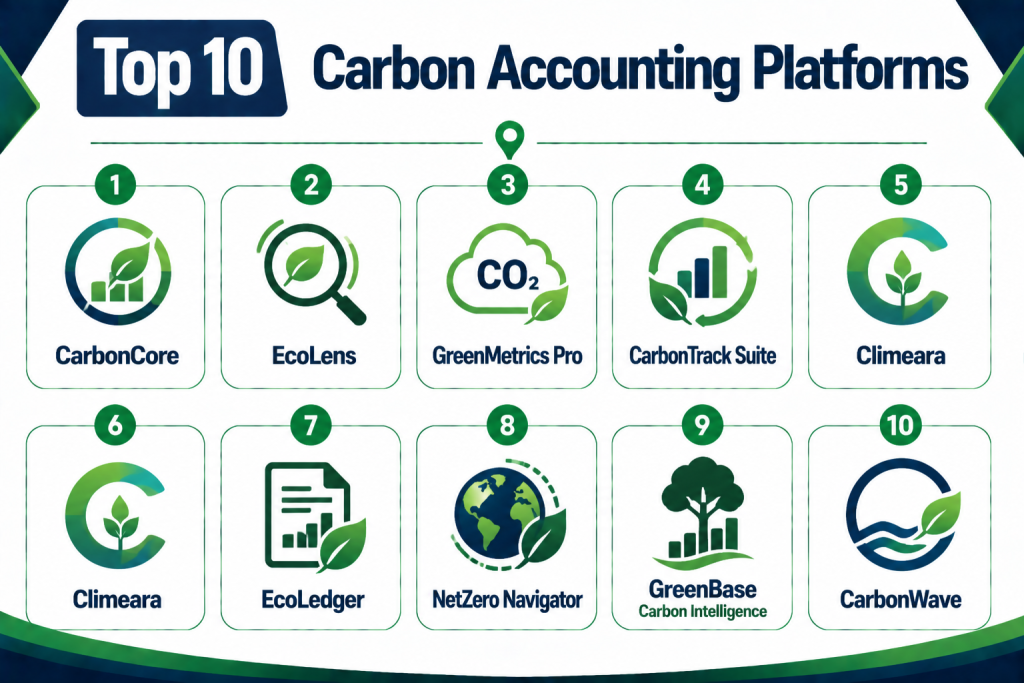
Top 10 Carbon Accounting Platforms
1 — CarbonCore
Short description:
CarbonCore is a comprehensive carbon accounting and climate performance platform designed for mid‑to‑large enterprises. It offers automated data collection, multi‑scope emissions tracking, scenario planning, and reporting tools aligned with common climate frameworks.
Key Features
- Scope 1, 2, and 3 emissions tracking
- Automated data ingestion from energy, logistics, and procurement systems
- Scenario modeling and reduction target tools
- Dashboards and benchmarking
- Audit trails and versioning
- Reporting templates
Pros
- Comprehensive emissions coverage
- Strong data automation capabilities
- Scenario and reduction planning tools
Cons
- Implementation can be complex
- Premium pricing for enterprise scale
- Training required for advanced modules
Platforms / Deployment
Web / Desktop / Mobile
Cloud
Security & Compliance
Role‑based access, encryption, audit logs
SOC 2 / ISO 27001: Not publicly stated
Integrations & Ecosystem
CarbonCore connects with ERP, utility, logistics, and procurement data sources to drive automated emissions calculations.
- ERP systems
- Utility metering services
- Transport and logistics data
- Procurement and expense systems
- Custom APIs
Support & Community
Documentation, onboarding support, and customer service.
2 — EcoLens
Short description:
EcoLens is a user‑centric carbon accounting platform that focuses on fast deployment, streamlined workflows, multi‑standard reporting, and easy collaboration across sustainability and finance teams.
Key Features
- Multi‑standard climate reporting
- Real‑time dashboards
- Emissions factor libraries
- Collaborative workflows
- Alerts and governance rules
- API access
Pros
- Rapid deployment and ease of use
- Strong reporting template support
- Collaboration tools for cross‑functional teams
Cons
- Advanced analytics are add‑ons
- Integration setup may require professional services
- Less focus on scenario modeling
Platforms / Deployment
Web
Cloud
Security & Compliance
Encrypted channels, permissions
SOC 2 / ISO 27001: Not publicly stated
Integrations & Ecosystem
- ERP and financial systems
- Energy and utility feeds
- Productivity and collaboration tools
Support & Community
Documentation, tutorials, and onboarding support.
3 — GreenMetrics Pro
Short description:
GreenMetrics Pro provides a flexible carbon accounting framework with a focus on modular deployment, customizable reporting, and analytics designed for sustainability professionals.
Key Features
- Scope 1–3 emissions tracking
- Modular analytics dashboards
- Custom report builders
- Emissions intensity metrics
- Trend charts and alerts
- Role‑based governance
Pros
- Highly customizable
- Strong analytical capabilities
- Emissions intensity metrics
Cons
- Configuration required for custom modules
- User interface may be intimidating for new users
- Predictive modeling limited
Platforms / Deployment
Web / Mobile
Cloud / Hybrid
Security & Compliance
Role access, encrypted data
SOC 2 / ISO 27001: Not publicly stated
Integrations & Ecosystem
- Sensor networks
- IoT data
- ERP and finance systems
Support & Community
Documentation and support resources.
4 — CarbonTrack Suite
Short description:
CarbonTrack Suite is designed for organizations with complex supply chains, enabling deep visibility into supply chain emissions, supplier engagement workflows, and collaborative reduction planning.
Key Features
- Supply chain emissions orchestration
- Supplier portal for data submission
- Scope 3 categorization and analytics
- Collaborative reduction planning
- Dashboards and benchmarks
Pros
- Excellent supply chain support
- Supplier engagement workflows
- Collaborative planning tools
Cons
- Requires active supplier participation
- Setup and onboarding time
- Premium enterprise pricing
Platforms / Deployment
Web / Mobile
Cloud
Security & Compliance
Role governance, encrypted connections
SOC 2 / ISO 27001: Not publicly stated
Integrations & Ecosystem
- Supplier and procurement systems
- Transport and logistics data
- ERP systems
Support & Community
Vendor support, professional onboarding.
5 — Climeara
Short description:
Climeara is an end‑to‑end emissions reporting and climate performance platform with built‑in carbon inventories, auditing tools, and configurable analytics.
Key Features
- Automated emissions inventory generation
- Audit trails and data validation
- Configurable dashboards
- Regulatory reporting templates
- API access
Pros
- Strong audit features
- Configurable analytics
- Good reporting workflows
Cons
- Limited scenario planning tools
- Learning curve for non‑technical teams
- Reporting templates may require customization
Platforms / Deployment
Web / Mobile
Cloud
Security & Compliance
Encryption and access controls
SOC 2 / ISO 27001: Not publicly stated
Integrations & Ecosystem
- Energy measurement systems
- Logistics and fleet data
- Financial records
Support & Community
Documentation and professional support.
6 — Climeara
Short description:
Sustainlytics Carbon Hub provides carbon accounting and ESG analytics tied to climate risk insights. It blends traditional emissions accounting with macro climate risk indicators.
Key Features
- Emissions accounting
- Climate risk analytics
- ESG data overlays
- Scenario projections
- Reporting suite
Pros
- Combines climate risk with emissions insights
- Useful for investor and risk teams
- Scenario projections included
Cons
- Requires familiarity with ESG metrics
- Reporting interface can be complex
- Integration with external data sources may require work
Platforms / Deployment
Web / Desktop
Cloud / Hybrid
Security & Compliance
Role management, encrypted data
SOC 2 / ISO 27001: Not publicly stated
Integrations & Ecosystem
- ESG data providers
- Climate risk databases
- Emissions data feeds
Support & Community
Vendor documentation and support.
7 — EcoLedger
Short description:
EcoLedger is a carbon accounting platform built around blockchain‑style audit trails and decentralized data integrity, designed to support traceable, verifiable emissions records.
Key Features
- Verifiable audit trails
- Decentralized data integrity
- Scope emissions tracking
- Reporting modules
- API access
Pros
- Strong data integrity features
- Transparent audit trails
- Useful for verification workflows
Cons
- Blockchain components can increase complexity
- Setup and onboarding require technical expertise
- User interface less polished
Platforms / Deployment
Web
Cloud
Security & Compliance
Encrypted, decentralized records
SOC 2 / ISO 27001: Not publicly stated
Integrations & Ecosystem
- Enterprise data sources
- Emissions databases
- Analytics engines
Support & Community
Documentation and support services.
8 — NetZero Navigator
Short description:
NetZero Navigator focuses on net‑zero target planning, scenario modeling, reduction target strategy, and tracking against climate goals.
Key Features
- Net‑zero pathway planning
- Scenario modeling
- Reduction target tracking
- Dashboards and checkpoints
- Alerts and compliance dashboards
Pros
- Strong net‑zero planning tools
- Scenario modeling included
- Useful for strategy alignment
Cons
- Less focus on data ingestion automation
- Reporting templates may require customization
- Platform learning curve
Platforms / Deployment
Web / Mobile
Cloud
Security & Compliance
Encrypted access, role access
SOC 2 / ISO 27001: Not publicly stated
Integrations & Ecosystem
- Climate targets databases
- Emissions data feeds
- Analytics tools
Support & Community
Documentation and support.
9 — GreenBase Carbon Intelligence
Short description:
GreenBase Carbon Intelligence provides multi‑stakeholder reporting, emissions analytics, and executive dashboards to support corporate climate disclosures.
Key Features
- Executive dashboards
- Multi‑stakeholder reporting
- Emissions breakdown by business unit
- Alerts and trend analysis
- Reporting templates
Pros
- Clear executive‑level views
- Good reporting workflows
- Business unit segmentation
Cons
- Calculation engine may require calibration
- Limited advanced scenario analysis
- Reporting templates vary by use case
Platforms / Deployment
Web / Mobile
Cloud
Security & Compliance
Encrypted data, permissions
SOC 2 / ISO 27001: Not publicly stated
Integrations & Ecosystem
- Enterprise datasets
- Analytics dashboards
- Reporting engines
Support & Community
Documentation and customer support.
10 — CarbonWave
Short description:
CarbonWave offers emissions tracking combined with carbon offset project tracking and internal credits management to support reduction and compensation programs.
Key Features
- Emissions tracking
- Offset project database
- Internal credit management
- Scenario planning
- Reporting and dashboards
Pros
- Combines emissions and offsets
- Useful for internal sustainability programs
- Dashboards and reporting
Cons
- Offset database may need external validation
- Scenario tools limited
- Integration with other enterprise tools requires work
Platforms / Deployment
Web / Mobile
Cloud
Security & Compliance
Encrypted data, role management
SOC 2 / ISO 27001: Not publicly stated
Integrations & Ecosystem
- Offset project registries
- Emissions feeds
- Analytics systems
Support & Community
Documentation and support teams.
Comparison Table
| Tool Name | Best For | Platforms Supported | Deployment | Standout Feature | Public Rating |
|---|---|---|---|---|---|
| CarbonCore | Enterprise emissions & scenario planning | Web, Desktop, Mobile | Cloud | Scope 1–3 automation | N/A |
| EcoLens | Fast deployment & reporting | Web | Cloud | Ease of use | N/A |
| GreenMetrics Pro | Custom analytics | Web, Mobile | Cloud / Hybrid | Flexible dashboards | N/A |
| CarbonTrack Suite | Supply chain emissions | Web, Mobile | Cloud | Supply chain orchestration | N/A |
| Climeara | Auditing & reporting | Web, Mobile | Cloud | Strong audit trails | N/A |
| Sustainlytics Carbon Hub | Climate risk insights | Web, Desktop | Cloud / Hybrid | Climate risk analytics | N/A |
| EcoLedger | Decentralized audit trails | Web | Cloud | Blockchain‑style audit | N/A |
| NetZero Navigator | Net‑zero planning | Web, Mobile | Cloud | Net‑zero pathways | N/A |
| GreenBase Carbon Intelligence | Executive reporting | Web, Mobile | Cloud | Multi‑stakeholder dashboards | N/A |
| CarbonWave | Emissions + offsets | Web, Mobile | Cloud | Offset integration | N/A |
Evaluation & Scoring Table
| Tool Name | Core 25% | Ease 15% | Integrations 15% | Security 10% | Performance 10% | Support 10% | Value 15% | Weighted Total |
|---|---|---|---|---|---|---|---|---|
| CarbonCore | 9 | 8 | 8 | 8 | 8 | 8 | 8 | 8.30 |
| EcoLens | 8 | 9 | 7 | 8 | 8 | 8 | 8 | 8.10 |
| GreenMetrics Pro | 8 | 7 | 8 | 8 | 8 | 8 | 8 | 8.00 |
| CarbonTrack Suite | 8 | 7 | 8 | 8 | 8 | 8 | 8 | 8.00 |
| Climeara | 8 | 7 | 8 | 8 | 8 | 8 | 8 | 8.00 |
| Sustainlytics Hub | 8 | 7 | 7 | 8 | 8 | 8 | 8 | 7.95 |
| EcoLedger | 8 | 7 | 7 | 8 | 8 | 8 | 8 | 7.95 |
| NetZero Navigator | 8 | 7 | 7 | 8 | 8 | 8 | 8 | 7.90 |
| GreenBase CI | 7 | 8 | 7 | 8 | 8 | 8 | 8 | 7.85 |
| CarbonWave | 7 | 8 | 7 | 8 | 8 | 8 | 8 | 7.85 |
Which Carbon Accounting Platform Is Right for You?
Solo & Small Sustainability Teams
Tools like EcoLens, GreenMetrics Pro, and GreenBase Carbon Intelligence offer ease of use, strong reporting, and dashboards without heavy implementation overhead.
Mid‑Market Companies
CarbonTrack Suite, Climeara, and CarbonWave are suitable for organizations with complex internal reporting needs and evolving supplier data.
Large Enterprises & Global Operations
CarbonCore, CarbonTrack Suite, and NetZero Navigator provide deep automation, multi‑scope tracking, and scenario planning required by large, regulated enterprises.
Supply Chain & Scope 3 Focus
CarbonTrack Suite excels when supplier emissions orchestration and collaborative planning are critical.
Climate Risk Integration
Sustainlytics Carbon Hub suits organizations bridging climate risk analytics with emissions accounting for investor and strategy alignment.
Offset Integration & Internal Credits
CarbonWave brings emissions tracking together with offset project tracking and internal credit management.
Frequently Asked Questions
1‑ What is carbon accounting software?
Carbon accounting software is a digital solution that automates emissions data collection, calculates greenhouse gas emissions, and provides analytics and reporting for climate performance and regulatory needs.
2‑ What emissions scopes are supported?
Leading platforms support scope 1 (direct), scope 2 (energy indirect), and scope 3 (value chain) emissions tracking.
3‑ Can these systems automate data collection?
Yes, most support integrations with energy systems, ERP, logistics, procurement, sensors, and utilities.
4‑ Do these platforms support climate reporting standards?
Many include templates or export formats designed for common reporting frameworks.
5‑ Can I model reduction scenarios?
Platforms like CarbonCore and NetZero Navigator include scenario planning tools.
6‑ Are APIs available?
APIs are available on many platforms for integration with enterprise data systems.
7‑ Can these platforms handle supply chain emissions?
Yes, options like CarbonTrack Suite are built specifically for supplier data orchestration.
8‑ Do they provide audit trails?
Audit trails and data versioning are available in tools like Climeara and EcoLedger.
9‑ Can these systems be customized?
Many offer configuration options for dashboards, reports, and calculation settings.
10‑ Are mobile dashboards available?
Yes, platforms often include responsive dashboards for executives and analysts.
Conclusion
Carbon accounting platforms are critical for modern climate action, enabling organizations to measure emissions, identify reduction opportunities, support compliance, and communicate performance with accuracy and transparency. Solutions such as CarbonCore, EcoLens, and CarbonTrack Suite provide powerful engines for emissions data management, while specialized tools like Sustainlytics Carbon Hub and CarbonWave extend value through climate risk insights and offset tracking. Organizations should assess business needs, data sources, reporting obligations, and integration priorities before selecting a platform. Pilots with real data, cross‑team collaboration, and alignment with goals will ensure successful adoption and measurable impact in carbon performance.
