Introduction
Grid Operations EMS/DMS Software enables utilities and energy operators to monitor, control, and optimize electrical distribution and transmission networks. These platforms streamline real-time operations, manage data from smart devices, and improve decision-making efficiency across complex grids. In and beyond, digital transformation, renewable integration, and AI-powered analytics are making EMS/DMS critical for modern grid reliability and sustainability.
Real-world use cases include:
- Monitoring and controlling substation operations for improved reliability.
- Automated fault detection and response in transmission networks.
- Integration of distributed energy resources (DERs) and renewable energy sources.
- Predictive maintenance for critical grid assets.
- Data-driven load forecasting and energy optimization.
What buyers should evaluate:
- Core EMS/DMS functionalities and automation capabilities.
- Scalability to accommodate smart grid expansion.
- AI/ML analytics and predictive features.
- Real-time monitoring and alerting performance.
- Integration with SCADA, IoT devices, and DERs.
- Security protocols and compliance (e.g., NERC CIP, ISO 27001).
- Ease of deployment (cloud, on-prem, hybrid).
- Vendor support and community ecosystem.
Best for: Utility operators, energy providers, microgrid managers, and large-scale industrial energy users seeking real-time control, predictive insights, and grid optimization.
Not ideal for: Small facilities or organizations without complex grid infrastructure, where simpler monitoring or third-party cloud energy management tools suffice.
Key Trends in Grid Operations EMS/DMS Software
- AI and ML integration for predictive maintenance and demand forecasting.
- Edge computing adoption for faster, decentralized data processing.
- Renewable energy orchestration for solar, wind, and battery storage integration.
- Enhanced cybersecurity protocols to protect critical infrastructure.
- Cloud-based deployments increasing flexibility and scalability.
- Interoperability standards enabling better integration with legacy systems.
- Digital twins for simulation and operational planning.
- Regulatory compliance automation with built-in reporting.
- IoT device integration for real-time monitoring.
- Advanced visualization dashboards for operator efficiency.
How We Selected These Tools (Methodology)
- Market adoption and utility sector mindshare.
- Comprehensive feature sets covering EMS and DMS requirements.
- Proven reliability and operational performance signals.
- Security posture assessment including encryption and access control.
- Integration and ecosystem maturity with SCADA, IoT, and analytics platforms.
- Fit across organizational segments: small grids, mid-market, large utilities.
- Vendor support quality, documentation, and training resources.
- Innovation in predictive analytics, AI, and smart grid readiness.
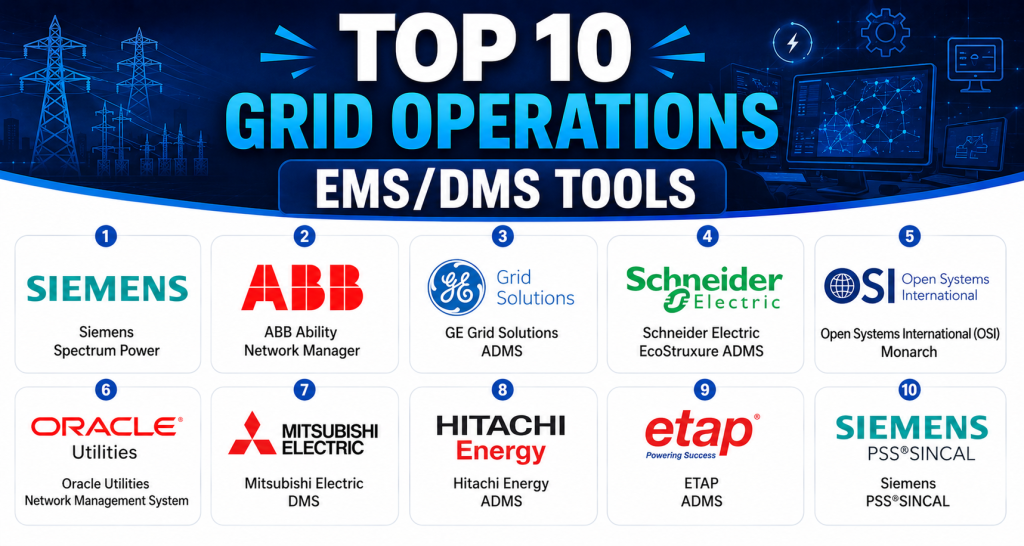
Top 10 Grid Operations EMS/DMS Tools
1- Siemens Spectrum Power
Short description: Siemens Spectrum Power provides utilities with a complete EMS/DMS solution to monitor, control, and optimize energy distribution. It targets large utility operators and industrial-scale grids.
Key Features
- Real-time energy management dashboards.
- Fault detection and automated response.
- Load balancing and optimization.
- DER integration and control.
- Predictive analytics for maintenance.
Pros
- Highly scalable for large grids.
- Extensive integration with SCADA and smart devices.
Cons
- Complex implementation requiring specialized expertise.
- High cost for smaller utilities.
Platforms / Deployment
- Windows / Linux
- Hybrid
Security & Compliance
- SSO/SAML, encryption, RBAC
- Not publicly stated
Integrations & Ecosystem
Spectrum Power integrates with SCADA systems, IoT sensors, and renewable energy management platforms.
- APIs for custom applications
- DER management
- Predictive maintenance tools
Support & Community
- Vendor support with training programs.
- Active utility-focused user community.
2- ABB Ability Network Manager
Short description: ABB Ability Network Manager offers robust EMS/DMS functionalities for transmission and distribution grids, emphasizing automation and operational intelligence.
Key Features
- Advanced real-time grid monitoring.
- Contingency analysis and fault location.
- Integration with renewable energy sources.
- Energy forecasting and optimization.
- Visualization and reporting tools.
Pros
- Strong predictive analytics.
- Reliable integration with legacy systems.
Cons
- Implementation can be time-consuming.
- Requires ongoing vendor support.
Platforms / Deployment
- Windows / Linux
- Cloud / On-prem
Security & Compliance
- Encryption, audit logs
- Not publicly stated
Integrations & Ecosystem
- SCADA interfaces
- DER and smart meter integration
- API for third-party analytics
Support & Community
- Extensive documentation
- Vendor-led support and community forums
3- GE Grid Solutions ADMS
Short description: GE’s ADMS provides utilities with an advanced platform for distribution management, integrating EMS and DMS capabilities with analytics for improved reliability.
Key Features
- Fault detection and restoration.
- Volt/VAR optimization.
- Distributed generation management.
- Predictive maintenance using analytics.
- Mobile and remote monitoring.
Pros
- Comprehensive grid management.
- Advanced automation features.
Cons
- Steep learning curve.
- Deployment cost can be high.
Platforms / Deployment
- Windows / Linux
- On-prem / Hybrid
Security & Compliance
- Not publicly stated
Integrations & Ecosystem
- SCADA, GIS, AMI systems
- DER and IoT integration
- RESTful APIs
Support & Community
- Vendor support
- Training and professional services
4- Schneider Electric EcoStruxure ADMS
Short description: EcoStruxure ADMS helps utilities optimize grid operations with integrated EMS/DMS, analytics, and IoT-enabled management.
Key Features
- Real-time operational dashboards.
- DER orchestration.
- Predictive maintenance analytics.
- Load forecasting.
- Energy optimization.
Pros
- Cloud-ready with hybrid deployment options.
- Strong interoperability.
Cons
- May require extensive configuration.
- Support can be region-specific.
Platforms / Deployment
- Windows / Linux / Web
- Hybrid
Security & Compliance
- Not publicly stated
Integrations & Ecosystem
- IoT sensors
- AMI and SCADA
- Open APIs for extensions
Support & Community
- Vendor support packages
- Knowledge base and community forums
5- Open Systems International (OSI) Monarch
Short description: Monarch EMS/DMS platform delivers advanced control and analytics for utilities with scalable, modular architecture.
Key Features
- Energy management control.
- Real-time fault detection.
- Automation for distribution and transmission.
- Predictive analytics.
- Load and voltage optimization.
Pros
- Modular design allows phased deployment.
- Strong analytics capability.
Cons
- Implementation complexity.
- Smaller vendor community.
Platforms / Deployment
- Windows / Linux
- On-prem / Hybrid
Security & Compliance
- Not publicly stated
Integrations & Ecosystem
- SCADA and DMS integration
- IoT device support
- API connectivity
Support & Community
- Vendor support and training
- Limited online community
6- Oracle Utilities Network Management System
Short description: Oracle’s solution integrates EMS/DMS capabilities with data analytics for operational efficiency and grid reliability.
Key Features
- Automated fault detection.
- Load and voltage management.
- DER and renewable integration.
- Predictive analytics.
- Visualization dashboards.
Pros
- Strong analytics and reporting.
- Scalable for large utilities.
Cons
- Higher cost and complexity.
- Implementation time can be long.
Platforms / Deployment
- Windows / Linux
- Cloud / On-prem
Security & Compliance
- Not publicly stated
Integrations & Ecosystem
- SCADA and AMI integration
- REST APIs
- DER management
Support & Community
- Vendor support
- Documentation and training
7- Mitsubishi Electric DMS
Short description: Mitsubishi Electric’s DMS platform helps distribution operators manage and optimize network performance and reliability.
Key Features
- Real-time monitoring.
- Fault detection and isolation.
- Load and voltage optimization.
- DER integration.
- Predictive maintenance.
Pros
- Reliable performance.
- Strong support for distribution grids.
Cons
- Limited analytics compared to other platforms.
- Regional availability may vary.
Platforms / Deployment
- Windows / Linux
- On-prem / Hybrid
Security & Compliance
- Not publicly stated
Integrations & Ecosystem
- SCADA
- GIS and AMI systems
- API support
Support & Community
- Vendor-led training
- Documentation available
8- Hitachi Energy ADMS
Short description: Hitachi Energy’s ADMS offers comprehensive EMS/DMS features, emphasizing automation, AI analytics, and grid optimization.
Key Features
- Distribution and transmission monitoring.
- DER orchestration.
- Predictive analytics and AI-driven insights.
- Automated fault response.
- Load and voltage management.
Pros
- Strong AI integration.
- Flexible deployment options.
Cons
- Implementation complexity.
- Requires trained personnel.
Platforms / Deployment
- Windows / Linux / Web
- Hybrid
Security & Compliance
- Not publicly stated
Integrations & Ecosystem
- SCADA, GIS, AMI
- API integration
- IoT device connectivity
Support & Community
- Vendor support
- Online knowledge base
9- ETAP ADMS
Short description: ETAP ADMS provides utilities with an integrated solution for real-time monitoring, automation, and predictive analytics in grid management.
Key Features
- Energy management dashboards.
- Fault detection and restoration.
- Volt/VAR optimization.
- Load forecasting.
- DER integration.
Pros
- Intuitive interface.
- Strong simulation and analytics.
Cons
- Smaller user community.
- Training required for complex features.
Platforms / Deployment
- Windows
- On-prem / Hybrid
Security & Compliance
- Not publicly stated
Integrations & Ecosystem
- SCADA and GIS
- API for third-party tools
- IoT sensor support
Support & Community
- Vendor training and documentation
- Technical support available
10- Siemens PSS®SINCAL
Short description: Siemens PSS®SINCAL is a DMS-focused platform supporting grid planning, operations, and optimization for utilities and industrial grids.
Key Features
- Load flow and network analysis.
- Fault location and restoration.
- Distribution planning tools.
- DER and renewable integration.
- Predictive analytics.
Pros
- Strong planning and operational analysis.
- Scalable for industrial and utility networks.
Cons
- Less focused on real-time EMS compared to others.
- Complex configuration.
Platforms / Deployment
- Windows / Linux
- On-prem / Hybrid
Security & Compliance
- Not publicly stated
Integrations & Ecosystem
- SCADA
- GIS and AMI
- API support
Support & Community
- Vendor support
- Documentation and training resources
Comparison Table (Top 10)
| Tool Name | Best For | Platform(s) Supported | Deployment | Standout Feature | Public Rating |
|---|---|---|---|---|---|
| Siemens Spectrum Power | Large utilities | Windows / Linux | Hybrid | Real-time operational control | N/A |
| ABB Ability Network Manager | Transmission & distribution | Windows / Linux | Cloud / On-prem | Advanced predictive analytics | N/A |
| GE Grid Solutions ADMS | Utilities with DERs | Windows / Linux | On-prem / Hybrid | Fault detection & restoration | N/A |
| Schneider EcoStruxure ADMS | Smart grid operators | Windows / Linux / Web | Hybrid | Cloud-ready hybrid deployment | N/A |
| OSI Monarch | Modular grid control | Windows / Linux | On-prem / Hybrid | Modular architecture | N/A |
| Oracle Utilities NMS | Large-scale utilities | Windows / Linux | Cloud / On-prem | Data analytics integration | N/A |
| Mitsubishi Electric DMS | Distribution operators | Windows / Linux | On-prem / Hybrid | Grid reliability focus | N/A |
| Hitachi Energy ADMS | Automation & AI | Windows / Linux / Web | Hybrid | AI-driven grid insights | N/A |
| ETAP ADMS | Real-time monitoring | Windows | On-prem / Hybrid | Simulation & analytics | N/A |
| Siemens PSS®SINCAL | Grid planning | Windows / Linux | On-prem / Hybrid | Planning and network analysis | N/A |
Evaluation & Scoring of Grid Operations EMS/DMS Tools
| Tool Name | Core (25%) | Ease (15%) | Integrations (15%) | Security (10%) | Performance (10%) | Support (10%) | Value (15%) | Weighted Total |
|---|---|---|---|---|---|---|---|---|
| Siemens Spectrum Power | 9 | 7 | 8 | 8 | 9 | 8 | 7 | 8.4 |
| ABB Ability Network Manager | 9 | 8 | 8 | 8 | 9 | 7 | 7 | 8.3 |
| GE Grid Solutions ADMS | 8 | 7 | 7 | 7 | 8 | 7 | 7 | 7.6 |
| Schneider EcoStruxure ADMS | 8 | 8 | 8 | 7 | 8 | 7 | 7 | 7.8 |
| OSI Monarch | 7 | 7 | 7 | 7 | 7 | 6 | 7 | 7.1 |
| Oracle Utilities NMS | 8 | 7 | 7 | 7 | 8 | 7 | 7 | 7.6 |
| Mitsubishi Electric DMS | 7 | 8 | 6 | 6 | 7 | 6 | 7 | 6.8 |
| Hitachi Energy ADMS | 8 | 7 | 7 | 7 | 8 | 7 | 7 | 7.6 |
| ETAP ADMS | 7 | 8 | 6 | 6 | 7 | 6 | 6 | 6.7 |
| Siemens PSS®SINCAL | 7 | 7 | 7 | 6 | 7 | 6 | 7 | 6.9 |
Interpretation: Scores are comparative; higher totals indicate broader feature coverage, ease, integration maturity, security, performance, support, and value. Organizations should weigh the factors most relevant to their operational context.
Which Grid Operations EMS/DMS Tool Is Right for You?
Solo / Freelancer
Not typically applicable; simpler tools or cloud-based monitoring services are more appropriate.
SMB
Mitsubishi Electric DMS, ETAP ADMS: manageable complexity and cost-effective for mid-size grids.
Mid-Market
Schneider EcoStruxure ADMS, OSI Monarch: scalable, hybrid deployment options, moderate customization.
Enterprise
Siemens Spectrum Power, ABB Ability Network Manager, GE Grid Solutions ADMS: robust, enterprise-grade functionality for large grids.
Budget vs Premium
ETAP ADMS and OSI Monarch suit budget-conscious operations; Siemens and ABB platforms are premium with broader capabilities.
Feature Depth vs Ease of Use
Enterprise solutions offer depth but require expertise; mid-market solutions balance usability with functionality.
Integrations & Scalability
Siemens Spectrum Power and Hitachi Energy ADMS integrate with DER, SCADA, GIS, and IoT devices for scalability.
Security & Compliance Needs
Choose platforms with proven encryption, access controls, and audit capabilities. Compliance certifications may be vendor-dependent; verify for NERC, ISO, or local regulations.
Frequently Asked Questions (FAQs)
1- What deployment options are available for EMS/DMS software?
Most platforms offer on-prem, hybrid, or cloud deployment, depending on utility size and IT strategy.
2- How long does implementation typically take?
Implementation ranges from months for mid-market grids to over a year for large utilities, factoring in integration and testing.
3- Are these tools suitable for renewable energy integration?
Yes, leading EMS/DMS tools support solar, wind, and battery storage integration for real-time control and optimization.
4- What is the typical cost structure?
Costs vary widely; enterprise tools are high-capex with licensing, support, and training. Mid-market tools offer flexible licensing.
5- How secure are these platforms?
Most offer encryption, access control, SSO, and audit logging; verify compliance for ISO, NERC, or GDPR requirements.
6- Can EMS/DMS tools integrate with existing SCADA systems?
Yes, integration with SCADA, GIS, and AMI systems is a standard requirement for operational continuity.
7- What common mistakes should organizations avoid?
Skipping training, underestimating integration complexity, and ignoring predictive analytics features.
8- How scalable are these solutions?
Enterprise-grade EMS/DMS platforms scale to national grids; mid-market tools scale to regional distribution networks.
9- Are there open-source options available?
Few open-source solutions exist; most credible tools are commercial with enterprise support.
10- How do I evaluate which tool fits my utility?
Consider grid size, real-time requirements, AI/analytics needs, deployment preferences, integration with existing systems, and budget.
Conclusion
Selecting the right EMS/DMS software depends on grid complexity, integration needs, and operational scale. Enterprise operators benefit from Siemens, ABB, and GE platforms, while mid-market utilities may prefer Schneider or OSI Monarch for balance of usability and features. Begin by shortlisting , pilot integrations, and validate predictive analytics, security, and DER capabilities before full deployment. These platforms are foundational for reliable, efficient, and sustainable grid operations.
