Introduction
Smart Meter Data Management Systems (MDMS) are specialized platforms designed to collect, store, analyze, and process data from smart meters deployed across utility networks. These systems ensure that energy consumption information is accurate, accessible, and actionable for utilities, regulators, and consumers. In and beyond, the growing adoption of smart grids, renewable energy, and IoT-enabled devices makes MDMS essential for energy efficiency, regulatory compliance, and customer engagement.
Real-world use cases include:
- Aggregating and normalizing electricity, gas, and water usage data from millions of smart meters.
- Detecting anomalies and managing billing accuracy.
- Enabling demand response programs and dynamic pricing.
- Integrating distributed energy resources (DERs) for grid optimization.
- Supporting predictive maintenance and outage management.
What buyers should evaluate:
- Core MDMS capabilities: data collection, storage, normalization, and reporting.
- Scalability for regional or national deployments.
- Real-time analytics and predictive modeling.
- Integration with billing systems, SCADA, and IoT platforms.
- Security features and compliance with ISO 27001, GDPR, or NERC CIP.
- Cloud, on-prem, or hybrid deployment flexibility.
- Data privacy and role-based access control.
- Vendor support, community, and update frequency.
- Ease of use and dashboard experience.
- Total cost of ownership and licensing options.
Best for: Utilities, energy providers, grid operators, and energy service companies managing large-scale smart meter deployments or advanced metering infrastructure (AMI).
Not ideal for: Small utilities or organizations without AMI infrastructure, or those needing only basic consumption monitoring or billing.
Key Trends in Smart Meter Data Management Systems
- AI-powered analytics for load forecasting, anomaly detection, and predictive maintenance.
- Edge computing integration to reduce latency and improve local decision-making.
- Cloud-native deployments for scalability and remote accessibility.
- Integration with IoT and DERs to manage solar, wind, and battery storage.
- Cybersecurity enhancements including encryption, multi-factor authentication, and audit logging.
- Real-time alerts and visualization dashboards for operational intelligence.
- Regulatory compliance automation for GDPR, ISO, NERC, and other standards.
- Advanced APIs enabling flexible data integration with billing and operational platforms.
- Data monetization and analytics services for energy efficiency programs.
- Hybrid deployment models for gradual modernization of legacy systems.
How We Selected These Tools (Methodology)
- Market adoption and presence in major utility segments.
- Feature completeness covering core MDMS, analytics, and integration capabilities.
- Reliability and performance metrics based on operational experience.
- Security posture including encryption, access control, and audit readiness.
- Extensibility and integrations within the broader utility ecosystem.
- Vendor support, training, and community engagement.
- Suitability for different utility sizes: SMB, mid-market, enterprise.
- Innovation in AI, IoT, and cloud deployment readiness.
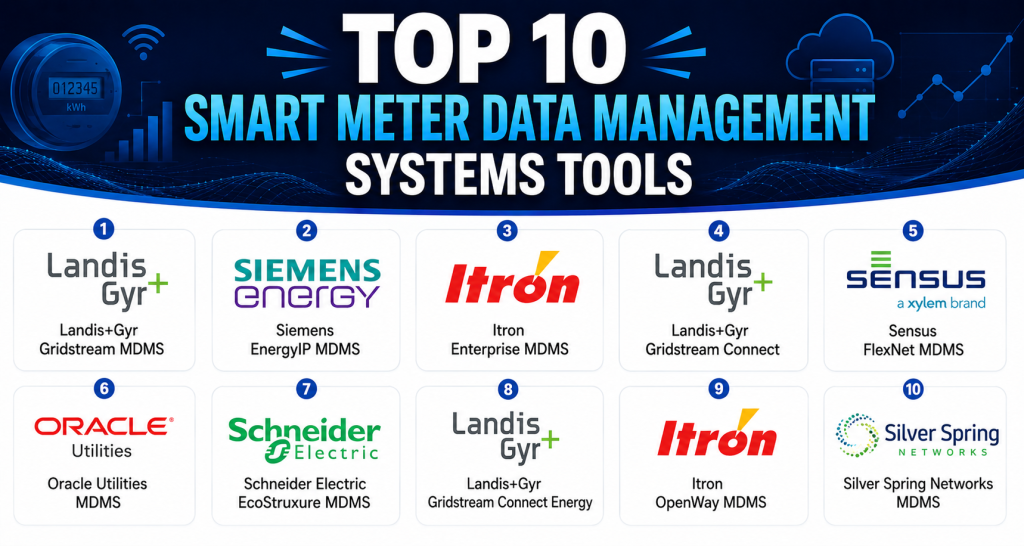
Top 10 Smart Meter Data Management Systems Tools
1- Landis+Gyr Gridstream MDMS
Short description: Landis+Gyr Gridstream MDMS consolidates data from smart meters, enabling utilities to streamline operations, ensure accurate billing, and improve customer engagement. Ideal for large-scale electricity, gas, and water utilities.
Key Features
- Data collection and normalization from multiple meter types.
- Real-time meter data validation and anomaly detection.
- Integration with billing and customer information systems.
- Load forecasting and demand response support.
- Advanced reporting and dashboards.
Pros
- Scalable for national-level AMI deployments.
- Robust data analytics for operational and business insights.
Cons
- Requires specialized training for complex features.
- Implementation can be lengthy for large deployments.
Platforms / Deployment
- Web / Windows
- Cloud / Hybrid
Security & Compliance
- SSO, encryption, audit logs
- Not publicly stated
Integrations & Ecosystem
Supports SCADA, billing systems, and IoT devices.
- Open APIs for integration
- DER and renewable management
- Data visualization tools
Support & Community
- Vendor support with training
- Active user forums and documentation
2- Siemens EnergyIP MDMS
Short description: Siemens EnergyIP MDMS aggregates, analyzes, and manages utility meter data with high scalability and real-time insights for electricity, water, and gas utilities.
Key Features
- Real-time data acquisition and validation.
- Predictive analytics for outage management.
- Integration with billing and enterprise systems.
- Multi-utility data normalization.
- Visualization dashboards with reporting capabilities.
Pros
- High scalability and flexibility.
- Strong analytics for operational efficiency.
Cons
- Premium pricing may not suit smaller utilities.
- Complexity in initial configuration.
Platforms / Deployment
- Web / Windows / Linux
- Cloud / Hybrid
Security & Compliance
- Encryption, role-based access
- Not publicly stated
Integrations & Ecosystem
- Billing and ERP integration
- IoT and DER connectivity
- RESTful API support
Support & Community
- Dedicated vendor support
- Knowledge base and training resources
3- Itron Enterprise MDMS
Short description: Itron Enterprise MDMS enables utilities to collect, manage, and analyze large-scale meter data, supporting operational efficiency and improved customer service.
Key Features
- Advanced data validation and anomaly detection.
- Load profiling and energy forecasting.
- Integration with AMI, billing, and ERP systems.
- Event and alert management.
- Cloud-ready deployment options.
Pros
- Scalable for medium to large utilities.
- Flexible integration with existing IT systems.
Cons
- Learning curve for advanced analytics.
- Initial setup can be resource-intensive.
Platforms / Deployment
- Web / Windows
- Cloud / Hybrid
Security & Compliance
- Not publicly stated
Integrations & Ecosystem
- SCADA, AMI, and billing platforms
- API extensibility
- Analytics dashboards
Support & Community
- Vendor support with onboarding
- Documentation available online
4- Landis+Gyr Gridstream Connect
Short description: Gridstream Connect MDMS consolidates meter data, provides analytics, and integrates with enterprise systems for improved energy management and customer billing accuracy.
Key Features
- Real-time data acquisition and monitoring.
- Event management and automated notifications.
- Load and demand analytics.
- Predictive maintenance support.
- Reporting and visualization tools.
Pros
- Strong integration with AMI and billing.
- Supports multi-utility operations.
Cons
- Implementation complexity for smaller utilities.
- Requires specialized IT expertise.
Platforms / Deployment
- Windows / Web
- Hybrid / Cloud
Security & Compliance
- Encryption, RBAC
- Not publicly stated
Integrations & Ecosystem
- Billing systems
- SCADA and IoT integration
- REST APIs
Support & Community
- Training programs
- Vendor-led support and community forums
5- Sensus FlexNet MDMS
Short description: Sensus FlexNet MDMS handles meter data from electricity, water, and gas utilities, providing scalable analytics and integration for operational excellence.
Key Features
- Multi-utility data consolidation.
- Load management and demand forecasting.
- Event and outage management.
- Integration with billing and CRM systems.
- Predictive analytics for meter performance.
Pros
- Cloud-ready and scalable.
- Strong analytical insights.
Cons
- Implementation may require vendor assistance.
- Advanced features may need additional training.
Platforms / Deployment
- Web / Windows
- Cloud / Hybrid
Security & Compliance
- Not publicly stated
Integrations & Ecosystem
- Billing and ERP
- SCADA and IoT devices
- API access for analytics
Support & Community
- Vendor support and professional services
- Documentation and knowledge base
6- Oracle Utilities MDMS
Short description: Oracle MDMS integrates smart meter data management with analytics, supporting utilities with billing accuracy, operational efficiency, and data-driven decision-making.
Key Features
- Data acquisition and normalization.
- Event management and alerts.
- Predictive analytics for energy consumption.
- Multi-utility and multi-region support.
- Visualization dashboards and reporting.
Pros
- Advanced analytics and forecasting.
- Scalable for large deployments.
Cons
- High cost and complex implementation.
- Requires training for advanced features.
Platforms / Deployment
- Web / Windows / Linux
- Cloud / Hybrid
Security & Compliance
- Not publicly stated
Integrations & Ecosystem
- SCADA, AMI, billing systems
- IoT integration
- REST APIs
Support & Community
- Vendor-led support and onboarding
- Training resources available
7- Schneider Electric EcoStruxure MDMS
Short description: EcoStruxure MDMS by Schneider Electric manages, validates, and analyzes smart meter data to optimize energy distribution and billing accuracy.
Key Features
- Real-time meter data monitoring.
- Data validation and normalization.
- Load profiling and forecasting.
- Event management and alerts.
- Integration with enterprise systems.
Pros
- Cloud-enabled with hybrid options.
- Strong analytics capabilities.
Cons
- Configuration complexity for multi-utility deployments.
- Regional support may vary.
Platforms / Deployment
- Windows / Web / Linux
- Hybrid / Cloud
Security & Compliance
- Not publicly stated
Integrations & Ecosystem
- AMI and SCADA systems
- Billing and ERP integration
- API support for extensibility
Support & Community
- Vendor training and professional services
- Knowledge base available
8- Landis+Gyr Gridstream Connect Energy
Short description: This MDMS focuses on energy utilities, offering high-volume data processing, predictive analytics, and billing integration for optimized grid operations.
Key Features
- Data aggregation from smart meters.
- Automated event and alert processing.
- Predictive analytics for energy and equipment.
- Multi-utility support.
- Reporting dashboards.
Pros
- Efficient processing of large meter datasets.
- Strong predictive insights.
Cons
- Complexity may require vendor support.
- Cost may be prohibitive for smaller utilities.
Platforms / Deployment
- Windows / Web
- Hybrid / Cloud
Security & Compliance
- Not publicly stated
Integrations & Ecosystem
- SCADA and ERP integration
- IoT device support
- Open APIs
Support & Community
- Vendor support
- Online documentation
9- Itron OpenWay MDMS
Short description: Itron OpenWay MDMS consolidates, analyzes, and manages smart meter data to improve operational efficiency and enable data-driven energy management programs.
Key Features
- Data normalization and validation.
- Load and consumption analytics.
- Integration with billing and AMI systems.
- Event and outage management.
- Forecasting and predictive maintenance.
Pros
- Scalable and cloud-ready.
- Strong analytics for utilities.
Cons
- Implementation requires planning and expertise.
- Advanced features may have a learning curve.
Platforms / Deployment
- Web / Windows
- Cloud / Hybrid
Security & Compliance
- Not publicly stated
Integrations & Ecosystem
- AMI, SCADA, billing systems
- API extensibility
- Analytics dashboards
Support & Community
- Vendor-led support
- Documentation and knowledge base
10- Silver Spring Networks MDMS
Short description: Silver Spring MDMS provides utilities with a scalable, cloud-based solution for smart meter data collection, validation, and analysis, supporting operational optimization and billing accuracy.
Key Features
- Multi-utility data management.
- Real-time validation and anomaly detection.
- Integration with billing and enterprise systems.
- Predictive analytics and forecasting.
- Event and alert management.
Pros
- Cloud-native and scalable.
- Streamlined integration with AMI.
Cons
- Learning curve for complex analytics.
- Advanced configuration may need vendor assistance.
Platforms / Deployment
- Web / Windows
- Cloud / Hybrid
Security & Compliance
- Not publicly stated
Integrations & Ecosystem
- SCADA, ERP, and billing integration
- API support
- IoT and AMI connectivity
Support & Community
- Vendor support and training
- Online documentation and forums
Comparison Table (Top 10)
| Tool Name | Best For | Platform(s) Supported | Deployment | Standout Feature | Public Rating |
|---|---|---|---|---|---|
| Landis+Gyr Gridstream MDMS | Large utilities | Windows / Web | Cloud / Hybrid | High-volume data processing | N/A |
| Siemens EnergyIP MDMS | Multi-utility operations | Windows / Linux / Web | Cloud / Hybrid | Predictive analytics | N/A |
| Itron Enterprise MDMS | Medium to large utilities | Web / Windows | Cloud / Hybrid | Flexible integration | N/A |
| Landis+Gyr Gridstream Connect | Multi-utility management | Windows / Web | Hybrid / Cloud | Real-time event monitoring | N/A |
| Sensus FlexNet MDMS | Utilities with AMI | Web / Windows | Cloud / Hybrid | Scalable analytics | N/A |
| Oracle Utilities MDMS | Enterprise-scale deployments | Web / Windows / Linux | Cloud / Hybrid | Advanced forecasting | N/A |
| Schneider EcoStruxure MDMS | Smart grid operators | Windows / Web / Linux | Hybrid / Cloud | Cloud-enabled analytics | N/A |
| Landis+Gyr Gridstream Connect Energy | Energy utilities | Windows / Web | Hybrid / Cloud | High-volume data processing | N/A |
| Itron OpenWay MDMS | Utilities with advanced AMI | Web / Windows | Cloud / Hybrid | Data normalization & forecasting | N/A |
| Silver Spring Networks MDMS | Scalable cloud deployments | Web / Windows | Cloud / Hybrid | Cloud-native smart meter integration | N/A |
Evaluation & Scoring of Smart Meter Data Management Tools
| Tool Name | Core (25%) | Ease (15%) | Integrations (15%) | Security (10%) | Performance (10%) | Support (10%) | Value (15%) | Weighted Total |
|---|---|---|---|---|---|---|---|---|
| Landis+Gyr Gridstream MDMS | 9 | 7 | 8 | 7 | 9 | 8 | 7 | 8.1 |
| Siemens EnergyIP MDMS | 9 | 8 | 8 | 7 | 8 | 7 | 7 | 8.0 |
| Itron Enterprise MDMS | 8 | 7 | 7 | 7 | 8 | 7 | 7 | 7.5 |
| Landis+Gyr Gridstream Connect | 8 | 7 | 7 | 7 | 8 | 7 | 7 | 7.5 |
| Sensus FlexNet MDMS | 8 | 7 | 7 | 7 | 8 | 7 | 7 | 7.5 |
| Oracle Utilities MDMS | 9 | 7 | 8 | 7 | 8 | 7 | 7 | 7.9 |
| Schneider EcoStruxure MDMS | 8 | 7 | 7 | 7 | 8 | 7 | 7 | 7.5 |
| Landis+Gyr Gridstream Connect Energy | 8 | 7 | 7 | 7 | 8 | 7 | 7 | 7.5 |
| Itron OpenWay MDMS | 8 | 7 | 7 | 7 | 8 | 7 | 7 | 7.5 |
| Silver Spring Networks MDMS | 8 | 7 | 7 | 7 | 8 | 7 | 7 | 7.5 |
Interpretation: Scores provide a comparative overview of core functionality, ease of use, integration maturity, security, performance, support, and value. Organizations should consider their specific AMI scale, operational needs, and budget when interpreting these scores.
Which Smart Meter Data Management Tool Is Right for You?
Solo / Freelancer
Typically not relevant; small-scale cloud energy monitoring tools may suffice.
SMB
Itron Enterprise MDMS, Sensus FlexNet MDMS: manageable deployment and cost-effective.
Mid-Market
Landis+Gyr Gridstream Connect, Schneider EcoStruxure MDMS: balanced usability, integration, and analytics.
Enterprise
Landis+Gyr Gridstream MDMS, Siemens EnergyIP MDMS, Oracle Utilities MDMS: robust scalability, advanced analytics, and enterprise-grade security.
Budget vs Premium
Mid-market options are cost-conscious; enterprise platforms provide extensive capabilities at premium pricing.
Feature Depth vs Ease of Use
Enterprise solutions offer advanced features requiring expertise; mid-market solutions provide an easier learning curve with sufficient analytics.
Integrations & Scalability
Enterprise MDMS tools integrate with AMI, SCADA, billing, and DER systems, offering extensive scalability.
Security & Compliance Needs
Evaluate tools for encryption, RBAC, audit logs, and vendor compliance certifications relevant to GDPR, ISO, or NERC standards.
Frequently Asked Questions (FAQs)
1- How much does a Smart Meter Data Management System cost?
Costs vary based on utility size, deployment model, and feature set. Enterprise-scale solutions are higher cost, while mid-market tools are more budget-friendly.
2- Can MDMS integrate with existing billing systems?
Yes, most MDMS platforms support seamless integration with billing, ERP, and CRM systems.
3- Are cloud deployments safe for utility data?
Yes, provided encryption, access control, and audit features are properly implemented; verify vendor compliance.
4- What is the implementation timeline?
Deployment can take 3–12 months depending on scale, integration complexity, and AMI network size.
5- How do MDMS platforms handle predictive analytics?
AI and machine learning are applied for anomaly detection, load forecasting, and predictive maintenance to improve efficiency.
6- Are these systems suitable for renewable energy integration?
Yes, most modern MDMS solutions integrate DERs, enabling smart grid optimization.
7- What common mistakes should utilities avoid?
Skipping vendor training, underestimating integration complexity, and ignoring data validation features.
8- Can small utilities benefit from MDMS?
Yes, but simpler cloud-based monitoring tools may be more cost-effective for smaller deployments.
9- Are there open-source MDMS options?
Limited; most credible tools are commercial with vendor support.
10- How to choose the right MDMS?
Consider AMI scale, deployment model, analytics needs, integration with existing systems, and compliance requirements.
Conclusion
Smart Meter Data Management Systems are crucial for modern utilities managing large-scale AMI networks. Enterprise solutions like Landis+Gyr Gridstream MDMS and Siemens EnergyIP MDMS offer scalability and advanced analytics, while mid-market options like Sensus FlexNet MDMS or Itron Enterprise MDMS balance usability and cost. Start by shortlisting , run pilot integrations, and validate analytics, security, and compliance capabilities before full-scale deployment. A well-chosen MDMS ensures operational efficiency, accurate billing, and data-driven energy management.
