Introduction
Factory Automation MES (Manufacturing Execution System) for Semiconductors is software that manages and monitors production processes on the semiconductor fabrication floor. In plain English, it connects machines, operators, and production lines to ensure wafers are processed efficiently, defects are minimized, and yields are maximized. The system provides real-time visibility into production status, machine performance, and quality metrics.
In , semiconductor fabs face higher complexity with advanced nodes, smaller geometries, and AI-assisted manufacturing. MES platforms are critical to coordinate multiple tools, automate workflows, and ensure compliance with strict quality standards. These systems reduce cycle times, prevent costly scrap, and enable data-driven process optimization.
Real-world use cases include:
- Real-time monitoring of wafer fabrication steps.
- Automated routing of wafers between process stations.
- Predictive maintenance of lithography, etching, and deposition tools.
- Integration of quality data for root cause analysis.
- Multi-fab synchronization and reporting dashboards.
What buyers should evaluate:
- Compatibility with fab equipment and automation tools
- Real-time monitoring and alerting capabilities
- Data analytics and predictive maintenance features
- Scalability for multiple fabs or product lines
- Security and compliance for sensitive production data
- Ease of use and configurability
- Reporting and visualization capabilities
- Integration with ERP and quality management systems
- Total cost of ownership and licensing model
Best for: semiconductor manufacturers, production engineers, process control teams, and operations managers in medium to large fabs.
Not ideal for: small prototype labs or outsourced fabs, where MES may be unnecessary or handled by the foundry.
Key Trends in Factory Automation MES (Semiconductor)
- Adoption of AI and machine learning for predictive maintenance and yield optimization.
- Real-time integration with IoT-enabled fab equipment for continuous monitoring.
- Cloud-enabled MES for multi-site collaboration and analytics.
- Enhanced cybersecurity and compliance, including SOC 2, ISO 27001, and GDPR readiness.
- Digital twin simulations to test process changes virtually before implementation.
- Automated reporting dashboards for cross-functional teams.
- Integration of statistical process control and defect pattern recognition.
- Focus on heterogeneous fab environments with multi-node support.
- Advanced workflow automation to reduce manual intervention.
- Flexible pricing models including subscription and hybrid deployment options.
How We Selected These Tools (Methodology)
- Market adoption and recognition among semiconductor fabs.
- Completeness of MES features including scheduling, routing, and analytics.
- Reliability and performance signals from real-world deployments.
- Security posture based on publicly stated certifications and practices.
- Breadth of integrations with fab equipment, ERP, and quality systems.
- Scalability and fit for different company sizes and complexity levels.
- User interface and configurability for operators and engineers.
- Support, documentation, and onboarding offerings.
- Innovation and readiness for emerging industry trends.
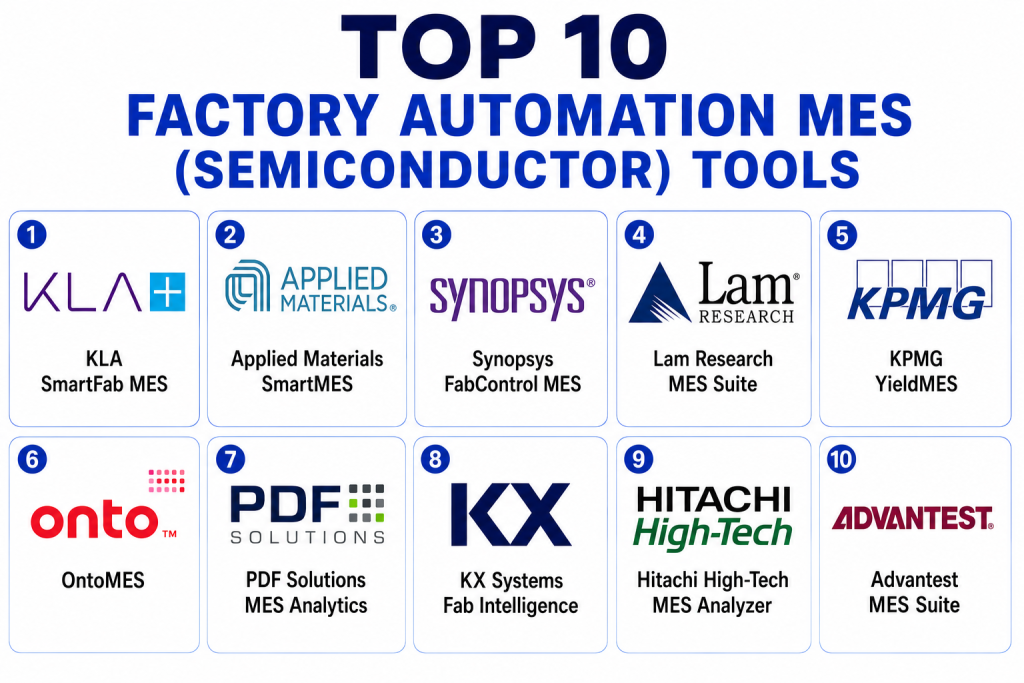
Top 10 Factory Automation MES (Semiconductor) Tools
1- KLA SmartFab MES
Short description: Enterprise-grade MES for semiconductor fabs, providing real-time monitoring, defect tracking, and workflow automation to optimize production efficiency.
Key Features
- Real-time machine and wafer monitoring
- Predictive maintenance alerts
- Workflow automation and routing
- Multi-fab data aggregation
- Defect pattern analysis
- Customizable reporting dashboards
Pros
- Highly scalable for large fabs
- Strong analytics and predictive capabilities
Cons
- High implementation complexity
- Significant training required for operators
Platforms / Deployment
- Web / Windows
- Cloud / Hybrid
Security & Compliance
- Not publicly stated
Integrations & Ecosystem
Supports MES, ERP, and fab equipment APIs
- Fab tool interfaces
- ERP connectors
- BI reporting integration
- Custom API for analytics
Support & Community
- Extensive documentation
- Enterprise-level training and onboarding
- Active user community
2- Applied Materials SmartMES
Short description: Focuses on semiconductor process automation with optical inspection integration, real-time data collection, and predictive analytics.
Key Features
- Wafer-level defect monitoring
- Process control analytics
- Integration with fab equipment
- Historical trend analysis
- Custom dashboards and alerts
Pros
- Accurate multi-layer inspection integration
- Supports complex process monitoring
Cons
- Hardware-dependent features
- Limited flexibility for small fabs
Platforms / Deployment
- Web / Windows
- Cloud / On-premises
Security & Compliance
- Not publicly stated
Integrations & Ecosystem
- MES/ERP connectors
- Fab equipment API integration
- Reporting tools
Support & Community
- Vendor-led onboarding
- Technical support tiers
- Limited online forums
3- Synopsys FabControl MES
Short description: AI-enabled MES that helps fabs predict yield issues, automate workflows, and analyze multi-fab data for optimized operations.
Key Features
- Predictive yield analytics
- AI-driven defect detection
- Automated wafer routing
- Multi-fab dashboard
- Root cause analysis alerts
Pros
- Strong AI-assisted analytics
- Efficient multi-fab coordination
Cons
- Requires computational resources
- Learning curve for AI features
Platforms / Deployment
- Web / Linux
- Cloud / Hybrid
Security & Compliance
- Not publicly stated
Integrations & Ecosystem
- MES and ERP connectors
- Fab tool APIs
- BI and reporting tools
Support & Community
- Documentation and training
- Enterprise-level support
- Limited community presence
4- Lam Research MES Suite
Short description: Provides workflow automation and defect correlation to improve yield and throughput in semiconductor manufacturing environments.
Key Features
- Process analytics dashboards
- Real-time monitoring
- Defect correlation tools
- Historical trend analysis
- Automated reporting
Pros
- Rapid root cause identification
- User-friendly interface
Cons
- Primarily suited for large fabs
- Limited AI automation
Platforms / Deployment
- Web / Windows
- On-premises / Hybrid
Security & Compliance
- Not publicly stated
Integrations & Ecosystem
- Fab equipment connectors
- MES/ERP integration
- API support for dashboards
Support & Community
- Technical support
- Vendor-led training
- Enterprise-focused community
5- KPMG YieldMES
Short description: Cloud-first MES solution integrating AI insights for process optimization, multi-fab coordination, and predictive analytics.
Key Features
- Cloud-based production monitoring
- AI-driven trend detection
- KPI dashboards
- Multi-fab reporting
- Custom alerts
Pros
- Reduces IT overhead via cloud
- Actionable AI insights
Cons
- Consulting-driven setup may increase cost
- Less hands-on control for fab operators
Platforms / Deployment
- Web
- Cloud
Security & Compliance
- Not publicly stated
Integrations & Ecosystem
- MES and ERP connectors
- Fab equipment integration
- Reporting APIs
Support & Community
- Vendor consultancy support
- Training services
- Limited online community
6- OntoMES
Short description: Modern MES platform combining real-time fab monitoring with predictive analytics for scrap reduction and yield optimization.
Key Features
- Real-time production monitoring
- Predictive defect alerts
- Multi-fab support
- Custom dashboards
- Workflow automation
Pros
- Rapid deployment
- AI-assisted process monitoring
Cons
- Newer tool with smaller adoption
- Limited documentation
Platforms / Deployment
- Web / Windows
- Cloud / Hybrid
Security & Compliance
- Not publicly stated
Integrations & Ecosystem
- MES/ERP connectors
- Fab tool APIs
- Analytics integration
Support & Community
- Online support
- Vendor-led training
- Growing user community
7- PDF Solutions MES Analytics
Short description: Provides ML-driven yield analytics and defect prediction across semiconductor fabs with historical data analysis.
Key Features
- ML-based defect prediction
- Process correlation analytics
- Multi-fab dashboards
- KPI tracking
- Root cause analytics
Pros
- Strong analytics for complex processes
- Multi-layer defect detection
Cons
- Complex implementation
- Higher cost for small fabs
Platforms / Deployment
- Web / Linux
- Cloud / Hybrid
Security & Compliance
- Not publicly stated
Integrations & Ecosystem
- MES and ERP connectors
- Fab tool API integration
- Reporting dashboards
Support & Community
- Technical support
- Training
- Limited forums
8- KX Systems Fab Intelligence
Short description: Event-driven MES platform using high-frequency data streams for real-time fab insights and anomaly detection.
Key Features
- Event-driven analytics
- Real-time process alerts
- Predictive defect notifications
- Custom dashboards
- Multi-fab integration
Pros
- Immediate issue detection
- Supports high-volume data processing
Cons
- Technical expertise required
- Limited SMB adoption
Platforms / Deployment
- Web / Linux
- Cloud / On-premises
Security & Compliance
- Not publicly stated
Integrations & Ecosystem
- MES/ERP connectors
- Fab equipment API
- Custom dashboards
Support & Community
- Vendor support
- Documentation
- Enterprise community
9- Hitachi High-Tech MES Analyzer
Short description: Integrates inspection and analytics for defect pattern identification and process control optimization in fabs.
Key Features
- Defect pattern recognition
- Statistical process control
- Multi-fab support
- Historical trend dashboards
- Automated reporting
Pros
- Strong analytics capability
- Multi-product line support
Cons
- Hardware-dependent
- Training required
Platforms / Deployment
- Web / Windows
- On-premises
Security & Compliance
- Not publicly stated
Integrations & Ecosystem
- Fab equipment integration
- MES/ERP connectors
- Reporting tools
Support & Community
- Vendor onboarding
- Technical support
- Limited online community
10- Advantest MES Suite
Short description: End-to-end MES solution managing wafer quality, routing, and process optimization for high-volume semiconductor fabs.
Key Features
- Wafer quality monitoring
- Root cause analytics
- Predictive defect detection
- Multi-fab integration
- KPI reporting dashboards
Pros
- Complete yield management
- Real-time alerts
Cons
- Implementation complexity
- Higher cost
Platforms / Deployment
- Web / Windows
- Cloud / On-premises
Security & Compliance
- Not publicly stated
Integrations & Ecosystem
- MES/ERP connectors
- Fab equipment APIs
- Reporting integration
Support & Community
- Vendor support
- Documentation and training
- Enterprise community
Comparison Table (Top 10)
| Tool Name | Best For | Platform(s) Supported | Deployment | Standout Feature | Public Rating |
|---|---|---|---|---|---|
| KLA SmartFab MES | Large enterprise fabs | Web/Windows | Cloud/Hybrid | Predictive analytics & defect detection | N/A |
| Applied Materials SmartMES | Multi-layer inspection | Web/Windows | Cloud/On-prem | Optical defect integration | N/A |
| Synopsys FabControl MES | AI-driven fabs | Web/Linux | Cloud/Hybrid | Predictive yield & workflow automation | N/A |
| Lam Research MES Suite | Large fabs | Web/Windows | On-prem/Hybrid | Root cause analytics | N/A |
| KPMG YieldMES | Cloud-focused MES | Web | Cloud | AI trend detection | N/A |
| OntoMES | Modern SMB/Mid-fab | Web/Windows | Cloud/Hybrid | Real-time monitoring | N/A |
| PDF Solutions MES Analytics | Multi-layer fabs | Web/Linux | Cloud/Hybrid | ML-driven defect prediction | N/A |
| KX Systems Fab Intelligence | High-volume fabs | Web/Linux | Cloud/On-prem | Event-driven analytics | N/A |
| Hitachi High-Tech MES Analyzer | Inspection-heavy fabs | Web/Windows | On-premises | Defect pattern recognition | N/A |
| Advantest MES Suite | Enterprise fabs | Web/Windows | Cloud/On-prem | End-to-end yield management | N/A |
Evaluation & Scoring of Factory Automation MES
| Tool Name | Core (25%) | Ease (15%) | Integrations (15%) | Security (10%) | Performance (10%) | Support (10%) | Value (15%) | Weighted Total (0–10) |
|---|---|---|---|---|---|---|---|---|
| KLA SmartFab MES | 9 | 7 | 8 | 6 | 9 | 8 | 7 | 8.0 |
| Applied Materials SmartMES | 8 | 7 | 7 | 6 | 8 | 7 | 7 | 7.5 |
| Synopsys FabControl MES | 9 | 6 | 8 | 6 | 8 | 7 | 7 | 7.7 |
| Lam Research MES Suite | 8 | 8 | 7 | 6 | 8 | 7 | 7 | 7.5 |
| KPMG YieldMES | 7 | 8 | 7 | 6 | 7 | 7 | 6 | 7.0 |
| OntoMES | 8 | 7 | 7 | 6 | 8 | 7 | 7 | 7.5 |
| PDF Solutions MES Analytics | 8 | 6 | 7 | 6 | 8 | 7 | 7 | 7.4 |
| KX Systems Fab Intelligence | 8 | 6 | 7 | 6 | 8 | 7 | 7 | 7.4 |
| Hitachi High-Tech MES Analyzer | 8 | 7 | 6 | 6 | 8 | 7 | 7 | 7.3 |
| Advantest MES Suite | 9 | 6 | 7 | 6 | 8 | 7 | 7 | 7.6 |
Scores are comparative, illustrating relative strength across features, usability, integrations, security, performance, support, and value.
Which Factory Automation MES Tool Is Right for You?
Solo / Freelancer
MES tools are primarily enterprise-focused; individual operators or freelancers typically do not require MES systems.
SMB
OntoMES and KPMG YieldMES offer simpler deployment and cloud access suitable for smaller fabs or pilot production lines.
Mid-Market
Applied Materials SmartMES and Lam Research MES Suite balance scalability with ease of use for mid-sized operations.
Enterprise
KLA SmartFab MES, Synopsys FabControl, and Advantest MES Suite provide end-to-end monitoring, AI-assisted analytics, and multi-fab coordination.
Budget vs Premium
Cloud-based OntoMES and KPMG YieldMES are cost-effective for SMBs. Premium enterprise suites offer advanced AI, predictive maintenance, and multi-fab scalability.
Feature Depth vs Ease of Use
High feature depth: KLA, Synopsys, Advantest.
Ease of use: OntoMES, Lam Research MES Suite.
Integrations & Scalability
Enterprise tools integrate widely with MES, ERP, and fab equipment. SMB solutions may need additional configuration.
Security & Compliance Needs
Check for SOC 2 or ISO certifications where sensitive production data is involved. Otherwise, “Not publicly stated” is default.
Frequently Asked Questions (FAQs)
1- What pricing models are common for MES?
MES solutions often use subscription-based cloud pricing or license fees for on-prem deployments. Costs depend on fab size, modules, and deployment.
2- How long does implementation take?
Implementation can range from a few weeks for cloud-based MES to several months for enterprise-scale, multi-fab installations.
3- Are AI features standard?
Not all MES platforms have AI. Some, like KLA or Synopsys, provide predictive analytics and defect detection, while others focus on workflow management.
4- How scalable are these tools?
Enterprise MES platforms can scale across multiple fabs and product lines. SMB-focused platforms are best for single-fab operations.
5- What integrations are critical?
Integration with fab tools, MES, ERP, and quality management systems is essential for effective production monitoring.
6- Are these tools secure?
Security varies. Some provide SSO/MFA, audit logs, and encryption. Explicit certifications are often “Not publicly stated.”
7- Can I switch MES vendors?
Switching is possible but complex due to integration dependencies and historical data migration.
8- What are common mistakes?
Skipping training, ignoring integration needs, and neglecting compliance requirements.
9- How is ROI measured?
ROI is measured via improved yield, reduced scrap, decreased downtime, and faster cycle times.
10- Are there open-source alternatives?
Open-source MES options for semiconductor fabs are rare; most production-grade solutions are proprietary.
Conclusion
Factory Automation MES is essential for semiconductor fabs seeking improved yield, efficiency, and quality control. The “best” tool depends on fab size, complexity, and production requirements. Enterprise fabs may benefit from KLA SmartFab, Synopsys FabControl, or Advantest MES Suite for full-scale AI-assisted operations, while mid-market fabs can consider Lam Research MES Suite or Applied Materials SmartMES for practical dashboards and workflow automation. Buyers should shortlist , run pilot programs, validate integrations and security, and scale gradually to maximize operational efficiency.
