Introduction
Quality Inspection Computer Vision Tools are software solutions that use cameras, AI, and machine learning to automatically inspect products, detect defects, and ensure quality standards on production lines. In simple terms, these tools let manufacturers “see” and analyze parts and products faster and more accurately than human inspectors, helping reduce errors, scrap, and operational inefficiencies.
In , with increasing automation and high-speed manufacturing, these tools are essential. Modern computer vision solutions can integrate with robotics, IoT devices, and MES/ERP systems to provide real-time insights, predictive defect detection, and adaptive inspection workflows.
Real-world use cases include:
- Detecting surface defects in electronics and semiconductor wafers.
- Monitoring automotive components for assembly errors.
- Inspecting pharmaceutical packaging for labeling or sealing defects.
- Quality control in food production and packaging lines.
- Tracking product dimensions, color consistency, or surface finish in high-volume manufacturing.
What buyers should evaluate:
- Accuracy and resolution of inspection
- AI and deep learning capabilities
- Integration with production equipment and MES systems
- Real-time analytics and predictive defect detection
- Scalability for multi-line or multi-site deployment
- User interface and configurability
- Reporting, dashboards, and alerts
- Deployment flexibility (cloud, on-prem, hybrid)
- Security and compliance standards
- Cost vs expected ROI
Best for: quality engineers, production managers, industrial automation teams, and high-volume manufacturers in electronics, automotive, pharmaceuticals, and consumer goods.
Not ideal for: very low-volume operations or manual inspection environments where automation is unnecessary.
Key Trends in Quality Inspection Computer Vision
- Widespread adoption of AI/ML for adaptive and predictive inspection.
- Real-time inspection using edge computing for faster processing.
- Integration with industrial robotics for automated handling and inspection.
- Cloud-enabled dashboards for multi-site monitoring and analytics.
- Predictive maintenance integration to minimize downtime.
- Enhanced cybersecurity and data compliance for sensitive production data.
- Use of 3D vision and laser scanning for micro-component inspection.
- Interoperability with MES, ERP, and IoT systems.
- Modular and scalable solutions for small to large factories.
- Flexible subscription and pricing models for cost management.
How We Selected These Tools (Methodology)
- Market adoption and presence in industrial automation.
- Completeness of features, including AI, 3D/2D imaging, and defect detection.
- Reliability and performance in high-volume production environments.
- Security posture and compliance readiness.
- Integrations with MES, ERP, and production line equipment.
- Fit across small, medium, and large manufacturers.
- User interface design and ease of configurability.
- Vendor support, documentation, and training availability.
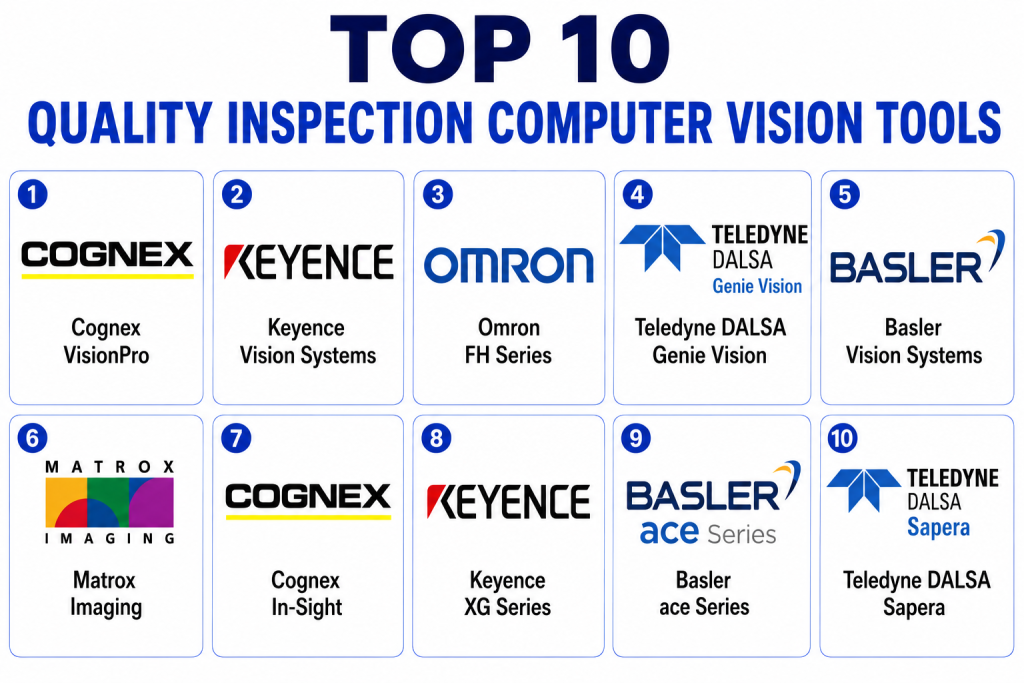
Top 10 Quality Inspection Computer Vision Tools
1- Cognex VisionPro
Short description: Enterprise-grade computer vision software for automated defect detection, assembly verification, and quality control in high-speed production lines.
Key Features
- AI-powered image analysis
- 2D and 3D inspection capabilities
- Real-time defect detection
- Robotics integration
- Multi-camera support
- Customizable reporting dashboards
Pros
- High-speed, precise inspections
- Scalable for complex production lines
Cons
- High implementation cost
- Requires trained operators
Platforms / Deployment
- Windows / Linux
- Cloud / On-premises / Hybrid
Security & Compliance
- Not publicly stated
Integrations & Ecosystem
Supports MES, ERP, and industrial robots
- Robotics API interfaces
- MES connectors
- ERP integration
- BI reporting dashboards
Support & Community
- Extensive documentation
- Vendor-led training programs
- Active industrial automation community
2- Keyence Vision Systems
Short description: Compact and flexible computer vision tools for assembly verification, defect detection, and product quality inspection.
Key Features
- High-resolution imaging
- AI-based anomaly detection
- Multi-sensor integration
- Real-time monitoring dashboards
- Automated alerting
Pros
- Quick deployment and setup
- User-friendly programming interface
Cons
- Limited advanced analytics
- Less suitable for very high-speed production
Platforms / Deployment
- Windows / Linux
- On-premises / Hybrid
Security & Compliance
- Not publicly stated
Integrations & Ecosystem
- PLC and robot controllers
- MES/ERP connectors
- Custom API integration
- Reporting dashboards
Support & Community
- Technical support
- Vendor-led onboarding
- Moderate user community
3- Omron FH Series
Short description: Advanced computer vision platform for micro-defect detection in electronics and automotive manufacturing with AI-assisted 2D/3D inspection.
Key Features
- 3D and 2D imaging
- AI defect recognition
- High-speed image processing
- Multi-camera support
- Robotic manipulator integration
Pros
- Exceptional accuracy
- Multi-line support for complex fabs
Cons
- Complex setup and training
- High cost for SMB factories
Platforms / Deployment
- Windows / Linux
- Cloud / On-premises
Security & Compliance
- Not publicly stated
Integrations & Ecosystem
- MES and ERP systems
- Robotics API integration
- Custom reporting dashboards
Support & Community
- Vendor support
- Onsite training
- Enterprise user community
4- Teledyne DALSA Genie Vision
Short description: Machine vision cameras and software for automated inspection, defect detection, and quality verification in high-volume production environments.
Key Features
- High-speed imaging
- AI-driven pattern recognition
- Multi-camera synchronization
- Automated alerts and dashboards
- Real-time reporting
Pros
- Scalable for high-volume factories
- Excellent image quality
Cons
- Hardware-dependent
- Requires programming expertise
Platforms / Deployment
- Windows / Linux
- On-premises / Hybrid
Security & Compliance
- Not publicly stated
Integrations & Ecosystem
- Robotics interfaces
- MES/ERP connectors
- API for custom analytics
- Reporting dashboards
Support & Community
- Technical support
- Documentation
- Vendor training programs
5- Basler Vision Systems
Short description: Modular vision cameras and software for automated quality inspection, defect detection, and part verification across industries.
Key Features
- High-resolution imaging
- Real-time AI inspection
- Multi-camera integration
- Remote monitoring dashboards
- Custom analytics dashboards
Pros
- Flexible across industries
- Compact and modular design
Cons
- Requires third-party integration
- Advanced features need skilled operators
Platforms / Deployment
- Windows / Linux
- On-premises / Hybrid
Security & Compliance
- Not publicly stated
Integrations & Ecosystem
- MES connectors
- Robotics and PLC interfaces
- BI reporting integration
- API for custom analytics
Support & Community
- Vendor training programs
- Online support resources
- Industrial user community
6- Matrox Imaging
Short description: Vision software with deep learning for automated inspection, defect detection, and quality assurance in industrial production.
Key Features
- AI-driven defect detection
- Multi-camera coordination
- Real-time monitoring
- Workflow automation
- 3D imaging
Pros
- Supports complex production lines
- Advanced analytics for micro-defects
Cons
- Requires expertise for setup
- Limited cloud capabilities
Platforms / Deployment
- Windows / Linux
- On-premises / Hybrid
Security & Compliance
- Not publicly stated
Integrations & Ecosystem
- Robotics integration
- MES/ERP connectors
- API for reporting
- Custom dashboards
Support & Community
- Vendor documentation
- Training programs
- Enterprise support
7- Cognex In-Sight
Short description: Industrial-grade vision inspection system for defect detection, assembly verification, and quality control in automated factories.
Key Features
- AI-assisted image analysis
- 2D/3D inspection
- Real-time alerts
- Multi-camera support
- Robotics integration
Pros
- Reliable and mature platform
- Wide industrial adoption
Cons
- Premium pricing
- Complex configuration for multi-camera setups
Platforms / Deployment
- Windows
- On-premises / Hybrid
Security & Compliance
- Not publicly stated
Integrations & Ecosystem
- MES/ERP connectors
- Robotics APIs
- BI integration
Support & Community
- Vendor support
- Documentation and training
- Enterprise community
8- Keyence XG Series
Short description: High-speed vision inspection platform for precision defect detection and quality verification in automated production lines.
Key Features
- AI anomaly detection
- High-speed imaging
- Multi-sensor integration
- Real-time monitoring
- Robotics coordination
Pros
- Extremely fast inspections
- Compact and flexible
Cons
- Limited AI training features
- Less suitable for multi-fab setups
Platforms / Deployment
- Windows
- On-premises / Hybrid
Security & Compliance
- Not publicly stated
Integrations & Ecosystem
- PLC and robotics interfaces
- MES/ERP connectors
- API for dashboards
Support & Community
- Vendor support
- Onboarding programs
- Moderate user community
9- Basler ace Series
Short description: Cost-effective machine vision cameras and software for automated inspection and quality control in small-to-medium factories.
Key Features
- High-resolution imaging
- AI-assisted inspection
- Multi-camera support
- Real-time dashboards
- Workflow automation
Pros
- Easy to deploy
- Affordable for SMBs
Cons
- Limited advanced analytics
- Requires hardware integration
Platforms / Deployment
- Windows / Linux
- On-premises
Security & Compliance
- Not publicly stated
Integrations & Ecosystem
- Robotics/PLC interfaces
- MES connectors
- Reporting dashboards
Support & Community
- Vendor-led training
- Documentation
- Moderate community
10- Teledyne DALSA Sapera
Short description: Deep learning vision software for automated inspection, defect detection, and process optimization in high-speed production environments.
Key Features
- AI-based inspection
- Multi-camera coordination
- Real-time defect alerts
- Robotics integration
- Custom dashboards
Pros
- Advanced AI for complex defects
- Flexible deployment
Cons
- Steep learning curve
- High initial cost
Platforms / Deployment
- Windows / Linux
- On-premises / Hybrid
Security & Compliance
- Not publicly stated
Integrations & Ecosystem
- MES/ERP connectors
- Robotics APIs
- BI reporting integration
Support & Community
- Vendor support
- Documentation and training
- Enterprise user base
Comparison Table (Top 10)
| Tool Name | Best For | Platform(s) Supported | Deployment | Standout Feature | Public Rating |
|---|---|---|---|---|---|
| Cognex VisionPro | Industrial automation | Windows | On-prem/Hybrid | AI-assisted inspection | N/A |
| Keyence Vision Systems | SMB & medium lines | Windows/Linux | On-prem/Hybrid | Easy programming | N/A |
| Omron FH Series | Electronics/automotive | Windows/Linux | Cloud/On-prem | AI + 3D inspection | N/A |
| Teledyne DALSA Genie Vision | High-volume factories | Windows/Linux | On-prem/Hybrid | High-speed imaging | N/A |
| Basler Vision Systems | Multi-industry | Windows/Linux | On-prem/Hybrid | Modular design | N/A |
| Matrox Imaging | Complex assembly | Windows/Linux | On-prem/Hybrid | AI + deep learning | N/A |
| Cognex In-Sight | Enterprise fabs | Windows | On-prem/Hybrid | Mature industrial adoption | N/A |
| Keyence XG Series | High-speed inspection | Windows | On-prem/Hybrid | Extremely fast inspection | N/A |
| Basler ace Series | SMB factories | Windows/Linux | On-prem | Cost-effective | N/A |
| Teledyne DALSA Sapera | Advanced AI inspection | Windows/Linux | On-prem/Hybrid | Deep learning | N/A |
Evaluation & Scoring of Quality Inspection Computer Vision Tools
| Tool Name | Core (25%) | Ease (15%) | Integrations (15%) | Security (10%) | Performance (10%) | Support (10%) | Value (15%) | Weighted Total (0–10) |
|---|---|---|---|---|---|---|---|---|
| Cognex VisionPro | 9 | 7 | 8 | 6 | 9 | 8 | 7 | 8.0 |
| Keyence Vision Systems | 8 | 8 | 7 | 6 | 8 | 7 | 7 | 7.5 |
| Omron FH Series | 9 | 6 | 8 | 6 | 8 | 7 | 7 | 7.7 |
| Teledyne DALSA Genie Vision | 8 | 7 | 7 | 6 | 8 | 7 | 7 | 7.5 |
| Basler Vision Systems | 8 | 8 | 7 | 6 | 8 | 7 | 7 | 7.5 |
| Matrox Imaging | 9 | 6 | 7 | 6 | 8 | 7 | 7 | 7.6 |
| Cognex In-Sight | 9 | 6 | 7 | 6 | 8 | 7 | 7 | 7.6 |
| Keyence XG Series | 8 | 7 | 7 | 6 | 8 | 7 | 7 | 7.5 |
| Basler ace Series | 7 | 8 | 7 | 6 | 7 | 7 | 7 | 7.2 |
| Teledyne DALSA Sapera | 9 | 6 | 7 | 6 | 8 | 7 | 7 | 7.6 |
Scores are comparative and show relative strength across core features, usability, integrations, security, performance, support, and value.
Which Quality Inspection Computer Vision Tool Is Right for You?
Solo / Freelancer
Not applicable; designed for industrial automation environments.
SMB
Basler ace Series or Keyence Vision Systems are cost-effective and easier to deploy.
Mid-Market
Teledyne DALSA Genie Vision or Matrox Imaging balance performance and advanced inspection features.
Enterprise
Cognex VisionPro, Omron FH Series, and Teledyne DALSA Sapera provide robust AI-assisted inspection, multi-camera coordination, and scalability.
Budget vs Premium
SMBs can choose Basler or Keyence for low-cost deployment; premium enterprise options offer advanced AI, multi-line capability, and robotics integration.
Feature Depth vs Ease of Use
High feature depth: Cognex VisionPro, Omron FH Series, Teledyne DALSA Sapera.
Ease of use: Basler ace Series, Keyence Vision Systems.
Integrations & Scalability
Enterprise platforms integrate with MES, ERP, and robotics. SMB tools may need additional integration support.
Security & Compliance Needs
Check for SOC 2 or ISO certification when handling sensitive production data. Otherwise, “Not publicly stated.”
Frequently Asked Questions (FAQs)
1- What pricing models are common?
Pricing is typically hardware + software license or subscription-based for cloud-enabled features. Cost varies by line speed, AI capabilities, and factory size.
2- How long does onboarding take?
Small systems: days; multi-line, multi-camera setups: several weeks.
3- Are AI features standard?
Not all tools have AI. Advanced platforms like Cognex, Omron, and Teledyne DALSA provide AI-based defect detection.
4- How scalable are these tools?
Enterprise-grade platforms can support multiple cameras and lines; SMB solutions are limited but easy to deploy.
5- What integrations are critical?
MES, ERP, robotic arms, and PLC integration is essential for fully automated inspection workflows.
6- Are these tools secure?
Security features vary. Some include encryption and access control. Certifications are often “Not publicly stated.”
7- Can I switch vendors?
Switching is possible but requires recalibration, retraining, and data migration.
8- What are common mistakes?
Neglecting integration requirements, underestimating operator training, and skipping maintenance schedules.
9- How is ROI measured?
Measured via reduced defects, scrap, downtime, and increased throughput.
10- Are there open-source alternatives?
Few exist; most industrial-grade computer vision inspection solutions are proprietary.
Conclusion
Quality Inspection Computer Vision Tools are essential for high-speed, high-volume manufacturing, providing precise defect detection, assembly verification, and quality assurance. Enterprise factories may benefit from Cognex VisionPro, Omron FH Series, or Teledyne DALSA Sapera for AI-assisted multi-camera inspection. Mid-market or SMB operations can start with Basler ace Series or Keyence Vision Systems for cost-effective deployment. Buyers should shortlist , run pilots, validate integrations and security, and scale gradually to maximize quality, efficiency, and ROI.
