Introduction
Order‑to‑Cash (O2C) Platforms are systems that help companies manage the full revenue cycle — from order entry, fulfillment, billing, and invoicing to revenue collection and accounting. In plain English, these platforms ensure that when a customer places an order (for a product, service, subscription, or campaign), every step that follows — pricing, credit validation, fulfillment, billing, and payment — happens accurately, quickly, and in compliance with financial policies.
In and beyond, as enterprises become more digital, global, and subscription‑oriented, O2C platforms are critical. They reduce errors, accelerate cash flow, improve customer satisfaction, and provide real‑time visibility into financial performance. Increasing complexity of pricing models — especially in SaaS, influencer marketing, subscription services, and hybrid business models — means manual spreadsheets and disconnected systems are no longer sustainable.
Real‑world use cases include:
- Order fulfillment automation: Streamline the path from a signed influencer marketing contract to delivery and revenue recognition.
- Billing and invoicing: Automatically issue accurate invoices after order confirmation with service‑level terms embedded.
- Revenue recognition compliance: Ensure financial reporting aligns with accounting standards.
- Cash application and collections: Automatically match payments to invoices to improve cash flow.
- Analytics and forecasting: Track outstanding receivables, sales performance, and revenue trends in real time.
What buyers should evaluate:
- Ability to handle complex pricing and discount rules
- Integration quality with CRM, ERP, billing, and payment systems
- Automation of order fulfillment, invoicing, and collections
- Support for subscription or usage‑based revenue
- Compliance and audit readiness
- Analytics, dashboards, and reporting capabilities
- Scalability for growth and international operations
- Ease of use and learning curve
- Security and access controls
- Vendor support and implementation services
Best for: CFOs, revenue operations, sales operations, finance teams, and enterprise IT in mid‑market to global enterprises with complex sales and billing processes.
Not ideal for: Very small businesses with simple pricing, low order volumes, and straightforward invoicing, where manual or ERP‑embedded O2C may suffice.
Key Trends in Order‑to‑Cash Platforms
- AI‑driven cash forecasting to predict collections and optimize working capital.
- Real‑time revenue and receivables analytics embedded into sales and finance dashboards.
- Automation of dispute, credit, and collections workflows to reduce days sales outstanding (DSO).
- Native integration with CRM, ERP, payment gateways, and tax systems for frictionless financial data flow.
- Support for complex and hybrid billing models (subscription + usage + one‑time fees).
- Cloud‑first architectures with hybrid deployment options for global compliance.
- Dynamic credit scoring and credit hold automation to mitigate risk on new orders.
- Embedded compliance and audit trails for SOC 2, GDPR, and financial audits.
- Self‑service billing portals that reduce manual support burden.
- Flexible pricing models that cater to SMBs and enterprises alike.
How We Selected These Tools (Methodology)
We evaluated platforms based on:
- Market adoption and mindshare across industries with complex O2C needs.
- Feature completeness across order management, billing, payments, collections, and analytics.
- Reliability and performance signals from customer reviews and uptime benchmarks.
- Security posture insights where available: encryption, SSO, MFA, audit logging.
- Integration ecosystem with ERP, CRM, payment gateways, tax engines, and analytics stacks.
- Customer fit across segments — from SMB to enterprise.
- Ease of onboarding and user adoption based on training and documentation.
- Scalability and global operational readiness.
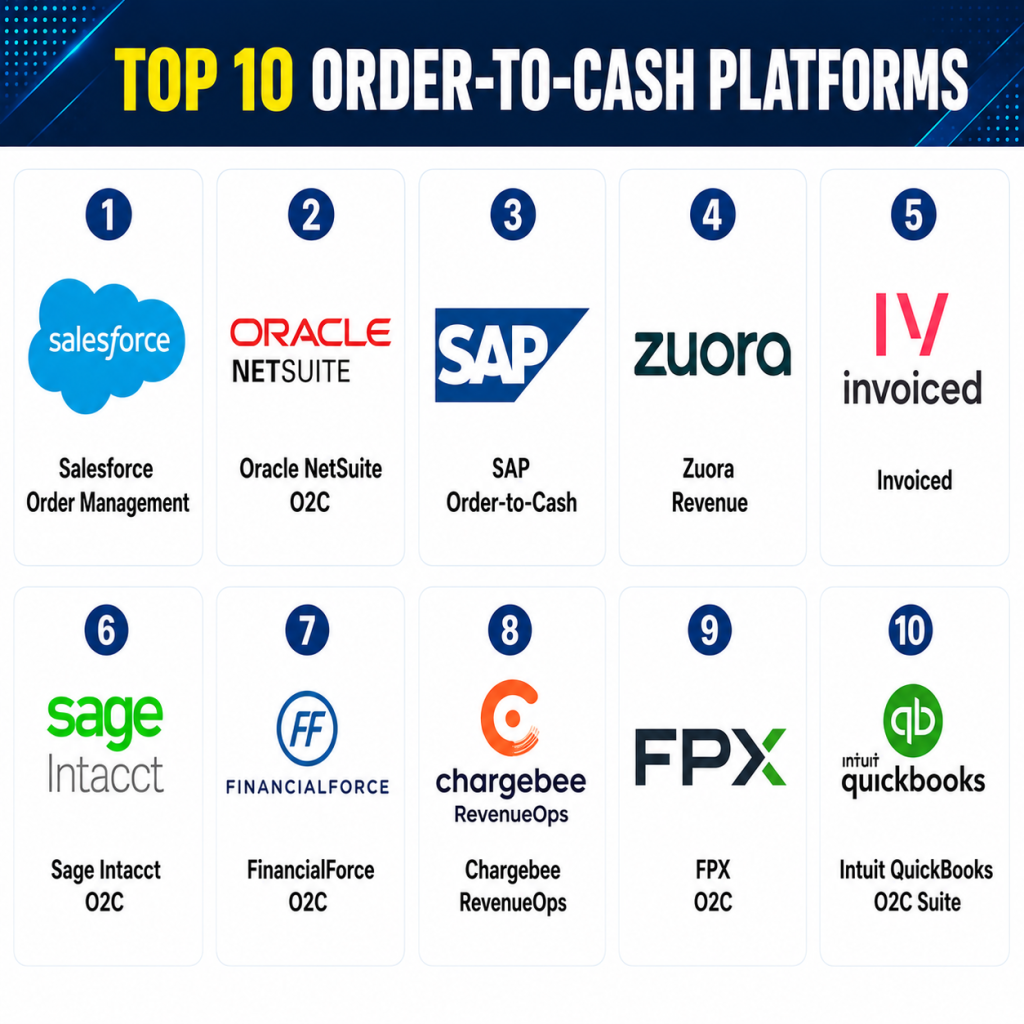
Top 10 Order‑to‑Cash Platforms
1 — Salesforce Order Management
Short description: Salesforce Order Management automates the end‑to‑cash process for complex sales where orders are created across channels, ensuring fulfillment, billing coordination, and revenue visibility within the Salesforce ecosystem.
Key Features
- Unified order lifecycle tracking
- Multi‑channel order management
- Automated billing triggers
- Inventory and fulfillment coordination
- Real‑time dashboards and alerts
- Order amendments and change management
- Integration with CRM and billing systems
Pros
- Deep alignment with Salesforce CRM workflows
- Real‑time visibility into orders and revenue
- Scalable for high‑volume environments
Cons
- Cost may be high for smaller teams
- Advanced configurations require Salesforce expertise
- Billing functions may need additional modules
Platforms / Deployment
- Web / iOS / Android
- Cloud
Security & Compliance
- SSO/SAML, MFA, encryption, audit logs
- SOC 2, GDPR
- Role‑based access control (RBAC)
Integrations & Ecosystem
Salesforce Order Management is deeply integrated with:
- Salesforce CRM
- Billing and payment gateways
- Inventory and fulfillment systems
- Tax engines
- APIs for custom workflows
Support & Community
Varies based on Salesforce support tier.
Large global community and extensive documentation.
2 — Oracle NetSuite O2C
Short description: Oracle NetSuite’s Order‑to‑Cash platform offers end‑to‑end automation of orders, billing, revenue recognition, and cash application within a unified ERP and financial suite.
Key Features
- Multi‑currency and global tax support
- Automated order fulfillment and billing
- Revenue recognition and compliance reporting
- Accounts receivable and collections workflows
- Order modifications and audit trails
- Analytics and forecasting dashboards
Pros
- Unified ERP + O2C workflows
- Strong financial compliance and global readiness
- Scales from mid‑market to enterprise
Cons
- Enterprise pricing
- Implementation requires expert support
- Learning curve for finance teams
Platforms / Deployment
- Web
- Cloud
Security & Compliance
- Encryption, SSO
- SOC 2, GDPR
- Audit logging
Integrations & Ecosystem
NetSuite O2C is often part of NetSuite ERP, integrates with:
- Payment gateways
- CRM solutions
- Tax and compliance tools
- External billing systems
- APIs for extensions
Support & Community
Tiered support through Oracle NetSuite, documentation available, community forums.
3 — SAP Order‑to‑Cash
Short description: SAP’s O2C platform is designed for large enterprises with global operations, combining order fulfillment, billing, revenue management, and collections within SAP’s ERP environment.
Key Features
- Global order orchestration
- Complex pricing and discount support
- Billing and revenue processes
- Accounts receivable and dispute management
- Financial reconciliation
- Real‑time operational analytics
Pros
- Enterprise‑grade robustness
- Designed for complex multi‑entity organizations
- Strong compliance tools
Cons
- Long implementation cycles
- High total cost of ownership
- Requires SAP expertise
Platforms / Deployment
- Web
- Cloud / On‑premises / Hybrid
Security & Compliance
Not publicly stated specific certifications beyond SAP platform standards.
Includes RBAC, encryption, audit logs.
Integrations & Ecosystem
Integrates with:
- SAP CRM and ERP modules
- Billing and tax engines
- Payment systems
- Custom APIs
Support & Community
SAP support tiers, extensive global partner ecosystem, community resources.
4 — Zuora Revenue
Short description: Zuora Revenue automates revenue management within the quote‑to‑cash lifecycle, with strong support for subscription and usage‑based billing, compliance, and reporting.
Key Features
- Subscription and usage billing
- Revenue recognition automation
- Order and invoice coordination
- Contract amendments and renewals
- Compliance dashboards
- Analytics and forecasting
Pros
- Built for subscription‑driven businesses
- Strong usage‑based pricing support
- Automated compliance and revenue rules
Cons
- Pricing and configuration complexity
- Enterprise focus, costlier for SMBs
- Requires integration with CRM and order systems
Platforms / Deployment
- Web
- Cloud
Security & Compliance
Not publicly stated certifications; typically supports encryption and RBAC.
Integrations & Ecosystem
- CRM systems
- Billing and payment gateways
- ERP systems
- APIs
Support & Community
Support tiers available, documentation and training provided.
5 — Invoiced
Short description: Invoiced is a dedicated order‑to‑cash platform focused on billing, invoicing automation, payment collection, and revenue optimization for mid‑market companies.
Key Features
- Automated invoicing
- Payment collection workflows
- Dunning and retries
- Subscription and recurring billing
- Customer self‑service portal
- Reporting and dashboards
Pros
- Simplifies invoice and payment workflows
- Good for subscription and recurring revenue
- Customer portal improves collections
Cons
- Less robust for ERP replacement
- Limited order fulfillment features
- SMB focus may lack enterprise scale
Platforms / Deployment
- Web
- Cloud
Security & Compliance
Not publicly stated specific certifications — generally supports encryption and standard access controls.
Integrations & Ecosystem
- Payment gateways
- CRM and accounting systems
- APIs for extensibility
- Billing and tax engines
Support & Community
Live support, training resources, documentation.
6 — Sage Intacct O2C
Short description: Sage Intacct’s order‑to‑cash capabilities focus on mid‑market financial leaders needing billing, receivables, and revenue automation integrated with core accounting.
Key Features
- Order billing and invoicing
- Accounts receivable automation
- Revenue scheduling and recognition
- Cash application
- Dashboards and analytics
- Multi‑entity support
Pros
- Strong accounting alignment
- Scales across business units
- Real‑time financial visibility
Cons
- Less focus on complex order orchestration
- Enterprise integration may need partners
- Smaller ecosystem than large suites
Platforms / Deployment
- Web
- Cloud
Security & Compliance
Not publicly stated; typical platform encryption and access controls.
Integrations & Ecosystem
- CRM and ERP integrations
- Payment systems
- APIs
Support & Community
Tiered support, documentation available.
7 — FinancialForce O2C
Short description: Built on the Salesforce platform, FinancialForce O2C handles order fulfillment, billing, revenue recognition, and collections for service‑centric enterprises.
Key Features
- Order and contract automation
- Subscription billing
- Revenue recognition
- Payment collection
- Analytics and reporting
- CRM alignment
Pros
- Native to Salesforce ecosystem
- Good for professional services and recurring revenue
- Unified data model
Cons
- Salesforce dependency increases cost
- Not ideal outside Salesforce environments
- Enterprise focus
Platforms / Deployment
- Web / Mobile
- Cloud
Security & Compliance
Built on Salesforce security standards: encryption, SSO, audit logs.
Integrations & Ecosystem
- Salesforce CRM
- Billing and payment systems
- APIs
Support & Community
Salesforce‑aligned support and documentation.
8 — Chargebee RevenueOps
Short description: Chargebee offers a strong subscription‑centric O2C suite with automated billing, revenue recognition, payments, and analytics for SaaS and recurring‑revenue businesses.
Key Features
- Subscription billing automation
- Revenue recognition
- Customer dunning and collections
- Payment gateway integrations
- Analytics dashboards
- Multi‑product billing
Pros
- Built for recurring revenue models
- Self‑service portals improve collections
- Flexible subscription billing
Cons
- Less suitable for traditional product orders
- May require partner for ERP syncing
- Mid‑market focus
Platforms / Deployment
- Web
- Cloud
Security & Compliance
Not publicly stated; standard platform encryption and RBAC.
Integrations & Ecosystem
- CRM and accounting systems
- Payment gateways
- APIs
Support & Community
Live support, documentation, training.
9 — FPX O2C
Short description: FPX provides advanced order‑to‑cash automation for enterprises needing custom quoting, order orchestration, billing rules, and revenue insights.
Key Features
- Guided quoting and price validation
- Order orchestration
- Billing and invoice generation
- Accounts receivable workflows
- Analytics dashboards
- Integration APIs
Pros
- Strong rule‑based billing and quoting
- Handles complex enterprise pricing
- Analytics flexibility
Cons
- Enterprise pricing
- Implementation complexity
- Less SMB focus
Platforms / Deployment
- Web
- Cloud
Security & Compliance
Not publicly stated; general encryption and access controls.
Integrations & Ecosystem
- CRM, ERP, billing systems
- APIs
Support & Community
Enterprise support tiers.
10 — Intuit QuickBooks O2C Suite
Short description: While QuickBooks is primarily an accounting suite, its order‑to‑cash features — automated invoicing, payment management, and receivables — serve small to mid‑market businesses well.
Key Features
- Order and invoice automation
- Accounts receivable tracking
- Payments and collection
- Financial reporting
- Customer management
- Dashboards
Pros
- Ideal for small to medium businesses
- Easy to use and deploy
- Strong accounting backbone
Cons
- Not enterprise‑grade
- Limited advanced billing rules
- Smaller integration ecosystem
Platforms / Deployment
- Web / Windows / macOS / Mobile
- Cloud
Security & Compliance
Not publicly stated; standard business platform encryption.
Integrations & Ecosystem
- CRM and payment systems
- APIs
- Accounting integrations
Support & Community
Live support tiers, documentation, large community.
Comparison Table (Top 10)
| Tool Name | Best For | Platform(s) Supported | Deployment | Standout Feature | Public Rating |
|---|---|---|---|---|---|
| Salesforce Order Management | Salesforce‑centric enterprises | Web, iOS, Android | Cloud | Real‑time order orchestration | N/A |
| NetSuite O2C | Global ERP users | Web | Cloud | Unified ERP + O2C | N/A |
| SAP O2C | Large global enterprises | Web | Cloud/On‑premises/Hybrid | Enterprise scalability | N/A |
| Zuora Revenue | Subscription‑centric businesses | Web | Cloud | Subscription revenue automation | N/A |
| Invoiced | Mid‑market recurring revenue | Web | Cloud | Customer billing automation | N/A |
| Sage Intacct O2C | Mid‑market finance teams | Web | Cloud | Accounting alignment | N/A |
| FinancialForce O2C | Salesforce‑based services | Web/Mobile | Cloud | Native Salesforce O2C | N/A |
| Chargebee RevenueOps | Recurring & SaaS | Web | Cloud | Subscription billing optimization | N/A |
| FPX O2C | Enterprise pricing automation | Web | Cloud | Rule‑based billing & quoting | N/A |
| QuickBooks O2C Suite | Small & mid‑market | Web/Windows/Mobile | Cloud | Easy SMB O2C | N/A |
Evaluation & Scoring
| Tool Name | Core (25%) | Ease (15%) | Integrations (15%) | Security (10%) | Performance (10%) | Support (10%) | Value (15%) | Weighted Total |
|---|---|---|---|---|---|---|---|---|
| Salesforce Order Management | 9 | 8 | 9 | 9 | 9 | 8 | 8 | 8.9 |
| NetSuite O2C | 8 | 7 | 8 | 8 | 8 | 7 | 7 | 7.8 |
| SAP O2C | 9 | 6 | 9 | 8 | 9 | 7 | 6 | 7.6 |
| Zuora Revenue | 8 | 7 | 8 | 8 | 8 | 7 | 7 | 7.7 |
| Invoiced | 7 | 9 | 7 | 7 | 7 | 8 | 8 | 7.7 |
| Sage Intacct O2C | 7 | 8 | 7 | 7 | 7 | 7 | 8 | 7.6 |
| FinancialForce O2C | 8 | 8 | 8 | 8 | 8 | 8 | 7 | 7.8 |
| Chargebee RevenueOps | 7 | 9 | 7 | 7 | 7 | 8 | 8 | 7.8 |
| FPX O2C | 8 | 7 | 7 | 7 | 8 | 7 | 7 | 7.4 |
| QuickBooks O2C Suite | 6 | 9 | 6 | 7 | 6 | 8 | 9 | 7.1 |
Interpretation: Higher weighted totals indicate stronger overall platforms based on feature breadth, ease, integrations, security, performance, support, and value relative to business needs.
Which Order‑to‑Cash Tool Is Right for You?
Solo / Freelancer
- QuickBooks O2C Suite: Simplifies basic order, billing, and payment tracking.
SMB
- Invoiced or Chargebee RevenueOps: Automates invoicing and subscription billing without heavy ERP overhead.
Mid‑Market
- FinancialForce O2C or Salesforce Order Management: Balances automation with scalability.
Enterprise
- Salesforce Order Management, NetSuite O2C, SAP O2C: Advanced capabilities for global operations, compliance, and complex pricing models.
Budget vs Premium
- Budget: QuickBooks, Invoiced, Chargebee
- Premium: Salesforce, SAP, NetSuite
Feature Depth vs Ease of Use
- Depth: SAP, Salesforce, NetSuite
- Ease: QuickBooks, Invoiced, Chargebee
Integrations & Scalability
- Best for CRM/ERP integration: Salesforce, NetSuite, FinancialForce
- Simpler integration needs: Invoiced, Chargebee
Security & Compliance Needs
- High compliance requirements: SAP, Salesforce, NetSuite
- SMB compliance: QuickBooks, Invoiced
Frequently Asked Questions (FAQs)
1‑ What pricing models do O2C platforms use?
Most platforms offer subscription‑based pricing, typically per user or enterprise tier. Premium modules (AI, advanced analytics) may be extra.
2‑ How long does implementation take?
Small teams can go live in weeks; enterprise rollouts with complex integrations can take months.
3‑ Are O2C platforms suitable for subscription revenue?
Yes, leading solutions support subscription, usage‑based, and hybrid billing models.
4‑ What are common implementation mistakes?
Skipping requirements gathering, ignoring integration strategies, and underestimating data migration efforts.
5‑ How secure are these platforms?
Enterprise tools offer encryption, SSO/MFA, audit logs, and compliance with SOC 2 and GDPR. Check vendor documentation for specifics.
6‑ Can existing orders/invoices be imported?
Yes, most systems support bulk import via CSV or integration with CRM/ERP during onboarding.
7‑ Do O2C tools provide analytics?
Yes, dashboards typically provide insights into receivables, revenue trends, orders, and payment performance.
8‑ Are mobile apps available?
Many platforms offer web and mobile interfaces for real‑time visibility on the go.
9‑ Can O2C improve collections?
Yes — automated reminders, dunning, and payment matching features reduce days sales outstanding.
10‑ What alternatives exist for very small businesses?
Manual spreadsheets or simple accounting software may suffice for low order volumes.
Conclusion
Choosing the right Order‑to‑Cash platform depends on your organization’s complexity, integration requirements, revenue model, and growth trajectory. SMBs can benefit from Invoiced, Chargebee, or QuickBooks for automated billing and collections. Mid‑market teams should consider Salesforce Order Management or FinancialForce for deeper process automation. Enterprises with global operations and complex pricing will find robust capabilities in Salesforce, NetSuite, or SAP.
