Introduction
Edge Device Management Tools are software solutions that allow organizations to monitor, configure, secure, and maintain devices at the edge of networks. These tools help manage IoT, industrial, and distributed devices that operate outside centralized data centers.
Managing edge devices is critical for industries with real-time processing requirements, remote monitoring, or decentralized infrastructures. These tools ensure operational continuity, security, and data integrity while optimizing device performance.
Real-world use cases include:
- Remote monitoring of industrial equipment and sensors
- Deployment and update of software and firmware to edge devices
- Predictive maintenance and device health monitoring
- Secure access control and compliance enforcement
- Analytics and integration with cloud or on-prem systems
Evaluation criteria for buyers include:
- Device onboarding and provisioning
- Remote configuration and updates
- Security and access control features
- Monitoring, alerting, and reporting
- Scalability across large device networks
- Integration with cloud, IoT, and analytics platforms
- Automation and AI capabilities
- Compliance and auditing features
- Dashboard visualization and analytics
- Cost-effectiveness and deployment flexibility
Best for: IT teams, operations managers, and enterprises deploying distributed edge devices.
Not ideal for: Small deployments or organizations without remote or critical edge devices.
Key Trends in Edge Device Management Tools
- AI-driven predictive maintenance and anomaly detection
- Integration with IoT and industrial platforms
- Cloud-native and hybrid deployment support
- Automated firmware and software updates
- Security enforcement for distributed devices
- Real-time device telemetry and monitoring
- Role-based access control and audit logging
- Low-code/no-code workflow automation
- Edge-to-cloud data synchronization
- Flexible subscription and pricing models
How We Selected These Tools
- Evaluated market adoption and enterprise recognition
- Assessed completeness of features, including device provisioning, monitoring, and security
- Reviewed reliability and performance signals across large device fleets
- Analyzed security posture and compliance capabilities
- Considered integrations and API extensibility
- Evaluated suitability across SMB, mid-market, and enterprise organizations
- Reviewed support quality, documentation, and community strength
- Measured scalability and flexibility across edge environments
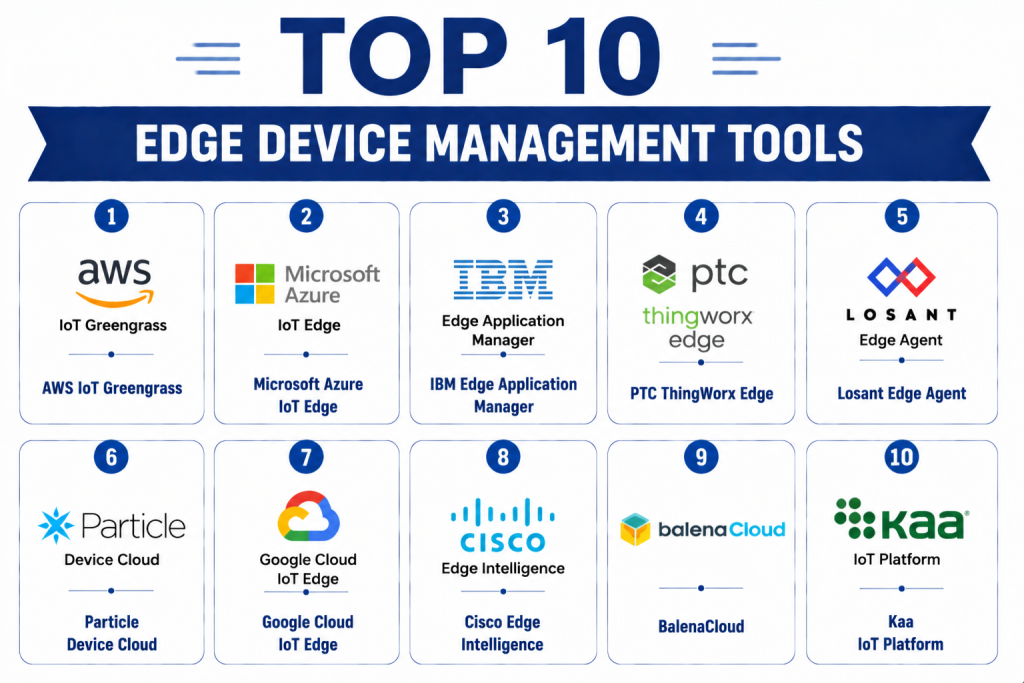
Top 10 Edge Device Management Tools
1- AWS IoT Greengrass
Short description: Provides secure edge computing, device management, and local data processing for connected devices and IoT environments.
Key Features
- Device provisioning and authentication
- Local data processing and edge computing
- Secure message communication
- OTA updates for firmware and software
- Integration with AWS analytics and ML services
Pros
- Scalable and secure
- Tight integration with AWS ecosystem
Cons
- Learning curve for AWS users
- Costs may rise with device scale
Platforms / Deployment
- Linux / Windows / macOS / iOS / Android
- Cloud / Edge
Security & Compliance
- Encryption, IAM, audit logs
- SOC 2, ISO 27001, GDPR
Integrations & Ecosystem
- AWS cloud services
- Machine learning pipelines
- APIs for custom edge workflows
Support & Community
- AWS enterprise support
- Developer forums
2- Microsoft Azure IoT Edge
Short description: Extends cloud intelligence to edge devices for management, analytics, and AI-driven automation.
Key Features
- Local analytics and processing
- Secure device provisioning and identity
- OTA firmware and configuration updates
- Integration with Azure cloud and AI services
- Real-time monitoring and alerts
Pros
- Enterprise-ready and scalable
- Strong AI and analytics integration
Cons
- Azure-focused ecosystem
- Premium cost for advanced features
Platforms / Deployment
- Linux / Windows
- Cloud / Hybrid
Security & Compliance
- SSO, encryption, RBAC
- ISO 27001, SOC 2
Integrations & Ecosystem
- Azure analytics and cloud services
- IoT Hub and DevOps pipelines
- APIs for custom applications
Support & Community
- Microsoft support tiers
- Active developer community
3- IBM Edge Application Manager
Short description: Provides AI-powered edge device management, deployment, and orchestration for enterprise IoT and edge workloads.
Key Features
- Edge device provisioning and management
- AI-driven workload deployment
- Automated software updates
- Real-time device telemetry and monitoring
- Policy-based compliance enforcement
Pros
- Strong AI capabilities for edge computing
- Supports industrial-scale deployments
Cons
- Complex setup
- Premium enterprise pricing
Platforms / Deployment
- Linux / Windows / macOS
- Cloud / Edge
Security & Compliance
- Encryption, RBAC
- SOC 2, ISO 27001
Integrations & Ecosystem
- Cloud and analytics platforms
- Industrial IoT systems
- APIs and SDKs
Support & Community
- Enterprise support
- Active community
4- PTC ThingWorx Edge
Short description: Industrial-focused edge platform providing device management, real-time monitoring, and predictive maintenance analytics.
Key Features
- Edge device provisioning
- Predictive maintenance analytics
- Real-time dashboards
- OTA updates and remote configuration
- Integration with ERP and MES
Pros
- Excellent industrial IoT support
- Strong predictive analytics
Cons
- Complex deployment for SMBs
- Higher pricing for enterprise features
Platforms / Deployment
- Linux / Windows / macOS / iOS / Android
- Cloud / On-premises
Security & Compliance
- Encryption, audit logs
- Not publicly stated
Integrations & Ecosystem
- ERP, MES, cloud analytics
- APIs for custom integration
Support & Community
- Vendor support
- Developer forums
5- Losant Edge Agent
Short description: Enables real-time edge device monitoring, workflow automation, and remote management for distributed IoT environments.
Key Features
- Edge telemetry collection
- Workflow and automation engine
- OTA updates
- Real-time dashboards
- Device provisioning
Pros
- Flexible and low-code automation
- Supports offline operation
Cons
- Smaller ecosystem
- Learning curve for workflow automation
Platforms / Deployment
- Linux / Windows / macOS
- Cloud / Hybrid
Security & Compliance
- Encryption, RBAC
- Not publicly stated
Integrations & Ecosystem
- Cloud analytics platforms
- APIs for custom workflows
- Webhooks for event-driven actions
Support & Community
- Vendor support
- Documentation and forums
6- Particle Device Cloud
Short description: Provides cloud and edge device management, OTA updates, and real-time monitoring for connected products.
Key Features
- Device onboarding and authentication
- OTA firmware updates
- Telemetry ingestion and monitoring
- Event-driven actions
- Analytics dashboards
Pros
- Simple setup for connected products
- Real-time monitoring
Cons
- Limited enterprise features
- Best for small to mid-size fleets
Platforms / Deployment
- Linux / Windows / macOS / iOS / Android
- Cloud
Security & Compliance
- Encryption, access control
- Not publicly stated
Integrations & Ecosystem
- Webhooks and APIs
- Cloud analytics
- SDKs for device integration
Support & Community
- Documentation and community forums
7- Google Cloud IoT Edge
Short description: Extends Google Cloud analytics and AI to edge devices with secure management and real-time monitoring.
Key Features
- Device provisioning and registry
- Local data processing and analytics
- Secure communication
- OTA updates
- Integration with cloud ML
Pros
- Scales for enterprise IoT
- Strong analytics and ML support
Cons
- Google Cloud-focused
- Complexity for heterogeneous fleets
Platforms / Deployment
- Linux / Windows / macOS / iOS / Android
- Cloud / Edge
Security & Compliance
- Encryption, audit logs
- Not publicly stated
Integrations & Ecosystem
- Cloud ML and analytics
- APIs and IoT services
- Event-driven workflows
Support & Community
- Google Cloud support tiers
- Developer forums
8- Cisco Edge Intelligence
Short description: Enterprise edge management platform offering device monitoring, analytics, and security enforcement at the network edge.
Key Features
- Edge device connectivity
- Real-time telemetry
- Security policy enforcement
- Analytics dashboards
- OTA updates
Pros
- Enterprise-grade network and security integration
- Scalable for large fleets
Cons
- Best with Cisco network environments
- Premium cost
Platforms / Deployment
- Linux / Windows / macOS / iOS / Android
- Cloud / Hybrid
Security & Compliance
- Encryption, RBAC, audit logs
- Not publicly stated
Integrations & Ecosystem
- Cisco network devices
- ITSM tools
- APIs
Support & Community
- Cisco enterprise support
- Documentation and forums
9- BalenaCloud
Short description: Cloud-based edge device management platform for provisioning, monitoring, and updating IoT devices.
Key Features
- Device provisioning and authentication
- OTA software and firmware updates
- Real-time monitoring and alerts
- Dashboard analytics
- Remote device management
Pros
- Easy deployment for product teams
- Strong real-time monitoring
Cons
- Limited industrial IoT features
- Smaller enterprise ecosystem
Platforms / Deployment
- Linux / Windows / macOS / iOS / Android
- Cloud
Security & Compliance
- Encryption, access control
- Not publicly stated
Integrations & Ecosystem
- APIs for devices
- Cloud analytics
- Webhooks for workflows
Support & Community
- Documentation and support
- Developer community
10- Kaa IoT Platform
Short description: Open-source edge and IoT management platform for device provisioning, monitoring, and OTA updates.
Key Features
- Device onboarding and lifecycle management
- Real-time telemetry
- OTA firmware updates
- Analytics and dashboards
- Multi-protocol support
Pros
- Open-source flexibility
- Supports heterogeneous devices
Cons
- Requires technical expertise
- Community-based support
Platforms / Deployment
- Linux / Windows / macOS
- Cloud / On-premises
Security & Compliance
- Not publicly stated
Integrations & Ecosystem
- APIs for cloud and analytics
- Device SDKs
- Protocol adapters
Support & Community
- Community forums
- Documentation
Comparison Table (Top 10 Edge Device Management Tools)
| Tool Name | Best For | Platform(s) Supported | Deployment | Standout Feature | Public Rating |
|---|---|---|---|---|---|
| AWS IoT Greengrass | Enterprise IoT | Linux / Windows / macOS / iOS / Android | Cloud / Edge | Scalable AWS integration | N/A |
| Microsoft Azure IoT Edge | Enterprise IoT | Linux / Windows | Cloud / Hybrid | AI & analytics at edge | N/A |
| IBM Edge Application Manager | Industrial IoT | Linux / Windows / macOS / iOS / Android | Cloud / Hybrid | AI-driven edge insights | N/A |
| PTC ThingWorx Edge | Industrial IoT | Linux / Windows / macOS / iOS / Android | Cloud / On-prem | Predictive maintenance | N/A |
| Losant Edge Agent | Mid-market & Enterprise | Linux / Windows / macOS | Cloud / Hybrid | Low-code workflow automation | N/A |
| Particle Device Cloud | Connected product fleets | Linux / Windows / macOS / iOS / Android | Cloud | OTA firmware updates | N/A |
| Google Cloud IoT Edge | Cloud-native IoT | Linux / Windows / macOS / iOS / Android | Cloud / Edge | Cloud ML at edge | N/A |
| Cisco Edge Intelligence | Enterprise IoT | Linux / Windows / macOS / iOS / Android | Cloud / Hybrid | Network & security integrated | N/A |
| BalenaCloud | IoT product teams | Linux / Windows / macOS / iOS / Android | Cloud | Easy provisioning & monitoring | N/A |
| Kaa IoT Platform | Open-source IoT fleets | Linux / Windows / macOS | Cloud / On-prem | Flexible open-source platform | N/A |
Evaluation & Scoring of Edge Device Management Tools
| Tool Name | Core (25%) | Ease (15%) | Integrations (15%) | Security (10%) | Performance (10%) | Support (10%) | Value (15%) | Weighted Total (0–10) |
|---|---|---|---|---|---|---|---|---|
| AWS IoT Greengrass | 9 | 7 | 9 | 9 | 9 | 8 | 7 | 8.6 |
| Microsoft Azure IoT Edge | 8 | 7 | 8 | 8 | 8 | 8 | 7 | 7.8 |
| IBM Edge Application Manager | 8 | 7 | 8 | 7 | 8 | 7 | 7 | 7.6 |
| PTC ThingWorx Edge | 8 | 7 | 7 | 7 | 8 | 7 | 7 | 7.6 |
| Losant Edge Agent | 7 | 8 | 7 | 7 | 7 | 7 | 7 | 7.2 |
| Particle Device Cloud | 7 | 8 | 6 | 7 | 7 | 7 | 7 | 7.0 |
| Google Cloud IoT Edge | 7 | 7 | 6 | 7 | 7 | 7 | 7 | 6.8 |
| Cisco Edge Intelligence | 8 | 7 | 7 | 7 | 8 | 7 | 7 | 7.6 |
| BalenaCloud | 6 | 8 | 6 | 6 | 7 | 7 | 7 | 6.8 |
| Kaa IoT Platform | 6 | 7 | 6 | 6 | 7 | 7 | 8 | 6.8 |
Interpretation: Weighted totals reflect comparative capabilities in management, security, monitoring, and integration for edge devices.
Which Edge Device Management Tool Is Right for You?
Solo / Freelancer
Particle Device Cloud or Kaa IoT for small or prototype edge device deployments.
SMB
Losant Edge Agent or BalenaCloud for cost-effective management and automation.
Mid-Market
PTC ThingWorx Edge or Cisco Edge Intelligence for scalable edge monitoring and orchestration.
Enterprise
AWS IoT Greengrass, Azure IoT Edge, or IBM Edge Application Manager for large-scale, secure, and analytics-driven edge deployments.
Budget vs Premium
Budget teams may rely on open-source Kaa IoT or Particle Cloud. Premium enterprises benefit from AWS, Azure, or IBM platforms.
Feature Depth vs Ease of Use
Complex deployments suit AWS, Azure, IBM, or PTC. Smaller or simpler edge fleets work well with Losant or Balena.
Integrations & Scalability
AWS, Azure, IBM, and PTC offer robust integrations and scale globally.
Security & Compliance Needs
Enterprises requiring encryption, audit logs, RBAC, and compliance certifications should focus on AWS, Azure, or IBM platforms.
Frequently Asked Questions (FAQs)
1- What is an Edge Device Management Tool?
Software for provisioning, monitoring, updating, and securing distributed edge devices across networks and IoT environments.
2- Can these platforms manage large fleets?
Yes. Enterprise platforms like AWS, Azure, and IBM scale to tens of thousands or more edge devices.
3- Do these tools support OTA updates?
Yes, most platforms allow firmware and software updates over-the-air to ensure security and consistency.
4- Are they suitable for industrial IoT?
Yes, platforms like PTC ThingWorx, IBM, and Cisco Edge Intelligence target industrial environments.
5- Can these tools integrate with cloud analytics?
Yes. They support integration with cloud-based analytics, AI, and operational dashboards for actionable insights.
6- How secure are edge device management platforms?
Enterprise platforms provide encryption, RBAC, SSO, audit logs, and compliance with SOC 2, ISO, and GDPR standards.
7- Are open-source options available?
Yes, Kaa IoT offers open-source flexibility for custom edge device management.
8- Do these platforms provide real-time monitoring?
Yes, all platforms include dashboards, alerts, and telemetry monitoring for device health and performance.
9- Can small organizations benefit?
Yes, solutions like Particle Cloud, BalenaCloud, or Kaa IoT provide affordable options for small fleets.
10- What are common challenges?
Integration complexity, heterogeneous devices, scaling, and ensuring secure remote management are common challenges.
Conclusion
Edge Device Management Tools help organizations efficiently manage distributed, connected, and IoT devices. Selection depends on fleet size, device diversity, automation needs, and integration requirements. Smaller teams may prefer lightweight or open-source solutions, while enterprises require scalable, AI-driven, and fully integrated platforms. Shortlist , run pilot programs, and validate security and integrations before full deployment.
