Introduction
Knowledge Graph Databases are specialized databases designed to represent, store, and query complex relationships between entities in a graph format. Unlike traditional relational databases, they model data as nodes (entities) and edges (relationships), enabling semantic queries, relationship analysis, and connected insights across diverse datasets.
In , as organizations manage growing volumes of structured and unstructured data across multi-cloud environments, knowledge graph databases are essential for applications in AI, recommendation engines, fraud detection, and enterprise data integration. These platforms allow companies to derive richer insights from connected data, supporting real-time analytics, semantic search, and AI-driven reasoning.
Real-world use cases include:
- Building recommendation engines for e-commerce and streaming platforms.
- Detecting fraud and anomalies in finance and insurance datasets.
- Semantic search and natural language query capabilities.
- Knowledge management and enterprise data integration.
- AI/ML applications requiring relationship-aware datasets.
Evaluation Criteria for Buyers:
- Support for graph query languages (SPARQL, Cypher, Gremlin)
- Scalability for large graph datasets
- Performance of relationship queries and traversals
- Integration with AI/ML and analytics pipelines
- Deployment flexibility (cloud, on-prem, hybrid)
- Security and access control (RBAC, SSO, encryption)
- Data modeling and visualization capabilities
- Monitoring, logging, and alerting features
- Open-source vs commercial ecosystem support
- Vendor support and community maturity
Best for: Data scientists, knowledge engineers, AI/ML teams, and enterprises managing connected, relationship-rich datasets across industries such as finance, healthcare, e-commerce, and media.
Not ideal for: Organizations with simple relational datasets or minimal connected data; traditional relational or NoSQL databases may suffice.
Key Trends in Knowledge Graph Databases
- AI-enhanced graph analytics for predictive insights and anomaly detection.
- Integration with multi-cloud, hybrid, and on-prem data sources.
- Real-time graph querying and dynamic relationship updates.
- Semantic search and natural language interface support.
- Enhanced observability, lineage, and graph monitoring.
- Enterprise-grade security and compliance with RBAC, SSO, and encryption.
- Low-code/no-code interfaces for business analysts.
- Automated knowledge graph construction from structured and unstructured data.
- Scalability for billion-node graphs with optimized storage engines.
- Flexible pricing models including cloud, consumption-based, and enterprise licensing.
How We Selected These Tools (Methodology)
- Evaluated market adoption and recognition among enterprises and AI/ML teams.
- Assessed feature completeness including query languages, relationship modeling, and visualization.
- Reviewed performance and reliability for large-scale graph traversals.
- Verified security posture, including RBAC, encryption, and compliance certifications.
- Checked integration ecosystem with BI, AI, ML, and analytics tools.
- Considered customer fit across SMB, mid-market, and enterprise segments.
- Prioritized platforms with AI/ML-ready graph capabilities.
- Examined support and community engagement for onboarding, troubleshooting, and development.
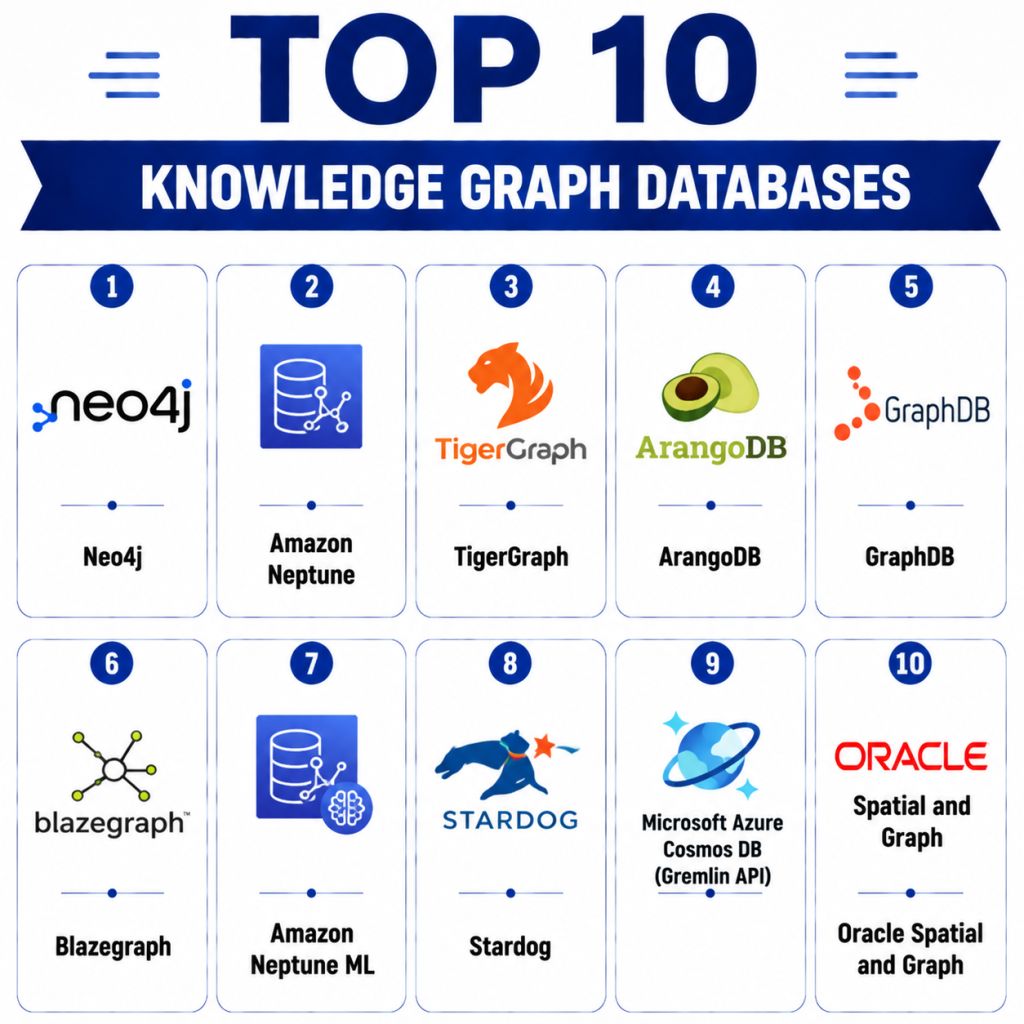
Top 10 Knowledge Graph Databases
1- Neo4j
Short description: Neo4j is a leading graph database platform optimized for storing and querying highly connected data. It is widely used for recommendation engines, fraud detection, and knowledge management.
Key Features
- Cypher query language for graph operations
- ACID-compliant transactional support
- Scalable for large graphs
- Graph visualization and modeling tools
- Integration with AI/ML pipelines
- High-performance traversal engine
Pros
- Mature ecosystem and tooling
- High performance for connected data queries
- Active developer and enterprise community
Cons
- Requires expertise in graph modeling
- Licensing cost for enterprise features
Platforms / Deployment
- Linux, Windows / Cloud / On-prem / Hybrid
Security & Compliance
- RBAC, encryption, SSO/SAML
- SOC 2, ISO 27001
Integrations & Ecosystem
Supports BI, ML, and analytics platforms.
- Python, Java, and .NET APIs
- Apache Spark, TensorFlow
- Tableau, Power BI
Support & Community
Enterprise support available, active developer forums, extensive documentation.
2- Amazon Neptune
Short description: Amazon Neptune is a fully managed graph database service that supports both property graphs and RDF triples for relationship-driven applications.
Key Features
- Supports Gremlin and SPARQL query languages
- Fully managed cloud deployment
- High availability and durability
- Integration with AWS ecosystem
- Automated backups and patching
- Optimized for read-heavy and write-heavy workloads
Pros
- Fully managed with minimal operational overhead
- Seamless AWS integration
- Scalable and highly available
Cons
- Limited to AWS ecosystem
- Cloud-only deployment
Platforms / Deployment
- Cloud (AWS)
Security & Compliance
- Encryption at rest and in transit
- SOC 2, ISO 27001, GDPR
Integrations & Ecosystem
- AWS services: S3, Lambda, Redshift
- BI and analytics tools
- AI/ML platforms on AWS
Support & Community
AWS enterprise support, online documentation, AWS developer community.
3- TigerGraph
Short description: TigerGraph is a scalable, enterprise-grade graph database designed for real-time analytics on large datasets, suitable for fraud detection, recommendation engines, and supply chain intelligence.
Key Features
- GSQL query language
- Real-time analytics and graph traversals
- Multi-cloud and on-prem deployment
- Built-in graph visualization
- High-speed parallel processing
- AI/ML integrations
Pros
- High performance for large, complex graphs
- Supports real-time analytics
- Flexible deployment models
Cons
- Enterprise features require licensing
- Learning curve for GSQL
Platforms / Deployment
- Linux / Cloud / On-prem / Hybrid
Security & Compliance
- RBAC, encryption
- SOC 2, ISO 27001
Integrations & Ecosystem
- BI tools: Tableau, Power BI
- Data pipelines: Kafka, Spark
- ML frameworks: TensorFlow, PyTorch
Support & Community
Enterprise support, documentation, active knowledge graph community.
4- ArangoDB
Short description: ArangoDB is a multi-model database supporting graphs, documents, and key-value data, providing flexible data modeling for connected data applications.
Key Features
- Supports graph, document, and key-value models
- AQL query language
- ACID transactions
- Distributed graph processing
- Cloud and on-prem deployments
- Visualization and data management tools
Pros
- Multi-model flexibility
- Scalable distributed architecture
- Open-source community support
Cons
- Enterprise-grade features require licensing
- Complex setup for large-scale deployments
Platforms / Deployment
- Linux, Windows / Cloud / On-prem / Hybrid
Security & Compliance
- RBAC, encryption
- Not publicly stated
Integrations & Ecosystem
- APIs: REST, JavaScript, Python
- BI integration: Tableau, Power BI
- Cloud connectors: AWS, Azure, GCP
Support & Community
Open-source and commercial support, documentation, active forums.
5- GraphDB
Short description: GraphDB is an RDF graph database optimized for semantic queries and knowledge representation, often used in linked data and AI knowledge management.
Key Features
- SPARQL query engine
- RDF triple storage
- Semantic reasoning and inference
- High-performance graph processing
- Scalable clustering
- Integration with AI and NLP pipelines
Pros
- Optimized for semantic and linked data
- Scalable for enterprise knowledge graphs
- Strong AI/ML integration
Cons
- Primarily RDF-focused
- Less suited for property graph modeling
Platforms / Deployment
- Linux, Windows / Cloud / On-prem
Security & Compliance
- RBAC, encryption
- Not publicly stated
Integrations & Ecosystem
- NLP and AI frameworks
- BI tools: Tableau
- APIs for custom application integration
Support & Community
Enterprise support, documentation, academic community contributions.
6- Blazegraph
Short description: Blazegraph is an open-source, high-performance graph database designed for RDF data and large-scale knowledge graph applications.
Key Features
- RDF triple store
- SPARQL query support
- High-performance transactional engine
- Clustering and replication
- Semantic reasoning
- REST API and Java APIs
Pros
- Open-source and extensible
- High scalability and performance
- Supports semantic queries
Cons
- Enterprise support limited
- Primarily RDF-focused
Platforms / Deployment
- Linux / Cloud / On-prem
Security & Compliance
- Basic RBAC
- Not publicly stated
Integrations & Ecosystem
- APIs: REST, Java
- AI/NLP pipelines
- Semantic web tools
Support & Community
Open-source community support, forums, documentation.
7- Amazon Neptune ML
Short description: Neptune ML extends Amazon Neptune by integrating ML models to analyze graph patterns and predict relationships.
Key Features
- Graph ML capabilities
- Real-time predictions on relationships
- Integration with Neptune databases
- Automated model training pipelines
- Query optimization
- Cloud-native deployment
Pros
- Direct integration with Neptune
- Enables predictive analytics on graph data
- Fully managed
Cons
- Limited to AWS ecosystem
- Requires Neptune instance
Platforms / Deployment
- Cloud (AWS)
Security & Compliance
- Encryption, RBAC
- SOC 2, ISO 27001
Integrations & Ecosystem
- AWS ML services: SageMaker
- BI and analytics tools
- REST APIs
Support & Community
AWS support, documentation, developer forums.
8- Stardog
Short description: Stardog is an enterprise knowledge graph platform combining graph database, reasoning, and search for connected data applications.
Key Features
- RDF and property graph support
- SPARQL and reasoning engine
- Full-text search and semantic search
- Cloud and on-prem deployments
- Role-based security and auditing
- AI/ML integration
Pros
- Powerful semantic and property graph capabilities
- Enterprise-grade security and compliance
- Scalable and extensible
Cons
- Commercial licensing
- Learning curve for semantic reasoning
Platforms / Deployment
- Linux, Windows / Cloud / On-prem / Hybrid
Security & Compliance
- RBAC, SSO, encryption
- SOC 2, ISO 27001, GDPR
Integrations & Ecosystem
- APIs: REST, Java
- BI tools: Tableau, Power BI
- AI pipelines: TensorFlow, PyTorch
Support & Community
Enterprise support, knowledge base, active forums.
9- Microsoft Azure Cosmos DB (Gremlin API)
Short description: Cosmos DB with Gremlin API enables property graph modeling for global-scale knowledge graphs with multi-region replication and low-latency queries.
Key Features
- Gremlin graph query support
- Multi-region replication
- Global low-latency access
- Fully managed cloud service
- Integration with Azure ecosystem
- Security and compliance controls
Pros
- Cloud-native and globally scalable
- Managed service with high availability
- Multi-cloud integration via connectors
Cons
- Tied to Azure ecosystem
- Commercial pricing
Platforms / Deployment
- Cloud (Azure)
Security & Compliance
- RBAC, encryption
- SOC 2, ISO 27001, GDPR
Integrations & Ecosystem
- Azure ML, Power BI
- REST APIs and SDKs
- Data pipelines and connectors
Support & Community
Microsoft enterprise support, documentation, community forums.
10- Oracle Spatial and Graph
Short description: Oracle Spatial and Graph extends Oracle Database with graph database capabilities, supporting both RDF and property graphs for enterprise knowledge management.
Key Features
- RDF and property graph support
- SPARQL and PGQL query languages
- Integration with Oracle analytics
- Scalable graph processing
- Security and access control
- Enterprise-grade reliability
Pros
- Mature enterprise platform
- Supports complex, connected datasets
- Tight integration with Oracle analytics
Cons
- Enterprise licensing required
- Primarily suited for Oracle ecosystem
Platforms / Deployment
- Linux, Windows / Cloud / On-prem / Hybrid
Security & Compliance
- RBAC, SSO, encryption
- SOC 2, ISO 27001, GDPR
Integrations & Ecosystem
- Oracle analytics and BI
- APIs and SDKs
- ML and AI pipelines
Support & Community
Enterprise support, documentation, Oracle user community.
Comparison Table (Top 10)
| Tool Name | Best For | Platform(s) Supported | Deployment | Standout Feature | Public Rating |
|---|---|---|---|---|---|
| Neo4j | Property graph | Linux, Windows | Cloud / On-prem / Hybrid | High-performance traversal | N/A |
| Amazon Neptune | RDF & Property graph | Cloud (AWS) | Cloud | Fully managed | N/A |
| TigerGraph | Real-time analytics | Linux | Cloud / On-prem / Hybrid | Parallel graph processing | N/A |
| ArangoDB | Multi-model | Linux, Windows | Cloud / On-prem / Hybrid | Graph + document + key-value | N/A |
| GraphDB | Semantic web | Linux, Windows | Cloud / On-prem | RDF reasoning engine | N/A |
| Blazegraph | RDF graphs | Linux | Cloud / On-prem | Open-source, high-performance | N/A |
| Neptune ML | Predictive analytics | Cloud (AWS) | Cloud | ML integration | N/A |
| Stardog | Enterprise knowledge | Linux, Windows | Cloud / On-prem / Hybrid | Semantic reasoning & search | N/A |
| Cosmos DB Gremlin API | Property graph | Cloud (Azure) | Cloud | Global low-latency | N/A |
| Oracle Spatial & Graph | Enterprise graph | Linux, Windows | Cloud / On-prem / Hybrid | RDF + property graph | N/A |
Evaluation & Scoring of Knowledge Graph Databases
| Tool Name | Core (25%) | Ease (15%) | Integrations (15%) | Security (10%) | Performance (10%) | Support (10%) | Value (15%) | Weighted Total |
|---|---|---|---|---|---|---|---|---|
| Neo4j | 9 | 8 | 8 | 8 | 9 | 8 | 7 | 8.3 |
| Amazon Neptune | 8 | 8 | 8 | 8 | 8 | 7 | 7 | 7.8 |
| TigerGraph | 9 | 7 | 8 | 8 | 9 | 8 | 7 | 8.2 |
| ArangoDB | 8 | 7 | 8 | 7 | 8 | 7 | 8 | 7.7 |
| GraphDB | 8 | 7 | 8 | 7 | 8 | 7 | 7 | 7.5 |
| Blazegraph | 7 | 7 | 7 | 7 | 8 | 7 | 8 | 7.3 |
| Neptune ML | 8 | 7 | 8 | 8 | 8 | 7 | 7 | 7.8 |
| Stardog | 9 | 7 | 8 | 8 | 9 | 8 | 7 | 8.2 |
| Cosmos DB Gremlin | 8 | 8 | 8 | 8 | 8 | 7 | 7 | 7.8 |
| Oracle Spatial & Graph | 9 | 7 | 8 | 8 | 9 | 8 | 7 | 8.2 |
Interpretation: Weighted scores reflect comparative platform strengths in query performance, integrations, ease of use, and enterprise suitability. Higher totals indicate more robust knowledge graph capabilities for complex datasets.
Which Knowledge Graph Database Tool Is Right for You?
Solo / Freelancer
- Neo4j Express or Blazegraph for experimentation and small-scale graph projects.
SMB
- ArangoDB or TigerGraph for cloud-native multi-source connected data applications.
Mid-Market
- Amazon Neptune or Stardog for hybrid cloud, analytics, and BI integration.
Enterprise
- Neo4j Enterprise, Oracle Spatial & Graph, or Neptune ML for large-scale, secure, and AI/ML-ready knowledge graphs.
Budget vs Premium
- Open-source tools offer cost efficiency; enterprise tools provide governance, performance, and compliance features.
Feature Depth vs Ease of Use
- Neo4j and Stardog offer deep graph capabilities; ArangoDB and TigerGraph provide lower-code, multi-model flexibility.
Integrations & Scalability
- Enterprise platforms like Neo4j, Neptune, and Stardog scale globally across cloud, hybrid, and on-prem deployments.
Security & Compliance Needs
- HIPAA, SOC 2, ISO 27001, and GDPR compliant options are available with Neo4j Enterprise, Stardog, and Neptune ML.
Frequently Asked Questions (FAQs)
1- What pricing models are typical?
Open-source databases are free; commercial platforms use subscription or enterprise licensing models.
2- How long does deployment take?
Small-scale graphs can deploy in days; enterprise deployments require weeks for integration and optimization.
3- Are these platforms cloud-ready?
Yes, most top knowledge graph databases support cloud, hybrid, and on-prem deployments.
4- Do they support AI/ML integration?
Yes, platforms like Neptune ML, TigerGraph, and Stardog integrate with AI/ML pipelines.
5- Can they handle billions of nodes?
Enterprise platforms like Neo4j, TigerGraph, and Oracle Spatial & Graph scale to billion-node graphs.
6- Is graph query performance fast?
Optimized storage engines and caching provide sub-second query response for complex traversals.
7- Are low-code options available?
Some tools like Stardog and ArangoDB offer low-code and visual modeling interfaces.
8- How is security managed?
RBAC, encryption, SSO/SAML, and audit logs enforce secure access and compliance.
9- Can they integrate with BI tools?
Yes, all top platforms support Tableau, Power BI, and other analytics connectors.
10- What are alternatives for simple datasets?
Relational databases or document stores may suffice for less connected datasets.
Conclusion
Knowledge Graph Databases enable enterprises to model, query, and analyze highly connected data, supporting AI, analytics, and semantic search. Open-source tools like Blazegraph and ArangoDB provide flexibility and cost efficiency, while enterprise-grade solutions like Neo4j, Stardog, and Amazon Neptune offer scalability, governance, and AI/ML integration.
