Introduction
AI Translation for Government Services Tools use artificial intelligence, machine learning, natural language processing, speech recognition, and automated language technologies to help government agencies provide multilingual services to citizens.
Governments serve diverse populations where residents may speak different languages or require translation support for accessing public information, healthcare services, legal documents, emergency communication, immigration services, and administrative programs.
Traditional translation processes often rely on human translators, which can be expensive, time-consuming, and difficult to scale during high-demand situations. AI-powered translation platforms help government organizations deliver faster and more accessible multilingual services.
These tools analyze text, speech, documents, and conversations to provide accurate translations while supporting communication between government employees and citizens.
AI translation solutions help organizations:
- Translate government documents
- Improve citizen communication
- Support multilingual public services
- Enable real-time interpretation
- Reduce translation workload
- Improve accessibility
- Expand digital government services
AI translation platforms are used by:
- Government agencies
- Municipal departments
- Immigration offices
- Public healthcare systems
- Emergency services
- Courts and legal departments
- Education departments
- International organizations
Modern platforms combine neural machine translation, speech recognition, large language models, terminology management, and automated language workflows.
The goal of these solutions is to make government services more inclusive, accessible, and efficient for citizens regardless of language barriers.
How AI Translation for Government Services Works
Data Input
AI systems process:
- Government documents
- Citizen requests
- Web content
- Forms
- Audio conversations
- Video communication
Language Understanding
AI analyzes:
- Sentence meaning
- Context
- Terminology
- Cultural language differences
- Government-specific vocabulary
Translation Generation
AI produces:
- Text translations
- Speech translations
- Document translations
- Real-time interpretation
Quality Improvement
AI improves through:
- Human corrections
- Translation memories
- Domain-specific terminology
- Feedback loops
Deployment
Government organizations use AI translation through:
- Web portals
- Mobile applications
- Call centers
- Service kiosks
- Internal systems
Common Use Cases
- Multilingual citizen portals
- Immigration services
- Public health communication
- Emergency alerts
- Government document translation
- Legal document support
- Public education materials
- International cooperation
- Customer service centers
- Accessibility programs
Why AI Translation Tools Matter for Government Services
Improved Citizen Access
AI helps citizens access government information in their preferred language.
Faster Communication
Real-time translation improves communication speed.
Lower Operational Costs
Automation reduces dependence on manual translation for routine content.
Better Emergency Response
Multilingual communication helps during emergencies.
Increased Inclusion
Government services become more accessible to diverse communities.
Evaluation Criteria for Buyers
Translation Accuracy
Tools should provide reliable translations across languages.
Language Coverage
Platforms should support multiple languages and regional variations.
Real-Time Translation
Important for:
- Citizen calls
- Meetings
- Emergency communication
Document Processing
Solutions should handle:
- Forms
- Reports
- Legal documents
- Public notices
Security and Privacy
Government data requires strong protection.
Integration Capability
Important integrations include:
- Government portals
- Contact centers
- Document systems
- Mobile applications
Customization
Platforms should support government-specific terminology.
Key Trends
AI-Powered Multilingual Government Services
Governments are adopting AI to improve citizen access.
Real-Time Speech Translation
AI is enabling faster communication between officials and citizens.
Large Language Model Translation
Advanced AI models are improving contextual translation quality.
Digital Government Accessibility
Translation is becoming a core part of online public services.
Domain-Specific Translation
AI models are being customized for legal, healthcare, and administrative terminology.
Human-AI Translation Collaboration
Organizations are combining AI speed with human review for critical content.
Methodology
The following platforms were evaluated using:
- Translation capabilities
- Government service suitability
- Language support
- Speech translation features
- Document translation
- Security features
- Integration support
- Ease of use
- Reliability
- Price and value
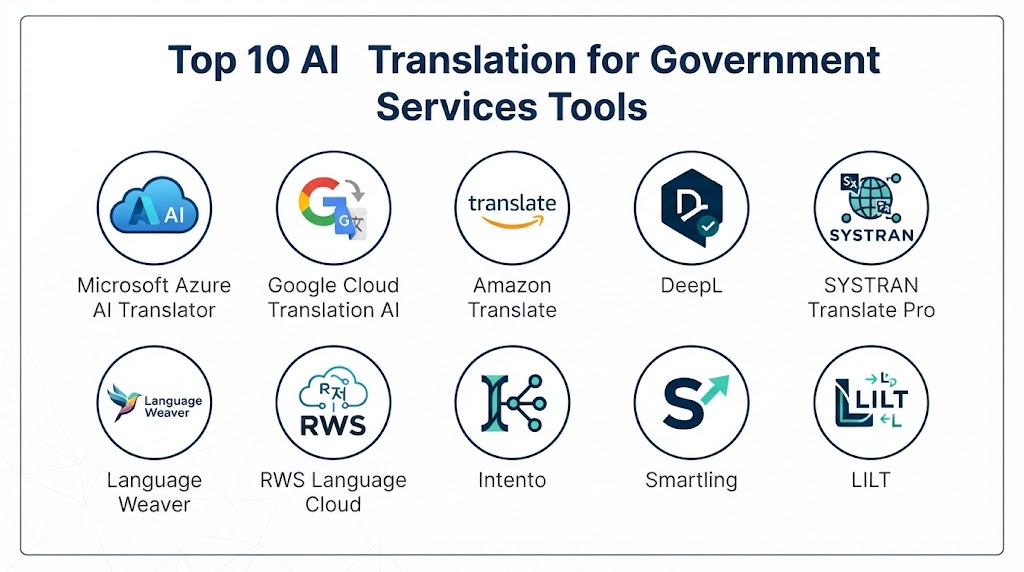
Top 10 AI Translation for Government Services Tools
1. Google Cloud Translation AI
Google Cloud Translation provides AI-powered translation services for multilingual applications.
Key Features
- Neural machine translation
- Language detection
- Document translation
- Speech translation support
- Custom translation models
- API integration
- Real-time translation
- Translation management
- Language analytics
- Enterprise controls
Pros
- Supports many languages
- Strong AI translation quality
- Scalable cloud platform
- Developer-friendly APIs
- Good ecosystem integration
Cons
- Cloud dependency
- Requires configuration
- Sensitive data requires governance
Platforms
Cloud platform.
Deployment or Support
Cloud deployment.
Security & Compliance
Enterprise cloud security controls.
Integrations & Ecosystem
Government portals, applications, APIs, and communication systems.
Support & Community
Enterprise support.
2. Microsoft Azure AI Translator
Azure AI Translator provides enterprise translation capabilities for organizations.
Key Features
- Text translation
- Speech translation
- Custom terminology
- Document translation
- Language detection
- API integration
- Real-time communication
- AI models
- Workflow automation
- Enterprise security
Pros
- Strong enterprise integration
- Supports government workflows
- Custom terminology support
- Scalable infrastructure
- Security capabilities
Cons
- Requires technical setup
- Cloud-based
- Advanced customization needs expertise
Platforms
Cloud platform.
Deployment or Support
Azure cloud deployment.
Security & Compliance
Enterprise security controls.
Integrations & Ecosystem
Microsoft applications, government systems, APIs, and communication platforms.
Support & Community
Microsoft support ecosystem.
3. Amazon Translate
Amazon Translate provides neural machine translation services.
Key Features
- Neural translation
- Real-time translation
- Document translation
- Language detection
- Custom terminology
- API access
- Application integration
- Automated workflows
- Scalable processing
- Cloud analytics
Pros
- Scalable infrastructure
- Flexible APIs
- Strong cloud ecosystem
- Fast translation processing
- Developer-friendly
Cons
- Requires AWS expertise
- Customization needed
- Cloud dependency
Platforms
AWS cloud platform.
Deployment or Support
Cloud deployment.
Security & Compliance
AWS security controls.
Integrations & Ecosystem
AWS services, applications, government platforms, and APIs.
Support & Community
AWS support ecosystem.
4. DeepL Translator
DeepL provides AI translation technology focused on natural language quality.
Key Features
- Neural translation
- Document translation
- Writing assistance
- Glossaries
- Language detection
- Enterprise translation
- API integration
- Security controls
- Text improvement
- Collaboration tools
Pros
- High-quality translations
- Strong language fluency
- Easy usability
- Good document support
- Enterprise options
Cons
- Language coverage varies
- Requires review for official documents
- Enterprise features vary
Platforms
Cloud platform.
Deployment or Support
Cloud deployment.
Security & Compliance
Security controls vary.
Integrations & Ecosystem
Business applications, APIs, and document systems.
Support & Community
Customer support.
5. IBM Watson Language Translator
IBM provides AI language translation capabilities.
Key Features
- Language translation
- Custom language models
- Text analysis
- API integration
- Document workflows
- AI language processing
- Enterprise deployment
- Translation management
- Analytics
- Automation
Pros
- Enterprise AI capabilities
- Customization support
- Strong security focus
- Integration options
- Suitable for organizations
Cons
- Requires expertise
- Implementation effort
- Enterprise-focused
Platforms
Cloud platform.
Deployment or Support
Cloud deployment.
Security & Compliance
Enterprise security controls.
Integrations & Ecosystem
IBM systems, applications, APIs, and enterprise platforms.
Support & Community
Enterprise support.
6. SYSTRAN Translate
SYSTRAN provides enterprise translation solutions.
Key Features
- Neural translation
- Government translation support
- Secure translation
- Custom language models
- Document translation
- Terminology management
- API access
- Workflow automation
- Enterprise deployment
- Language analytics
Pros
- Strong enterprise translation
- Security-focused options
- Custom models
- Government suitability
- Domain-specific translation
Cons
- Enterprise implementation
- Requires configuration
- Pricing varies
Platforms
Cloud and enterprise platforms.
Deployment or Support
Cloud and private deployment.
Security & Compliance
Enterprise security controls.
Integrations & Ecosystem
Government systems, document platforms, and enterprise applications.
Support & Community
Enterprise support.
7. LanguageLine AI Translation Solutions
LanguageLine provides language interpretation and translation services supported by technology.
Key Features
- AI-assisted translation
- Interpretation services
- Multilingual communication
- Document translation
- Call center support
- Language access solutions
- Workflow management
- Human-AI collaboration
- Reporting
- Accessibility support
Pros
- Strong government language service experience
- Human support available
- Good interpretation capabilities
- Suitable for public services
- Multilingual support
Cons
- Service-based model
- Pricing varies
- AI capabilities depend on service
Platforms
Cloud and service platforms.
Deployment or Support
Managed service deployment.
Security & Compliance
Security controls vary.
Integrations & Ecosystem
Contact centers, government services, and communication systems.
Support & Community
Professional support.
8. Unbabel AI Translation Platform
Unbabel combines AI translation with human review workflows.
Key Features
- AI translation
- Human quality review
- Language workflows
- Translation management
- Content localization
- Quality scoring
- Automation
- Collaboration
- Analytics
- API integration
Pros
- Human-AI combination
- Quality control
- Workflow automation
- Enterprise support
- Good localization capabilities
Cons
- Requires workflow setup
- Cost varies
- Human review adds complexity
Platforms
Cloud platform.
Deployment or Support
Cloud deployment.
Security & Compliance
Enterprise security controls.
Integrations & Ecosystem
Customer platforms, content systems, APIs, and communication tools.
Support & Community
Enterprise support.
9. Smartling AI Translation
Smartling provides translation management and localization technology.
Key Features
- AI translation
- Translation management
- Quality monitoring
- Workflow automation
- Content localization
- Analytics
- Human review
- API integration
- Language assets
- Reporting
Pros
- Strong translation workflows
- Good localization support
- Quality management
- Enterprise capabilities
- Automation features
Cons
- Enterprise-focused
- Requires configuration
- Localization complexity
Platforms
Cloud platform.
Deployment or Support
Cloud deployment.
Security & Compliance
Enterprise security controls.
Integrations & Ecosystem
Content platforms, applications, APIs, and business systems.
Support & Community
Enterprise support.
10. RWS Language Cloud
RWS provides AI translation and language management solutions.
Key Features
- Machine translation
- Translation management
- Language automation
- Document translation
- Terminology management
- Localization workflows
- Quality monitoring
- Enterprise integrations
- Reporting
- Collaboration
Pros
- Strong language services expertise
- Enterprise capabilities
- Good workflow management
- Supports complex translation needs
- Localization support
Cons
- Enterprise-oriented
- Implementation effort
- Requires configuration
Platforms
Cloud platform.
Deployment or Support
Cloud deployment.
Security & Compliance
Enterprise security controls.
Integrations & Ecosystem
Content systems, government platforms, and enterprise applications.
Support & Community
Enterprise support.
Comparison Table
| Tool Name | Best For | Platform(s) Supported | Deployment | Standout Feature | Public Rating |
|---|---|---|---|---|---|
| Google Cloud Translation AI | Large-scale translation | Cloud | Cloud | Language coverage | N/A |
| Azure AI Translator | Government enterprise use | Cloud | Cloud | Enterprise integration | N/A |
| Amazon Translate | Developer applications | Cloud | Cloud | Scalable APIs | N/A |
| DeepL Translator | High-quality translation | Cloud | Cloud | Natural language quality | N/A |
| IBM Watson Translator | Enterprise translation | Cloud | Cloud | AI customization | N/A |
| SYSTRAN Translate | Secure translation | Cloud/Private | Hybrid | Domain translation | N/A |
| LanguageLine AI | Public language access | Cloud | Managed | Interpretation support | N/A |
| Unbabel | AI + human translation | Cloud | Cloud | Quality workflows | N/A |
| Smartling | Localization workflows | Cloud | Cloud | Translation management | N/A |
| RWS Language Cloud | Enterprise language services | Cloud | Cloud | Localization expertise | N/A |
Weighted Evaluation
| Tool Name | Core Features 25% | Ease of Use 15% | Integrations & Ecosystem 15% | Security & Compliance 10% | Performance & Reliability 10% | Support & Community 10% | Price/Value 15% | Total |
|---|---|---|---|---|---|---|---|---|
| Google Cloud Translation | 25 | 14 | 15 | 10 | 10 | 10 | 12 | 96 |
| Azure AI Translator | 25 | 14 | 15 | 10 | 10 | 10 | 12 | 96 |
| Amazon Translate | 24 | 13 | 15 | 10 | 10 | 10 | 12 | 94 |
| DeepL Translator | 23 | 15 | 13 | 10 | 10 | 10 | 12 | 93 |
| IBM Watson Translator | 23 | 12 | 14 | 10 | 10 | 10 | 11 | 90 |
| SYSTRAN Translate | 24 | 12 | 14 | 10 | 10 | 10 | 11 | 91 |
| LanguageLine AI | 23 | 13 | 13 | 10 | 10 | 10 | 11 | 90 |
| Unbabel | 23 | 14 | 14 | 10 | 10 | 10 | 11 | 92 |
| Smartling | 23 | 13 | 14 | 10 | 10 | 10 | 11 | 91 |
| RWS Language Cloud | 24 | 12 | 14 | 10 | 10 | 10 | 10 | 90 |
Which AI Translation for Government Services Tool Is Right for You?
Choose Google Cloud Translation AI when large-scale multilingual services are required.
Choose Azure AI Translator when government systems need enterprise integration.
Choose Amazon Translate when scalable translation APIs are needed.
Choose DeepL Translator when high-quality language output is important.
Choose IBM Watson Language Translator when enterprise AI customization is required.
Choose SYSTRAN Translate when secure government translation is needed.
Choose LanguageLine AI Translation Solutions when human-supported language access is important.
Choose Unbabel when AI and human review workflows are required.
Choose Smartling when translation management is a priority.
Choose RWS Language Cloud when complex localization programs are required.
Implementation Playbook
Phase 1: Define Translation Goals
- Identify language requirements
- Select government services
- Define quality standards
- Identify user groups
- Establish success metrics
Phase 2: Prepare Language Data
- Collect government terminology
- Prepare translation memories
- Configure security policies
- Connect service platforms
- Define workflows
Phase 3: Deploy AI Translation
- Configure translation models
- Integrate government portals
- Enable document translation
- Set review processes
- Test accuracy
Phase 4: Measure Results
- Improve citizen access
- Reduce translation delays
- Monitor quality
- Track service usage
- Improve communication
Phase 5: Maintain Responsible AI
- Review translations
- Update terminology
- Monitor accuracy
- Protect citizen data
- Maintain human oversight
Common Mistakes
- Using AI without human review for critical documents
- Ignoring regional language differences
- Poor terminology management
- Weak privacy controls
- Not testing translation accuracy
- Lack of integration planning
- Ignoring accessibility requirements
- Overlooking cultural context
FAQs
1. What are AI Translation Tools for Government Services?
AI Translation Tools help government organizations provide multilingual communication using artificial intelligence.
2. How does AI improve government translation services?
AI provides faster translation, automated workflows, and multilingual access.
3. Can AI replace human translators?
AI supports translation teams but human review remains important for sensitive content.
4. What government services use AI translation?
Healthcare, immigration, education, public safety, and citizen service departments use these tools.
5. Can AI translate legal and government documents?
AI can assist with translation, but official documents often require human validation.
6. Are AI translation systems secure?
Organizations should evaluate privacy, encryption, and access controls.
7. Can AI provide real-time speech translation?
Many platforms support speech and conversation translation.
8. How many languages can AI translation tools support?
Language support varies by platform.
9. Can AI translation integrate with government portals?
Many solutions provide APIs and integration options.
10. What should governments consider before selecting an AI translation tool?
Governments should evaluate accuracy, security, language coverage, integrations, customization, and cost.
Conclusion
AI Translation for Government Services Tools are helping governments improve accessibility, communication, and citizen engagement by removing language barriers.Google Cloud Translation AI, Microsoft Azure AI Translator, Amazon Translate, DeepL, and SYSTRAN provide powerful translation capabilities for public sector needs, while human-assisted platforms support sensitive communication requirements.The most effective government translation strategy combines AI efficiency with human expertise, strong privacy practices, domain-specific terminology, and responsible implementation. AI enables governments to deliver faster, more inclusive, and more accessible services to diverse communities.
