Introduction
Since the beginning of buying and selling, business owners and investors have wished for a magical crystal ball. They all want to know one simple thing: what is going to happen tomorrow? If a store owner knows what people want to buy next month, they can stock up early. If an investor knows a company will do well next year, they can buy shares today. For hundreds of years, people have tried to guess the future by looking at charts, reading the news, and trusting their gut feelings. But human guesses are very often wrong.
Now, a new kind of technology is turning that crystal ball dream into reality. We are talking about Artificial Intelligence. If you want to learn more about this amazing technology, a great place to start is Aiuniverse.xyz, which has lots of helpful information. Artificial Intelligence is essentially a very smart computer program that can look at millions of pieces of information in a few seconds. It uses this information to make highly accurate guesses about where the market is going next.
In this post, we are going to look closely at how these smart computer systems actually work. We will talk about why human beings struggle so much to guess market trends, how computers read millions of data points, and what the future holds for buying, selling, and investing. You do not need to be a math genius or a computer expert to understand this. We will break it down so it is as easy to understand as reading a children’s storybook.
The Problem with Human Market Predictions
Trying to guess what the market will do is incredibly hard for human beings because of the way our brains are built. Think about a regular person trying to decide if they should buy a stock or start selling a new type of shoe. That person might read the morning newspaper, watch a financial news show on television, and look at a few charts showing past sales. They are gathering information, but the human brain can only hold so much information at one time before it gets tired, confused, or simply forgets things.
The biggest problem humans face is the sheer amount of information out there today. Every single minute, thousands of news articles are published, millions of social media posts are shared, and global events happen that affect the prices of goods. A human analyst, even a very smart one, cannot physically read ten thousand reports in an hour. Because we cannot see the whole picture, our guesses are often based on incomplete information. We miss hidden clues because there is simply too much data for our eyes to read and our brains to process.
Then, there is the problem of human emotion. When it comes to money, human beings are driven by two very strong feelings: fear and greed. When the market is going down, people panic. Fear takes over, and they sell their investments at a loss just to stop the pain. On the flip side, when a trend is popular, greed kicks in. People rush to buy things at very high prices because they are afraid of missing out. These emotions completely ruin logical thinking and lead to terrible business decisions.
Because we are limited by our slow reading speed and our strong emotions, we need a better way to predict the future. We need a system that does not need to sleep, does not get a headache from reading too many spreadsheets, and never feels scared or greedy. This is exactly why the financial world and large businesses have started using computers to do the heavy lifting.
How Artificial Intelligence Reads the Market
Reading Millions of Data Points
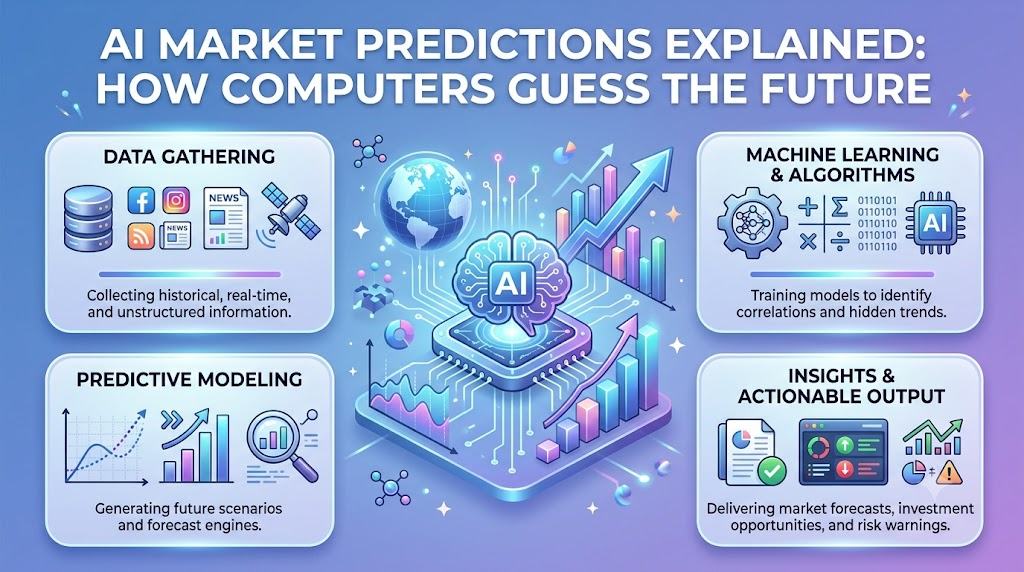
To understand how computers predict the future, you have to understand a concept called Machine Learning. Do not let the name scare you. It simply means teaching a computer to recognize patterns by showing it past examples. Imagine showing a child a hundred pictures of dogs and a hundred pictures of cats. Soon, the child learns the difference. AI does the exact same thing with numbers. It looks at decades of past market prices, sales numbers, and weather patterns. By looking at all this past data, the computer learns the hidden patterns that lead to prices going up or down. Because it is a machine, it can read millions of these data points in the blink of an eye.
Understanding Human Sentiment (Social Media & News)
But markets are not just about numbers; they are about people. If people are happy about a company, they buy its products. If they are angry at a company, they stop buying. AI has a special tool that allows it to “read” human emotions on the internet. It can scan millions of posts on platforms like Twitter or Facebook, and read thousands of news articles all at once. The AI looks for positive words or negative words to figure out the general mood of the public. This helps the computer guess if a trend is about to take off or if a product is about to fail, long before the sales numbers even drop.
Removing Emotion from the Equation
The best part about using a computer program to guess market trends is that the computer has no feelings. When bad news breaks and the stock market starts to fall, human traders might panic and start screaming on the trading floor. The AI does not scream. It does not feel fear. It just looks at the pure math. It calculates the exact probability of what will happen next based on historical data. By completely removing human emotion from the decision-making process, AI makes choices that are calm, calculated, and based entirely on cold, hard facts.
Comparing Human Analysts vs. AI Predictors
Here is a simple look at the main differences between a regular human worker and a smart computer program when it comes to guessing market trends:
| Feature | Human Analyst | AI Predictor |
| Speed of Reading Data | Slow. Can read a few reports a day. | Instant. Can read millions of pages in seconds. |
| Emotional Bias | High. Gets scared, greedy, or panicked easily. | Zero. Only cares about pure math and facts. |
| Working Hours | Needs 8 hours of sleep, weekends off, and lunch breaks. | Works 24 hours a day, 7 days a week, never rests. |
As you can see from the table above, humans and machines operate in completely different ways. A human analyst might bring years of life experience to the table, and they might have a good “gut feeling” about a certain company. But a gut feeling cannot compete with a machine that has literally memorized every single price change in the history of the stock market.
Furthermore, the world moves very fast today. News breaks in the middle of the night. A natural disaster in one country can change the price of oil in another country just minutes later. A human being might be asleep when this happens, but the AI system is always awake, always watching, and always calculating.
This does not mean human workers are useless. Humans are still needed to tell the AI what to look for and to make the final choices based on the computer’s advice. It is a partnership. The AI does the heavy lifting of reading the data, and the human uses that clean, organized information to decide what to do next.
Real-World Scenarios: AI in Action
Let us look at a real-world example to make this even clearer. Imagine a large retail company that sells clothing. The managers need to know what color of winter coats will be popular next year so they can start making them now. In the past, they might just guess based on what sold well last year. Today, they use AI. The computer looks at fashion blogs, social media posts, weather forecasts, and historical sales data. It notices a rising trend of people talking about the color dark green online. The AI tells the clothing company, “Stock up on dark green coats for November.” The company listens, and they sell out completely, making a huge profit.
Now let us look at an investor trying to make money in the stock market. This investor wants to find a small company that is about to become very successful. The AI program helps them do this by finding hidden clues that no human could see. The computer might notice that a small technology company has been slowly hiring a lot of very smart engineers over the past three months, and that supply chain data shows they are ordering parts for a secret new product. The AI alerts the investor to buy the stock now while it is cheap. Months later, the new product is announced, the stock price shoots up, and the investor makes money.
These tools are not just for giant corporations with billions of dollars anymore. Because technology is getting cheaper and easier to use, even small business owners can now access simple AI programs. A local coffee shop owner can use predictive software to know exactly how much milk to order for next week based on upcoming weather and local event schedules, ensuring they never run out and never waste money on spoiled milk.
The Future of Market Forecasting
So, what does the future hold? Will computers eventually be able to predict everything perfectly with zero mistakes? The simple answer is no. The world is full of random events that no computer can predict. A sudden storm, an unexpected political event, or a global health crisis can happen out of nowhere and completely change the market in an instant. AI is not a magic wand that can see the future perfectly; it is just a very powerful calculator that guesses what is most likely to happen based on the past.
Another interesting question is what happens when every single person and company starts using AI to predict the market. If everyone’s computer tells them to buy the exact same stock at the exact same time, the market will change completely. It could create strange loops where computers are just trying to outsmart other computers. Financial experts are already trying to figure out how to handle a world where machines are doing most of the buying and selling.
Eventually, using AI to predict market trends will become completely normal. It will be just like using a calculator to do math or using a GPS map on your phone to find directions. We will not think of it as strange or futuristic anymore. It will simply be the standard tool that every business person uses to make smarter, safer, and faster decisions in their daily work.
FAQs
What is Artificial Intelligence in simple terms?
Artificial Intelligence is a type of computer program that is designed to learn and make decisions almost like a human brain, but much faster.
How does AI predict the stock market?
It predicts the market by looking at millions of pieces of past information, like old prices and news stories, to find hidden patterns that tell it what might happen next.
Can AI read human emotions?
Yes, AI can scan thousands of social media posts and news articles to figure out if people are generally feeling happy or angry about a certain product or company.
Why are humans bad at guessing market trends?
Humans struggle because we can only read a small amount of information at a time, and our decisions are often ruined by strong emotions like fear and greed.
Does an AI system ever get tired?
No, a computer program never gets tired, never needs to sleep, and can analyze data 24 hours a day without stopping.
Can AI predict the future perfectly every time?
No, AI cannot predict random events like natural disasters or sudden political changes, so its guesses will never be 100 percent perfect.
What does “Machine Learning” mean?
Machine Learning is a way of teaching a computer by showing it many examples, allowing it to learn patterns and make guesses based on those past examples.
Do I need to be a computer expert to use AI for my business?
No, many modern AI tools are built to be very easy to use, just like regular apps on your phone, so anyone can use them.
Will AI replace human workers in finance?
AI will not completely replace humans; instead, it will do the heavy lifting of reading data, while humans will still make the final big decisions.
What happens when everyone uses AI to predict the market?
If everyone uses AI, the market might become a place where computers are mostly reacting to other computers, which is a new challenge experts are trying to solve.
Conclusion
Predicting the future of a market will always have a little bit of mystery to it. Human beings have always struggled with guessing trends because our brains cannot process massive amounts of information, and our emotions often lead us to make poor choices out of fear or greed.
Artificial Intelligence solves these problems by acting as an untiring, emotionless reader of data. By looking at millions of past events, reading the public mood on the internet, and removing human panic from the equation, these smart computer systems give us the best possible guesses about what will happen tomorrow. Whether it is a clothing store ordering winter coats or an investor looking for a good stock, AI is helping people make better choices. While it will never be a perfect crystal ball, it is the most powerful tool we have ever built to understand the busy, complicated world of buying and selling.
