Introduction
Imagine a busy restaurant kitchen where cooks prepare meals for hundreds of hungry guests. If the vegetables arrive late, or if someone mixes salt instead of sugar into the cake, dinner is ruined.
In the digital world, data works the exact same way. Companies rely on information to make smart choices, but bad or delayed data creates massive confusion.
This is where DataOps changes everything. It combines smart teamwork, automation, and continuous quality checks to ensure data flows smoothly from one place to another.
For engineers and curious learners exploring modern data practices, platforms like TheDataOps.org offer educational resources to master these essential operational workflows.
What Is DataOps and Why Does It Matter
DataOps stands for Data Operations. It is not just one single software program that you download to your laptop. Instead, it is a way of working that brings data engineers, analysts, and operations teams together.
Think of it like an automated water treatment plant. Water enters from a river, flows through filtration screens, gets tested for safety, and travels clean through pipes into your kitchen sink.
A modern data pipeline does the same thing with information. It takes messy numbers and words from apps, cleans them up, checks for mistakes, and sends them to dashboards so business leaders can make sound decisions.
Important Concept: Breaking Down Team Silos
In traditional offices, data engineers write code in one room, data scientists build models in another room, and IT operators run the servers down the hall.
When something breaks, teams often point fingers at each other. DataOps breaks down these walls by using shared tools, transparent processes, and automated alerts so everyone works toward the same goal.
Practical Example: The Broken Sales Report
Consider an online shoe store. Every midnight, a computer program collects all shoe sales and updates a main dashboard for the managers.
Without DataOps:
- A tiny bug enters the code on Tuesday.
- Nobody notices that European sales are missing.
- The finance director makes buying decisions using incorrect numbers.
With DataOps:
- Automated tests run the moment new sales arrive.
- The system spots the missing European numbers instantly.
- An automated alert stops the pipeline, notifies an engineer, and prevents faulty reports from reaching leadership.
Core Technical Building Blocks of DataOps
To make data move safely at high speeds, engineering teams rely on several key technical practices borrowed from modern software development.
| Core Component | Everyday Analogy | Role in the Data Pipeline |
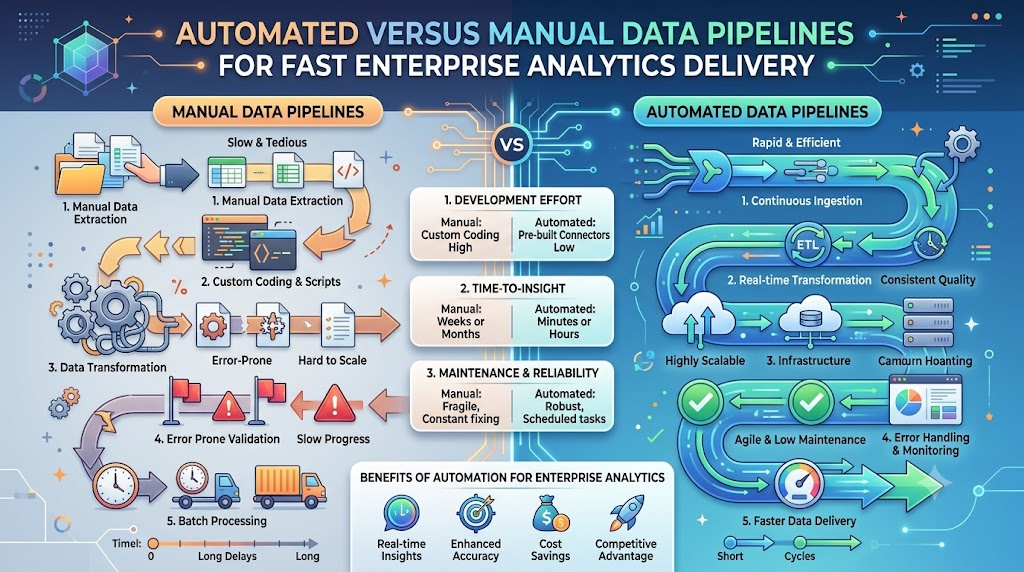
| Data Pipeline Automation | Assembly line conveyor belt | Moves and transforms data automatically without manual button clicks |
| CI/CD for Data | Proofreader before printing | Tests pipeline code changes before releasing them to live production |
| Data Quality Management | Metal detector at airport | Scans incoming data to catch missing fields, null values, or formatting errors |
| Data Observability | Dashboard gauges in a car | Monitors system health, data delivery speeds, and volume changes in real time |
Continuous Integration and Continuous Delivery (CI/CD)
Continuous integration means that whenever a developer updates pipeline code, automated robots immediately test that code to see if it breaks anything.
Continuous delivery means that once the code passes every test, it gets deployed directly into the live system. This eliminates risky manual deployments late on Friday nights.
Data Quality Management and Validation
Raw data is naturally messy. Sometimes mobile apps send text where numbers belong, or a sensor drops out and sends blank entries.
Data quality tools act as automated guards. They inspect rows of incoming data against strict business rules:
- Is every customer age greater than zero?
- Are order dates set in the correct calendar format?
- Did we receive roughly the same volume of records as yesterday?
If records fail these sanity checks, they get quarantined for inspection rather than corrupting the analytics warehouse.
Data Observability and Health Monitoring
Traditional monitoring only tells you if your computer server is turned on. Data observability goes deeper by checking the health of the data itself.
Observability tracks five critical pillars:
- Freshness: Did the information arrive on schedule?
- Distribution: Are the values falling within expected ranges?
- Volume: Did a million records arrive, or only fifty?
- Schema: Did an engineer alter table columns unexpectedly?
- Lineage: Where did this data originate, and who consumes it downstream?
The Essential Tools Powering Modern Data Operations
A dependable DataOps platform ties together specialized open-source engines and cloud utilities to coordinate complex workflows.
Orchestration and Compute Engines
- Apache Airflow: Acts as the train dispatcher, scheduling and orchestrating tasks so Step B only runs after Step A finishes successfully.
- Apache Kafka: Streams information instantly like a live news broadcast, enabling real-time event processing.
- Apache Spark: Crushes massive volumes of raw numbers across clusters of machines in parallel.
Infrastructure and Observability
- Kubernetes & Docker: Package pipelines into lightweight, portable containers that run identically on a developer laptop or inside a public cloud.
- Jenkins: Runs automated build pipelines and validation suites whenever code changes get submitted.
- Grafana: Displays visual metric charts, alerting on-call engineers if data latency spikes unexpectedly.
Practical Applications in the Real World
Modern organizations cannot afford to wait weeks for data updates. Practical automation transforms how companies handle critical information.
Healthcare Patient Analytics
Hospitals connect monitoring devices, laboratory databases, and pharmacy inventories. Automated data validation ensures doctors review accurate diagnostic timelines, preventing dangerous record mix-ups while safeguarding patient privacy.
Financial Fraud Detection
Banks process millions of card transactions per minute. Automated streaming pipelines run transaction attributes through machine learning models in fractions of a second to flag suspicious charges before payments settle.
Common Challenges and How Teams Solve Them
Transitioning to automated data operations requires overcoming common hurdles:
- Messy Legacy Systems: Decades-old databases often lack automated testing interfaces. Teams solve this by wrapping legacy systems in modular pipeline layers.
- Cultural Resistance: Engineers often resist writing automated tests for data scripts. Organizations solve this by demonstrating how automated testing eliminates midnight debugging emergencies.
- Data Privacy and Governance: Pipelines must never leak sensitive details. Modern DataOps engineers integrate data masking and automated encryption directly into pipeline stages.
Building a Career as a DataOps Engineer
Because reliable data is critical to every enterprise, the role of a DataOps Engineer has grown rapidly across technology teams.
These professionals combine data engineering craft with platform automation. Key skills include:
- Writing modular transformation code in Python or SQL.
- Building automated tests for schema validation and volume checks.
- Managing containerized pipeline tasks using cloud infrastructure.
- Diagnosing pipeline latency using modern observability dashboards.
Professionals seeking structured career paths often pursue targeted DataOps Training, structured DataOps Course materials, and reputable DataOps Certification programs to validate hands-on pipeline engineering capabilities. Organizations also leverage DataOps Consulting to modernize legacy architectures into self-healing platforms.
Frequently Asked Questions
What is the difference between DataOps and DevOps?
DevOps focuses on building, testing, and deploying traditional software applications like mobile apps or websites.
DataOps borrows those same concepts—such as automated testing and continuous integration—and applies them specifically to data pipelines, data warehouses, and analytics models where inputs are constantly changing.
Why is automated testing necessary for data pipelines?
Manual data verification is slow and error-prone.
Automated testing checks incoming data rows and schema definitions instantly, catching malformed records, missing values, and corrupted metrics before bad data reaches reporting dashboards.
What tools does a beginner need to learn first?
Beginners should start with foundational data engineering technologies.
Mastering Python for data processing, SQL for querying databases, and Git for version control provides the strongest baseline before moving into orchestration engines like Apache Airflow or container systems like Docker.
Can small businesses benefit from DataOps practices?
Yes. Even a small team with a single dashboard saves countless hours by implementing basic version control, automated scheduled scripts, and simple data quality checks.
Final Thoughts
Reliable, trustworthy data does not happen by accident. Just like an automated assembly line guarantees that every bicycle rolls out with tight bolts and pumped tires, DataOps ensures enterprise information flows smoothly, safely, and accurately.
By applying automation, continuous testing, and real-time observability to data pipelines, teams can spend less time fixing broken reports and more time uncovering valuable insights.
Whether you are an aspiring engineer or an experienced cloud architect looking to refine operational workflows, exploring specialized educational portals such as TheDataOps.org can guide your learning journey toward resilient, automated data engineering practices.
