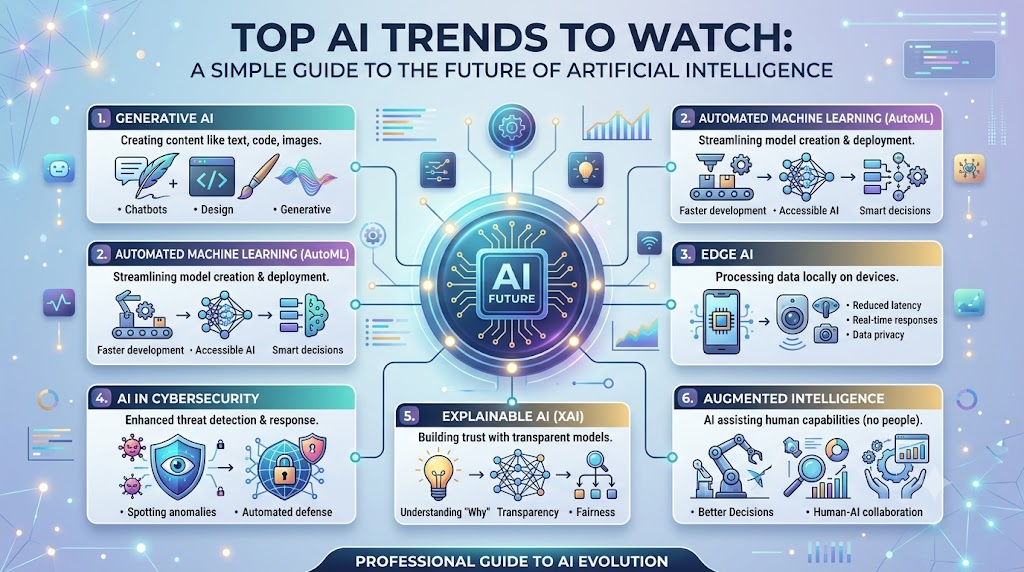
Artificial Intelligence is changing quickly. Every month, researchers build better models, and software teams release new tools. Keeping up with these changes can feel overwhelming, but understanding where the technology is heading does not require a degree in computer science. For readers following emerging technology on AIUniverse.xyz, learning the basics helps make sense of tools you encounter at work, school, and home.
In this guide, we break down the top AI trends to watch, explain how each one functions behind the scenes, and look honestly at both the benefits and the real-world challenges.
What Are AI Trends?
An AI trend represents a clear direction in how artificial intelligence is being researched, built, and used.
Think of it like weather patterns. A single rainy afternoon is just weather, but three straight weeks of rising temperatures mark a change in season. In technology, a single new mobile app is an isolated launch. When dozens of labs, open-source projects, and enterprise software companies all begin designing tools that can browse the web and click buttons on your behalf, that shared movement becomes a trend.
Why Should People Follow AI Trends?
Following artificial intelligence developments provides clear, practical value:
- Building Practical Skills: Learning how modern tools work helps you write better prompts, automate routine tasks, and stay relevant in your career.
- Making Smarter Software Choices: Understanding what models can and cannot do prevents spending money on tools that overpromise.
- Spotting Real Limitations: Knowing how AI generates answers makes it easier to spot errors, hallucinations, and security weaknesses.
- Planning Projects Accurately: Teams can design realistic workflows instead of relying on hype.
Top AI Trends to Watch
1. Agentic AI and Autonomous Task Execution
What Is It?
Agentic AI refers to systems designed not just to answer prompts with text, but to carry out multi-step tasks across external applications with minimal human supervision.
How Does It Work?
Standard AI models wait for a question and generate an answer. An AI agent breaks a larger goal into smaller steps, executes each action, checks its own work, and decides what to do next. For example, if you ask an agent to organize a meeting, it can check your calendar, search email threads for open times, draft an invitation, and wait for confirmation.
Why Does It Matter?
It shifts AI from an advisory role into an operational one, reducing the manual clicking and data copying workers perform every day.
Real-World Applications
- Customer Support: Agents that look up order history, run database queries, and initiate item replacements.
- Software Testing: Automated agents running web tests, detecting layout bugs, and submitting error tickets.
Challenges and Limitations
Agents can misinterpret instructions or loop endlessly if an unexpected error occurs. Granting tools permission to read and write data also raises security risks.
Future Outlook
Developers are focusing on strict permission boundaries and sandboxed environments so agents can work safely without accidental data deletion.
2. Smaller, Highly Efficient On-Device Models
What Is It?
Instead of sending every query to massive server farms, companies are developing compact AI models that run directly on laptops, tablets, and mobile phones.
How Does It Work?
Engineers use techniques such as model quantization (lowering the numeric precision of calculations) and knowledge distillation (training a smaller network to imitate a larger one). This reduces the memory and power required to run the model while preserving most of its reasoning capability.
Why Does It Matter?
On-device models work offline, respond with near-zero network lag, and protect private data because personal information never leaves your hardware.
Real-World Applications
- Real-Time Voice Translation: Converting spoken conversations on a phone without an active cellular or internet connection.
- Privacy-Conscious Writing Assistants: Proofreading sensitive emails and documents entirely on local memory.
Challenges and Limitations
Small models have tighter memory limits. They can struggle with complex academic questions, long documents, and advanced mathematical reasoning compared to massive cloud models.
Future Outlook
As device manufacturers include dedicated neural processing units (NPUs) in standard silicon chips, compact models will become default features in consumer operating systems.
3. Multimodal Reasoning and Interaction
What Is It?
Multimodal AI refers to models that understand, process, and combine different types of data—such as text, spoken audio, photos, diagrams, and video—within a single system.
How Does It Work?
Early systems required separate models: one transcribed speech to text, a second analyzed the text, and a third produced an answer. Modern multimodal models process audio waveforms, video frames, and tokens together, letting the system notice tone of voice, visual context, and spatial details simultaneously.
Why Does It Matter?
Human communication relies heavily on images, visual demonstrations, and speech. Multimodal tools allow people to interact with computers naturally.
Real-World Applications
- Visual Troubleshooting: Pointing a smartphone camera at an engine, circuit board, or appliance to identify broken parts.
- Accessible Computing: Describing video environments in real time for visually impaired users.
Challenges and Limitations
Processing video and audio requires substantial compute power. Multimodal models can also misread visual details, such as confusing reflections with solid objects.
Future Outlook
Multimodal input is set to become the standard interface for personal computers and customer support desks, replacing text-only chat boxes.
4. AI-Assisted Code Development and Maintenance
What Is It?
AI coding assistants help software engineers write, review, document, and modernize programming code.
How Does It Work?
Trained on large repositories of public and permissive code, these tools analyze the surrounding project context and suggest completions for functions, generate unit tests, and translate legacy syntax into modern frameworks.
Why Does It Matter?
Programmers spend significant time reading documentation and writing boilerplate setup code. Assistants shorten turnaround times on basic tasks.
Real-World Applications
- Test Generation: Writing automated unit tests for newly completed features.
- Legacy Code Migration: Translating older codebase scripts into modern languages.
Challenges and Limitations
AI code assistants frequently introduce subtle security vulnerabilities, reference deprecated software libraries, or invent functions that do not exist. Human code review remains essential.
Future Outlook
Development environments are moving from inline line completion toward background agents that build pull requests, verify unit tests, and suggest security patches.
5. Open Weights and Community-Driven AI
What Is It?
Alongside closed proprietary models hosted behind paid APIs, independent organizations and university labs release open-weight models that anyone can download, run, and modify.
How Does It Work?
Research groups publish the trained parameter files of a model. Developers can host these weights on their own cloud servers or home workstations, inspect the design, and fine-tune the model on custom datasets.
Why Does It Matter?
Open weights keep advanced technology accessible, prevent vendor lock-in, and allow researchers around the world to audit systems for safety and bias.
Real-World Applications
- Specialized Enterprise Solutions: Companies training models on proprietary internal legal archives without sharing data with third parties.
- Academic Research: University labs analyzing model architectures without paying per-token API fees.
Challenges and Limitations
Hosting open models requires capable hardware and technical maintenance. Open weights can also be used by bad actors to generate spam or malicious software without safety filters.
Future Outlook
The performance gap between top-tier proprietary APIs and open-weight models continues to narrow, giving developers more independence in choosing their tech stack.
6. AI Governance, Watermarking, and Provenance
What Is It?
As synthetic images, voices, and text spread online, new systems and legal frameworks are emerging to verify authenticity, protect copyright, and track how models are trained.
How Does It Work?
Techniques like cryptographic metadata tagging (such as C2PA standards) and invisible algorithmic watermarks embed tamper-resistant digital stamps inside generated media. Regulators are also setting audit standards for training data transparency and algorithmic bias.
Why Does It Matter?
Protecting trust online requires dependable ways to distinguish authentic camera footage from computer-generated media, while protecting intellectual property rights.
Real-World Applications
- News Verification: News outlets confirming that an image originated from a verified photojournalist’s camera.
- Enterprise Compliance: Auditing HR tools to ensure screening algorithms do not discriminate against candidates.
Challenges and Limitations
Watermarks can often be stripped out by re-encoding files, cropping images, or taking simple screenshots. International regulations also vary significantly across regions.
Future Outlook
Identity verification, content provenance, and safety auditing will become mandatory standard requirements for major software providers and online platforms.
Understanding Benefits, Risks, and Practical Realities
Artificial intelligence provides clear advantages, but it is not a silver bullet. Understanding both sides ensures realistic planning.
| Category | Real Opportunities | Ongoing Risks & Bottlenecks |
| Productivity | Automates administrative data entry and summarization | Can produce plausible-sounding errors that waste review time |
| Accessibility | Helps non-experts write, debug simple scripts, and learn topics | Hallucinations can mislead beginners who cannot spot errors |
| Deployment | On-device models enable private, offline use cases | Advanced multi-step agents demand steep computing power |
| Transparency | Open weights give developers complete data control | Synthetic media creates challenges for content verification |
Frequently Asked Questions
What are AI trends?
An AI trend is a clear pattern in how artificial intelligence research, software tools, and real-world uses are moving across the industry over time.
Why is everyone talking about AI agents?
Unlike basic chatbots that only answer prompts, AI agents can take actions across tools—like searching a file, drafting an email, and updating a record—to finish complete tasks.
What is multimodal AI?
Multimodal AI means a system can read, listen to, and see different types of information—including text, spoken voice, images, and video—at the same time.
Can small AI models run without an internet connection?
Yes. Compact, efficient models can run directly on modern smartphones and laptops using onboard memory, working completely offline without sending data to cloud servers.
Are open-source AI models as good as proprietary ones?
Many open-weight models now rival commercial options on common tasks like writing, summarizing, and coding, though private services still lead in ultra-large multimodal reasoning.
What are the biggest risks of using AI in business?
Key risks include factual errors (hallucinations), data privacy leaks, intellectual property disputes, and agent software executing incorrect instructions without human oversight.
How can beginners start learning about artificial intelligence?
Beginners can start by testing free consumer AI tools, following structured beginner articles on portals like AIUniverse.xyz, and practicing writing clear, step-by-step instructions.
Will AI replace human software developers?
No. AI tools help developers write routine code and spot bugs faster, but human engineers are still needed to design systems, verify security, and solve complex business problems.
What is content provenance in artificial intelligence?
Content provenance is a digital method (like a secure digital watermark or certificate) used to track where media came from and whether it was created or edited using AI.
How should a team choose an AI tool?
Teams should look at data privacy terms, test accuracy on actual work samples, compare operating costs, and verify that human team members can easily review the tool’s output.
Conclusion
The artificial intelligence landscape is shifting from simple text chatbots toward integrated assistants: systems that interact through voice and vision, run locally on personal hardware, and assist with complex digital tasks. Keeping up with these developments does not mean adopting every shiny tool that appears. The most successful approach is practical: learn how these technologies operate, respect their limitations, and test them carefully against real-world needs.
